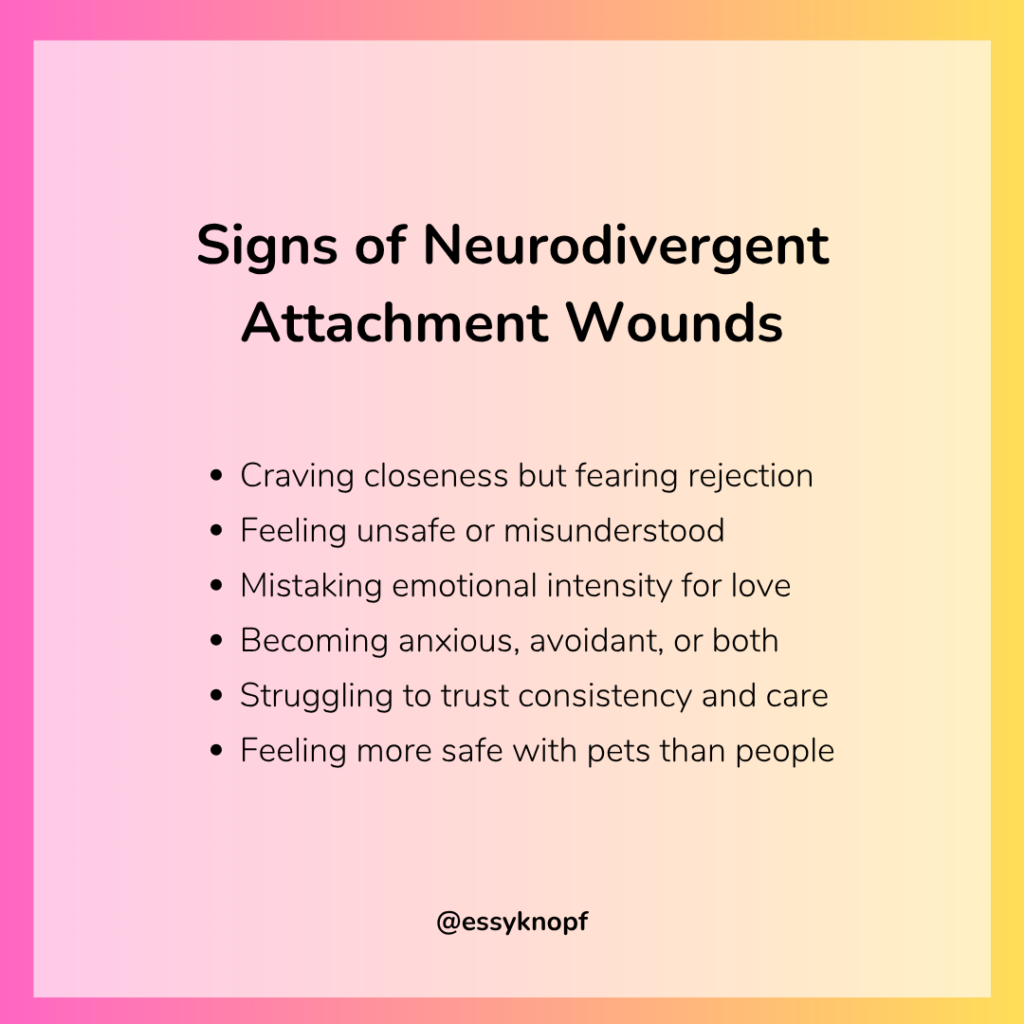
For many neurodivergent people, relationships can feel confusing, intense, or emotionally exhausting. We may crave closeness while also fearing rejection, criticism, abandonment, or emotional overwhelm.
Often, this begins early in life.
Growing up autistic or ADHD in a world that doesn’t always understand neurodivergence can leave lasting emotional impacts. Repeated experiences of invalidation, exclusion, bullying, or inconsistency can shape the way we connect with other people. Over time, this may contribute to insecure attachment patterns.
Some people become anxiously attached, constantly seeking reassurance and closeness. Others become avoidant, learning to rely only on themselves because connection no longer feels emotionally safe. Some experience a mixture of both.
This can create painful relationship dynamics. For example, an anxiously attached person may repeatedly pursue emotionally unavailable partners, mistaking the emotional highs and lows for genuine love or connection.
But emotional intensity is not the same thing as emotional safety.
The encouraging reality is that attachment can change. Healing is possible through what psychologists sometimes call “earned secure attachment,” developing a stronger sense of trust and safety through positive, consistent relationships over time.
And those relationships don’t always have to be romantic.
For many neurodivergent people, healing starts with a therapist, a close friend, a family member, or even a pet. Animals especially can offer a form of connection that feels steady, accepting, and emotionally grounding.
Consistent care matters. Safe relationships slowly teach the nervous system that connection does not always lead to shame, abandonment, or rejection.
Those experiences cumulatively can reshape how we relate to ourselves and to others.
Healing neurodivergent attachment wounds doesn’t happen overnight. But with enough safe, supportive experiences, it is possible to feel more secure, connected, and emotionally grounded in relationships.
Have you had a person—or even a pet—who helped you feel safer and more secure over time?
Essy Knopf is a therapist who likes to explore what it means to be neurodivergent and queer. Subscribe to get all new posts sent directly to your inbox.
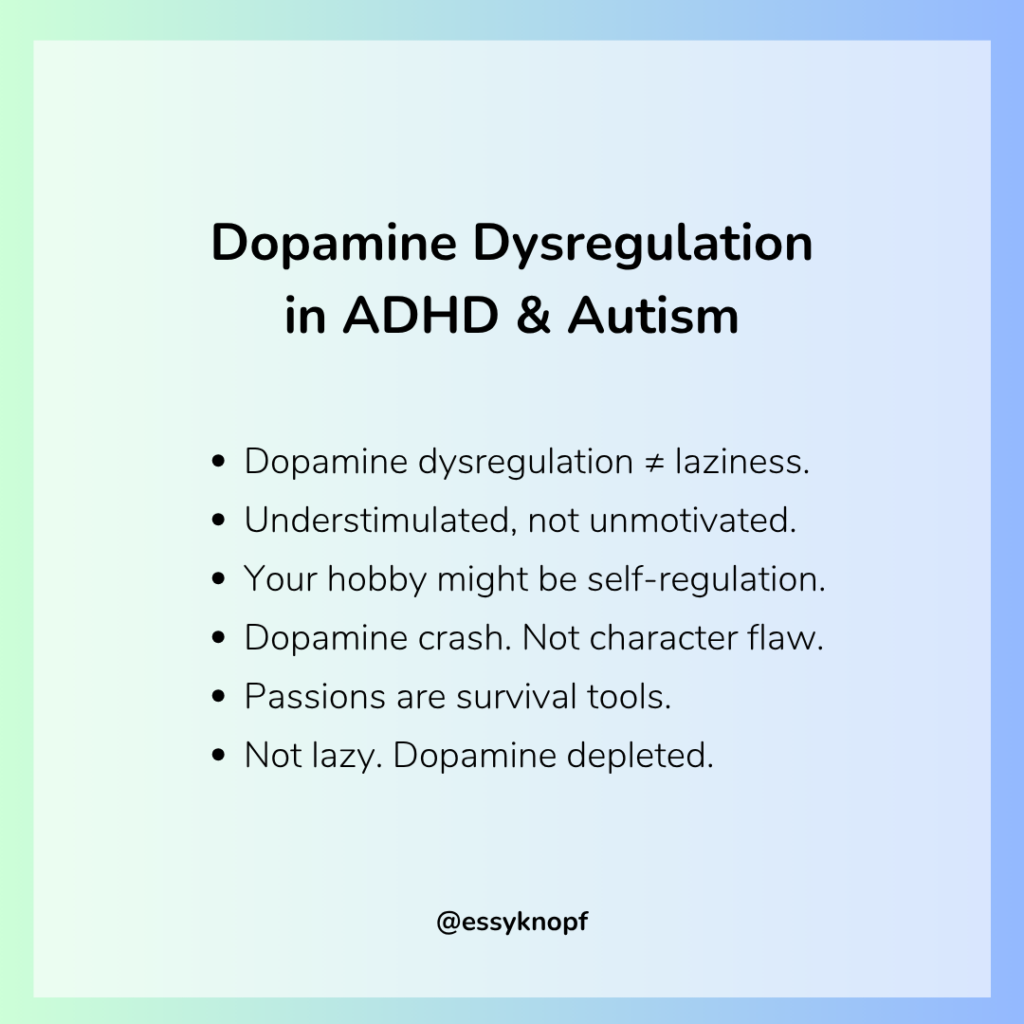
One of the lesser-discussed challenges of ADHD and autism is dopamine dysregulation.
Many neurodivergent people live with brains that struggle to maintain consistent dopamine levels, which can create an ongoing need for stimulation, novelty, or emotional engagement.
This often happens after work, during weekends, or anytime structure suddenly disappears. Once the external demands stop, neurodivergent individuals can be left feeeling flat, understimulated, emotionally depleted, or even mildly depressed.
To cope with dopamine dysregulation, many people instinctively seek fast sources of stimulation. This might look like binge eating sugar or carbs, marathon gaming sessions, doom-scrolling social media, impulse shopping, or endlessly consuming content online.
These behaviors are often attempts to regulate a nervous system struggling with dopamine dysregulation.
One healthier approach comes from cognitive behavioral therapy, specifically a strategy called behavioral activation. The idea is that engaging in activities that create a sense of mastery and pleasure can improve mood and reduce depressive symptoms.
For neurodivergent folks, this can be especially powerful when the activity directly addresses dopamine dysregulation by providing meaningful stimulation.
This is where special interests and passions become important. Writing, art, music, coding, puzzles, Lego builds, crafting, researching niche topics, or creating content online can all help regulate dopamine levels in a sustainable way.
These activities work because they provide both pleasure through stimulation and enjoyment, and mastery through progress, accomplishment, and skill-building.
That combination can help counter the emotional crashes associated with dopamine dysregulation.
Importantly, these activities do not need to be massive or energy-intensive. In fact, the best tools for managing dopamine dysregulation are often small, repeatable, and easy to engage with consistently.
A 20-minute creative session, practicing a song, organizing a collection, or working on a passion project may provide enough stimulation to shift the nervous system out of a slump.
Many autistic and ADHD individuals are taught to feel ashamed of their intense interests. But in reality, these passions may serve an important self-regulation function. Special interests can help stabilize mood and soothe the effects of dopamine dysregulation in ways neurotypical people may not fully understand.
While dopamine dysregulation can make everyday life feel emotionally exhausting for autistic and ADHD individuals, understanding what your brain is actually seeking can help you respond with compassion rather than shame.
What activities help you manage dopamine dysregulation? Are there special interests or hobbies that reliably pull you out of a slump? I’d love to hear your experiences in the comments.
Essy Knopf is a therapist who likes to explore what it means to be neurodivergent and queer. Subscribe to get all new posts sent directly to your inbox.
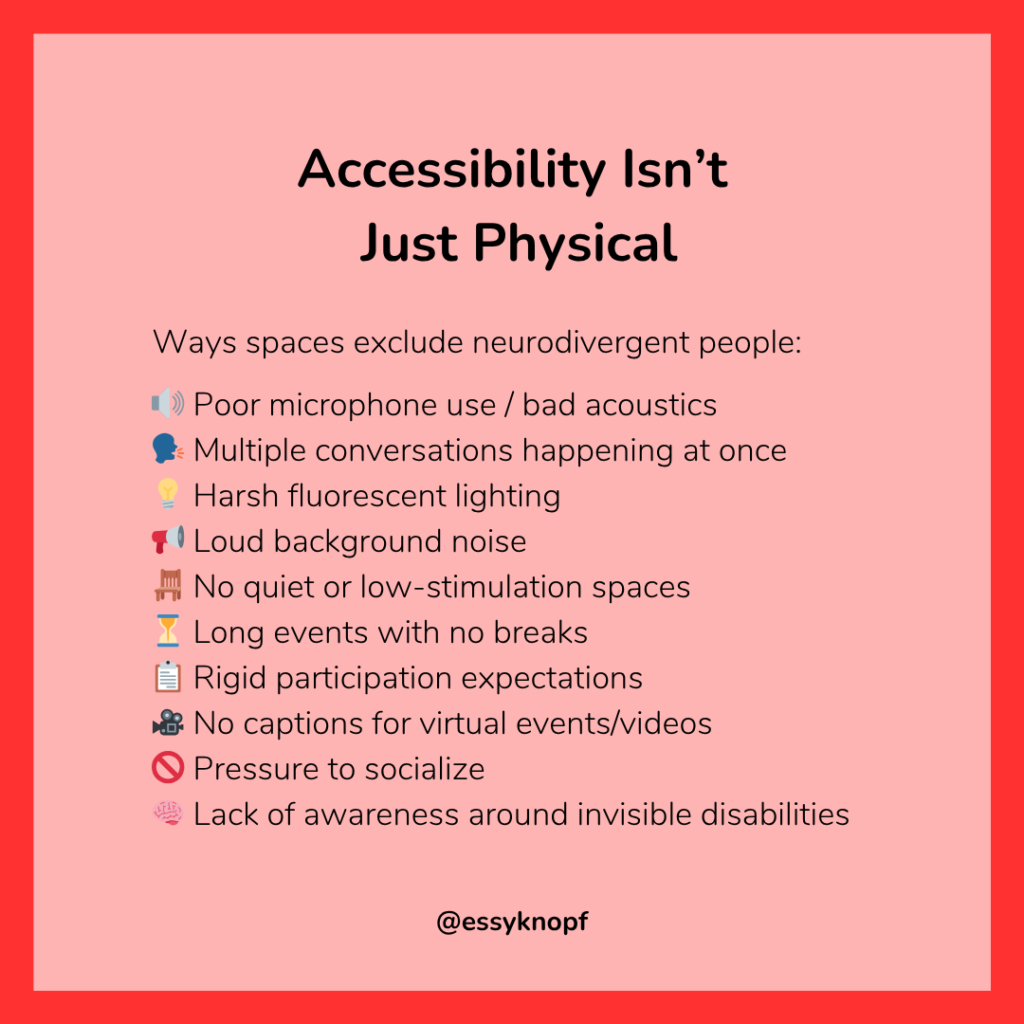
When people hear the word accessibility, they often think of ramps, elevators, wheelchair access, and accessible parking spaces. These accommodations are essential—but they’re also only part of the picture.
What often gets overlooked are the needs of people with invisible disabilities, including autistic and ADHD individuals.
You can walk into a space that appears inclusive on paper and still find yourself completely shut out of the experience.
Maybe the room acoustics are terrible, making it impossible to hear someone speaking. Maybe multiple conversations happening at once create sensory overload. Maybe fluorescent lighting feels physically painful. Maybe there’s no quiet space to decompress when things become overwhelming.
For someone with auditory processing challenges, ADHD, autism, sensory sensitivities—or a combination of these—these barriers can make participation exhausting.
I recently found myself in a community setting that was technically accessible. It had clear accommodations for physical disabilities, which was genuinely great to see.
But every time someone spoke into a microphone, they stood too far away for their voice to be heard clearly. Instead of hearing words, I heard muffled echoes and background noise.
Then came the social portion of the event, which was crowded, loud, and acoustically chaotic.
I wanted connection. I wanted community.
Pexels/Ekaterina Belinskaya
Instead, I found myself overwhelmed and frustrated.
And this is where many institutions miss the mark: accessibility often focuses on what can be easily seen while ignoring what can’t.
Essy Knopf is a therapist who likes to explore what it means to be neurodivergent and queer. Subscribe to get all new posts sent directly to your inbox.
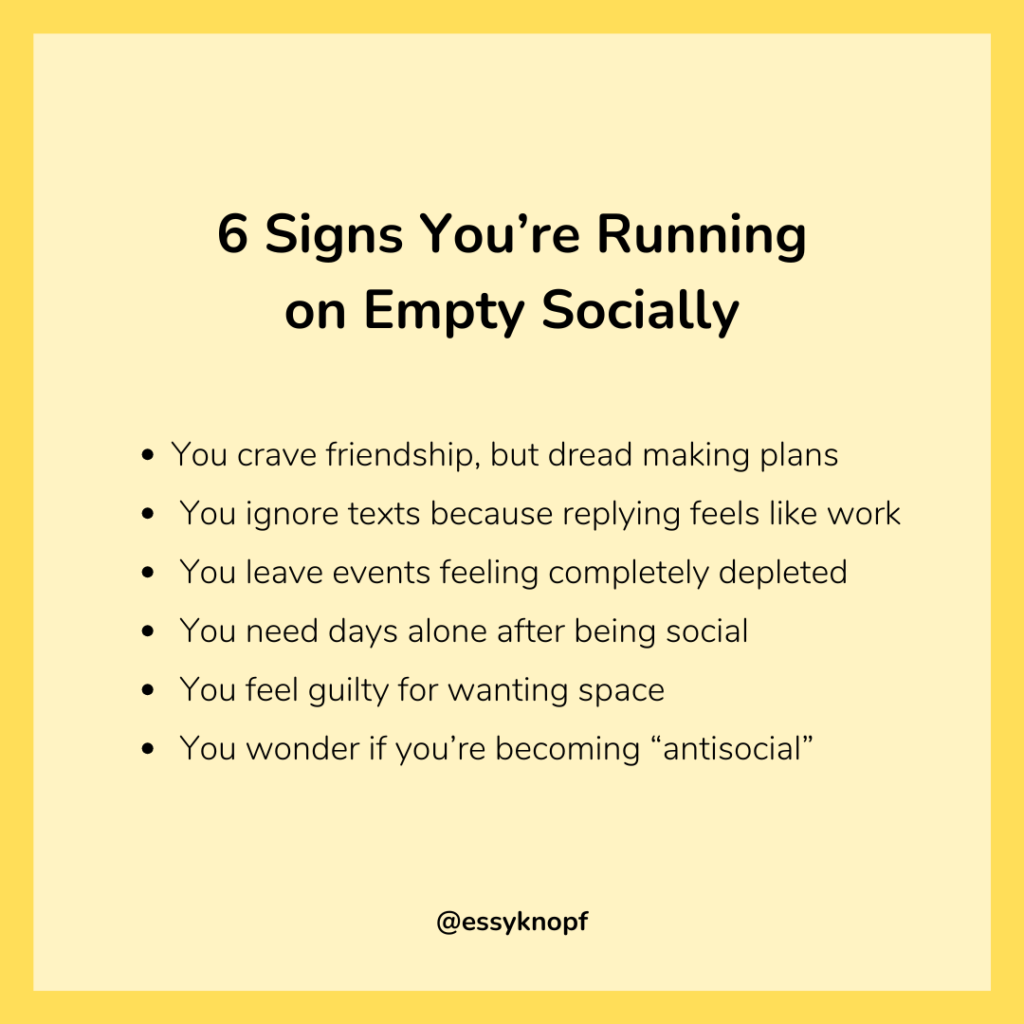
One of the more confusing realities of being neurodivergent is realizing you can genuinely enjoy people while also feeling completely depleted by them.
For years, I interpreted this contradiction as a personality flaw.
I’d spend large chunks of my week surrounded by people—clients, classmates, colleagues, friends, family members—and often enjoy those interactions. I like meaningful conversations. I value community. I want connection.
And yet there would inevitably come a point where even the smallest social interaction would begin to feel unbearable.
A text message would come through and I’d feel irritated.
Someone would try making small talk and I’d immediately want to escape.
I’d attend a social event with every intention of staying, only to find myself mentally planning my exit within the first hour.
At my worst, even making eye contact can feel like too much effort.
This used to leave me feeling ashamed.
How could I claim to care about people while simultaneously feeling so overwhelmed by them?
Was I antisocial? Selfish? Secretly a misanthrope?
The answer, I eventually realized, was much simpler: my neurodivergent social battery was depleted.
For many autistics and ADHDers, social interaction involves far more effort than others realize.
We may be masking our natural communication style. We may be monitoring our facial expressions to appear engaged. We may be suppressing stims, navigating sensory overwhelm, interpreting vague social cues, and carefully filtering our words to avoid being misunderstood.
And when life already demands constant interaction—whether through work, school, caregiving responsibilities, friendships, or community obligations—our social battery can burn out quickly.
This is where things can feel especially frustrating.
Many neurodivergent people genuinely want connection. We may want close friendships, romantic relationships, community spaces, and meaningful conversations.
But wanting connection doesn’t mean we always have the capacity for it. That distinction matters.
Unfortunately, many of us compare ourselves to neurotypical people who seem able to maintain packed social calendars with little visible effort. They work full-time, attend gatherings, reply to messages instantly, maintain friendships, and somehow still seem energized.
Meanwhile, we may need an entire weekend alone just to feel remotely functional again. That comparison can trigger intense shame.
We tell ourselves we should push harder. Stay longer. Be more available. Try harder to seem engaged.
But shaming yourself into social performance rarely works. It usually just accelerates burnout.
Learning to respect your social limits can feel deeply uncomfortable, especially if you’ve spent years measuring your worth through productivity or availability.
Sometimes respecting your needs looks like leaving an event early. Sometimes it means declining invitations.
Sometimes it means spending your weekend gaming, reading, lying in bed, or sitting in complete silence while your nervous system recalibrates.
That isn’t laziness or avoidance, but self-awareness. And the more you honor your limits, the more sustainable connection becomes.
Have you ever found yourself craving connection while also feeling completely overwhelmed by people?
What helps you recharge when your neurodivergent social battery runs low?
Essy Knopf is a therapist who likes to explore what it means to be neurodivergent and queer. Subscribe to get all new posts sent directly to your inbox.
You’re sitting at your desk, flicking between tabs like they owe you something. Your phone is in your hand, but you can’t remember why.
The day feels slippery; nothing’s sticking. You’re restless, underwhelmed, and oddly tired for someone who hasn’t really done anything yet.
This is how it starts.
Before the obsession. Before the deep dive. Before the notebooks and the color-coded spreadsheets and the midnight Amazon orders, there is the ache. The stillness.
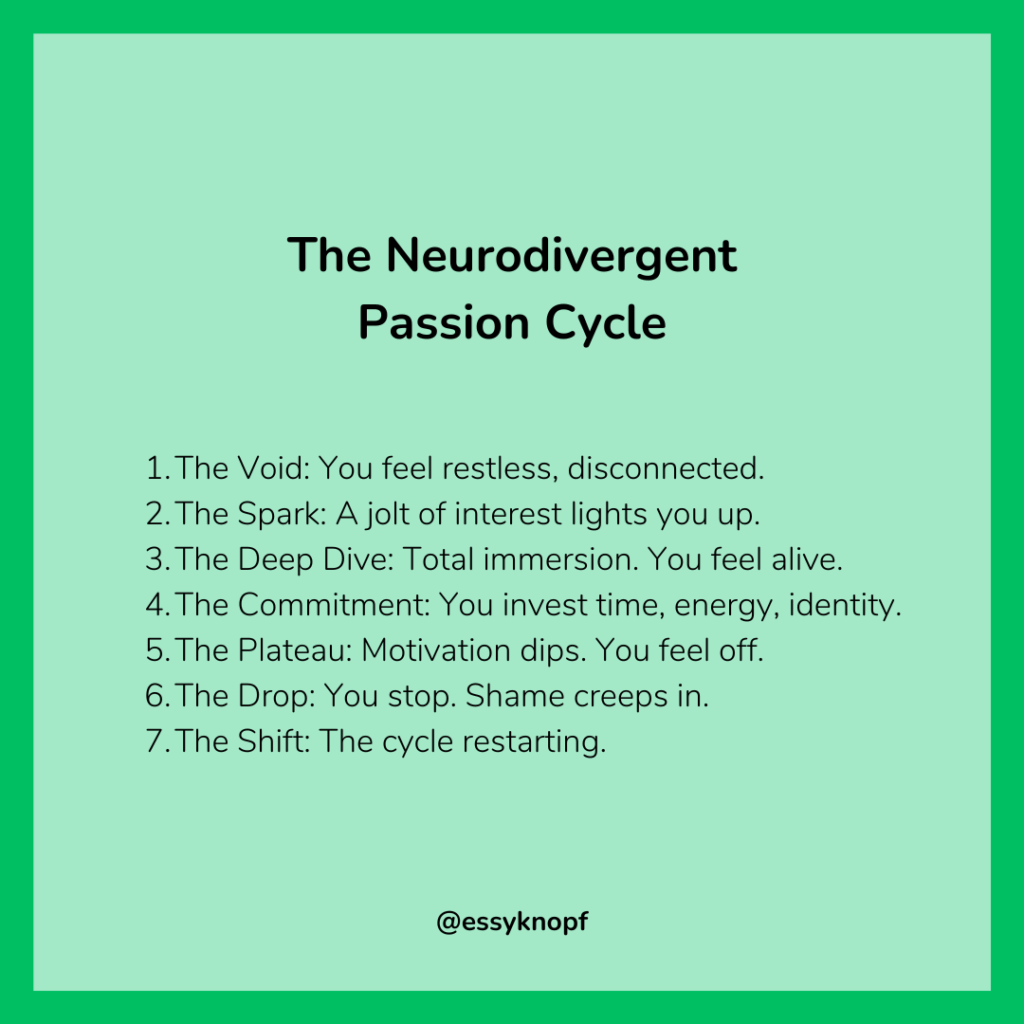
The weird, itchy emptiness that signals you’ve entered the first phase of what I call the neurodivergent passion cycle.
I’ve seen it in my clients, my community, and in myself again and again: this pattern of losing momentum, finding a spark, diving deep, and eventually drifting away.
And while it can feel confusing or even shameful, it’s not a personal failing, but a cycle that many autistic and ADHD folks move through naturally.
Phase 1: The Void
The first phase is The Void.
This is the emotional version of static. You might feel disconnected from your interests, your goals, even your identity. Tasks that once felt doable now feel slippery or irrelevant. Routines feel empty.
You scroll, you pause, you open tabs and close them again. You wonder: Is something wrong with me?
The Void is the reset before the re-ignition. The lull before the spark. A low-tide moment in the neurodivergent passion cycle, when your brain is scanning for something meaningful enough to matter again.
Phase 2: The Spark
Sometimes it’s a 2am rabbit hole on YouTube. Sometimes it’s a random conversation, a podcast episode, or a stray sentence in a book. Sometimes it’s nothing more than a vague flicker of interest that slowly intensifies.
But in a moment—however subtle—it clicks.
This is The Spark, the second phase of the neurodivergent passion cycle. And when it hits, it feels like oxygen after too long underwater.
Suddenly, something cuts through the fog. A topic, idea, or project presents itself and your brain lights up.
For many neurodivergent folks—especially those with ADHD or autistic wiring—the energy returns. The boredom lifts. You feel like you’ve re-entered your own life.
You might feel giddy, focused, even relieved. You might also feel a little frantic. The desire to act right now is real, because if you don’t, the spark might vanish. And you know what it’s like to lose a spark before it fully catches.
So you chase it.
You start a new note on your phone. You bookmark ten tabs. You scribble ideas in a notebook or voice-memo your thoughts while brushing your teeth. And maybe for the first time in days, weeks, or months, you feel genuinely alive again.
This phase of the neurodivergent passion cycle often gets mistaken for impulsivity. While others might see it as “just a passing interest,” for you, it feels like a possible identity. A calling. A new chapter. Even if it lasts only a little while, it matters.
But here’s the thing no one tells you: The Spark isn’t supposed to last forever.
Its job is to pull you out of The Void. To give you something to follow. Something to care about again. It’s the beginning of a story, and whether it becomes a long-term love or a short burst of joy, it deserves your attention.
So chase it. Let it burn bright. And know that it’s okay if you’re already dreaming big.
Because for neurodivergent brains, this is what it means to be in motion again.
Phase 3: The Deep Dive
You’ve followed the spark, and now you’re all in.
You’re devouring everything you can find. Articles. Podcasts. Reddit threads. Tutorials. Books. Product reviews. Academic journals you swore you’d never read again. Your browser history has a theme now. Your search bar knows your new obsession by name.
Welcome to The Deep Dive, the third phase of the neurodivergent passion cycle. This is where the energy shifts from curiosity to immersion.
And if you’re autistic or ADHD (or both), you might know this feeling intimately. It’s the sense of being lit up from the inside, of your thoughts aligning into something clear, vibrant, and hyper-focused.
All friction disappears. Executive functioning improves. You feel more capable, more organized, more you.
For autistics, this often resembles the early stages of a new passion. There’s structure here, logic, clarity. It brings peace. For ADHDers, this is hyperfocus at its most exhilarating.
This part of the neurodivergent passion cycle can be incredibly productive. You might be creating, building, learning, even teaching. The outside world starts to fade into the background. Your routines reorganize themselves around the interest. Time becomes slippery.
Sometimes you skip meals without noticing. Sometimes you stay up all night and wake up energized. Sometimes you get labeled “obsessive” or “intense.” But to you? It just feels necessary.
But there’s a caveat: in this phase, you can also start to disappear.
You might start canceling plans. Ignoring texts. Ghosting group chats. You do this because the outside world suddenly feels like an interruption. You’re busy building something. You’re becoming someone.
You may even begin to reshape your identity around this thing. “I’m a writer now.” “This is my path.” “This is who I’m supposed to be.” And in that moment, you mean it.
So let yourself go deep. Build, explore, create, become.
Phase 4: The Commitment
You’ve done the research. You’ve gathered the tools. You’ve built routines, created systems, maybe even reshaped your schedule to make space for this thing.
This is The Commitment phase—the fourth stage of the neurodivergent passion cycle. And it feels big.
You’ve moved from idea to identity. From hobby to habit.
You buy the higher-end version of the gear. You sign up for the class, the webinar, the certification.
You start telling people: “This is really important to me.” “This is who I am now.” “I think I’ve found it.” And maybe… you have.
For many neurodivergent people, we’re imagining a future where this interest becomes a path, a purpose, a way forward.
But here’s where things start to shift.
Because the moment you declare something—whether out loud, online, or even just to yourself—it becomes more than joy. It becomes responsibility.
You’ve claimed it. Now you have to keep it.
And for autistic and ADHD folks who’ve often struggled with consistency (or been shamed for perceived inconsistency), this can bring up anxiety.
The internal monologue starts whispering: “Don’t ruin this.” “Don’t drop it like the last one.” “You said this mattered. Now prove it.”
Even if no one else is pressuring you, you might start pressuring yourself. The initial spark of joy begins to carry weight.
Because the moment something becomes a “thing,” it feels like there’s something to lose. And with that comes rigidity. Perfectionism. Fear of messing it up.
For autistic folks, especially, there may be a deep desire to maintain structure and protect the routine that’s now built around this interest. For ADHDers, there may be a sudden urgency to “make it work” before motivation fades.
It’s still exciting, yes. Still meaningful. But a subtle tension is building.
Phase 5: The Plateau
At first, you don’t even notice it.
You sit down to work on your project, revisit your interest, or re-enter that creative flow… and something feels just a little off.
This is The Plateau, the fifth phase of the neurodivergent passion cycle.
From the outside, everything still looks the same. You’re still “doing the thing,” at least occasionally. You still talk about it. You still want to feel excited. But the effortless momentum you once had has starts to become more effortful.
For ADHDers, this might feel like the dopamine supply has been cut off. The novelty is gone. You’ve absorbed the basics. Mastered the structure. The learning curve has flattened, and with it, your motivation.
For autistics, it might feel more like sensory fatigue or cognitive saturation. The thing you loved may have required more emotional or mental energy than you realized. Now, that cost is catching up. And the scaffolding that held up your routines starts to wobble.
This phase can be incredibly disorienting. You may feel stuck between two realities: the excitement that was, and the numbness that is. And in this in-between space, shame loves to sneak in.
“Why can’t I get back into it?” “What happened to all that motivation?” “This always happens to me.”
The neurodivergent passion cycle often brings us to this juncture, where the joy fades, but the pressure remains. And because this phase rarely gets talked about, many of us misinterpret it as personal failure.
But let’s be clear: The Plateau is not failure. It’s the natural downshift after a surge of focus and engagement. It’s a signal that your brain is transitioning. Rebalancing. Resting. Searching.
What makes this phase harder is our instinct to force our way through it.
We make rigid plans. We double down on structure. We try to reignite the old fire with sheer willpower. And sometimes it works…for a while. But often, we’re just postponing the inevitable.
Phase 6: The Drop
You stop.
Not necessarily all at once. At first, it might look like a few skipped days. A tab you stop reopening. A tool you leave untouched on your desk. A message you meant to reply to—and didn’t.
Then suddenly, it’s been a week. Two weeks. A month. And you realize: you haven’t gone back.
This is The Drop, the sixth and most emotionally fraught stage of the neurodivergent passion cycle. Something that once made you feel alive has collapsed, leaving you with a sense of loss that can be sharper than most people realize.
You might look at the supplies you bought, the plans you made, the hours you invested, and feel a pang in your chest.
You start thinking things like: “Why do I always do this?” “Was it ever even real?” “What is wrong with me?”
The Drop often hijacks your self-worth.
For ADHDers, the crash can feel like emotional whiplash. You were finally focused, finally functioning, and now that clarity is gone. And with it, the version of yourself you liked.
For autistics, especially if the interest was deeply tied to routine or identity, the drop can leave you feeling unmoored. The structure collapses. The interest fades. The days lose shape. You might even start to question who you are without it.
And perhaps worst of all: the inner critic arrives. Loud. Familiar.
It reminds you of every unfinished project, every abandoned plan, every time someone called you “flaky” or “all over the place.”
You hear the echoes of teachers, parents, coworkers, partners: people who didn’t understand how your brain works.
Now their voices live in your own head. This is where internalized ableism shows up at full volume.
Shane tells you that your inconsistency makes you untrustworthy. That your shifts in energy make you immature. That your passions don’t count unless they last forever.
But none of that is true.
If you’re here, in The Drop, I want you to hear this clearly: Your spark was real. Your joy was real. Your momentum mattered. And the fact that it faded doesn’t erase any of that.
This is not the end of the story. It’s the space before the shift.
Phase 7: The Shift
There’s no grand reawakening. No big announcement. No Instagram-worthy comeback.
Just… a thought. A video that holds your attention a little longer than it should. A topic that makes your chest feel warm. A casual mention that leaves a trail of tabs open.
If you don’t find yourself returning to the Void, you may instead enter the Shift, the final (and first) phase of the neurodivergent passion cycle. The moment the wheel begins to turn again.
It’s subtle. Easy to miss if you’re still stuck in the shame spiral of The Drop. Your conscious mind might still be licking its wounds, replaying stories of failure or inconsistency. But your is already scanning. Already searching for what’s next.
This is the part of the cycle most often buried under self-doubt.
We tell ourselves: “I’m not allowed to start something new until I finish what I already failed.” “I always do this. What’s the point?” “Why bother if I’m just going to lose interest again?”
What’s important to recognize is that you are wired to seek. To scan. To latch onto what’s meaningful, rich, and alive. It’s how your brain reengages with the world on your terms.
For autistic and ADHD folks, The Shift is where hope returns. It represents a return to motion. To possibility. To curiosity.
That’s the gift of the neurodivergent passion cycle. It loops. It pulses. It resets.
And each time you come around again, you don’t start from zero. You start with the knowledge, growth, and insight that every past passion gave you; even the ones that felt unfinished.
What you built still mattered. What you felt was real. What you created exists. You are not flaky. You are a seasonal creature living in a linear world.
And The Shift is your invitation to begin again, perhaps with less pressure, and more self-trust.
You don’t need to justify it. You don’t need to explain it. You just need to notice it—and allow it.
Final Thoughts
If you’ve ever lit up with a new passion, poured yourself into it, and then felt the quiet grief of watching it fade… this post was for you.
The neurodivergent passion cycle is not a glitch. It’s not evidence of failure, immaturity, or inconsistency. It’s a rhythm. A process. A deep internal pattern that so many autistic and ADHD people experience, but few are ever taught to recognize, let alone honor.
You don’t move through life in straight lines. You move in pulses. Like tides. Like seasons. Like breath.
And when you understand your cycles—when you learn to name them, trust them, work with them instead of against them—you begin to find something deeper than discipline or “follow-through.”
You find self-respect.
You begin to say: “I’m in The Void. I’m resetting.” “This is The Spark! Let’s follow it.” “Ah, the Plateau. No need to panic. Just time to pause.”
“The Drop hurts, but it’s not the end.” “The Shift is here. I’m ready to begin again.”
This is not about “fixing” the cycle. It’s about recognizing that there was never anything broken to begin with.
You don’t owe anyone permanence. You don’t owe consistency that comes at the cost of your joy.
You owe yourself grace. Curiosity. Permission to follow what lights you up, even if it’s only for a season.
Because that’s where your magic lives.
Have you experienced this cycle? What phase are you in right now?
Essy Knopf is a therapist who likes to explore what it means to be neurodivergent and queer. Subscribe to get all new posts sent directly to your inbox.
Ever had a day where your brain simply refuses to cooperate?
You’re sitting in front of your to-do list, willing yourself to get started, but instead, you’re doomscrolling, staring at the wall, or bouncing between five half-finished tasks.
Then, the next day? You’re a whirlwind of productivity. Laundry’s done, inbox zeroed, meals prepped, water consumed. You feel clear, capable, maybe even unstoppable.
Same brain. Completely different state.
If you’re autistic, ADHD, or both, you likely know this cycle all too well. And you’ve probably internalized some painful messages about it: “Why can’t I just do the thing?” “Why am I like this?” “Everyone else seems to function just fine.”
While typically it’s described as a problem related to lack of motivation, discipline, willpower, or time management, it’s about dopamine regulation, executive functioning, and the way your neurodivergent brain shifts gears. Enter: the neurodivergent gear system.
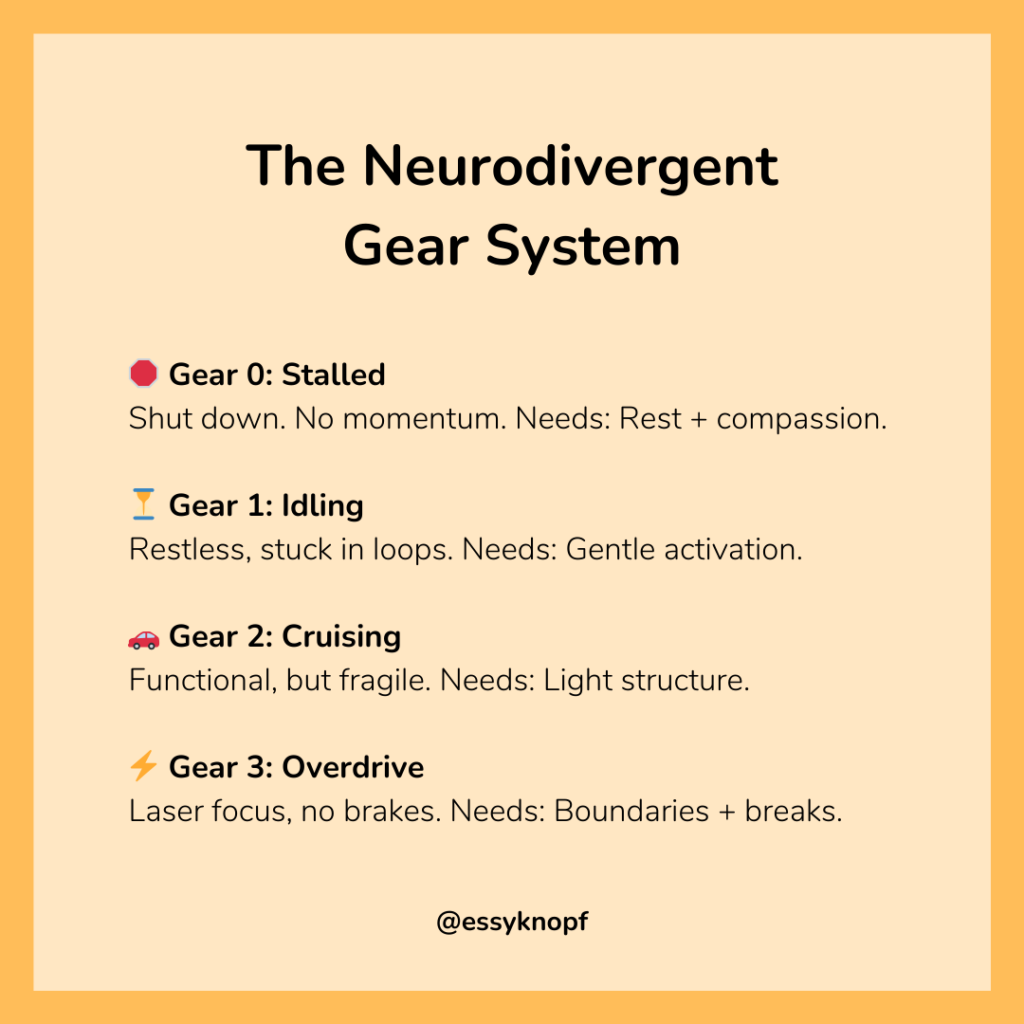
This is a framework I use to explain the different mental states we cycle through. Each “gear” represents a unique mix of energy, focus, mood, and executive function. Learning to recognize what gear you’re in is the first step toward moving through your day with more self-compassion and less shame.
Because when you understand how your brain operates, you stop asking, “What’s wrong with me?” And start asking, “What kind of support do I need right now?”
Gear 0: Stalled
Imagine trying to start a car with no fuel. You turn the key, press the gas, but nothing happens. That’s Gear 0: the Stalled state.
The lights are on, but nobody’s home. The idea of doing even one small task—brushing your teeth, replying to a text, making food—feels completely out of reach.
And worst of all? You don’t know how to get unstuck.
What Gear 0 Feels Like
Emotional numbness or shutdown
Anxious paralysis or depressive fog
Overwhelm at even the smallest responsibilities
Shame, guilt, or a loop of negative self-talk
A sense that time is passing, but you can’t start
From the outside, Gear 0 might look like procrastination. But inside, it’s more like internal collapse. For many neurodivergent folks, this state is chronic.
And in a society that values constant output, stalled can feel unforgivable.
Why This Happens
In Gear 0, dopamine is low, executive functioning is offline, and your nervous system may be in freeze mode. You may want to act, but your brain and body are in full shutdown.
You might hear yourself saying: “What is wrong with me?” “Why can’t I just get up?” “Everyone else manages. Why can’t I?”
But those questions are grounded in neuronormative expectations. The neurodivergent gear system reframes this experience not as failure, but as a biological state that requires care, not punishment.
How to Support Yourself in Gear 0
Gear 0 doesn’t respond to logic, pep talks, or productivity hacks. It responds to compassion and tiny sparks of activation.
Wiggle your fingers. Stretch one arm. Open a window. The smallest action is still movement. Try weighted blanket, soft textures, calming sounds, safe smells—anything that brings comfort to your nervous system. Or ask yourself: “What would help a little right now?” instead of “What should I be doing?”
And if nothing helps? That’s okay too. You’re not lazy. You’re not broken. You’re stalled. And stalled engines need time, fuel, and kindness to restart.
Gear 1: Idling
You’re not frozen anymore, but you’re definitely not going anywhere. Welcome to Gear 1: the Idling state.
The engine is technically running, but you’re stuck in neutral, buzzing with restless energy, yet unable to translate that into motion. You want to do something, anything, but your brain won’t cooperate. So you bounce from tab to tab, room to room, task to task… accomplishing exactly nothing.
This is the torture chamber of executive dysfunction. And it’s exhausting.
What Gear 1 Feels Like
Restless, jittery, uncomfortable in your own skin
Too anxious to relax, too foggy to focus
Aware of your responsibilities, but unable to begin
Constantly distracted, abandoning one task for another
You might start to pay a bill, then remember an email, then open your calendar, then look up new planners… and boom, 45 minutes have vanished and nothing’s actually done.
What’s Actually Happening
In Gear 1, your brain is seeking dopamine but not finding enough of it to initiate or sustain meaningful action. So it chases micro-hits: scrolling, snacking, fidgeting, YouTube rabbit holes.
This is your brain trying to self-regulate with whatever stimulation it can find.
It’s frustrating. It’s confusing. And it’s where shame likes to sneak in the side door: “You had time. Why didn’t you use it?” “You’re so disorganized.” “You’re doing this to yourself.”
That shame? It keeps the cycle going.
The neurodivergent gear system teaches us to recognize this state not as a moral failure, but as a mismatch: you have the intention to act, but not the neurochemical bridge to get there.
How to Support Yourself in Gear 1
The key is gentle activation, not forcing productivity.
Try:
Body doubling: Work alongside a friend (in person or virtually)
Timers: Try “just five minutes”—even one minute counts
Permission to start messy: Skip perfection. Begin in scraps.
External structure: Lists, sticky notes, or soft deadlines can anchor your drifting mind
And remember: the goal isn’t to leap to Gear 3. It’s to inch from 1 to 2. From scattered to slightly engaged. Even a tiny shift matters.
Gear 2: Cruising
Something clicks. You’ve taken that first step. Maybe you’ve brushed your teeth. Opened the document. Replied to that one email. And suddenly, you’re in it.
Welcome to Gear 2: the Cruising state. This is where things feel… okay. Not amazing. Not terrible. But doable. There’s just enough dopamine to get through tasks, and just enough focus to keep the momentum going.
It’s functional focus. And for many neurodivergent folks, this gear is the sweet spot.
What Gear 2 Feels Like
You’re moving steadily through tasks, maybe even enjoying them
You still get distracted, but not derailed
You’re managing your energy (barely), but you’re in motion
Your mood might be flat, neutral, or cautiously optimistic
You feel “like yourself” again. Just… more fragile
It’s the gear where you realize: “Oh. I’m not broken. I’m just a person who needs different conditions to function.”
The Delicate Balance of Gear 2
The neurodivergent gear system identifies Gear 2 as a transitional state. You’re no longer stuck, but you’re not fully locked in. It’s like cruising at a safe speed down an empty road, but knowing one red light, one interruption, one loud noise… could send you back to Gear 1 or even stall you out.
That makes this the perfect moment to support your state, so you can keep going without tipping into burnout or distraction.
How to Support Yourself in Gear 2
This is not the time to load your plate with high-stakes tasks. Instead, sustain the rhythm with just enough structure and support.
Try:
Loose plans: A simple “next few steps” list, instead of a rigid schedule
Soft accountability: Check-ins with a friend, or co-working platforms like Focusmate
Lean into flow: If you’re vibing with a task, ride the wave, even if it’s not the “most important” thing on your list
Hold space for breaks: Don’t wait for burnout. Rest before you need it
Also, be mindful of the inner critic that loves to whisper: “This isn’t real productivity.” “You’re not doing enough.” “You’re barely keeping up.”
Don’t let that voice steal your progress. Gear 2 is where sustainable momentum lives.
Gear 3: Overdrive
You’re in the zone. Ideas are flowing, tasks are flying off your list, time is melting away, and everything just clicks. You feel competent, confident… even euphoric.
This is Gear 3: Overdrive.
It’s the state that every productivity guru seems to worship, and the one many neurodivergent folks wish they could live in forever. Because here? You finally feel like you’re functioning the way everyone expects you to function all the time.
But here’s the thing: Gear 3 isn’t sustainable.
What Gear 3 Feels Like
Laser-focused attention, possibly to the point of forgetting to eat, drink, or rest
High energy, fast thinking, and a sense of “flow”
Creative breakthroughs, fast problem-solving, intense clarity
A strong urge to finish everything while the momentum lasts
A total disregard for time, physical needs, or future burnout
Overdrive can feel amazing. That’s why it’s so seductive. Especially for ADHDers, this is the gear of hyperfocus, and it often comes with a rush of relief.
You’re finally “doing the thing.” You feel powerful. Capable. Normal.
Why Overdrive Isn’t the Goal
Let’s be clear: there is nothing wrong with experiencing Overdrive. But problems show up when we try to live here.
This gear is often triggered by:
Urgency (deadlines, last-minute pressure)
Novelty (new ideas, exciting projects)
Passion (deep interest or personal relevance)
Panic (avoidance catch-up, “everything’s on fire” mode)
The neurodivergent gear system reminds us that these bursts of energy are signs that your brain is flooded with just enough dopamine to lock on… for now.
But what comes up must come down. And if we don’t pace ourselves, Gear 3 will eject us hard into a crash.
The Risks of Staying Too Long in Overdrive
We skip meals. Ignore fatigue. Cancel breaks. Delay rest. Push through red flags. Why?
Because we’ve been taught that this version of ourselves—the one that performs—is the real us. Everything else feels like failure.
So we tell ourselves: “I’ll rest later.” “I just need to get this one last thing done…” “This is the only time I’ve had this kind of focus. I have to take advantage of it.”
But this mentality leads directly to burnout. Overdrive without boundaries can thus become self-abandonment.
How to Support Yourself in Gear 3
The goal here is to honor it without losing yourself in it.
Try:
Set limits before you begin (e.g., “I’ll work for 90 minutes, then take a real break”)
Leave notes for Future You (sticky notes that say “Please rest. You deserve it.”)
Schedule body needs (hydration, food, movement) as non-negotiables
Watch for signs of mental fatigue: confusion, irritability, forgetfulness. Stop there, not two hours later
You’re not sabotaging yourself by slowing down. You’re protecting your ability to keep showing up tomorrow.
Because Gear 3 is a gift, but it’s not a place to live.
Downshifting: The Crash After the Clarity
One minute, you’re flying: locked in, productive, present. The next? You’re staring at the screen, blinking slowly, completely disconnected.
What just happened? Welcome to Downshifting: the often-sudden, deeply disorienting transition out of one gear into a lower state.
For many neurodivergent people, this is one of the hardest parts of the cycle.
What Downshifting Feels Like
Brain fog settling in like a heavy mist
Emotional flatness, irritability, or inexplicable sadness
Losing your train of thought mid-task
Feeling mentally blank but physically wired, or vice versa
A sudden inability to care about the thing that had you so focused minutes ago
Downshifting can hit like emotional whiplash. You were fine—even thriving—and now you’re dazed, frustrated, or spiraling.
What’s Really Going On
When you’ve been in Overdrive, you’ve likely burned through a ton of dopamine, emotional energy, and executive function. Your brain reaches a tipping point and pulls the brakes for you.
You didn’t “ruin it.” You didn’t “lose momentum.” You didn’t “self-sabotage.” You simply ran out of fuel.
In the neurodivergent gear system, Downshifting isn’t a backslide. It’s a necessary transition: your brain trying to recover from a high-output state.
But because we often don’t get any warning signs, it can feel like a betrayal: “Why can’t I just keep going?” “I was doing so well. What changed?” “I must have done something wrong.”
And that’s where shame tries to take over, unless we name what’s really happening.
How to Support Yourself While Downshifting
The most important thing? Resist the urge to push through. Instead, focus on soothing your nervous system and resetting gently.
Try:
Name it: “I’m downshifting right now. I didn’t fail. I’m transitioning.”
Offer comfort, not correction: Cozy clothes, warm drinks, movement, silence. Whatever helps you reset
Embrace soft stops: Give yourself permission to stop without finishing. Not everything has to be done to be valuable.
Compassionate self-talk: “I worked hard. I need care now, not criticism.”
The neurodivergent gear system reminds us that even rest states are part of the cycle. The crash is a signal that your brain needs something different now.
Final Thoughts: Learning Your Rhythm
So… what gear are you in right now?
Are you stalled in Gear 0, unable to get moving and feeling swallowed by shame?
Idling in Gear 1, buzzing with restless energy but unable to act?
Cruising in Gear 2, functioning steadily and managing your pace?
Flying in Gear 3, riding the high of hyperfocus and finally feeling “on”?
Or maybe you’re downshifting, wondering where the focus went and why you suddenly feel so flat?
Wherever you are, it’s okay. You’re cycling through a neurodivergent gear system that reflects how your brain naturally shifts through different states of attention, energy, and regulation.
And when you learn to name those states, you also learn how to support them: Instead of “I’m lazy,” you say, “I think I’m in Gear 1. I need some soft structure.”
Instead of “I ruined my flow,” you say, “I’m downshifting. What would comfort look like right now?” Instead of “Why can’t I be like this all the time?” you say, “Gear 3 was a gift, but I don’t have to live there.”
This isn’t about becoming more productive or fixing yourself. It’s about honoring the rhythm of your neurodivergent brain, with curiosity instead of shame.
Because once you stop fighting your gears, you can start driving your own way.
What gear are you in today? Share in the comments. And if you have your own personal strategies for shifting gears (or staying gentle while stalled), I’d love to hear them.
Essy Knopf is a therapist who likes to explore what it means to be neurodivergent and queer. Subscribe to get all new posts sent directly to your inbox.
Have you ever looked around your home and marveled at your museum of half-finished dreams?
Maybe there’s a guitar propped in the corner you haven’t strummed since that one YouTube tutorial. A forgotten sketchbook under your bed. That sourdough starter that lived and died in your fridge. Or an entire shelf of knitting supplies, untouched since last winter.
For autistics and ADHDers, this is a deeply familiar experience, so common that some of us have named it: the neurodivergent “hobby graveyard.”
But despite the cheeky name, this graveyard doesn’t symbolize failure. It’s often a representation of how your brain seeks out what it needs to feel engaged, alive, and emotionally regulated.
In a world built on productivity and permanence, we’re taught to see these abandoned hobbies as mess, waste, or shame. But what if they’re actually signs of resilience? What if each one was a temporary lifeline: something that kept you grounded, curious, or hopeful during a time when you needed it most?
Why We Chase Hobbies Like Mountains
For many neurodivergent folks, a new hobby often arrives like a lightning strike.
One moment you’re scrolling or watching something, and the next? You’re hooked. Suddenly, you’re deep in research mode. You’ve opened 37 tabs. You’ve joined a subreddit, a Discord server, maybe even ordered a book or two. Your brain, which often feels foggy or unfocused, is finally lit up.
Many autistic and ADHD brains struggle with dopamine regulation. That means we don’t always feel naturally motivated by the slow, steady rewards of daily life. We may feel flat or distracted when things aren’t novel, urgent, or emotionally meaningful. So when we stumble on something that does light us up—something new, challenging, or rich with possibility—it can feel like finding oxygen after holding our breath.
It feels like discovering a mountain and deciding: “I’m going to climb that.”
And climb we do. With intensity. With focus. With joy. Every step along the way—whether it’s learning a new skill, building a project, or immersing ourselves in a world—gives us the dopamine hits weneed to stay motivated, grounded, and connected to ourselves.
But here’s where the neurodivergent hobby graveyard starts to form. We reach the summit, and we realize the spark is gone.
And just like that, it becomes harder and harder to return. Not because we don’t care, but because our brain no longer gets the reward signal it needs to stay engaged.
The Crash: When the Spark Disappears
And when that reward is gone, energy dips. Our drive stalls. We stop feeling that magnetic pull to open the app, pick up the tools, or continue the course you were once so excited about.
At first, we might try to push through, telling ourselves you just need to try harder. But the truth is, it doesn’t feel the same anymore. The novelty is gone. The dopamine has dried up.
Welcome to the plateau: the beginning of what many of us experience as a crash.
From the outside, this sudden disinterest can look like flakiness or inconsistency. To neurotypical people, it may seem baffling: “But you were so into it!” And maybe we were. Passionately so. But what they don’t see is that the slope of the mountain has flattened, and with it, our brain’s motivation systems.
Here’s what’s really happening: when a hobby no longer gives our brain the same rewarding feedback—when there’s less challenge, less discovery, less novelty—our internal reward system disengages. The activity that once gave us life now requires maintenance mode, and for many neurodivergent folks, maintenance mode can feel like emotional quicksand.
And so, another cherished interest slips quietly into the neurodivergent hobby graveyard. This is often when the shame creeps in.
We look at the gear we bought. The half-finished sketch. The unread textbook. We might think: “I wasted all that money.” “Why can’t I ever finish anything?” “I get obsessed and then drop everything. What’s wrong with me?”
But it’s important to stress: this isn’t a flaw in our character. It’s a shift in our brain chemistry. What we’re experiencing is reward deficiency. We lost interest because our neurodivergent brain is no longer being fed in the way it needs.
And rather than sit in that empty space of disengagement, our minds—clever and resilient—starts scanning the horizon for the next mountain. The next spark. The next chance to feel alive.
Welcome to the Neurodivergent Hobby Graveyard
So here you are. Standing in a room that looks, in some ways, like a timeline of your past selves.
A watercolor kit in the closet. A ukulele in the corner. A pile of half-read books on obscure historical events. A closet full of fitness gear. A forgotten podcast idea. A domain name you bought in a fit of inspiration.
This, my friend, is the neurodivergent hobby graveyard.
But let’s get one thing straight: this is nota junkyard of failure. It’s a record of your curiosity. Your effort. Your desire to engage with the world in a way that made sense to your brain at the time.
Every item in your hobby graveyard had a purpose, maybe even a mission. It was your way of saying: “This could be something. This might help me feel more like myself.” And maybe it did—for a while.
Maybe that fermentation kit got you through a dark winter. Maybe that YouTube channel helped you connect with someone across the globe. Maybe that embroidery phase gave your hands something to do when your anxiety was peaking.
Each hobby—no matter how long it lasted—served a role.
Each one was a lighthouse in a moment when your brain needed direction, grounding, or escape.
But eventually, the light faded. The path shifted. The mountain flattened. And you, brilliantly adaptive as ever, moved on. And that’s okay.
What isn’t okay is the shame we carry when we look at the debris. Shame that says: “You’re wasteful. You’re inconsistent. You’re broken.”
None of those things are true. The neurodivergent hobby graveyard is proof of only one thing: that you try again and again to meet your brain’s needs with the tools available to you.
Our graveyards are really a monument to persistence.
What If It Wasn’t a Failure, But a Strategy?
Let’s pause for a moment and ask a radically different question: What if abandoning hobbies wasn’t a sign of failure, but a strategy?
What if your brain, in all its complexity, knows it needs constant engagement, challenge, and stimulation to feel alive, and what if it’s doing its absolute best to find that? Again and again?
The truth is, the cycle of intense passion followed by abrupt disengagement is often a direct result of how ADHD and autistic brains are wired.
We’re not meant to “pick one thing and stick with it forever.” That idea—of linear growth, lifelong interests, and consistent progress—was built for neurotypical reward systems. The kind that thrive on delayed gratification, predictability, and sameness.
But if you’re autistic or ADHD, your motivation is probably driven by very different fuel sources, such as novelty, creative challenge, emotional resonance, and a sense of discovery.
So of course your interests shift. So of course the dopamine dries up when things feel repetitive. So of course you move on when the spark disappears.
And here’s the beautiful part: you keep moving. Even after burnout. Even after guilt. Even after people around you suggest you’re “too much” or “never follow through.”
You keep seeking out the things that make your brain feel right. That keep you connected to yourself.
The neurodivergent hobby graveyard might look like scattered remains of abandoned pursuits, but if you look closer, you’ll see it’s also filled with survival strategies. Adaptations. Moments where you tried, again and again, to create meaning, focus, and joy.
How to Work With the Cycle (Instead of Against It)
You don’t have to “fix” this pattern. Your brain doesn’t need to be reprogrammed.
But you can learn to move through the hobby cycle with more intention, more support, and a whole lot less guilt.
Here are a few strategies that can help you honor your wiring, while protecting your energy, your time, and your wallet.
1. Introduce a Waiting Period
When a new hobby strikes, it’s easy to get swept up in the dopamine flood and go all in. Before you know it, you’ve spent $200 on gear and you’re researching Etsy store names.
Consider creating a small buffer between discovery and investment. Try saying, “I’ll wait two weeks before I buy anything over $30.” Or: “If I’m still excited about this next month, I’ll go deeper.”
This helps prevent future-you from feeling overwhelmed by clutter or financial regret. It also creates space for your interest to evolve naturally, without the pressure of needing to turn it into a long-term commitment.
2. Name the Phase You’re In
There’s something powerful about calling out where you are in the cycle.
Instead of hoping this will be the one that sticks, try saying: “I’m in the honeymoon phase right now.” “This might be a short-term spark, and that’s okay.” “I’m gathering info, not making a life decision.”
Naming the phase gives you perspective. It turns what might feel like a chaotic rush into something you can witness and understand. It helps you befriend the cycle instead of battling it.
And when you do eventually move on? There’s less shame, because you saw it coming. You accepted it from the start.
Another benefit? It keeps your neurodivergent hobby graveyard from becoming a place of surprise guilt. It turns it into a record of cycles you consciously chose to move through.
3. Start with Low-Stakes Entry Points
Instead of jumping in with both feet and a credit card, try dipping a toe.
Use free or trial versions of apps before subscribing. Watch YouTube tutorials before enrolling in a full course. See if your library has the book before buying it. Borrow gear from a friend or local lending group.
That way, if the interest fades, you haven’t lost much. And if it sticks? You’ve built the foundation without overcommitting.
4. Curate, Don’t Cling
Sometimes we hang onto old hobby supplies out of guilt. I spent money on that. I should try again. I need to finish what I started.
But holding onto things that no longer spark joy can actually drain your energy, and create visual clutter that keeps you stuck in shame.
Here’s a gentle reframe: Letting go doesn’t mean you failed. It means you’re making space for your next mountain, for clarity, for rest.
If it feels too hard to release completely, try making a “maybe box.” Put supplies in it and revisit it in three months. If you still feel neutral or avoidant? That’s your answer.
The neurodivergent hobby graveyard doesn’t need to become a cluttered storage room. It can become a curated museum of past lives, filled only with things you want to remember.
5. Celebrate What the Hobby Gave You
Even if you only stuck with something for a month, it still meant something.
Take time to name what each hobby gave you. Did it teach you something new? Help you through a hard time? Introduce you to a new friend or community? Offer a sense of identity, even temporarily?
Try journaling it out, or creating a visual timeline of your past interests. When you shift the narrative from “I gave up” to “Look what I gained”, the shame starts to loosen its grip.
Your neurodivergent hobby graveyard becomes a garden, full of growth, even if things didn’t bloom forever.
6. Anchor Your Identity Outside Your Interests
One of the hardest parts of this cycle is the identity whiplash. When you’re immersed in something, it can feel like you are that thing.
So when it fades, you might feel like you’ve lost part of yourself.
But your worth isn’t tied to your output, your hobbies, or your productivity.
You are still you when you’re bored. When you’re in-between passions. When you’re resting.
You are worthy of love and belonging, exactly as you are.
Final Thoughts
If you’ve ever looked around at your shelves, hard drives, or mental tabs and felt the weight of all the things you didn’t “finish,” please hear this: Your neurodivergent hobby graveyard is a map of who you’ve been, what you’ve needed, and how your brain has tried to care for you.
Each hobby was a moment of curiosity. A rebellion against monotony. A lifeline during stress or burnout. A way to regulate, reconnect, or remember who you are.
And yes, while it might sometimes be expensive, cluttered, or emotionally messy, it’s also a sign of something beautiful: your persistent, creative, ever-adaptive mind.
So the next time you find yourself mid-hyperfocus with a cart full of supplies or teetering on the edge of burnout, take a deep breath and remember: this cycle is a natural neurodivergent rhythm. And you can move through it with more grace and self-compassion each time.
What’s in your neurodivergent hobby graveyard? What did those past passions teach you about yourself, your needs, or your creativity? Have you found any gentle strategies that help you enjoy the spark without burning out?
Essy Knopf is a therapist who likes to explore what it means to be neurodivergent and queer. Subscribe to get all new posts sent directly to your inbox.
Have you spent most of your life carrying experiences that few people ever see? If you’re autistic, ADHD, chronically ill, or some combination of all three, there’s a good chance you already know what that feels like.
You live with a dozen intersecting realities—sensory sensitivities, executive dysfunction, fatigue, chronic pain, mental health conditions—and yet you’re constantly asked to condense all of that into one simple explanation. A label. A sentence. Something that fits the narrative people already expect to hear.
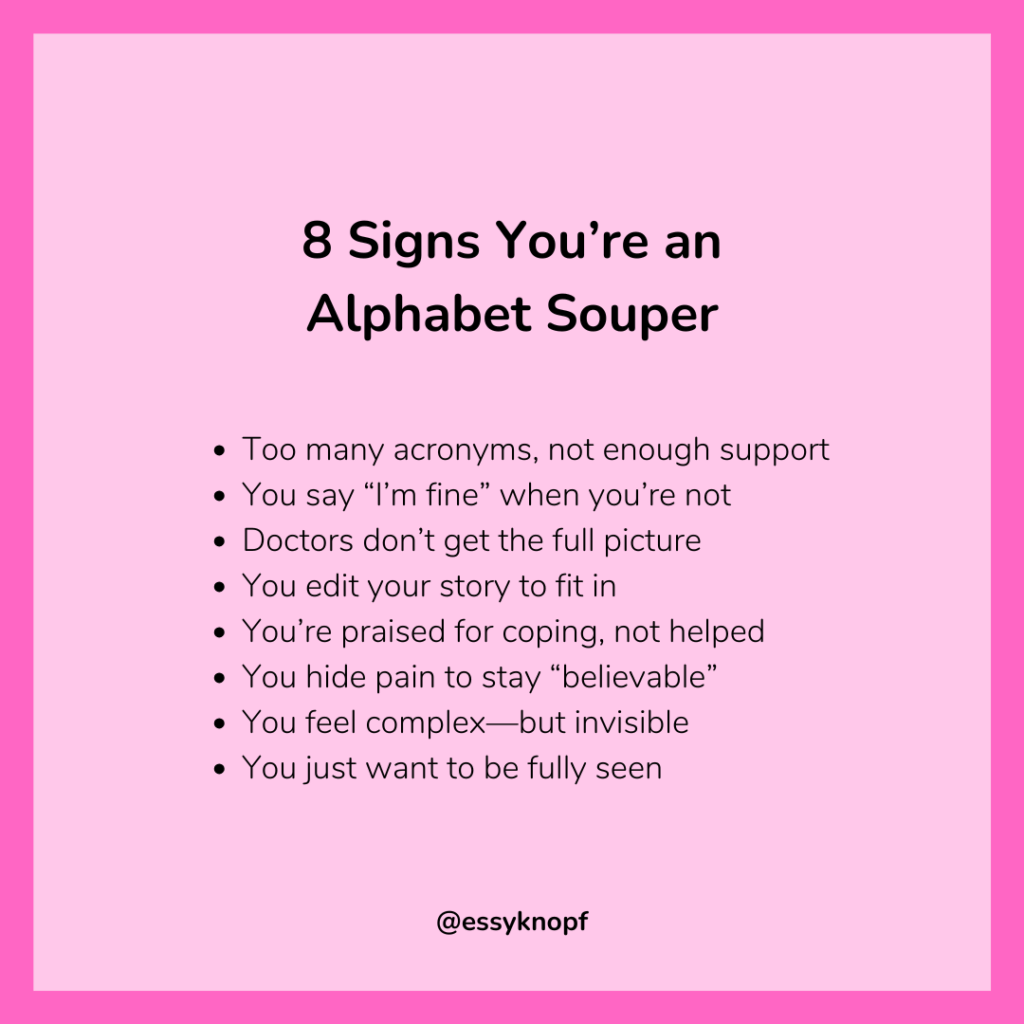
That’s why I use the term “alphabet souper.”
It’s my shorthand for a life shaped by diagnosis codes, misunderstood symptoms, and invisible struggles. It refers to the long string of acronyms many of us carry: ADHD, ASD, HSD, POTS, MCAS, IBS, C-PTSD, etc.—and more. Each one might explain a single piece of our reality, but none tell the full story. And most of the time, no one even asks.
Being an alphabet souper means living with neurodivergence and co-occurring challenges, while constantly being expected to explain it all in a way that’s easy for others to understand.
We become experts at this. Not because we want to. Because we’ve had to.
The Pressure to Be Legible
When you’re an alphabet souper, you quickly learn that complexity makes people uncomfortable. Most of the world is calibrated for simplicity. Single diagnoses. Clear causes. Easy fixes. But alphabet soupers don’t fit that mold.
Instead, we live at the intersection of multiple systems that don’t work the way they’re “supposed to.” Our experiences don’t follow a single diagnostic narrative. We might be managing sensory overwhelm, executive dysfunction, chronic illness flare-ups, social anxiety, and trauma, all in a single afternoon.
And yet, when we speak about our reality, we often feel pressure to streamline it. To reduce it to something legible. Something people will recognize. Something that sounds familiar enough not to raise eyebrows or questions we’re too tired to answer.
So we adapt. We learn to talk about our conditions in bite-sized chunks. We avoid going into detail. We measure our words against other people’s attention spans and comfort levels. We edit our stories because we know what happens when we don’t.
The more challenges you carry as an alphabet souper, the more invisible labor goes into appearing “manageable.” This is about more than masking. It’s about shaping your whole presence around what others can emotionally or intellectually tolerate.
Masking Runs Deeper Than People Think
When people talk about masking, they often imagine it as something surface-level: suppressing stims, mimicking facial expressions, mirroring tone. But for many of us living as an alphabet souper, masking runs far deeper.
We mask pain. We mask confusion. We mask the crashing of multiple internal systems while calmly nodding through a conversation. We become fluent in scripting—even basic interactions—because improvising takes energy we often don’t have.
And the longer we mask, the harder it becomes to remember what’s underneath.
Being an alphabet souper means juggling neurodivergence and co-occurring conditions that interact in unpredictable ways. Maybe it’s brain fog from POTS, overlaid with executive dysfunction from ADHD, while also managing the social load of masking autistic traits. On paper, we might look “functional.” But the cost of looking that way is rarely visible to others, and often invisible even to ourselves.
Masking becomes muscle memory. We’ve done it for so long, it can feel automatic. Expected. Sometimes even praised.
But here’s the truth: that praise is hollow. Because it usually comes from people who don’t see the after-effects. They don’t see the crash after we’ve held it together for too long. They don’t see the shutdowns, the flares, the hours lost trying to regulate. They see us as “resilient”, but they never asked what it cost.
For an alphabet souper, masking isn’t just about fitting in. It’s about managing other people’s reactions so we don’t lose support, credibility, or connection. And that’s a heavy ask, especially when you’re already carrying so much.
Complexity Isn’t a Defect
In a world that rewards neat categories and predictable narratives, being an alphabet souper often feels like you’re doing life wrong. You’re neurodivergent and you’re also navigating chronic illness, trauma, sensory processing differences, mental health struggles, and no one seems to know what to do with all that at once.
You get responses like, “That’s a lot,” or “Have you tried yoga?” You see the subtle wince when you bring up yet another acronym. You notice how people start to disengage when your story doesn’t have a simple ending or a tidy explanation.
There’s a widespread belief—sometimes unspoken, sometimes very loud—that if you have too many issues, you must be exaggerating. Or dramatic. Or maybe even difficult. But complexity isn’t a personal failing. It’s just reality for many of us.
Being an alphabet souper means that no single diagnosis explains everything, but each one adds to the picture. It’s layered. And those layers influence how we experience the world, how we communicate, how we move through each day.
But complexity makes systems freeze up. Medical professionals don’t know which part to treat first. Friends don’t know how to respond. Coworkers stop inviting you to things.
And so, out of self-protection, we start to censor. We pick the “most relatable” diagnosis to talk about and leave the others off the list. We say we’re “just tired” when we’re in full autonomic dysregulation. We avoid bringing up that a food sensitivity triggered a three-day spiral because it sounds too strange, too much.
We internalize the idea that to be supported, we must be simple.
But being an alphabet souper means embracing complexity, because denying it costs us more than anyone else. Denying it keeps us alone.
A Thousand Small Losses
Grief isn’t always loud. For an alphabet souper, it’s often subtle, cumulative: an echo that builds over time.
It starts with the doctor who dismisses your symptoms because your tests came back “normal.” The therapist who focuses on one diagnosis but ignores the others. The friend who changes the subject when you try to explain what a flare day really feels like.
None of these are big moments on their own. But together, they form a pattern. A long trail of interactions where your reality was too complex, too inconvenient, or simply too misunderstood.
When you’re an alphabet souper, the losses add up: the connection that fizzled out after you were “too honest”; the job interview that went silent after you disclosed; the look someone gave you when you tried to explain how everything overlaps—how your sensory overload makes your GI symptoms worse, which then spikes your anxiety, which makes your executive dysfunction spiral.
You learn not to go there, because you’ve learned most people don’t want to know.
You start skipping details. Leaving things out. Not mentioning the acronym you just got added to your file. That information, after all, could cost you in social currency.
Every time you withhold a part of your story, there’s a loss. A missed opportunity for understanding. A part of yourself that stays hidden.
And the hardest part? Even when you’re surrounded by people, you can feel deeply alone. Because no one sees the full version of you. Few people have stayed long enough—or listened closely enough—to hold your whole story.
That’s the ache many alphabet soupers carry: the longing to be known and believed, without having to shrink their truth to fit someone else’s comfort zone.
Final Thoughts
If you’ve ever felt like your story had too many moving parts to explain—if you’ve ever watched someone’s eyes glaze over as you tried to name what you’re carrying—you’re not alone. You’re likely an alphabet souper, navigating a world that doesn’t know how to hold the weight of complexity without trying to simplify, fix, or ignore it.
Being an alphabet souper means you’ve had to become your own translator, advocate, and interpreter, often in spaces that demand silence or performance over truth. That’s exhausting. And you deserve better.
You deserve to take up space with your full story, and not just the parts that are easy for others to digest. You deserve support that doesn’t disappear when the list of challenges gets longer. You deserve to say, “I’m struggling,” without having to earn that struggle’s legitimacy.
And above all, you deserve to be known without having to be explained.
Are you an alphabet souper too? Have you ever had to simplify your truth just to stay connected or believed?
Essy Knopf is a therapist who likes to explore what it means to be neurodivergent and queer. Subscribe to get all new posts sent directly to your inbox.
There’s a tension I carry in my body, like a coiled spring.
It shows up in the way I brace before I speak. The way I rehearse sentences in my head before I open my mouth. The way I watch for micro-reactions: a raised brow, a stifled sigh, a slight pause in someone’s tone.
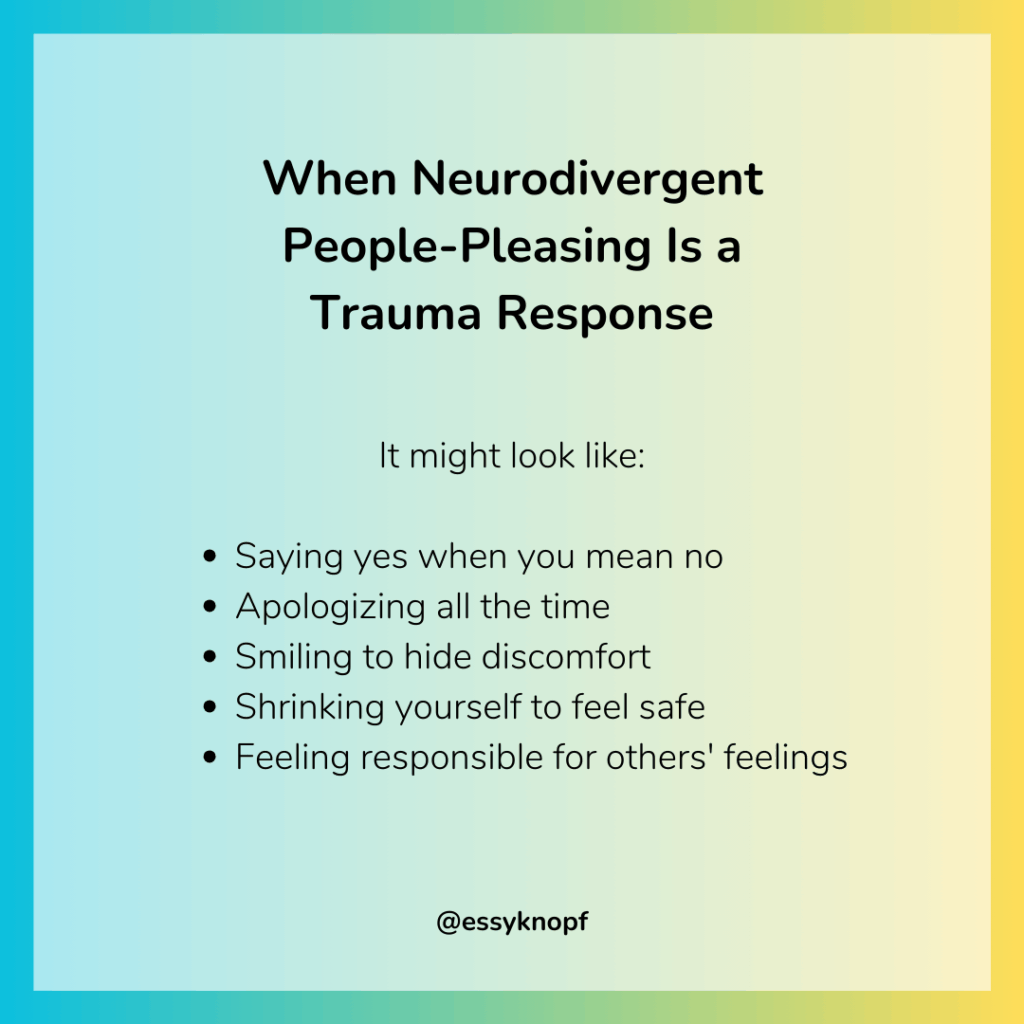
This is a learned posture of hypervigilance. A physical manifestation of years spent in what I now recognize as neurodivergent people-pleasing mode.
This behavior becomes our default when we’ve learned—early, often, and painfully—that our natural ways of being tend to invite misunderstanding, correction, or outright rejection. And even when those things aren’t happening in the moment, our bodies don’t forget.
The world may not be attacking us, but we’re still braced for the blow.
For many autistic and ADHD folks, this is the result of trauma; a deep-seated nervous system adaptation to a society that consistently sends the message: “You’re doing it wrong.”
Today, I want to talk about that: what it’s like to live in a constant state of neurodivergent people-pleasing, how it shapes our social lives, and what healing might begin to look like.
The Hidden Trauma Behind Neurodivergent People-Pleasing
When we talk about trauma, most people think of a singular, catastrophic event: a car crash, a violent assault, a natural disaster. But for many autistic and ADHD folks, trauma doesn’t arrive in one big wave. It’s a steady accumulation.
This is complex trauma. The kind that builds slowly, invisibly, over years of being misread, dismissed, or shamed for being different. It’s the slow drip of social rejection. The chronic sense of not belonging. The pain of having your true self constantly questioned, corrected, or ignored.
It’s being the child who was “too sensitive,” “too blunt,” “too loud,” “too weird.” The teen who masked so well they disappeared. The adult who performs normalcy so convincingly that their pain goes unseen.
These experiences don’t just hurt in the moment. They rewire your nervous system. Over time, your brain begins to anticipate judgment. You learn to preemptively scan every room, every face, every word. You rehearse. You shrink. You hide. You brace.
And the most insidious part? Much of what causes this trauma is praised by others.
Like staying quiet in class. Like forcing eye contact while your whole body screamed “no.” Like over-apologizing, over-explaining, over-functioning, just to prove you deserve to take up space.
This is the essence of neurodivergent people-pleasing: performing social acceptability at the expense of your own regulation. Adapting so thoroughly that others never see your distress. Being rewarded for suppressing yourself so effectively that you forget what authentic expression even feels like.
These survival strategies are reflexes, shaped by a thousand tiny lessons: that your comfort makes others uncomfortable, that your truth is too much, that your presence needs softening, shrinking, smoothing over.
But just because it’s common doesn’t mean it’s harmless. Neurodivergent people-pleasing often leads to chronic burnout, disconnection, and shame. Because when you’re constantly performing safety for others, there’s no room to experience it for yourself.
Empathy in People-Pleasing Mode Doesn’t Always Look How You Expect
When you’ve been punished for reacting the “wrong” way too many times, your brain learns to pause. To scan. To script. One of the ways we overcompensate in neurodivergent people-pleasing is by performing a pantomime of empathy.
In many situations that call for it, we may find that our brain is still buffering. Our nervous system might be flooded. Our emotional access might be delayed. Or we may not even know what we’re feeling, because alexithymia and overwhelm can block the emotional signals entirely.
So instead of feeling it in real-time, we run a mental checklist: What would comfort me if I were them? What tone feels safe? What’s the right facial expression to make them feel heard?
What you see on the outside might look like empathy. And in a way, it is. It’s intentional. It’s effortful. It’s us overfunctioning so we can show up, even if we’re still catching up inside.
We’ve learned to perform empathy in a way others recognize. And when we do it well, it usually lands. But it doesn’t feel authentic. It feels like a mask. A role we’ve rehearsed so often that we can do it on autopilot, but never without cost.
And when we’re the one in pain? When we drop the mask and don’t receive that same attunement in return? It stings. It affirms that we must keep performing to stay safe. That neurodivergent people-pleasing is not optional… it’s required.
Flat Doesn’t Mean Unfeeling: The Protective Stillness of People-Pleasing
Sometimes in conversation, we go quiet. Our voice flattens. Our face stops moving. Our answers shrink to short, clipped replies.
To someone on the outside, it might look like we’re annoyed, shut down, or checked out.
But what’s really happening is this: we’re trying to keep ourselves safe.
When you live in the cycle of neurodivergent people-pleasing, your nervous system is constantly monitoring for overload—social, emotional, sensory. And when it gets to be too much, your body does what it needs to do to stay regulated: it goes still.
We adopt a “bratty resting face,” which is often just a freeze response.
It can be triggered by a variety of factors: bright lights and too much background noise; a conversation that’s moving too fast to track; the fear of saying the wrong thing; the emotional weight of alexithymia (feeling something big but having no name for it).
We freeze also because moving might make things worse. We shrink our expressions to minimize risk. We quiet our tone, monitor our posture, try to reduce any variables that might be misread.
Ironically, it’s that effort to appear neutral that often gets misread the most. People ask, “Are you okay?” with a tone that suggests we’re not. They say, “You seem mad,” when we’re doing our best to hold it together. We may have even been told, “You looked like you hated me,” when we were actually doing everything in our power not to melt down in front of someone.
When we mask our overwhelm, we often still get it wrong. Because even silence can be judged. Even neutrality can be seen as hostility.
And so the cycle reinforces itself. We learn that even our coping strategies are risky. That even self-protection makes us vulnerable.
That’s the exhausting paradox of neurodivergent people-pleasing: you’re constantly adapting to avoid being misunderstood, only to be misunderstood anyway.
Hypervigilance As a People-Pleasing Strategy
“Did I say too much?” “Was that the wrong tone?” “Are they mad at me?” “Should I apologize, just in case?”
If these thoughts run on a loop in your mind after even the most casual social interaction, you’re not alone. And you’re not overthinking.
Most of us didn’t wake up one day with this hyper-awareness. We learned it.
We were the kids who asked blunt questions and got scolded for being rude. The teens who didn’t pick up on sarcasm or subtle cues, and got laughed at or excluded. The adults who are still told we’re “too much,” “too direct,” “too intense,” or “too sensitive.”
So we began to monitor ourselves. Every word. Every gesture. Every pause.
We rehearse conversations before they happen. We translate our natural language into something “acceptable.” We apologize for things that haven’t even gone wrong. This is how neurodivergent people-pleasing operates: as a finely-tuned, hypervigilant attempt to stay safe.
And when rejection still comes? We internalize it. It must be us. We’re broken. Dangerous. Too much.
When Intentions Are Misread, the Shame Stays
If you’re autistic or ADHD, chances are you’ve had this moment: you say something you think is helpful. Or curious. Or neutral. And suddenly someone pulls away. Their expression changes. The air in the room shifts.
And you’re left frozen with one burning question: “What did I do wrong?”
It’s a deeply familiar pain. One that activates every learned instinct of neurodivergent people-pleasing. We scramble to clarify, explain, backpedal, soothe.
But often, our attempts to clarify are seen as making it worse. We get told we’re being defensive. That we’re “making excuses.” That we’re “overreacting.”
When all we’re doing is reacting exactly the way someone would if they’ve been through this a thousand times before.
So now, when something feels off in a social moment, we panic. We rush to fix it. We over-explain. It might seem like we’re trying to deflect blame, when we’re really trying to preserve connection.
Because one misstep can feel like the end of a relationship. And often, it is.
What follows is a shame spiral: replaying the conversation on loop, analyzing every word, every glance, and wondering how we got it so wrong—again. And over time, that spiral deepens.
This is the long shadow of neurodivergent people-pleasing. Even when our intentions are good, even when our hearts are in the right place, our words might still be misunderstood. And the pain of that is cumulative.
From People-Pleasing to Safety: Reclaiming What Was Stolen
When you’ve spent years in neurodivergent people-pleasing mode, bracing for every social blow, scanning for signs you’ve messed up, scripting your every move, it’s easy to forget what safety even feels like.
Even calm moments can feel like ticking clocks. Even kind people can feel like question marks. Your body doesn’t know how to let go; only how to prepare.
Healing starts not in huge life changes, but in tiny moments. Like when you stim freely and no one makes it weird; you go monotone and no one assumes you’re mad; you say something awkward, and someone laughs with you, not at you; you freeze, and instead of demanding an explanation, someone gives you time.
These are the cracks in the armor. The beginnings of trust. Sometimes it starts with others. But more often, it has to start with you.
With choosing self-compassion instead of shame. With letting yourself pause without apologizing. With reminding yourself: “I’m not too much. I’m not defective. I’m just wired differently. And I’m doing the best I can.”
All of us deserve relationships where we don’t have to constantly manage risk. Where our differences aren’t liabilities, but part of how we exist in the world.
Yes, there will still be people who misunderstand. But there will also be people who don’t need you to perform for their comfort. Who see your flat voice, your delayed response, your stims, your blunt honesty—and lean in.
Final Thoughts
If socializing has always felt like a tightrope walk, you’re not alone.
You’ve just spent too long in neurodivergent people-pleasing mode, a state your nervous system learned to keep you safe in a world that didn’t always feel safe for people like you. And the fact that you’re still here, still trying, still reaching for connection? That’s resilience.
You don’t need to keep proving your worth through performance. You deserve connection that doesn’t demand translation. You deserve to exhale.
Have you found yourself stuck in neurodivergent people-pleasing too? What helped you start to feel safe again?
Essy Knopf is a therapist who likes to explore what it means to be neurodivergent and queer. Subscribe to get all new posts sent directly to your inbox.
For those of us who are autistic, ADHD, or otherwise neurodivergent, “unmasking” is often painted as a single, bold event. Like ripping off a disguise to reveal your true self underneath: finally free, finally whole.
But that’s not the reality for most of us.
Unmasking isn’t one grand gesture. It’s not a viral social media post. It’s not telling your boss about your diagnosis or suddenly deciding you’ll stim publicly from now on. Those might be parts of the process. But the real work is quieter, slower, and very personal.
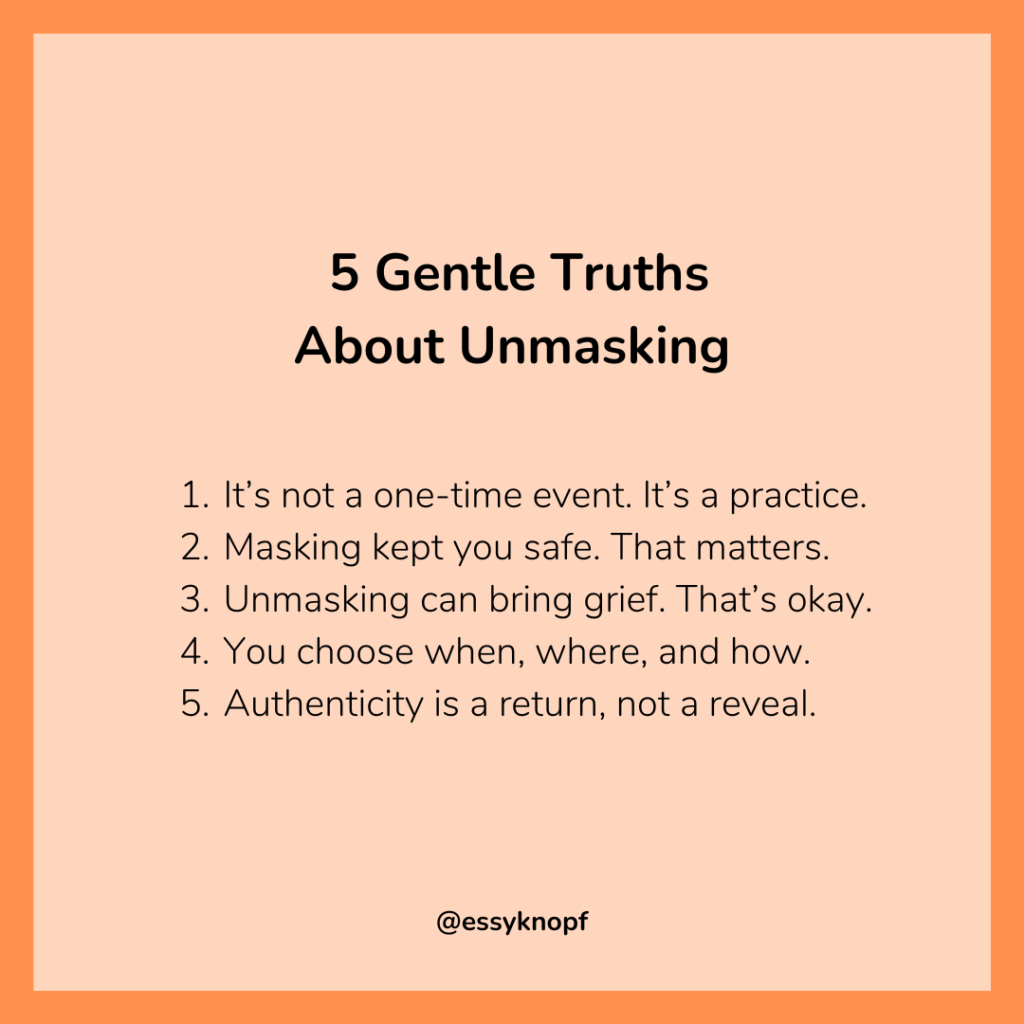
Unmasking is the ongoing practice of getting closer to your neurodivergent authenticity. It’s about noticing the habits you picked up to stay safe. The ways you’ve made yourself small to be accepted. And it’s about asking, day by day, “Is this who I really am, or is this who I’ve had to be?”
This post is for anyone sitting in that question.
We’ll talk about what masking actually looks like, why it was necessary, and what unmasking can mean as a rhythm, return, and reclamation.
What Masking Really Is (and Isn’t)
Masking is something many neurodivergent people learn to do—often without realizing it—because it helps us survive. It’s a highly skilled, adaptive response to a world that tends to reward sameness and penalize difference.
When we talk about masking, we’re talking about the suppression or editing of our natural behaviors in order to avoid conflict, blend in, or stay emotionally and physically safe. It can be deliberate: like scripting what you’ll say before a conversation. But more often, it’s automatic. Your nervous system just does it before you even realize.
You might:
Monitor your tone to avoid sounding “rude”
Laugh at jokes you don’t understand (or don’t find funny)
Sit on your hands so you don’t stim
Pretend to follow a conversation you’re totally lost in
Say “yes” when you desperately want to say “no”
Dress to blend in, even if the fabric feels wrong on your skin
These might sound like small adjustments. But over time, they chip away at your sense of self. The gap between who you are internally and how you show up externally starts to widen. And eventually, it becomes hard to tell where the mask ends, and where you begin.
And because masking becomes so normalized, unmasking doesn’t always look dramatic. Sometimes, it’s just… subtle. Almost invisible. Like:
Leaving a group chat without apologizing
Letting yourself stim in public
Wearing headphones even when people stare
Saying “I need a minute” instead of rushing to respond
Letting yourself cry when you’re overwhelmed, instead of powering through
And sometimes? Unmasking is simply noticing the urge to mask and choosing not to.
That’s the beginning of reclaiming neurodivergent authenticity. Not with fireworks, but with small acts of self-permission. Because while masking might have helped you survive, unmasking is how you begin to live.
Why It’s So Hard to Stop
If masking is so exhausting, why is it so hard to stop?
The answer is simple and heartbreaking: because it kept you safe.
Masking is an adaptation. It’s what you did, or still do, to avoid being hurt, rejected, or misunderstood. It helped you stay employed. Stay liked. Stay connected. Stay out of trouble.
Maybe you masked to avoid being bullied at school. Maybe you did it so your parents wouldn’t call you “too much.” Maybe you wanted to make friends, or just not be punished for existing the way you are. Maybe you didn’t even realize you were doing it… until you burned out.
You didn’t choose to mask because you didn’t like yourself. You masked because the world told you, directly or indirectly, that your unfiltered, unedited self wasn’t acceptable.
In a society built around neurotypical expectations, masking becomes the toll we pay for proximity to belonging. And over time, the mask starts to feel like “just the way I am.”
But here’s the thing: dropping the mask shifts how you relate to others, and it also changes how others relate to you.
Suddenly, you’re no longer the “easy one.” You’re not the people-pleaser, the always-agreeable friend, the chill coworker who never complains. You start setting boundaries. You speak up. You stim, say no, take breaks. You let your truth show.
And not everyone is ready for that.
Unmasking puts your neurodivergent authenticity on display. And sometimes, that means facing discomfort or rejection from others who were only ever comfortable with the masked version of you.
That’s why unmasking has to be a choice, rather than an obligation. It has to come from safety, not pressure. And safety isn’t just about logic. It’s about the body. Your nervous system has to feel safe enough to let the mask come down.
So if you find yourself frustrated, wondering why you can’t just “be real already,” take a breath. Offer yourself some compassion.
You’re still surviving, and that deserves to be honored. And the path back to neurodivergent authenticity begins with honoring every single version of you that helped keep you safe.
What Unmasking Really Looks Like
“Unmasking” sounds kind of glamorous. It’s easy to imagine it as a single, life-altering choice. A brave declaration. A before-and-after story with a clear transformation.
But real unmasking is rarely that cinematic.
Most of the time, unmasking looks awkward. Uneven. Vulnerable. Sometimes it’s incredibly freeing. Other times, it feels uncomfortable, exposing—even risky.
Sometimes unmasking is saying, “I don’t get it,” instead of pretending you do. Sometimes it’s showing up in clothes that feel right in your body, even if they make you stand out.
Sometimes it’s canceling plans and telling the truth about why: “I’m overwhelmed.” “I need rest.” “I’m not up for it today.”
It might look like:
Speaking at your natural cadence, even if people talk over you
Letting yourself stim openly
Using scripts because they help, not because you’re performing
Asking for what you need, without guilt or apology
Other times? Unmasking might mean choosing not to unmask. Because there are still environments—workplaces, family gatherings, classrooms—where masking remains protective. And that’s okay.
Unmasking isn’t about being completely transparent with everyone, all the time. It’s about agency.
It’s about knowing: “I’m masking right now, and I understand why.” And then asking: “Do I want to keep doing it in this moment? Or is there space for something more honest?”
That’s the core of neurodivergent authenticity. There’s no checklist. No badge. No one-size-fits-all roadmap.
But here’s something to look for: those quiet moments when your body exhales. When you laugh and don’t monitor the sound. When you leave a conversation feeling full instead of drained.
That’s how you know you’re heading in the right direction. Not toward some ideal version of your “real self,” but toward something more grounded, gentler, more you.
The Grief Beneath the Freedom
Unmasking is often framed as liberating, and it can be. But what we don’t talk about enough is that even freedom comes with grief.
Because every time you let go of a mask, you’re also acknowledging why it was there in the first place.
You’re reclaiming your truth, and you’re facing the hard reality that your truth was once unsafe. That you had to hide, shrink, or contort yourself to be accepted. That parts of you were only allowed conditionally… or not at all.
And that hurts.
You might grieve the years you spent trying to be “easy. The friendships that only worked because you were performing. The younger you who learned it wasn’t safe to be fully seen
That grief can feel disorienting. You may find yourself wondering, “Why didn’t I figure this out sooner?” or “How much of my life did I spend playing a role?” You may question your past: Was any of that real? Did they love me, or just the mask I wore?
Grief is part of the process of reconnecting with your neurodivergent authenticity. Because being honest with yourself sometimes means mourning the years you couldn’t be.
And yet… joy can still show up. Often, it tiptoes in alongside the grief.
Like the first time you stim in public and realize no one’s watching, or that you don’t care if they are. Like the first time you say no and feel relief instead of guilt. Like the first time someone meets your unfiltered self and stays.
Unmasking isn’t clean or linear. It’s layered. One moment, you’re laughing with wild, unmonitored freedom. The next, you’re grieving how long it took to feel that free.
And both are true. Both are sacred. Because each moment of pain you move through clears space; space for rest, for softness, for self-recognition.
And eventually, you start to feel it: “Oh. This is what it’s like to belong to myself.”
Unmasking as an Ongoing Practice
If you’re waiting for the moment when you’re “fully unmasked,” you might be waiting a while.
Because unmasking isn’t a set destination, but a practice you return to, again and again, with care.
Some days, you’ll show up fully, speaking freely, stimming openly, asking for what you need without second-guessing. Other days, you’ll go quiet. You’ll mask again out of habit, fear, or self-preservation. And that doesn’t make you a failure.
We don’t achieve some ideal version of your “real self” per se, but we do cultivate awareness. About tuning into your body, your instincts, your patterns, and making choices from a place of self-trust.
It’s asking yourself, in a moment of tension or discomfort: “Is this necessary right now?” “Or is this a habit I’m ready to shift?”
Over time, you begin to recognize the mask in real time. You notice when you’re bracing. When you’re adjusting. When you’re hiding… even just a little.
And in that noticing, something opens up. Choice. Softness. Space.
You begin to anchor your decisions in care for your nervous system. And through that, neurodivergent authenticity starts to feel less like a performance and more like a returning.
That’s the shift.
It’s not that you never mask again. It’s that when you do, you understand why. And when you don’t, you feel the difference. The breath. The relief. The honesty.
And when others meet you there, in your unmasked self, something sacred happens. You begin to experience a kind of connection that isn’t conditional. That doesn’t require efforting. That simply is.
So if you’re still figuring it out—still unlearning, still re-learning—you’re not behind. You’re right on time. You’re living the practice.
Keep noticing. Keep asking. Keep choosing.
Unmasking Rewrites the Past
Here’s something no one warns you about: unmasking can shift your relationships, and not always in the way you hope.
Sometimes, when you begin to show up more honestly, the people who were comfortable with the masked version of you… start to pull away.
Maybe they say, “You’ve changed.” Maybe they get frustrated when you start setting boundaries. Maybe they miss the version of you who never said no, never asked for space, never made things “complicated.”
And that can be deeply painful.
Because even if those connections weren’t fully authentic, they still gave you moments of belonging. They still mattered. And grieving them is valid.
But here’s the hard truth: if someone only accepts you on the condition that you remain small, agreeable, or self-denying, then their love is not love. It’s a contract.
A contract that says: “I like you… as long as you don’t inconvenience me. As long as you keep pretending.”
Breaking that contract is hard. But it’s also necessary.
Because every time you choose neurodivergent authenticity over appeasement, you create space. Space for the people who want the real you. The version who stims. Who sets boundaries. Who asks questions. Who needs breaks. Who doesn’t always smile when it’s expected.
You make room for friendships built on reciprocity, not performance.
It’s okay if the people who were drawn to your mask struggle with your truth. It doesn’t mean you’re doing unmasking wrong. It means it’s working.
Yes, it may come with loneliness, especially at first. But over time, something beautiful happens: you start to find your people. Or they find you. And the connection you create isn’t built on roles, but on resonance.
These are the people who don’t flinch when you stim. Who listen when you say, “I’m overstimulated.” Who celebrate your boundaries instead of resisting them. Who make you feel like you don’t have to explain or apologize for being exactly as you are.
And that? That’s worth the risk.
Final Thoughts
Unmasking isn’t about arriving at some perfected version of your true self. It’s not about never blending in, never adapting, or never struggling again.
It’s about recognizing your patterns with compassion. It’s about making choices rooted in self-awareness instead of self-erasure. And it’s about returning to your neurodivergent authenticity, in whatever way feels possible today.
There’s no rush. No right pace. No need to be fearless.
You can be soft. You can be scared. You can be figuring it out as you go. That is the process.
So if you’re somewhere in the messy middle—still masking sometimes, still unmasking in small ways—you’re not behind.
Essy Knopf is a therapist who likes to explore what it means to be neurodivergent and queer. Subscribe to get all new posts sent directly to your inbox.