

How do you know who to trust when you’re neurodivergent?


Many of us as neurodivergents ask a question because we want to understand. And yet what the other person hears is a challenge. By the time we realize they’re upset, they’ve already decided we were being difficult.
We might be willing to explain or apologize for how it came across. But we need an opportunity to have that conversation in the first place.
When experiences like this repeat, meeting someone new can involve a lot of private calculations. You might wonder, will they ask what you meant? Will they tell you if something bothers them? Or will you discover afterward that a conversation you thought went well was received very differently?
For me, this is part of what makes neurodivergent trust toward neurotypical folks complicated. I want connection, but I also want to know there will be room to work through a misunderstanding.
When Misunderstanding Becomes a Judgment
Damian Milton’s double empathy problem offers a useful way to understand communication difficulties between autistic and non-autistic people. It describes a breakdown in mutual understanding across different experiences and perspectives, challenging the assumption that the difficulty belongs entirely to the autistic person.
The concept was developed around autism, though the frustration of being misunderstood may also resonate with ADHD readers.
Consider direct communication. You might say to someone, “That plan won’t work because the building closes at five,” intending to flag a practical problem. The other person may hear you dismissing their effort.
Their reaction deserves consideration, but so too does your explanation. A useful conversation makes room for both: “I felt brushed off when you said that,” followed by a chance to clarify what you meant and find a way forward.
That becomes harder when “that sounded dismissive” turns into “you’re a dismissive person.”
If you’ve repeatedly been judged this way, withdrawing becomes the natural response. This way, you don’t have to keep guessing what went wrong. And yet you may still miss having people around you.
Do They Act With Integrity?
So how do you decide who you should let closer?
I pay attention to whether someone’s actions generally match what they tell me.
If they say they’ll call, do they call? If plans change, do they let me know? When they make a mistake, can they acknowledge it without making me feel unreasonable for noticing?
As an autistic person, I find that consistency grounding. I don’t want to spend my time in a relationship continually working out whether someone meant what they said.
Integrity doesn’t require perfect follow-through. People forget things and overestimate their capacity. They also have days when they can’t manage what they planned.
What helps me is how someone handles that situation. “I forgot, and I’m sorry. Let’s choose another time” gives us something to work with. Repeated promises followed by irritation when I ask about them leave me much less sure.
We want to ensure that others make commitments they can reasonably keep and are honest when they can’t.
Do They Treat You With Dignity?
The second question becomes especially useful when something goes wrong.
Can this person be upset with you while still speaking to you respectfully? Will they consider your explanation, even if it doesn’t immediately resolve their hurt?
Someone might say, “I’m not sure how you meant that. Can you explain?” They might need a break before talking. They may also tell you plainly that a comment hurt and ask you not to repeat it.
Respecting your dignity leaves room for those responses. It also means your communication differences aren’t used as evidence that you’re selfish or incapable of caring.
You have a part in this, too. If someone explains that your words hurt, listening goes a long way to help. You can also adjust how you express something while asking them to check their assumptions about your intentions.
That effort therefore needs to travel in both directions. If you’re always adjusting for their preferences while yours are dismissed, there’s a limit to what your effort alone can accomplish.
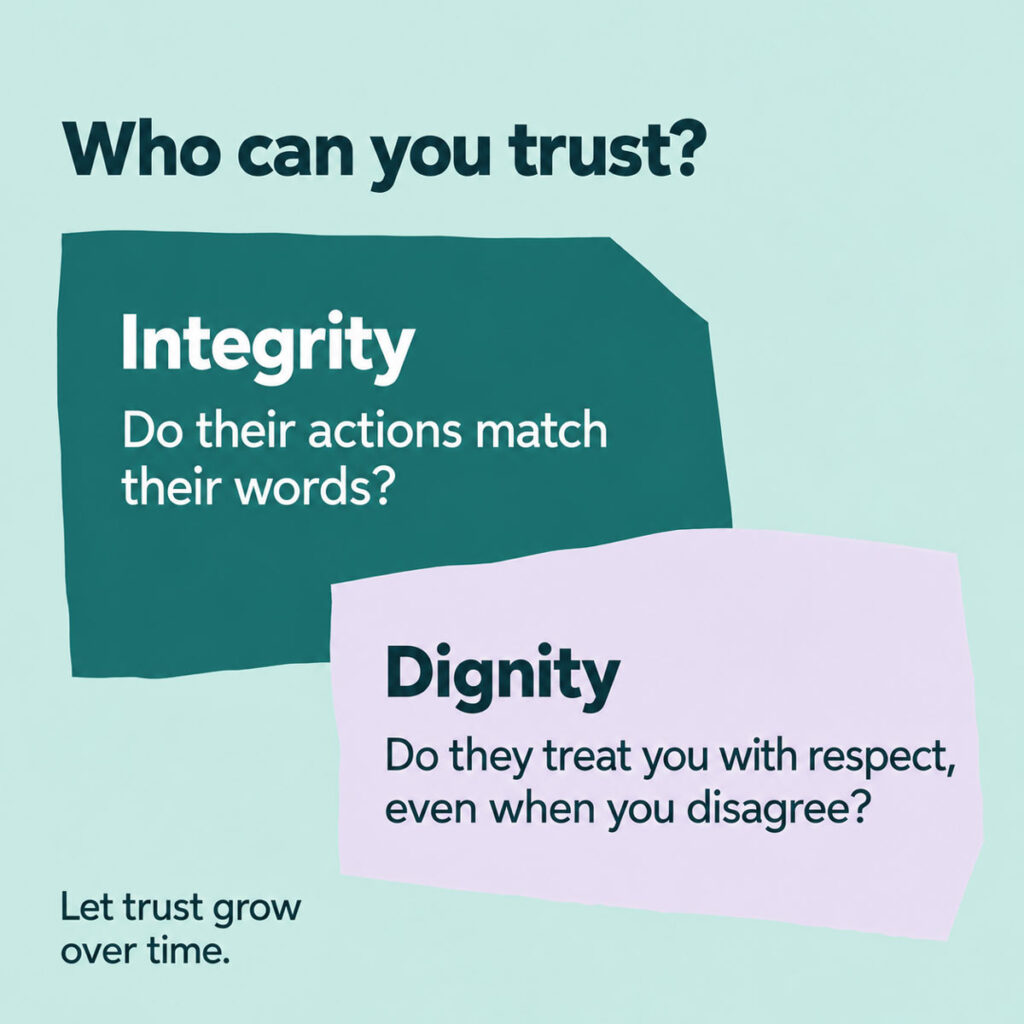
Let Trust Grow Through Ordinary Interactions
These two questions aren’t a guarantee that someone will be safe, but they are one way of noticing behavior without needing to predict a person’s entire character.
See how they respond to you expressing an ordinary preference: “Could we meet somewhere quieter?” Or a small clarification: “When you say ‘later,’ do you mean tonight?”
Then notice whether they are responsive to your needs.
Wrap Up
I’m more willing to trust someone when I’ve seen that their word means something and that a disagreement won’t cost me basic respect.
Integrity and dignity give me a practical starting point. They help me look beyond whether an interaction went perfectly and consider whether this is someone I could work through a difficult moment with.
What helps you trust someone enough to be yourself?
Essy Knopf is a therapist who likes to explore what it means to be neurodivergent and queer. Subscribe to get all new posts sent directly to your inbox.
© 2026 Ehsan "Essy" Knopf. Any views or opinions represented in this blog are personal and belong solely to the blog owner and do not represent those of people, institutions or organizations that the owner may or may not be associated with in professional or personal capacity, unless explicitly stated. All content found on the EssyKnopf.com website and affiliated social media accounts were created for informational purposes only and should not be treated as a substitute for the advice of qualified medical or mental health professionals. Always follow the advice of your designated provider.