

Neurodivergent humor: Why was it funny on TV but awkward in person?


You repeat a line that got a huge laugh on television, only for people to look suddenly conversation, and for the conversation to move on without you. Apparently, the joke works when that character says it, but sounds rude coming from you.
What changed?
I ran into this growing up exposed to sitcoms like Seinfeld. The characters said things I already thought about everyday life: how strange people could be, how awkward social expectations were. Sometimes I didn’t understand why it was funny. To me, they were pointing out the obvious.
But people clearly enjoyed it. I took that as permission to be equally direct, and sometimes borrowed jokes for my own conversations. The response was often nothing like the one on television.
Television leaves out part of the lesson
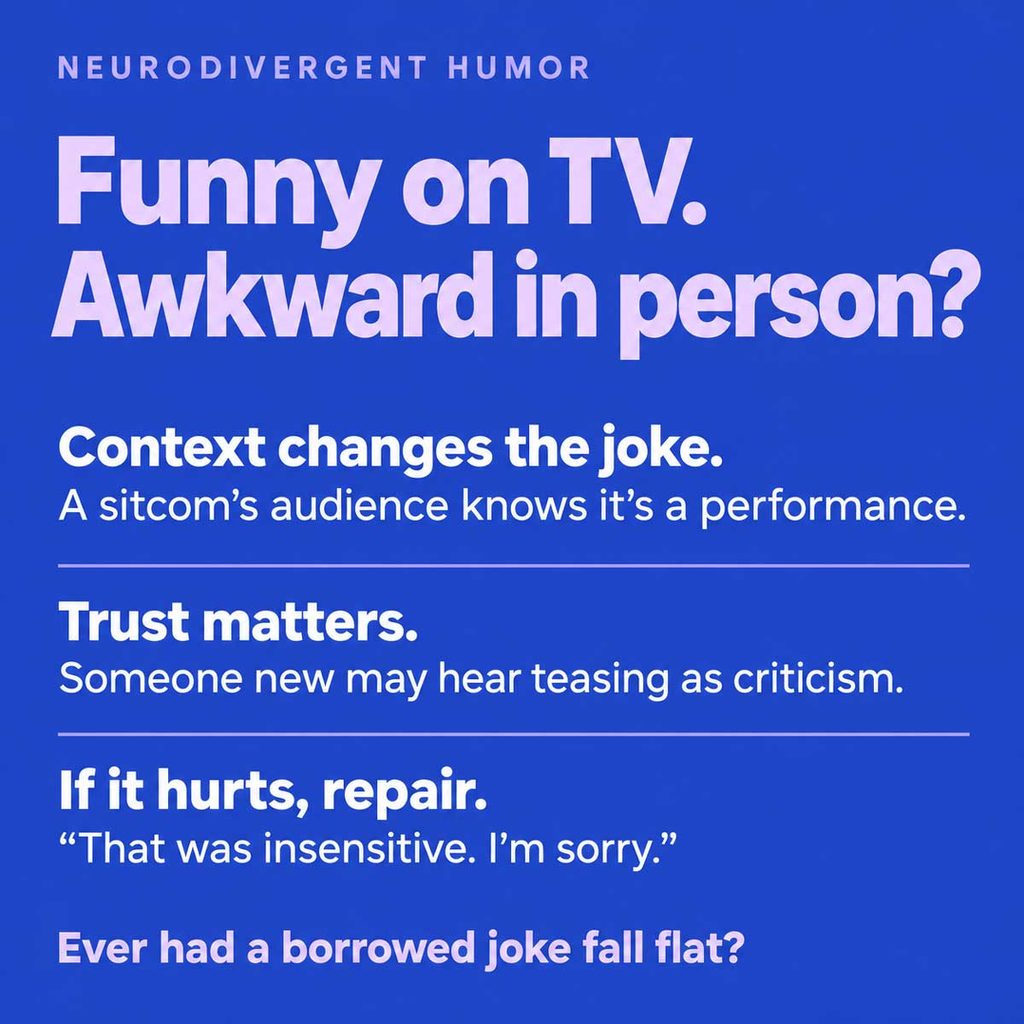
A sitcom gives us information that an ordinary conversation doesn’t. We know the characters and expect them to entertain us. We may be laughing at someone’s poor judgment rather than agreeing with what they said.
Watching as a young person, I didn’t always make that distinction. I heard the laugh and understood the line as socially approved.
In person, the listener has to work out what you mean without that context. They may hear a criticism where you intended a playful observation. If they don’t know you well, they have little reason to assume you’re being ironic.
Delivery matters too. A line said with exaggerated disbelief can sound different in a flat voice. That doesn’t make a flat delivery wrong; deadpan humor can be wonderful. It does mean the words alone won’t necessarily communicate that you’re joking.
This isn’t unique to neurodivergent humor, but it can be a frustrating discovery if you’ve been borrowing dialogue to help you navigate conversations.
Sometimes the problem really is the joke
There’s another part of this that’s harder to talk about. Sometimes a joke lands badly because it was insensitive.
In my twenties, before my autism diagnosis, a colleague told me about a puppy that had died in a preventable accident. I responded with a joke about natural selection.
I regret saying it. An animal had suffered, and I treated the story as an opportunity to make a clever remark.
I love dogs. That’s part of why the memory still bothers me: what I said communicated something so far from what I felt. But the people listening only had my words to go on. They couldn’t see the care for animals that I assumed was obvious.
I can understand my nervousness and limited awareness at the time while acknowledging that the comment was cruel. My diagnosis gives me context for some of my communication difficulties. It doesn’t make that joke harmless.
What “read the room” actually asks us to do
“Read the room” is frustrating advice when you need someone to explain what you’re supposed to notice.
A more useful starting point is to consider what the person has just shared. Are they joking about an everyday inconvenience, or telling you about something painful? If they’re describing a loss, responding to that loss gives you a clearer starting point than searching for a punchline.
It also helps to ask who the joke is aimed at. Making fun of a confusing parking sign is different from making fun of someone who is already embarrassed. A joke that works with a close friend may need more trust than you’ve established with a colleague.
For me, spontaneity is part of the pleasure of humor. Pausing can feel cumbersome, especially when the line arrives fully formed and I want to say it immediately. I’ve had to learn that having a funny association doesn’t oblige me to share it.
Which is not to say that it requires require reviewing every sentence before speaking. I’m more careful around fresh grief and subjects where I don’t know the other person’s experience. Those are useful places to slow down.
Repairing a joke without making excuses
If I realize I’ve said something hurtful, I try to name it plainly: “That was insensitive. I’m sorry. I shouldn’t have joked about that.”
Explaining that I meant to be funny adds little. The problem is already that I tried to be funny at the wrong moment.
Sometimes I only understand the impact later. I can still acknowledge it when appropriate, without asking the person to reassure me that I’m good or forgive me immediately.
These memories can become shame hangovers: incidents I revisit long after I’ve understood what went wrong. When that happens, I try to return to the specific lesson. I know why that comment was hurtful, and I’ve changed how I respond to similar situations. Repeatedly insulting myself won’t improve the repair.
Wrap Up
I still like my dry sense of humor. I enjoy noticing the absurdity of things, and I value people who share that enjoyment.
What I understand better now is that a joke happens between people. Whether it works depends partly on what they know about me and what’s happening for them. Learning to consider that has helped me keep the humor while becoming more thoughtful about where I use it.
Have you ever borrowed a joke from television and discovered it sounded very different in real life?
Essy Knopf is a therapist who likes to explore what it means to be neurodivergent and queer. Subscribe to get all new posts sent directly to your inbox.
© 2026 Ehsan "Essy" Knopf. Any views or opinions represented in this blog are personal and belong solely to the blog owner and do not represent those of people, institutions or organizations that the owner may or may not be associated with in professional or personal capacity, unless explicitly stated. All content found on the EssyKnopf.com website and affiliated social media accounts were created for informational purposes only and should not be treated as a substitute for the advice of qualified medical or mental health professionals. Always follow the advice of your designated provider.