

Why driving can be so exhausting when you’re neurodivergent


You’re looking forward to seeing your friends, but getting there is another matter. You’ll need to navigate unfamiliar streets and find parking.
As an auDHDer with anxiety, I find driving difficult for a variety of reasons. I worry about making mistakes, but that worry doesn’t prevent me from missing a sign because of distractibility. I get bored on long drives, yet extra stimulation can compete with the attention the road needs.
Meanwhile, my reluctance to leave early can add time pressure to something I already find stressful.
Worrying about mistakes doesn’t prevent inattention
I’m aware that a driving mistake could hurt someone. Even a minor collision can mean repairs and higher insurance premiums. Knowing the stakes, though, doesn’t give me reliable control over my attention.
Once, after leaving an event, I became confused by the surrounding one-way streets. My navigation kept telling me to turn around. I thought the app was recalculating incorrectly and missed the signs that would have told me otherwise.
I ended up driving the wrong way down a one-way street.
Someone gestured for me to go back, and police arrived shortly afterward. They let me off with a warning. I was relieved, but afterward I kept thinking about what could have happened if traffic had been coming toward me.
That experience captures something frustrating about neurodivergence and driving: I can care deeply about being careful and still miss important information. Being more frightened of making a mistake doesn’t necessarily help me notice the next sign.
Driving can be boring and demanding at the same time
On a long, repetitive stretch of road, I get restless. At traffic lights, I sometimes catch myself fidgeting or pulling at hairs without having noticed I’d started. An audiobook makes the journey more bearable.
Boredom can also enter the picture well before I’ve even left home.
I used to run late. These days, I’m more likely to allow exactly enough time to get somewhere, provided traffic cooperates and parking is easy.
I know leaving earlier would help. Then I imagine arriving fifteen minutes early and think, What am I supposed to do with that time? At home, there’s always one more thing I could finish.
So I use up the buffer before I leave. A red light or missed turn can become more stressful because I have no spare time.
For me, allowing extra travel time also means making early arrival tolerable. Bringing something to read once I’m parked gives me a reason to leave without squeezing in one last task.
Difficulty judging distances adds another worry
Attention isn’t the only challenge I’ve noticed. I also struggle to judge distances when reversing. I’ve scraped a wheel against a curb and made contact with another car while parking.
I don’t know exactly what accounts for that difficulty, and I wouldn’t assume it’s automatically explained by being neurodivergent. But it affects how I feel when I approach a parking space.
Past incidents add to the anxiety. Years ago, I rear-ended a car at low speed. An insurance claim followed, and my premiums increased while I was working part-time and money was tight.
After that, the possible consequences of a mistake felt very concrete. I was living in Los Angeles and depended on driving, so avoiding it wasn’t a straightforward option.
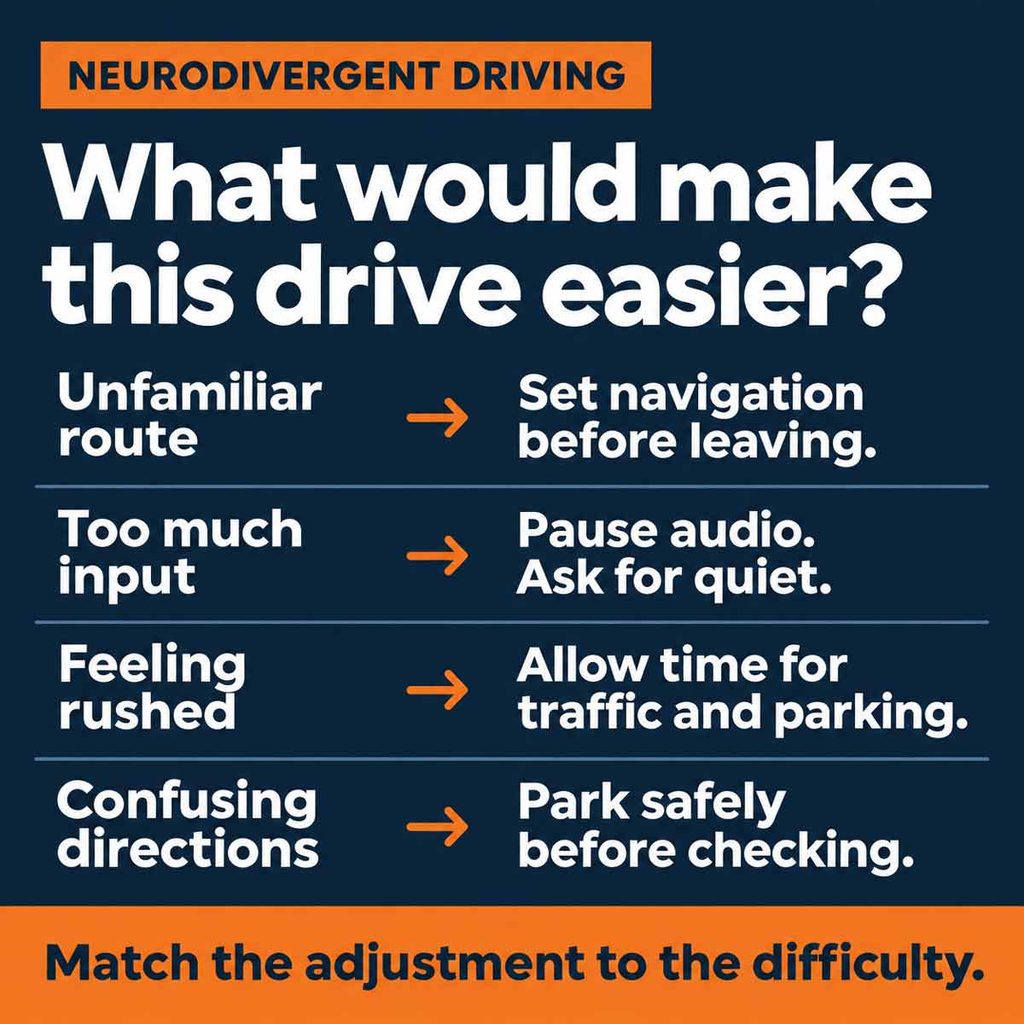
Match the support to the difficulty
If you are neurodivergent and struggle with driving anxiety as well, it helps to ask what is making a particular journey difficult:
- Unfamiliar directions: Review the route and set navigation before leaving. If you become confused, find a safe place to park before checking or adjusting it.
- Too much competing for your attention: Pause audio and ask passengers to hold the conversation while you negotiate a difficult stretch.
- Pressure to arrive on time: Include a time buffer that includes time for traffic and parking, and plan something you can comfortably do if you arrive early.
- Repeated problems judging distances: Have the difficulty assessed rather than relying on guesswork about its cause. Additional driving instruction or practice may also help identify what needs support.
Different difficulties need different responses. Leaving earlier can reduce the pressure to rush, but it won’t resolve trouble judging distances. If a problem keeps happening despite the adjustments you’ve made, that’s worth seeking further help with.
Wrap Up
What frustrates me about driving is that solving one problem can create another. An audiobook relieves boredom but can become distracting at a complicated intersection. Leaving early reduces time pressure, but means tolerating the wait when I arrive.
Those conflicts help explain why driving takes so much out of me as an auDHDer. I need to plan for the parts I find difficult and be willing to change what I’m doing as the demands of the journey change.
Do you find driving stressful, boring, or somehow both? What has made a difference for you?
Essy Knopf is a therapist who likes to explore what it means to be neurodivergent and queer. Subscribe to get all new posts sent directly to your inbox.
© 2026 Ehsan "Essy" Knopf. Any views or opinions represented in this blog are personal and belong solely to the blog owner and do not represent those of people, institutions or organizations that the owner may or may not be associated with in professional or personal capacity, unless explicitly stated. All content found on the EssyKnopf.com website and affiliated social media accounts were created for informational purposes only and should not be treated as a substitute for the advice of qualified medical or mental health professionals. Always follow the advice of your designated provider.