

Recognizing harm when you’re neurodivergent and used to doubting yourself


You tell a friend about something hurtful someone said, only for them to surprise you by explaining that the person is stressed or probably didn’t mean it.
In fact, you already considered that. You’ve spent hours considering it. What you wanted was some acknowledgment of what happened to you.
If you’re autistic or ADHD and accustomed to having your interpretation questioned, this can feel familiar. You leave wondering whether you’ve misunderstood again, even though the same thing keeps happening.
I’ve struggled with this myself. Learning about harmful relationship patterns has helped me make sense of experiences I previously couldn’t explain. It has also raised a question: how much do we need to understand about someone before we’re allowed to protect ourselves?
When giving the benefit of the doubt becomes a habit
If you know what it’s like to be misunderstood, you may be reluctant to judge someone else. You remember the times your words came out badly and wish someone had asked what you meant.
That generosity can make it difficult to revise your view of someone who initially seemed caring.
They tell you they respect you, then ridicule a need you’ve shared. You explain why it hurt. They say you’re too sensitive, and you start wondering how you could have explained it better.
You may wind up finding that you’re doing most of the work of keeping the relationship comfortable.
For me, neurodivergent self-trust includes allowing later experiences to change an earlier impression. Someone’s initial kindness is part of the picture. So is how they treat you when you disagree.
Why a label can feel like an answer
After enough confusing interactions, you may start researching. An article about narcissism describes something so familiar that you reread the paragraph.
There can be relief in that recognition: an experience that felt private and inexplicable suddenly has language around it.
I understand the appeal of learning everything you can. Research gives you something to work with when “trust your gut” feels unhelpful, especially if you’ve spent years being told your gut is wrong.
The difficulty comes when identifying a pattern turns into trying to establish a diagnosis. You may spend hours checking criteria while the practical question remains unanswered. Namely, what do you need to do about how this person treats you?
A personality disorder diagnosis does not establish that someone is abusive, and harmful behavior does not establish a personality disorder.
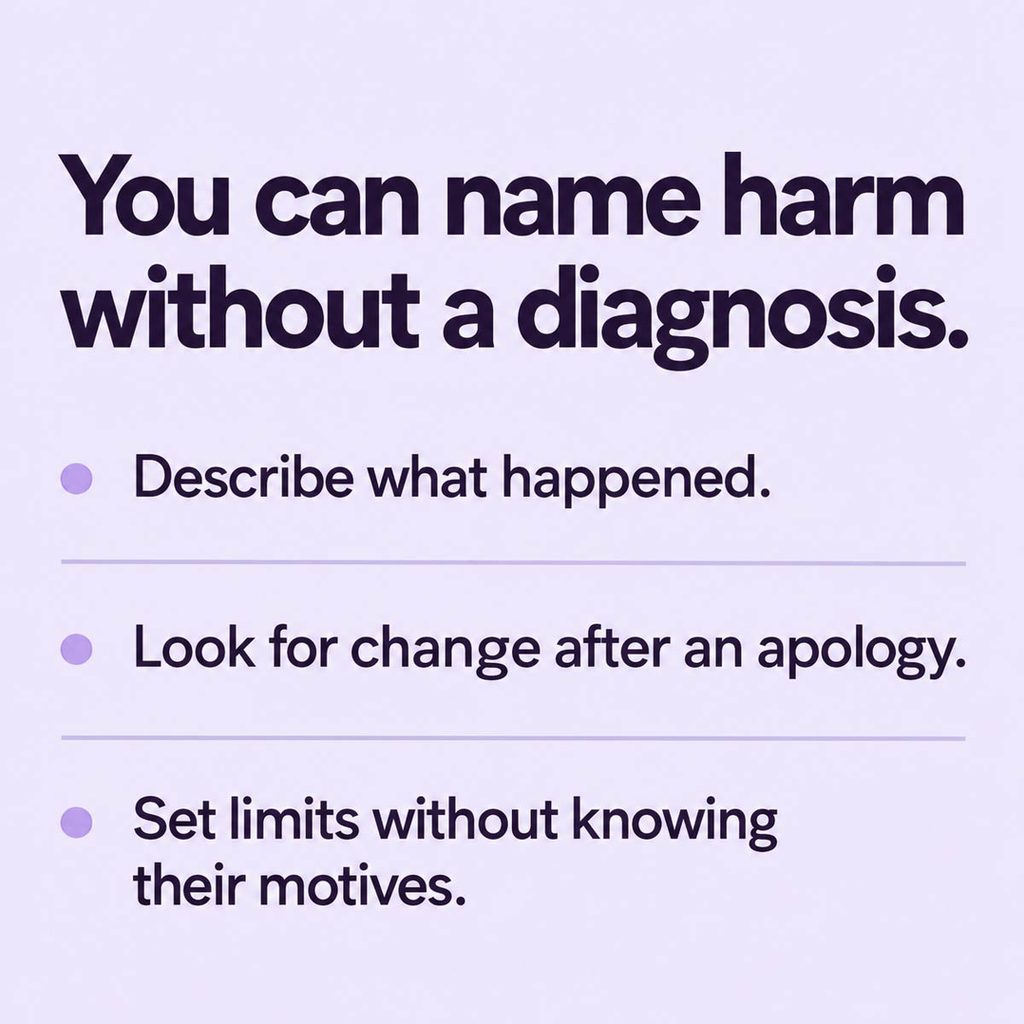
You can take the harm seriously without resolving the diagnosis.
Describe what keeps happening
Specific language can help you understand an experience and explain it to someone else.
“They’re toxic” leaves a lot open to interpretation. “They keep making jokes about my disability after I’ve asked them to stop” tells someone what the problem is.
You might notice that:
- Disagreements repeatedly become attacks on your character.
- A limit you’ve stated is treated as the beginning of a negotiation.
- Apologies are followed by the same behavior, without meaningful change.
These observations give you something concrete to consider. You don’t have to know whether someone intended to hurt you to recognize that the behavior is continuing.
There’s also a difference between an awkward interaction and an ongoing pattern. A person can respond badly, reflect, and make a repair. What matters is whether that repair changes your experience of the relationship. A serious incident can warrant action on its own; you don’t have to wait for it to happen again.
Understanding someone doesn’t settle what you should accept
Someone may be struggling. Their history may help explain their reactions. You can care about that and still need the behavior to stop.
When other people rush to explain their conduct, it can help to bring the conversation back to what you’re asking for: “I understand they’re having a hard time. I need you to hear that this keeps happening and is affecting me.”
The same applies to your own internal debate. You may never reach certainty about their motives. You can still decide to share less personal information, limit contact, or seek support in working out what feels manageable.
If raising a concern has led to intimidation or retaliation, you don’t owe the person another confrontation to prove you tried hard enough. Consider support from someone you trust or an abuse-informed professional before deciding your next step.
Wrap Up
Learning about harmful relationship patterns can give you language you badly needed. The useful part is what that knowledge helps you recognize and do.
Neurodivergent self-trust leaves room to reconsider your interpretation without automatically discarding it. Your account deserves attention, even when you don’t have a complete explanation for the other person’s behavior.
What helped you take a harmful pattern seriously when you were doubting yourself?
Essy Knopf is a therapist who likes to explore what it means to be neurodivergent and queer. Subscribe to get all new posts sent directly to your inbox.
© 2026 Ehsan "Essy" Knopf. Any views or opinions represented in this blog are personal and belong solely to the blog owner and do not represent those of people, institutions or organizations that the owner may or may not be associated with in professional or personal capacity, unless explicitly stated. All content found on the EssyKnopf.com website and affiliated social media accounts were created for informational purposes only and should not be treated as a substitute for the advice of qualified medical or mental health professionals. Always follow the advice of your designated provider.