

Shame hangovers: When a social moment stays with you for years


You’re halfway through an ordinary day when you remember something you said ten years ago. Your stomach drops. You cringe, despite knowing that everyone involved may have long since forgotten it.
Or perhaps the conversation happened yesterday. Someone’s expression changed after you spoke, and you’ve been trying to work out why ever since.
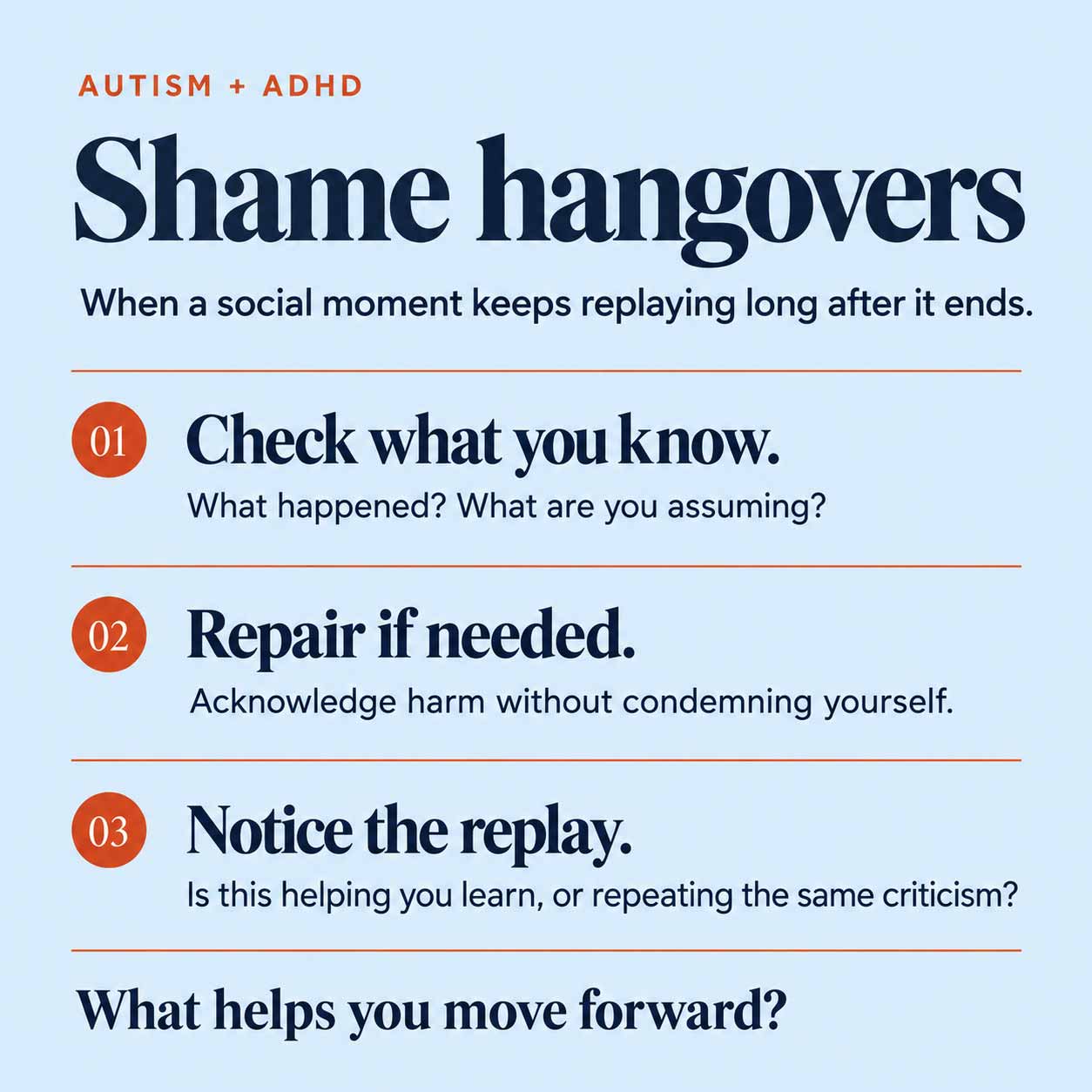
I’ve started calling this a shame “hangover:” the shame that lingers after a social interaction has ended. It’s a description of an experience, rather than a clinical term. For some autistic and ADHD adults, the replay can become more painful than the original exchange.
When uncertainty becomes self-blame
Sometimes we know what went wrong. We might have interrupted someone or made a comment we later recognized as hurtful.
Other times, we have very little information. Someone looked away, and we interpreted it as disapproval. A pause felt like rejection. Those reactions might mean something, but they don’t tell us exactly what the other person was thinking.
If you’ve often been misunderstood, it can be difficult to leave that uncertainty alone. You end up searching the conversation for an explanation and land on yourself: I made it awkward. I always do this.
An uncomfortable exchange becomes evidence about who you are. Once that happens, reviewing the details may turn into another opportunity to criticize yourself.
A rejection I carried for years
When I was around nineteen or twenty, I met a woman at a social event and thought we were getting along well. At the end of our conversation, I asked whether we could exchange numbers.
She said no.
I laughed awkwardly and walked away, feeling my stomach drop. I’m gay, and I’d been thinking about friendship. It hadn’t occurred to me that she might interpret the request as romantic interest. I assumed my intentions were obvious because they were obvious to me.
Looking back, that’s one possible explanation. I don’t actually know why she declined, and she didn’t owe me her number or an explanation.
What stayed with me was the feeling that I’d done something wrong without understanding what it was. I became tearful afterward. The person I was dating told me to move on, and someone else I confided in called me an “idiot.”
I needed help making sense of the interaction. Instead, those responses gave me more to feel ashamed of.
Months later, the woman greeted me at another event. I remember feeling so uncomfortable that I didn’t want to risk trying again. By then, that brief exchange had become something much bigger in my mind.
An awkward moment and a harmful action need different responses
Asking once to exchange numbers and accepting a “no” isn’t inherently wrongdoing. But I’ve also said things that were hurtful, including comments I now recognize as prejudiced.
Those situations require more than reassuring myself that I meant well.
Being neurodivergent can provide context for an interaction. It doesn’t establish why every mistake happened, and it doesn’t make someone else’s hurt disappear. I can acknowledge what I said, consider whether an apology would help, and change how I behave.
The difficulty comes when taking responsibility turns into repeatedly declaring myself a terrible person. At that point, I may be spending more time judging myself than understanding what needs to change.
Self-compassion allows me to be specific: That comment was hurtful. I understand why now, and I can respond differently. I don’t need to minimize it or keep punishing myself to prove I care.
What to do when the memory returns
Start by asking what you know. Did someone tell you they were hurt, or are you trying to interpret an expression? Both can feel upsetting, but they leave you with different information.
If there’s a clear action to take, make it proportionate. An apology might name what you said and acknowledge its impact without asking the other person to reassure you. For an incident from years ago, consider whether renewed contact would benefit them or mainly relieve your own discomfort.
If you’ve already addressed it, ask whether another replay is giving you anything new. You might remind yourself: “I’ve thought about this. I know what I’d do differently.” Then return to what you were doing, even if some discomfort remains.
It can also help to talk with someone who can offer perspective without insulting you or automatically insisting you did nothing wrong. You deserve room to understand a mistake without having your whole character reduced to it.
Wrap Up
Shame hangovers can make withdrawing feel safer than risking another difficult interaction. I understand that impulse. After enough painful experiences, even an invitation to connect can bring up memories of what happened before.
What has helped me is learning to look more fairly at those memories. Sometimes I needed to take responsibility. Sometimes I was confused or rejected, and treated that as proof I was defective. Recognizing the difference has made it easier to forgive myself.
Do old social moments return when you least expect them?
Essy Knopf is a therapist who likes to explore what it means to be neurodivergent and queer. Subscribe to get all new posts sent directly to your inbox.
© 2026 Ehsan "Essy" Knopf. Any views or opinions represented in this blog are personal and belong solely to the blog owner and do not represent those of people, institutions or organizations that the owner may or may not be associated with in professional or personal capacity, unless explicitly stated. All content found on the EssyKnopf.com website and affiliated social media accounts were created for informational purposes only and should not be treated as a substitute for the advice of qualified medical or mental health professionals. Always follow the advice of your designated provider.