Neurodivergent isolation: When being alone isn’t a choice

Essy Knopf neurodivergent isolation
Reading time: 4 minutes

For many autistic and ADHD people, loneliness develops slowly.

It can begin with being corrected for speaking too honestly, mocked for stimming, excluded from a group, or criticized for missing an unwritten social rule. When these experiences happen repeatedly, they can change the way we approach other people.

We learn to expect rejection before it arrives.

We might hesitate before sending a message, or decline invitations because we assume we will feel awkward or overwhelmed. We stop sharing the parts of ourselves that have been misunderstood.

We may tell ourselves, “I just prefer being alone.” And perhaps we do.

Many neurodivergent people genuinely enjoy solitude. Being alone can mean freedom from masking, social pressure, sensory overload, and the exhausting task of monitoring how other people are reacting to us.

But it is still worth asking: Is this solitude restoring me, or is it shrinking my world?

When Isolation Becomes Protection

Neurodivergent isolation is often both a lifestyle preference and an adaptation.

When connection has repeatedly led to embarrassment, correction, punishment, or rejection, the nervous system learns that distance is safer. Avoiding people becomes a way of preventing future pain.

But beneath the withdrawal, there may still be a wish for connection.

You may want someone to ask how your day was; who understands your communication style, respects your sensory needs, and does not require you to perform a more socially acceptable version of yourself.

Why Connection Can Feel So Risky

What might stop you from seeking such a connection is being told across your lifetime that your natural way of being is wrong.

Perhaps you were described as too sensitive, too intense, too quiet, too blunt, or too emotional. Maybe you were punished for behavior you did not realize was considered inappropriate. You may have been left out without explanation or told to “try harder” socially without receiving any useful guidance.

These experiences can create a heightened sensitivity to rejection.

You may interpret a friend replying briefly as proof that they are angry, or a delayed text as evidence that the relationship is ending.

In such cases, your nervous system is trying to protect you by spotting danger early.

The difficulty is that it may begin to react to all neutral situations as though rejection has already happened.

This can make relationships feel like constant work. Instead of simply being present, you may find yourself analyzing tone, facial expressions, pauses, punctuation, and every word you said afterward.

Even positive interactions can become exhausting.

The Hidden Appeal of Solitude

When you are alone, there is much less to decode.

You can stim without wondering whether someone finds it strange, or spend time with your interests without worrying that you are talking too much or neglecting others. You can choose your lighting, sound level, clothing, food, and routine.

Solitude can be deeply regulating.

For this reason, the goal should never be to pressure neurodivergent people into becoming more social. More social contact is not automatically better, especially when that contact requires masking or exposes someone to continued mistreatment.

The real question is whether one’s current level of solitude is chosen freely.

Healthy solitude usually leaves you feeling calmer, clearer, or more energized. Protective isolation can initially feel peaceful, but may also leave you feeling disconnected or resigned.

Many of us end up telling ourselves that we don’t need anyone, while secretly grieving the absence of meaningful relationships.

When Boundaries Hide Grief

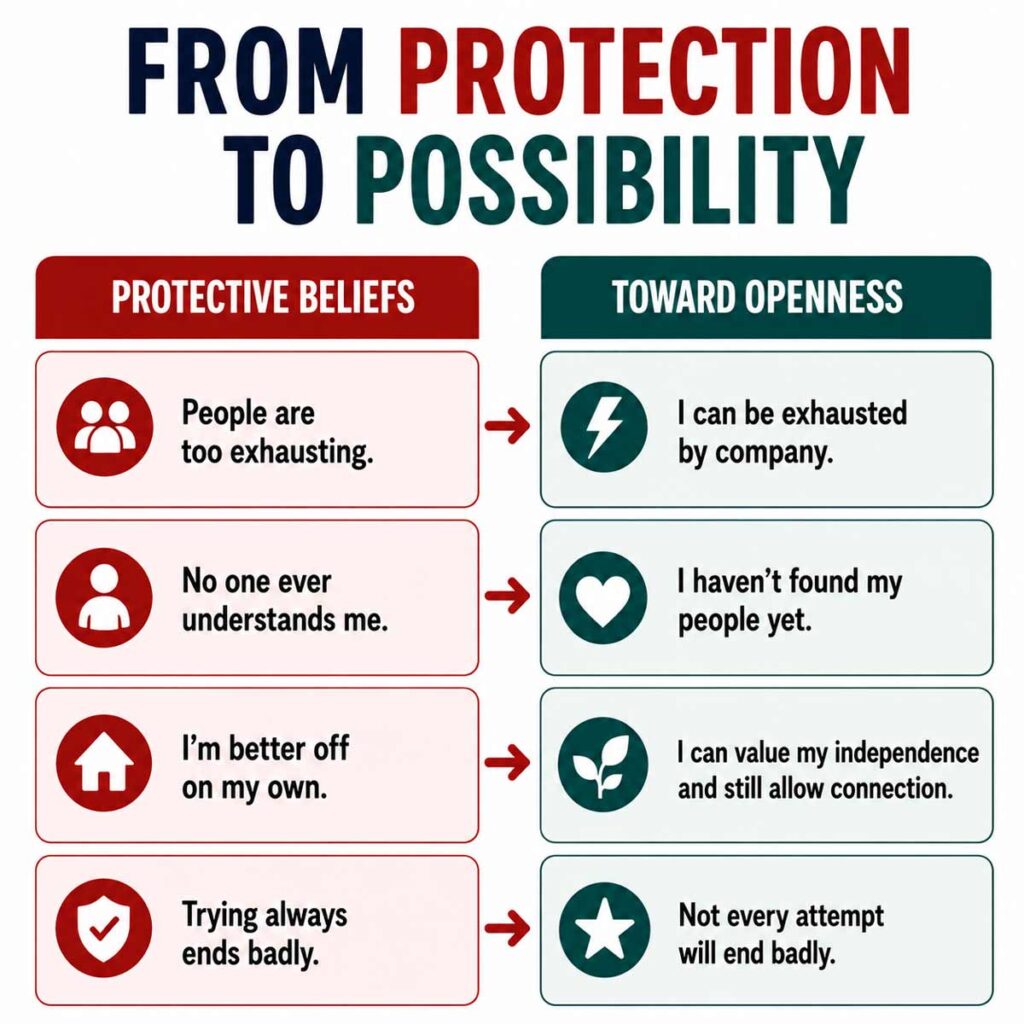
After enough painful social experiences, protective beliefs can sound like healthy boundaries: “People are too exhausting.” “No one ever understands me.” “I’m better off on my own.” “Trying always ends badly.”

Sometimes these statements are partly true. There may be people you are genuinely better off avoiding. Certain environments may be inaccessible or unsafe. Some relationships may demand far more than they give.

But it is also possible for a boundary to become so broad that it blocks every opportunity for connection.

The belief that all closeness is dangerous may protect you from rejection, but it also protects you from being known.

This is how isolation can become self-reinforcing. The less you interact with others, the fewer chances you have to experience safe connection. Without those corrective experiences, the belief that relationships always end badly remains unchallenged.

Returning to Connection Gently

Healing from neurodivergent isolation does not mean forcing yourself into crowded events, maintaining dozens of friendships, or pushing through social exhaustion.

It can begin much more gently. For example, replying to one message you have been avoiding, or sharing an honest thought with someone who has previously treated you with kindness.

Another option includes spending time in a neurodivergent-friendly group where direct communication and sensory needs are respected.

It can also help to identify what makes connection feel safer.

Perhaps you prefer communicating by text rather than phone, or meeting one person at a time. You may need plans to be made in advance, a clear end time, or permission to leave when you become overwhelmed.

These needs do not make you demanding, but help create the conditions in which genuine connection becomes possible, while leaving enough room for your full neurodivergent self.

Essy Knopf neurodivergent isolation

Learning to Trust Slowly

In opening ourselves to the right people, we must also remember that safe people are not perfect. Miscommunications are inevitable in every relationship, especially across different neurotypes.

What makes someone safe isn’t that they never misunderstand us, but that they’re willing to approach those misunderstandings with curiosity and compassion, as well as a desire to repair.

In such instances, ask yourself: Can the other person listen? Can they clarify rather than accuse? Can both of you acknowledge your part without turning the interaction into a verdict on your worth?

These experiences can gradually teach the nervous system that connection is not always dangerous.

Wrap Up

Neurodivergent isolation makes sense when you have spent years feeling misunderstood, corrected, or rejected.

Withdrawal may have helped you survive environments in which being your authentic self did not feel safe. There is no shame in having developed strategies that protected you.

But those strategies do not always have to remain permanent. You can honor your need for solitude while still remaining open to connection.

Have you ever realized that your preference for being alone was partly a form of protection? What helps connection feel safer for you?

Navigating social niceties as a neurodivergent

Essy Knopf neurodivergent social cues
Reading time: 2 minutes

When I lived in LA, I frequently encountered something I called “California nice.”

Strangers would chat with me at ice cream shops, supermarkets, beaches—almost anywhere. They were often warm, open, casual, and easygoing. They talked as though we already knew each other.

And honestly? It was lovely.

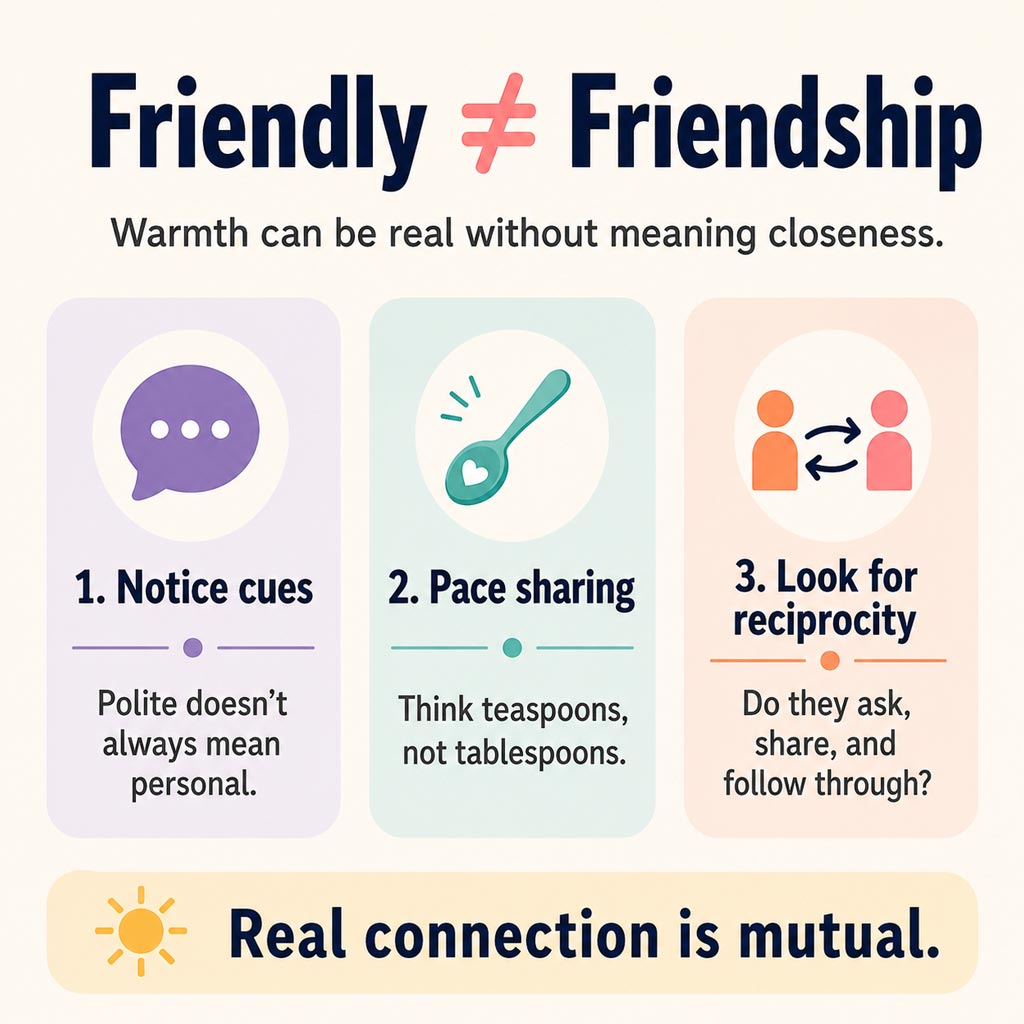
But as a neurodivergent, I learned quickly that friendliness didn’t always mean openness to friendship.

Someone might say, “We should totally hang out sometime,” and I would think, Ah. So we are absolutely not going to hang out.

Maybe they meant it, and maybe they didn’t. But I had no reliable way of knowing, so I treated it as social decoration: pleasant, but not necessarily meaningful.

The Confusion of Social Grooming

Many neurodivergents encounter some version of “California nice,” whether or not they live anywhere near California.

People smile, ask questions, say kind things, and perform warmth.

Often, it’s hard to know whether these social cues reflect genuine interest or simply ritualistic responses. Sometimes it’s just the social currency of the moment.

For autistic and ADHD people, this can be incredibly confusing. We may wonder: Is this person actually interested in me? Are they inviting closeness, or just being polite? Can I be myself here, or will that be “too much”?

The stakes can feel high because opening up to the wrong person can be painful.

Maybe we share too much too soon, start talking passionately about a special interest, or be direct, intense, blunt, darkly funny, or emotionally honest before the other person is ready.

And suddenly, what felt like connection becomes distance.

Try the Relay Race Approach

One helpful strategy is to treat conversation like a relay race.

In a relay race, you don’t hold onto the baton forever. You run your stretch, then pass it on.

Conversation can work the same way.

You share a little. They share a little. You ask something. They respond.

You offer one small piece of yourself. Then you pause and see what they do with it.

Think teaspoons, not tablespoons.

Instead of pouring out your whole inner world at once, you offer small amounts and watch for reciprocity. Do they ask follow-up questions? Do they share something personal too? Do they seem curious, comfortable, and engaged?

The key here is to pace revealing who you are so you can gather information and protect your nervous system.

Essy Knopf neurodivergent social cues

Pacing Can Create Safety

For many neurodivergents, social success is about finding ways to connect that don’t require abandoning ourselves.

Pacing gives us room to notice whether someone is capable of meeting us with curiosity, respect, and care. It helps us avoid the painful experience of offering vulnerability to people who only meant to exchange politeness.

And when someone does respond warmly—when they pick up the baton and pass it back—that’s useful information.

That may be someone worth getting to know.

Wrap Up

Navigating neurotypical social niceties can feel like trying to decode a language where half the words are implied and the rules keep changing.

But with social pacing, we can move more gently, protect ourselves from unnecessary hurt, and still leave space for real connection.

Have you ever struggled to tell the difference between friendliness and genuine friendship?

Neurodivergent social fatigue: The pain of wanting connection and needing solitude

Essy Knopf neurodivergent loneliness
Reading time: 4 minutes

There’s something gutting about seeing friends gather without you, even when you know you would’ve struggled to be there.

Maybe you were already drained. Maybe the setting would’ve been too loud, too bright, too unpredictable. Maybe you knew it would take days to recover. And still, when no one asks if you want to come, it stings.

That sting isn’t about the party itself. It’s about not being seen. Not being remembered.

Sometimes, when an invitation does arrive, a different kind of discomfort shows up. You feel dread creeping in. You start bargaining with yourself: could you go for just an hour? Could you make it work somehow?

The guilt of wanting to decline battles the fear of missing out. You want to be part of things. You want to say yes. But you also know what it’s going to cost.

This kind of tension wears you down. Invitations start to feel more like pressure than possibility. You wonder if saying no too often means people will eventually stop asking.

And when they do, you tell yourself you saw it coming. But it still hurts.

This is a core feature of neurodivergent social fatigue: the emotional conflict between desire for connection and the protective pull of solitude.

When Socializing Costs More Than It Gives

For many autistic and ADHD folks, socializing isn’t just showing up and having fun. It’s navigating complex terrain: planning, scripting, adjusting, and recovering. It’s effortful. Sometimes deeply draining.

Days in advance, the mental logistics begin. What’s the lighting like? Who’ll be there? What will I say? Will I have to explain why I’m not eating what everyone else is?

Once you arrive, sensory input starts to pile up. Bright lights, background chatter, music layered over conversation. You feel your nervous system go into high alert.

You smile. You laugh. You nod at the right moments. But internally, you’re juggling a dozen tasks at once. This is the side of neurodivergent social fatigue that others often don’t see.

And then comes the crash. The mask comes off. You lie still. You cancel plans. You fall into a loop of analyzing every word you said.

This is the hidden cost of connection. One that builds over time. And one that leaves you feeling like the “you” people see isn’t the whole you at all.

Feeling Left Out of Things We Didn’t Want to Attend

You see the photos: dinners, parties, spontaneous hangouts. Everyone smiling, shoulder to shoulder. And it hits—hard. This is what makes social comparison so dangerous.

You likely wouldn’t have gone. But no one asked. And that absence feels loud.

You try to reason with yourself. You remember all the events you turned down. All the times you needed space more than company. And yet, your heart still aches with loneliness.

That ache is familiar to anyone who’s lived with neurodivergent social fatigue. The pain that you weren’t thought of. That you don’t belong in the same way others do.

The Middle Place of Half-Belonging

There’s a quiet, hard-to-name place where many autistic and ADHD people live; a space between isolation and inclusion. You’re not totally alone. But you’re not fully held, either.

You have friends. You care about people. Some care deeply about you. But you still feel slightly out of orbit, like you’re never quite central in anyone’s world.

You’re rarely the first person someone calls. You don’t get added to the spontaneous group chat. If you don’t initiate, things often just… don’t happen.

So you become the one who plans. Who checks in. Who coordinates based on your bandwidth. It gives you a measure of control, and also reminds you of how little comes your way unless you ask.

When you stop reaching out, the quiet that follows feels unmistakable.

That quiet feeds into the sense that your social needs are inconvenient. That your boundaries are too high-maintenance. That others are happy to include you, but only if it’s easy.

This is a subtle, but deeply felt part of neurodivergent social fatigue: the slow accumulation of near-invisible reminders that your presence is optional. That people enjoy you, but don’t depend on you. That you’re liked, but not always remembered.

And somehow, almost-belonging can feel more painful than being entirely on your own.

Essy Knopf neurodivergent social fatigue

Making Peace with the Contradiction

Some days, connection feels worth chasing. Other days, the idea of texting back or being “on” for anyone feels impossible.

Your needs shift. Your energy changes. And your ability to tolerate discomfort doesn’t always line up with your desire for closeness.

There’s nothing wrong with you for needing space. There’s nothing wrong with you for wanting closeness, either. These aren’t failures. They’re just your reality.

For those living with neurodivergent social fatigue, one of the most healing practices can be this: letting both truths exist. “I’m sad I wasn’t there.” And also, “I needed to stay home.” Both are real. Both matter.

Sometimes peace comes through small, manageable bridges: quiet hangouts with one trusted person, short calls with a friend who doesn’t need small talk, messages exchanged at your own pace.

You begin to build a rhythm that honors your nervous system, without giving up on connection entirely.

And slowly, maybe, you stop chasing the idea of a perfectly fitting social life. You start noticing what feels good, even if it doesn’t look like everyone else’s version of “normal.”

Final Thoughts

Living with neurodivergent social fatigue means constantly balancing between craving connection and preserving your energy. That’s a heavy emotional lift—especially when the world moves faster, louder, and more casually than you do.

If you’ve felt like you’re always the one adapting, adjusting, bracing, you’re not alone.

You’re doing the best you can to meet your needs while still showing up. That deserves recognition. That deserves care.

Imagine how much gentler life would feel if people understood this. If “no” didn’t mean goodbye. If solitude wasn’t taken personally. If invitations came with room for nuance.

We’re not fully there yet, but by talking about this contradiction, by honoring our limits and longings side by side, we inch closer to the world we need.

So if you’re navigating neurodivergent social fatigue—if you’re walking that thin line between connection and protection—I see you. And your way of being in the world makes complete sense.

Have you wrestled with the challenge of neurodivergent social fatigue in your own life?

When your brain hits “buffering”: Understanding SES bandwidth saturation in autistics and ADHDers

Essy Knopf SES bandwidth saturation
Reading time: 2 minutes

You’re talking to someone and suddenly can’t track what they’re saying. Or you’re bouncing between tabs, reminders, and conversations, and everything just… collapses.

If you’re neurodivergent (ND), this may be something more specific than stress. It’s what I call SES bandwidth saturation—a full system overload across your sensory, executive, and social processing capacities.

Like a Wi-Fi network clogged by too many devices, your brain starts buffering. Sometimes, it crashes altogether.

What Is SES Bandwidth Saturation?

Every brain has a limit to how much it can process. But ND brains often fill up faster—especially when bombarded by:

  • Sensory input – loud sounds, bright lights, uncomfortable textures
  • Executive demands – planning, switching tasks, making decisions
  • Social effort – decoding tone, facial expressions, and social cues

Even one of these can be tiring. Stack them up, and that’s when SES bandwidth saturation hits. You’re not “too sensitive.” You’re maxed out.

Warning Signs of Overload

Saturation doesn’t look the same for everyone, but it often leads to:

  • Overload – irritability, anxiety, or focus struggles
  • Shutdown – going quiet, spacing out, or not being able to speak
  • Meltdown – emotional overflow, like crying, yelling, or panic
  • Burnout – long-term fatigue, numbness, or loss of motivation

This isn’t weakness—it’s your brain asking for relief.

Daily Life, Derailed

Let’s say you’re in a noisy café, trying to follow a conversation. You’re not just listening. You’re also filtering background noise, processing what’s being said, and keeping track of facial cues. That’s SES bandwidth saturation in action.

Or maybe you’re trying to finish a work task, but Slack pings, emails, and a surprise meeting derail your focus. Your executive bandwidth is spent before you even start.

The Hidden Cost: SES Debt

Even when you’re “holding it together,” you might be accumulating SES debt—a slow drain on your system that builds up over time.

Just like financial debt, if you don’t make regular deposits back into your energy reserves, eventually you hit zero.

Rebuilding Bandwidth: Strategies That Work

? Quick Restorative Practices

  • Micro-breaks between tasks
  • Noise-canceling tools for sensory downtime
  • Intentional pauses between social events

? Long-Term Recovery

  • Planned decompression – quiet weekends or tech-free evenings
  • Cognitive offloading – use to-do apps, alarms, sticky notes
  • Reclaim your rhythm – schedule breaks before you need them

Beyond Coping—Toward Recovery

Coping helps you survive the moment. Recovery helps you reset.

Scrolling endlessly or caffeinating through the day might seem helpful, but they won’t replenish your SES bandwidth. What will? Rituals of genuine rest. Boundaries that protect your capacity. And knowing it’s okay to say no.

Build a Bandwidth-Conscious Life

  • Ask for accommodations—even if it feels uncomfortable
  • Choose ND-friendly environments where possible
  • Make self-care non-negotiable—not a reward, but a requirement

Final Thoughts

You don’t have to “earn” rest. SES bandwidth saturation is real—and it deserves your attention. Recognizing the signs early is the first step toward sustainable self-care and avoiding burnout.

Does this sound familiar? How do you notice SES bandwidth saturation in your life—and what helps you recover?