

Neurodivergent isolation: When being alone isn’t a choice

For many autistic and ADHD people, loneliness develops slowly.
It can begin with being corrected for speaking too honestly, mocked for stimming, excluded from a group, or criticized for missing an unwritten social rule. When these experiences happen repeatedly, they can change the way we approach other people.
We learn to expect rejection before it arrives.
We might hesitate before sending a message, or decline invitations because we assume we will feel awkward or overwhelmed. We stop sharing the parts of ourselves that have been misunderstood.
We may tell ourselves, “I just prefer being alone.” And perhaps we do.
Many neurodivergent people genuinely enjoy solitude. Being alone can mean freedom from masking, social pressure, sensory overload, and the exhausting task of monitoring how other people are reacting to us.
But it is still worth asking: Is this solitude restoring me, or is it shrinking my world?
When Isolation Becomes Protection
Neurodivergent isolation is often both a lifestyle preference and an adaptation.
When connection has repeatedly led to embarrassment, correction, punishment, or rejection, the nervous system learns that distance is safer. Avoiding people becomes a way of preventing future pain.
But beneath the withdrawal, there may still be a wish for connection.
You may want someone to ask how your day was; who understands your communication style, respects your sensory needs, and does not require you to perform a more socially acceptable version of yourself.
Why Connection Can Feel So Risky
What might stop you from seeking such a connection is being told across your lifetime that your natural way of being is wrong.
Perhaps you were described as too sensitive, too intense, too quiet, too blunt, or too emotional. Maybe you were punished for behavior you did not realize was considered inappropriate. You may have been left out without explanation or told to “try harder” socially without receiving any useful guidance.
These experiences can create a heightened sensitivity to rejection.
You may interpret a friend replying briefly as proof that they are angry, or a delayed text as evidence that the relationship is ending.
In such cases, your nervous system is trying to protect you by spotting danger early.
The difficulty is that it may begin to react to all neutral situations as though rejection has already happened.
This can make relationships feel like constant work. Instead of simply being present, you may find yourself analyzing tone, facial expressions, pauses, punctuation, and every word you said afterward.
Even positive interactions can become exhausting.
The Hidden Appeal of Solitude
When you are alone, there is much less to decode.
You can stim without wondering whether someone finds it strange, or spend time with your interests without worrying that you are talking too much or neglecting others. You can choose your lighting, sound level, clothing, food, and routine.
Solitude can be deeply regulating.
For this reason, the goal should never be to pressure neurodivergent people into becoming more social. More social contact is not automatically better, especially when that contact requires masking or exposes someone to continued mistreatment.
The real question is whether one’s current level of solitude is chosen freely.
Healthy solitude usually leaves you feeling calmer, clearer, or more energized. Protective isolation can initially feel peaceful, but may also leave you feeling disconnected or resigned.
Many of us end up telling ourselves that we don’t need anyone, while secretly grieving the absence of meaningful relationships.
When Boundaries Hide Grief
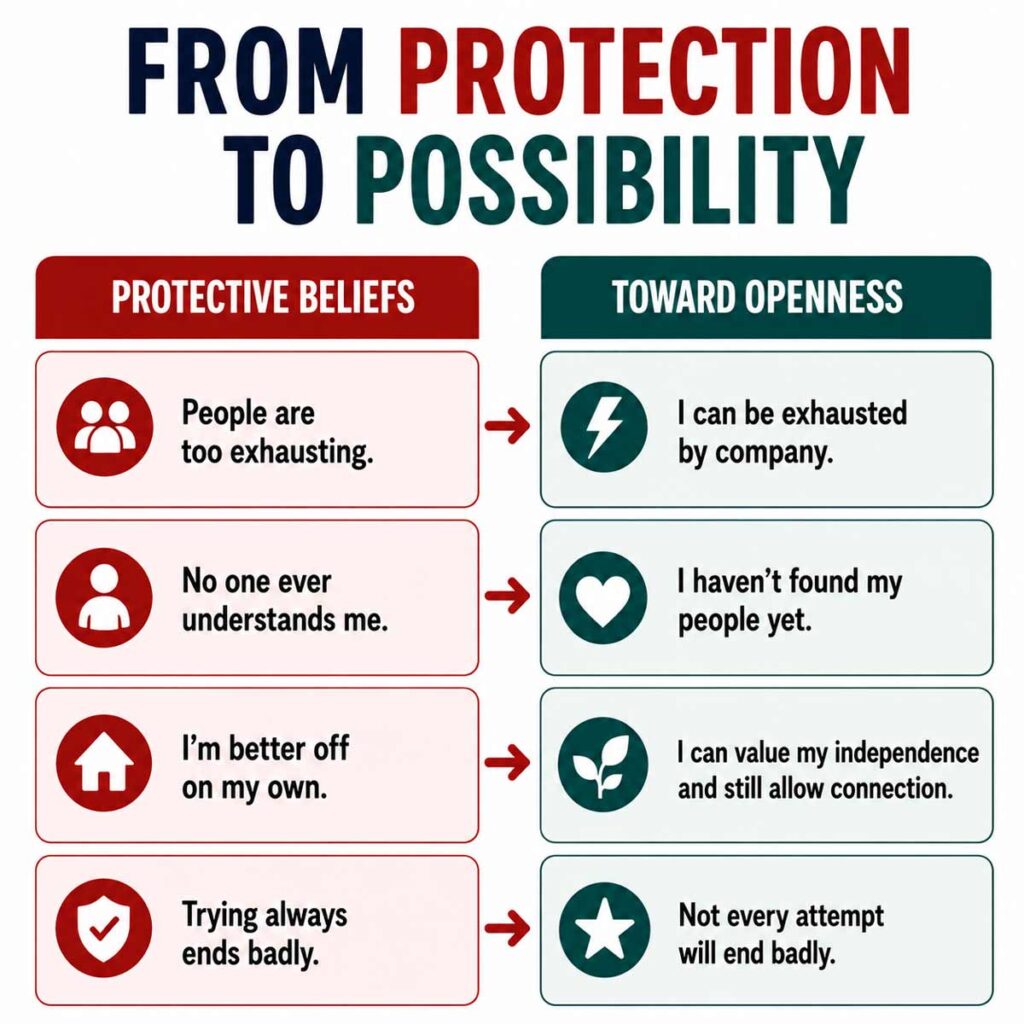
After enough painful social experiences, protective beliefs can sound like healthy boundaries: “People are too exhausting.” “No one ever understands me.” “I’m better off on my own.” “Trying always ends badly.”
Sometimes these statements are partly true. There may be people you are genuinely better off avoiding. Certain environments may be inaccessible or unsafe. Some relationships may demand far more than they give.
But it is also possible for a boundary to become so broad that it blocks every opportunity for connection.
The belief that all closeness is dangerous may protect you from rejection, but it also protects you from being known.
This is how isolation can become self-reinforcing. The less you interact with others, the fewer chances you have to experience safe connection. Without those corrective experiences, the belief that relationships always end badly remains unchallenged.
Returning to Connection Gently
Healing from neurodivergent isolation does not mean forcing yourself into crowded events, maintaining dozens of friendships, or pushing through social exhaustion.
It can begin much more gently. For example, replying to one message you have been avoiding, or sharing an honest thought with someone who has previously treated you with kindness.
Another option includes spending time in a neurodivergent-friendly group where direct communication and sensory needs are respected.
It can also help to identify what makes connection feel safer.
Perhaps you prefer communicating by text rather than phone, or meeting one person at a time. You may need plans to be made in advance, a clear end time, or permission to leave when you become overwhelmed.
These needs do not make you demanding, but help create the conditions in which genuine connection becomes possible, while leaving enough room for your full neurodivergent self.
Learning to Trust Slowly
In opening ourselves to the right people, we must also remember that safe people are not perfect. Miscommunications are inevitable in every relationship, especially across different neurotypes.
What makes someone safe isn’t that they never misunderstand us, but that they’re willing to approach those misunderstandings with curiosity and compassion, as well as a desire to repair.
In such instances, ask yourself: Can the other person listen? Can they clarify rather than accuse? Can both of you acknowledge your part without turning the interaction into a verdict on your worth?
These experiences can gradually teach the nervous system that connection is not always dangerous.
Wrap Up
Neurodivergent isolation makes sense when you have spent years feeling misunderstood, corrected, or rejected.
Withdrawal may have helped you survive environments in which being your authentic self did not feel safe. There is no shame in having developed strategies that protected you.
But those strategies do not always have to remain permanent. You can honor your need for solitude while still remaining open to connection.
Have you ever realized that your preference for being alone was partly a form of protection? What helps connection feel safer for you?
Essy Knopf is a therapist who likes to explore what it means to be neurodivergent and queer. Subscribe to get all new posts sent directly to your inbox.
© 2026 Ehsan "Essy" Knopf. Any views or opinions represented in this blog are personal and belong solely to the blog owner and do not represent those of people, institutions or organizations that the owner may or may not be associated with in professional or personal capacity, unless explicitly stated. All content found on the EssyKnopf.com website and affiliated social media accounts were created for informational purposes only and should not be treated as a substitute for the advice of qualified medical or mental health professionals. Always follow the advice of your designated provider.