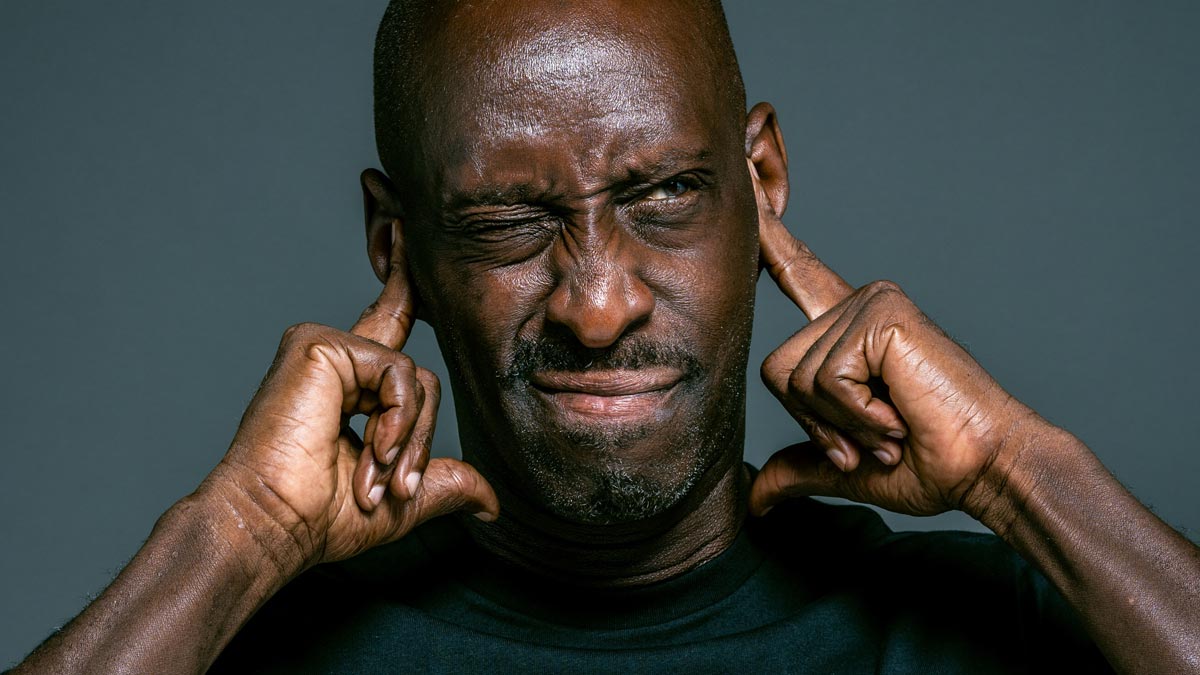
Someone beside you is chewing, and suddenly it’s all you can hear. You can’t follow the conversation, because each mouth sound makes you more tense. Nobody else seems bothered, which makes it awkward to explain why you need to move away.
For people with misophonia, everyday “human” sounds like these can make sharing a meal difficult. Online, those same noises are sometimes amplified for an audience that finds them relaxing.
Mukbang videos, which feature people eating on camera, bring that contrast into focus. Some viewers enjoy the chewing and lip-smacking. Others reach for the mute button.
I find myself caught between wanting to watch and wanting to switch them off.
When a sound provokes more than annoyance
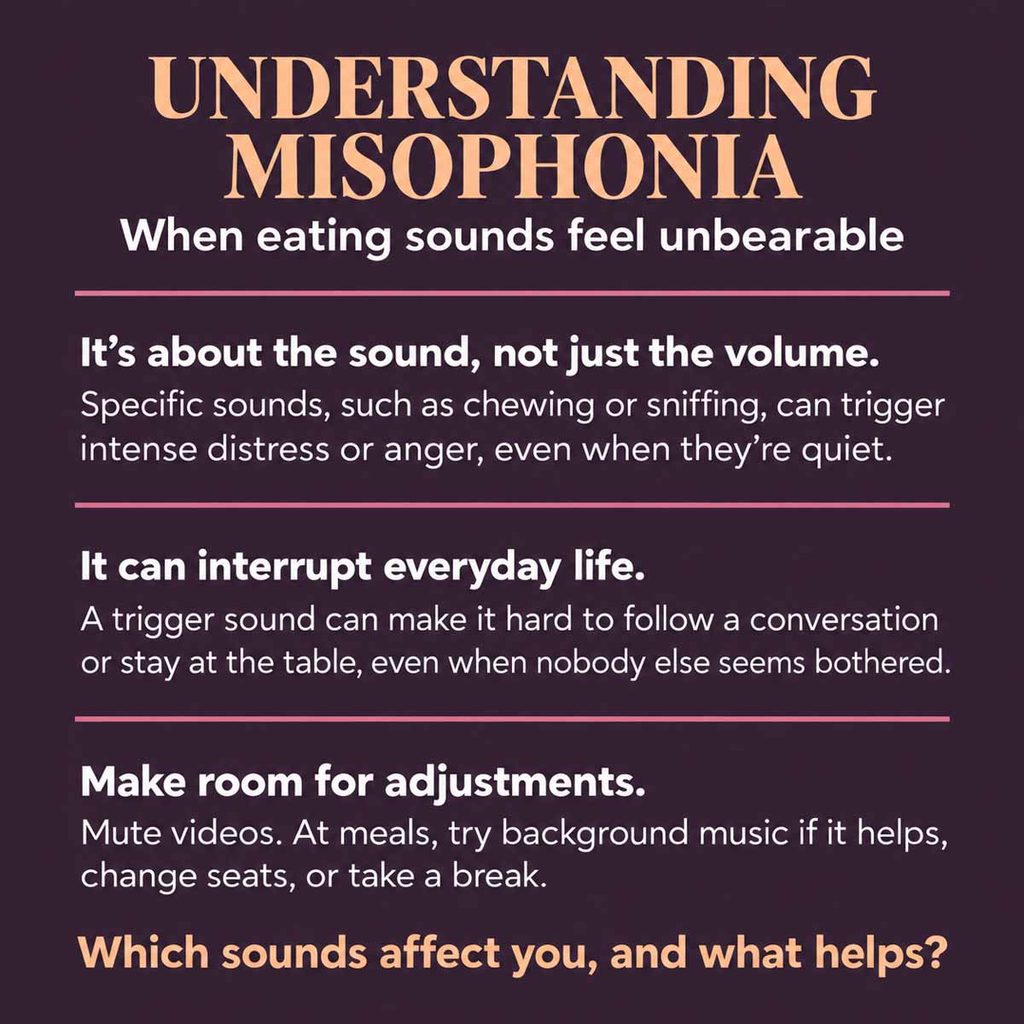
Misophonia involves a decreased tolerance for particular sounds or associated cues, which can bring on intense emotional and physical reactions. Eating sounds are common triggers, though the sounds that affect one person may not bother another. The reaction is tied to the specific sound or its meaning, rather than simply how loud it is.
For me, the response can feel like rage. I hear the noise and feel an immediate urge to get away from it.
Chewing and slurping are difficult, but other human sounds can catch me off guard too. Repeated sniffing, for example, or the little noises someone makes to show they’re listening. I can’t always predict what will bother me until it happens.
That can make social situations uncomfortable in ways other people don’t necessarily see. They’re carrying on with a conversation while I’m trying to manage my reaction to a sound they may barely notice.
A shared meal is harder to mute
The strange part is that I find the visual side of these videos genuinely appealing.
I love chewy textures. Mochi and gummies have a physical quality I enjoy, and watching someone bite into them brings that sensation to mind.
Online, I can switch off the sound. At a dinner table, it’s more complicated.
When I briefly lived in China, slurping was common in the dining settings I encountered. I found it difficult enough that I sometimes wanted to eat alone. The people around me were eating in a way that was ordinary for them, while I was becoming overwhelmed.
That distinction matters. My response to a sound doesn’t automatically mean the person making it is being inconsiderate. Equally, knowing they aren’t doing anything wrong doesn’t make the sound easier to tolerate.
It helps to explain what’s happening without making someone’s eating habits the entire problem: “Certain mouth sounds are really difficult for me. Could we put some music on?” Depending on the setting, sitting farther away or taking a short break might also make the meal more manageable.
Those adjustments won’t work for everyone. The point is to make a shared meal more comfortable without turning it into an argument about whether a sound should bother you.
Wrap Up
For now, the mute button lets me enjoy the mochi without the chewing. In person, I have to be more deliberate about what I need and how I communicate it.
I can want someone’s company and still struggle with the sound of them eating. Recognizing both makes it easier to explain why I might need an adjustment or a break.
Do you experience misophonia? How do you cope with it?
Essy Knopf is a therapist who likes to explore what it means to be neurodivergent and queer. Subscribe to get all new posts sent directly to your inbox.
You agree to stay a little longer, even though the restaurant noise is making it hard to think. Your friend wants to tell you something, and you don’t want them to feel brushed off. So you keep listening and hope they finish soon.
Later, you’re exhausted and irritated. You wanted to spend time with them, but you also wanted to leave half an hour ago.
This is one way neurodivergent self-silencing can show up: you hold back what you need because someone else’s possible disappointment feels more urgent. Sometimes you agree so quickly that you only recognize your discomfort afterward.
Asking for quiet becomes an apology, while leaving a gathering requires reassurance that you had a good time. You might even stay somewhere uncomfortable because saying nothing seems easier than convincing someone you aren’t rejecting them.
This can overlap with masking, particularly when you’re concealing discomfort or managing your expression to meet social expectations. Those adjustments may help you get through an interaction, which is part of what makes them difficult to reconsider.
Other people’s responses can reinforce the habit. Someone may describe you as easygoing without realizing how often you’re agreeing to things you don’t want.
After a while, you can find yourself wondering whether they would still enjoy your company if you asked for more.
Caring can take effort without being fake
Some autistic and ADHD adults need time to work out what they feel or how they want to respond. If a friend shares something painful while you’re overwhelmed, you may care about them and still struggle to find words.
Choosing a thoughtful response doesn’t make your concern artificial. Nor does needing a moment mean you lack empathy.
The pressure comes when you believe you must respond immediately, regardless of your capacity. You start worrying about whether your face looks sympathetic enough instead of listening to what the person is saying. Meanwhile, your own need for a pause goes unspoken.
A flat voice or quiet expression doesn’t necessarily reveal how much you care. You might be concentrating or tired; it may simply be how you communicate.
Saying, “I’m listening; I just need a moment to take that in,” gives the other person some context without requiring you to conceal what’s happening for you.
The difficult part is allowing disappointment
When you’re accustomed to holding back, another person’s disappointment can feel like evidence that you should have kept quiet.
But a friend can wish you’d stayed longer and still respect your decision to leave. You can care about that disappointment without changing your answer.
Waiting until nobody minds your boundary may mean never setting it. Even considerate people won’t always want the same thing you do.
What tells you more is how they respond. Do they accept your answer, even reluctantly? Or do they keep pressing until you give in?
You can explain your needs clearly. The other person’s willingness to respect them remains their responsibility.
Give yourself time before agreeing
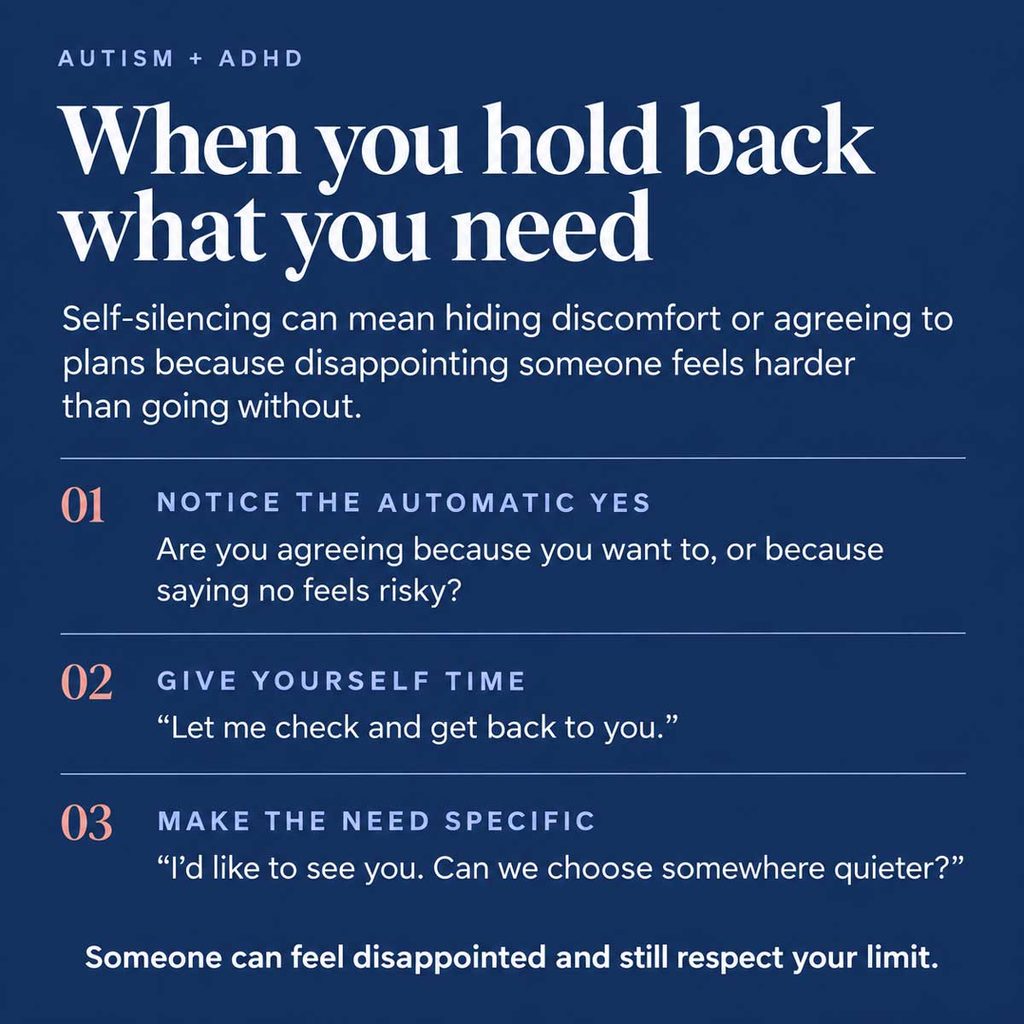
A useful place to begin is with the moment before your automatic yes.
“I’ll check and get back to you” gives you time to consider whether you actually want to go and what it would require. You don’t have to decide while watching someone’s face for signs of disappointment.
For plans you do want, try stating a limit early: “I’d love to come. I can stay for about an hour.” That may feel easier than waiting until you’re overwhelmed and trying to explain why you suddenly need to leave.
If you notice your discomfort only afterward, that information still helps. You might realize that dinner works better somewhere quieter, or that you need a shorter visit next time. You can use what you learned without criticizing yourself for not speaking up sooner.
Start with someone who has shown they can respect a request. You don’t need to disclose more or drop protective habits around someone who repeatedly punishes you for expressing needs.
When a person accepts your limit, give yourself a chance to notice. You asked for something, and the relationship continued. You don’t have to follow that with an apology.
Wrap Up
Neurodivergent self-silencing can be difficult to notice when you’ve become used to checking what everyone else wants first. Making room for your own needs starts with considering them before you commit.
The next time you feel yourself saying yes automatically, give yourself a moment. You may still choose yes, but you’ll have had a chance to include yourself in the decision.
Essy Knopf is a therapist who likes to explore what it means to be neurodivergent and queer. Subscribe to get all new posts sent directly to your inbox.
Have you ever left a conversation feeling fine, then started wondering whether something you said sounded rude?
By the time you get home, you’re considering sending a message to explain yourself. You don’t actually know whether the other person was offended. And yet leaving it alone feels risky.
For many autistic and ADHD adults, being misunderstood is familiar enough that we start preparing for it before it happens.
For example, we may qualify a question so it doesn’t sound like criticism. Or we may explain why we need time alone, then reassure the person that we enjoyed seeing them. Sometimes the explanation gets longer than whatever we originally wanted to say.
It can be hard to enjoy their company when we’re also reviewing our own performance.
When you start questioning your own intentions
There’s a difference between knowing you’re interested and knowing how to make that interest recognizable to someone else in a social interaction.
You might look away because it helps you listen, then remember that someone once accused you of ignoring them for doing exactly that. So you make yourself look back, even though you’re now finding it harder to follow the conversation.
Your attention shifts from what works for you to what will reassure them.
American sociologist and writer W. E. B. Du Bois explored a particular form of divided self-awareness through his concept of double consciousness: the experience of being Black in a racist society and seeing oneself through the judgments of the dominant white culture.
Although rooted in a distinct experience of racism, his account offers a useful way to think about neurodivergent masking: how we can become so accustomed to seeing ourselves through other people’s judgments that we begin to distrust our own understanding of ourselves.
You know you asked a sincere question, but someone heard a challenge. Now you’re wondering whether you were being difficult without realizing it.
When this happens repeatedly, knowing what you meant can stop feeling like enough. You start anticipating how you’ll be interpreted and adjusting yourself before you’ve even spoken.
How you end up doing the repair work
If your questions were treated as backtalk growing up, it makes sense that you might explain why you’re asking. If people regularly mistook your expression for anger, you may have learned to smile when you didn’t feel like smiling.
Those adjustments may have helped. They may still help. The difficulty is that you can become accustomed to making them whether or not the person in front of you needs them.
A friend gets quiet, and you start searching for what you did wrong. Perhaps they’re tired. Perhaps something you said did bother them. You don’t yet know, but you’re already working on an apology.
This is where I think we need to ask more of the people around us.
Autistic researcher Damian Milton’s double empathy problem describes how autistic and non-autistic people can struggle to understand each other across differences in experience and perspective.
It challenges the assumption that a misunderstanding must originate with the autistic person. The framework was developed around autism, though the question of shared effort may also resonate with ADHD readers.
Consider what happens when someone assumes your directness means you’re annoyed. You can explain what you meant, but they also need to be willing to reconsider their interpretation. If they continue treating their first impression as more reliable than your explanation, there’s a limit to what further explaining can accomplish.
Of course, we can hurt people without intending to. And we still need to listen when someone tells us that happened. But there should be room in that conversation for them to listen to us, too.
The conversation ends, but you’re still in it
Sometimes the most tiring part comes after social interactions. You’re making dinner and remembering a pause before someone answered you. You wonder whether you interrupted them. You pick up your phone, reread the message you’ve drafted, and decide it sounds excessive.
Then you wonder whether saying nothing would be worse.
Overexplaining can become a way of trying to settle that uncertainty. If you provide enough context, perhaps you can prevent someone from coming away with an impression of you that feels painfully wrong.
But you can’t always explain your way into feeling certain about what another person thinks. And the more time you spend trying, the less attention you may have for your own experience of the interaction.
Did you enjoy yourself? Were you comfortable? Did they make an effort to understand you?
These are questions that deserve some consideration before you spend hours deciding how to make yourself easier for others.
Letting someone else do their part
I don’t think “just stop caring what people think” is particularly helpful advice here. Other people’s judgments can affect our relationships and our jobs. Some of us have good reasons to be careful.
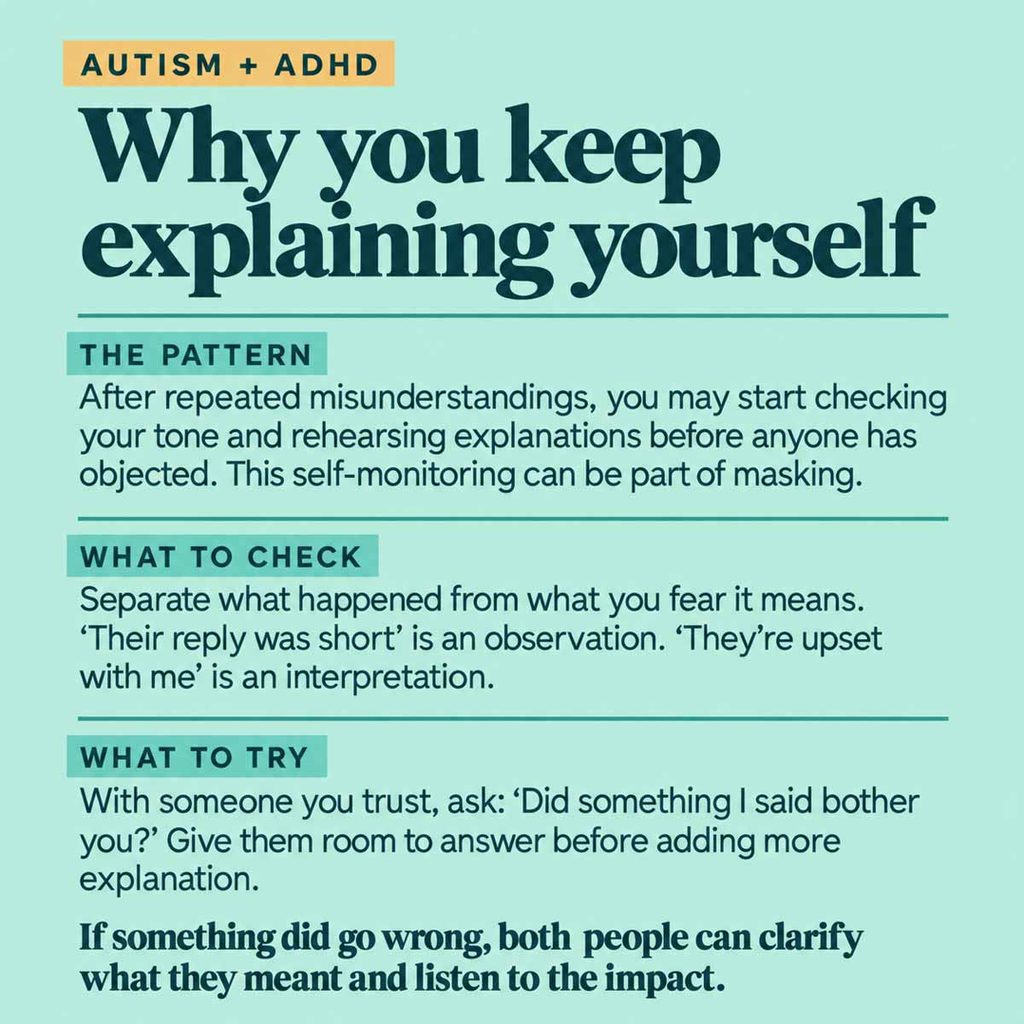
A more manageable starting point is to notice when you’re responding to something that happened and when you’re responding to something you fear happened. Another person’s short reply might make you uneasy, but it doesn’t tell you much by itself.
With someone you trust, you could ask, “Did that come across differently from how I intended?” That gives them a chance to tell you, rather than leaving you to construct both sides of the conversation.
You can also ask for an adjustment that would make future conversations easier: “Sometimes my voice sounds flat when I’m concentrating. If you think I’m upset, please ask.”
Then notice what they do with that information. Someone who wants to understand you may still get it wrong, but over time you should see some willingness to check their assumptions. You shouldn’t need to deliver the same explanation indefinitely.
There may also be people with whom you already feel less pressure to monitor yourself. Think about what they do that helps. Perhaps they take your questions at face value, or tell you plainly when something bothers them. That can give you a clearer sense of what to ask for in other relationships.
Wrap Up
It takes practice to leave a conversation alone when you’re used to reviewing everything you said. You may still feel the urge to send another explanation, even with people who have given you no reason to worry.
You can take that slowly. Start with someone who has shown they’ll ask when they’re unsure, and give them a chance to follow through. Being understood becomes a little less exhausting when you can trust the other person to participate.
Do you find yourself explaining more than you wanted to because you’re afraid of being misunderstood?
Essy Knopf is a therapist who likes to explore what it means to be neurodivergent and queer. Subscribe to get all new posts sent directly to your inbox.
Someone leans in and asks, “Can I give you a hug?” It’s meant to be comforting, maybe even healing.
But instead of warmth, your nervous system responds with alarm.
Do I have to? Will I seem rude if I say no? What if they think I don’t care about them?
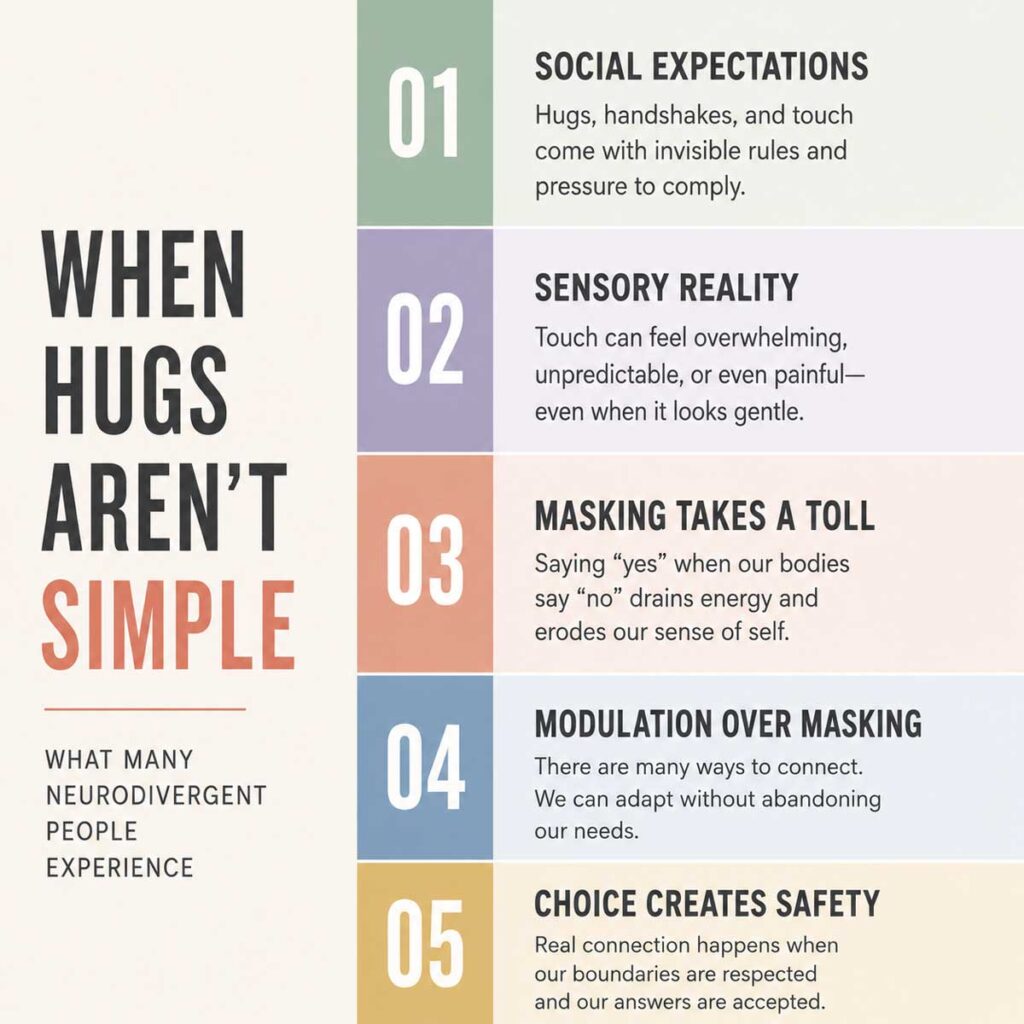
For many autistic and ADHD people, seemingly simple gestures like hugs, handshakes, and pats on the back come with sensory discomfort, social expectations, and a lifetime of pressure to respond the “right” way.
When Touch Comes With an Invisible Social Script
Hugs and handshakes carry meaning.
A hug might communicate affection, reassurance, or connection. A handshake might signal politeness or respect.
Because these gestures are so normalized, declining them can feel surprisingly difficult.
You may not actually want the hug—but you also don’t want to hurt someone’s feelings. Which is why you might want to say yes.
You tense your body, endure the contact, smile afterward, and hope nobody notices how uncomfortable you were.
For some neurodivergent people, this becomes another form of masking: suppressing your natural response so other people remain comfortable.
Touch Can Feel Very Different in a Neurodivergent Body
Sensory experiences vary enormously from person to person.
A hug that feels soothing to someone else might feel irritating, invasive, or overwhelming to you. A handshake introduces all kinds of unpredictable and uncomfortable sensations, such as pressure or moisture.
Even an unexpected pat on the shoulder can leave some people feeling unsettled long after the other person has forgotten it happened.
At the same time, being touch-sensitive doesn’t necessarily mean disliking all touch.
You might dislike light touch but enjoy firm pressure. You might love hugs from someone you trust but dislike being hugged unexpectedly. Or you might enjoy touch one day and find the exact same gesture unbearable when you’re already overstimulated.
The important distinction is choice.
Touch tends to feel very different when you want it, expect it, and have some control over how it happens.
The Cost of Always Saying Yes
Many neurodivergent people learn early that their boundaries will not always be understood.
We hear messages like: “It’s only a hug.” “Don’t be so sensitive.” “They’re just trying to be nice.”
Eventually, those messages can become internal ones. You may start telling yourself that refusing physical affection makes you difficult, cold, or ungrateful.
So instead of asking, What does my body actually want? you ask, What response will make everyone else comfortable?
Repeatedly overriding yourself can make it harder to recognize your own preferences at all.
That’s one of the hidden costs of masking: you can become so practiced at performing comfort that you lose touch with whether you actually feel comfortable.
Try Modulating Instead of Masking
There is another option. I call it modulating.
Masking means suppressing yourself to meet someone else’s expectations. Modulating means finding a way to participate in connection while still respecting your own needs.
Instead of enduring a hug you don’t want, you might say: “I’m not much of a hug person, but I’m really happy to see you.”
You might offer a fist bump instead of a handshake. You might prefer a side hug. Or, with someone you trust, you might explain that firm pressure feels much better than a light embrace.
Modulation gives you permission to move away from an all-or-nothing choice between complete compliance and complete withdrawal.
You can still connect. You just get to have some say in how that connection happens.
Consent Means the Answer Can Be No
Asking “Would you like a hug?” is only meaningful if saying no is genuinely acceptable.
Consent isn’t just about asking the question. It’s about respecting the answer without sulking, demanding an explanation, or treating someone’s boundary as rejection.
“No thanks.” “Not today.” “I’d rather fist bump.” Those should all be complete answers.
For neurodivergent people, creating this kind of consent culture can make relationships feel far safer.
It communicates something important: You don’t have to override your nervous system to prove that you care about me.
And that can create much more genuine intimacy than automatically performing a social ritual ever could.
Wrap Up
There is nothing inherently more loving about a hug than a wave, fist bump, smile, or heartfelt conversation.
The most meaningful form of connection is one both people can actually participate in comfortably.
Learning to identify your neurodivergent touch sensitivity—and communicate what does and doesn’t work for you—can take practice, especially after years of automatically putting other people’s comfort first.
But the people who care about you may appreciate being shown how to connect with you in a way that actually feels good.
What kind of touch feels comfortable to you—and which social gestures do you wish you felt more able to decline?
Essy Knopf is a therapist who likes to explore what it means to be neurodivergent and queer. Subscribe to get all new posts sent directly to your inbox.
Before attending the event, you prepare a few questions in advance.
Once you’re there, you remind yourself not to interrupt, talk too much, or get carried away discussing something that interests you.
Even with all that preparation, the interaction may still feel strained.
Perhaps the other person becomes distracted or gives shorter responses. Maybe they change the subject abruptly or seem eager to end the conversation.
Afterward, it can be difficult not to wonder what went wrong.
When rejection turns into self-criticism
Repeated social difficulties can leave a lasting impression.
You may begin thinking: I talked too much. I was too intense. They must’ve thought I was strange.
These conclusions can feel convincing, particularly when they echo messages you have received over many years. Being corrected, excluded, misunderstood, or treated as socially inappropriate can gradually shape the way you as a neurodivergent person interpret later interactions.
This can also lead to you repeatedly replaying conversations. You might find yourself perseverating over others’ facial expressions, pauses, changes in tone, or particular words and trying to determine what they meant.
Although this may feel like an attempt to learn from the experience, it can easily become exhausting self-monitoring rather than useful reflection.
Social difficulties do not happen in isolation
Neurodivergent people may be quick to assume that a difficult interaction reflects something they did wrong. But social communication is shaped by both people.
Your direct question may be interpreted as confrontational. Your enthusiasm may be read as being overly intense. A neurodivergent person’s indirect communication may be difficult to follow. Two people may also simply have different expectations around humor, openness, pacing, or emotional expression.
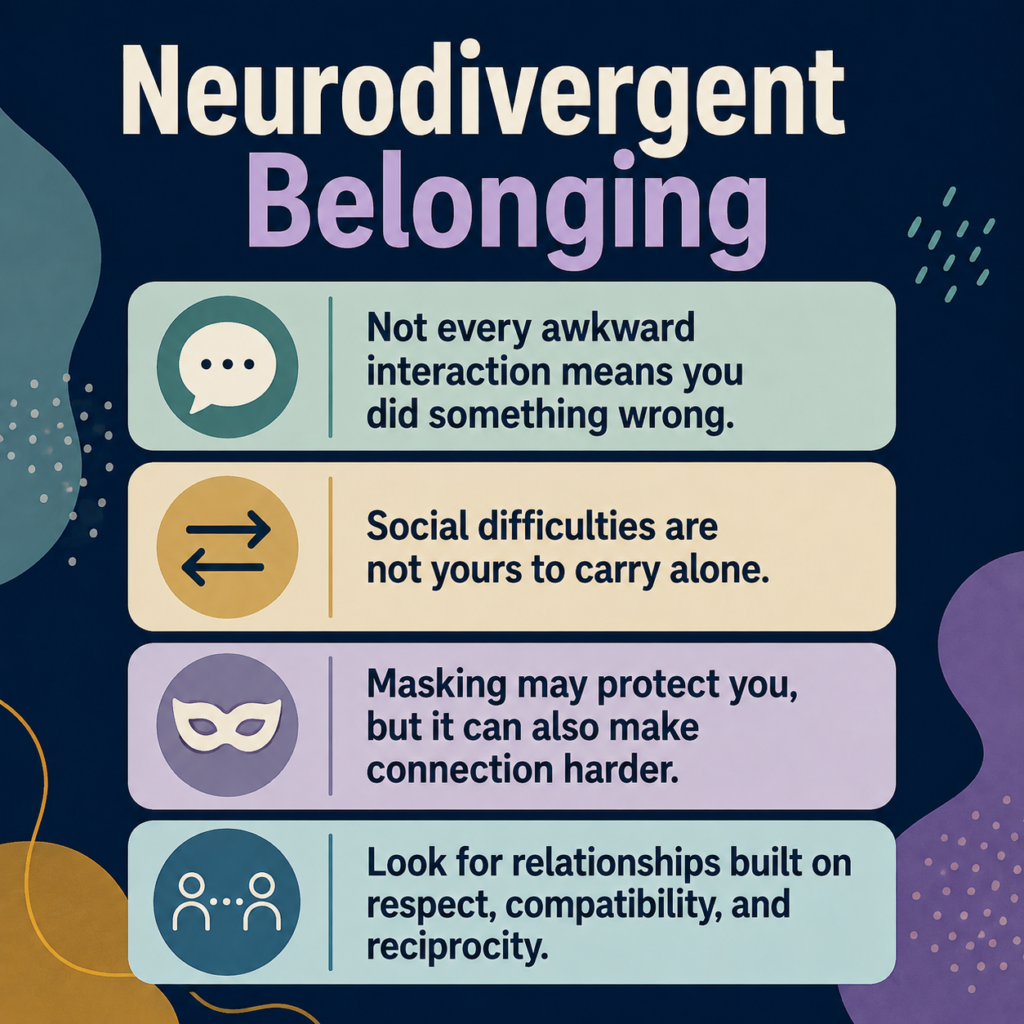
Not every unsuccessful interaction needs to be treated as a mistake that must be identified and corrected.
Sometimes the issue is simply a poor interpersonal fit.
Masking can complicate belonging
For people who have experienced frequent rejection, masking may become a form of protection.
As neurodivergents, we often learn to speak less, suppress stimming, avoid discussing your interests, or carefully monitor how we are coming across to avoid being socially punished.
These strategies can certainly reduce social risk, but they can also make genuine connection more difficult, because other people are interacting with a highly managed version of you.
Not that one should abandon caution or disclosing everything immediately. What I’m suggesting is that it might be possible to allow more room, gradually and selectively, for your natural communication style, interests, and preferences to be visible.
Neurodivergent belonging can prove even more difficult to build when acceptance depends entirely on concealment.
Pay attention to compatibility
It can be useful to shift attention away from whether you successfully impressed someone and toward what the interaction was actually like for you.
Were you able to speak without monitoring every sentence? Did the other person show genuine interest? Could a misunderstanding be clarified without becoming a major rupture? Did you feel respected, even when your communication styles differed?
These questions offer information about compatibility rather than social performance.
You don’t need to be equally comfortable with everyone to belong. What is needed, rather, is relationships in which difference can exist without becoming a constant source of tension or judgment.
Wrap Up
After years of difficult social experiences, an awkward interaction can easily feel like confirmation of an old belief about yourself.
It may be more useful to consider a wider range of explanations, such as anxiety, incompatible communication styles, misunderstanding, the social setting, or simply a lack of mutual connection.
Finding meaningful relationships is not only a matter of improving social skill; it also involves finding people with whom understanding, respect, and reciprocity are possible.
Essy Knopf is a therapist who likes to explore what it means to be neurodivergent and queer. Subscribe to get all new posts sent directly to your inbox.
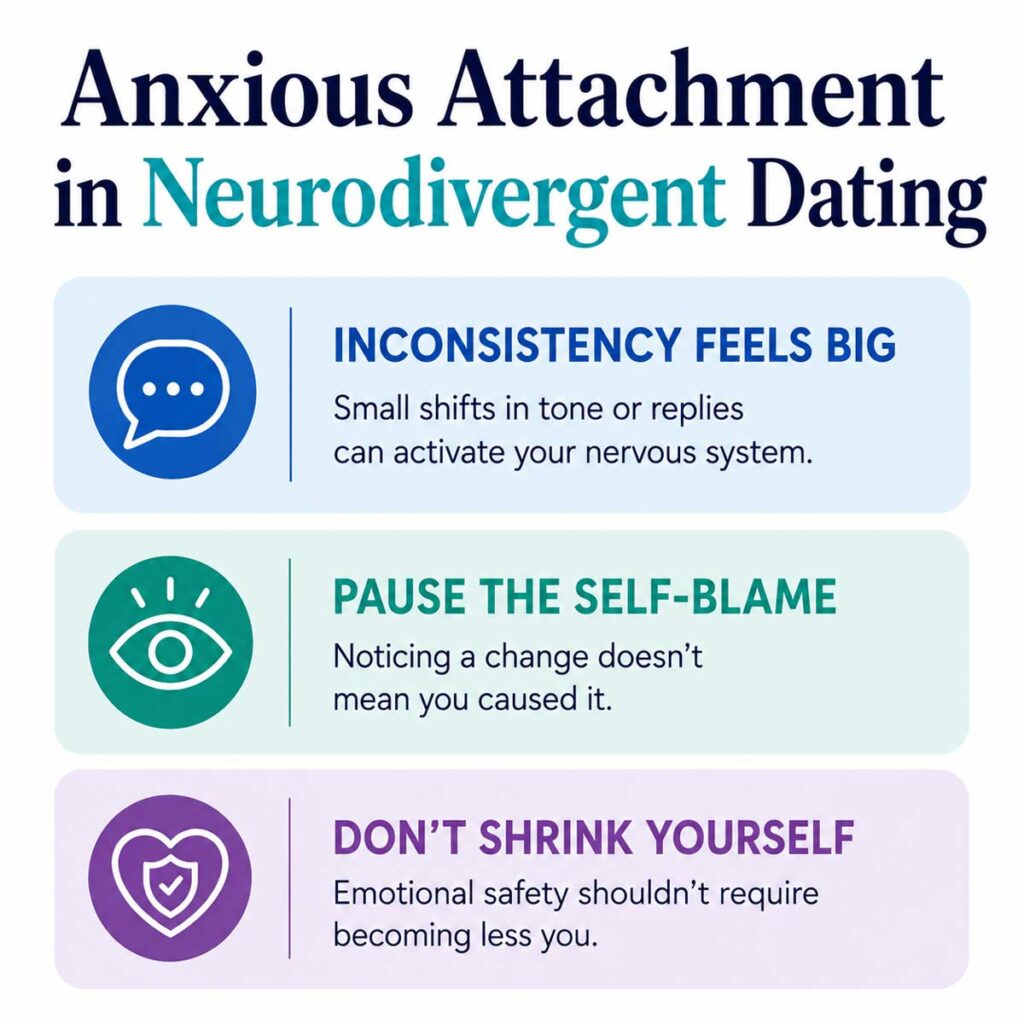
Many autistic and ADHD people are highly sensitive to changes in patterns, including tone, communication, and emotional availability.
If you’ve also experienced rejection, exclusion, or relationships where someone slowly disappeared, subtle distancing may feel like a warning sign.
So you try to fix things.
You delay your replies so you don’t seem too eager, share less, and ask for less. You become more agreeable.
Slowly, the focus shifts from: “Is this relationship working for me?” to: “How do I stop this person from leaving?”
That’s where anxious attachment can lead you toward self-abandonment.
Signs of an anxious–avoidant dynamic
Avoidant attachment doesn’t always look like someone obviously running away from intimacy.
Sometimes it looks like inconsistency.
They may be very engaged one day and emotionally distant the next. When you ask what changed, they tell you that you’re overthinking.
You try to address a problem, and they shut down or say they “don’t want to fight.”
You share something vulnerable, and they change the subject, intellectualize your feelings, or offer a response that sounds empathetic without actually feeling emotionally present.
As a result, you may begin doubting your own perceptions.
You can notice a pattern without blaming yourself
Anxiety can sometimes cause us to interpret uncertainty negatively. But that doesn’t mean every concern is imagined.
The key is separating observation from interpretation.
For example: “They’ve initiated fewer conversations this week” is an observation.
“They’re losing interest because I ruined everything” is an interpretation.
You can take what you’re noticing seriously without automatically deciding it means there is something wrong with you.
Fast intimacy isn’t always secure intimacy
Another confusing pattern can be intense closeness early in dating.
Someone might tell you: “I’ve never connected with anyone like this.” “You understand me better than anyone.”
For neurodivergent people who have spent years feeling misunderstood, that kind of recognition can be incredibly powerful.
But intensity isn’t the same thing as safety.
Emotional security develops through consistency, honesty, repair, and the willingness to stay present when things become uncomfortable.
Stop trying to earn emotional availability
Anxious attachment, in the absence of reflection, can turn dating into an audition.
You may try to become less sensitive, or eager, or demanding, or visibly neurodivergent.
And yet, emotional safety shouldn’t require you to continually shrink yourself.
Healthy relationships still involve misunderstandings, frustration, and occasional distance. The difference is that both people are willing to communicate, reconnect, and repair.
So when you notice yourself obsessing over how to keep someone interested, try asking a different question: Do I feel emotionally safe, valued, and able to be myself with this person?
That question may tell you far more than analyzing another text message ever will.
Wrap Up
If you have anxious attachment, someone pulling away can trigger much more than disappointment. It can also activate old experiences of rejection and leave you scrambling to figure out what you did wrong.
But someone else’s emotional distance is not automatically evidence that you need to change yourself.
Pay attention to patterns. Pay attention to how the relationship makes you feel. And remember that your needs matter too.
Have you ever found yourself becoming smaller or less authentic when someone started pulling away?
Essy Knopf is a therapist who likes to explore what it means to be neurodivergent and queer. Subscribe to get all new posts sent directly to your inbox.
Have you spent most of your life being told, directly or indirectly, that you need to tone yourself down?
Maybe you learned to explain yourself before anyone asked, apologize before anyone complained, or keep certain needs to yourself because experience taught you that expressing them would create tension.
You might have become very good at reading the room because you were always trying to work out whether someone was irritated with you.
It starts with being corrected often enough that you begin correcting yourself. Someone tells you that you are too ___ (insert pejorative here: sensitive, too intense, too blunt, too distracted, too much, etc.).
A teacher might decide you are lazy when you cannot get started on an assignment. A parent becomes frustrated by a sensory issue you cannot simply switch off. Other kids notice that you talk differently, move differently, or care deeply about things they do not understand, and also make sure you know they have noticed.
At some point, those reactions stop feeling like other people’s interpretations of you and start feeling like the truth.
That is where shame becomes difficult to untangle.
When shame starts sounding like your own voice
Internalized ableism rarely announces itself as such.
It sounds more like, Why can’t I just handle this? Or, I should know better by now. Or, I always make things awkward.
Sometimes it shows up before anything has even happened. You sense that somebody might be annoyed, so you start explaining. You think you may have spoken too much, so you replay the conversation afterward. Someone’s tone changes slightly and your mind immediately starts searching for what you did wrong.
After years of this, it can become hard to tell where reasonable self-reflection ends and self-surveillance begins.
There is a difference between realizing you made a mistake and deciding that the mistake says something terrible about who you are. Or between recognizing that something is difficult for you and treating that difficulty as proof of personal failure.
Yet, for autistic and ADHD people, those distinctions can get blurred very early.
If your executive functioning problems were consistently treated as carelessness, eventually you may come to believe you are careless. If your sensory needs were treated as fussiness, you may feel embarrassed by them. If people repeatedly interpreted your directness as hostility, you may second-guess yourself every time you speak plainly.
This can leave many of us with a legacy of inadequacy and shame.
Shame resilience does not mean becoming fearless
The idea of shame resilience is useful because it does not require us to somehow stop feeling shame.
That would be a strange goal anyway, since shame is a powerful social emotion, and most of us are going to experience it from time to time.
The more useful question is what happens after it appears. Do you immediately believe what it is telling you? Do you retreat, attack yourself, or change your behavior before you have even decided whether you have actually done something wrong?
Or can you stay with the discomfort long enough to become curious about it?
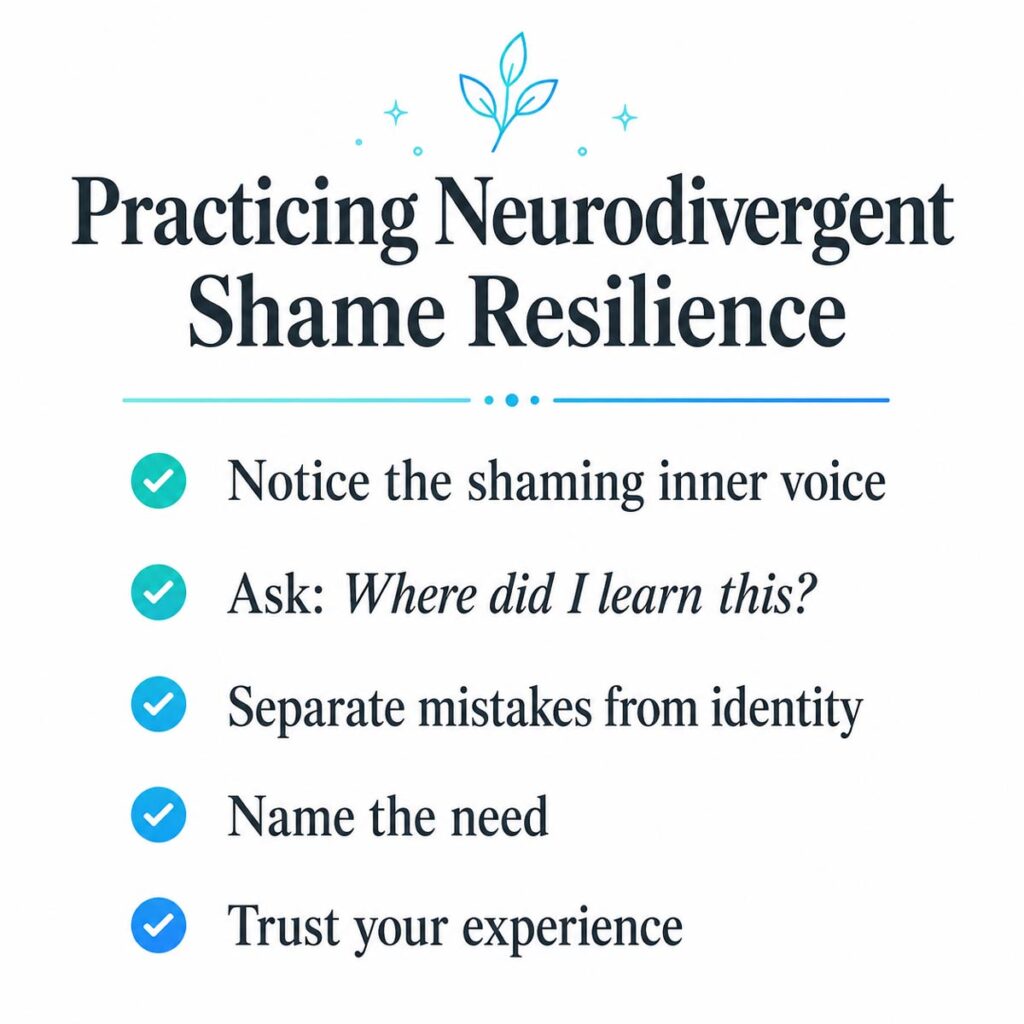
One question I find especially useful is: Where did I learn this? Not, Why am I like this? Or What is wrong with me?
Instead, we can ask ourselves: Where did I learn that needing more time makes me difficult? Where did I learn that asking for clarification makes me stupid? Where did I learn that resting before I am completely exhausted is lazy?
Recognizing that a belief has a history can make it feel a little less like an unquestionable fact.
Authenticity can feel wrong before it feels right
There is a lot of talk about “being your authentic self,” but that phrase can become almost meaningless when you have spent years trying to work out which version of yourself other people will tolerate.
For someone who has masked heavily, authenticity may not feel freeing at first. Embarrassment may even result.
For example, you might decide to tell someone that a restaurant is too loud for you rather than forcing yourself through dinner, and then spend the next hour wondering whether you were difficult.
Or you may ask for instructions to be written down instead of pretending you will remember them, only to feel self-conscious about needing that support in the first place.
Even letting yourself stim more openly, asking someone what they meant rather than guessing, or admitting that you are overwhelmed can bring up a surprising amount of discomfort.
That makes sense when hiding those things once helped you avoid criticism.
Being more authentic does not require that we abandon self-awareness or decide that our impact on other people no longer matters. But it is an invitation to no longer assume, as a starting point, that your needs and differences are the problem.
Sometimes the shame really is coming from outside
One thing I think gets lost in conversations about shame is that we often talk about it as though it exists entirely inside the individual. It does not.
Shame is social. People use it, sometimes deliberately and sometimes without much thought, to enforce what they consider normal.
Familiar examples are a child who moves too much being told to sit properly. Someone who communicates directly is criticized for their tone. Or an employee asks for an accommodation and suddenly senses that they are being seen as inconvenient.
No one has to say, “There is something wrong with you,” because they’ve communicated that message quite effectively in other ways.
Body language is sometimes all that is necessary. A pause. A look. An eye roll. Communication may also involve a joke made at your expense, or a sudden coolness that enters a conversation after you have said something in a way that was not expected.
If you have spent years noticing those reactions, it is no wonder that you become cautious.
This is why shame resilience cannot simply mean teaching yourself that everybody accepts you and that all of your fears are irrational. Sometimes people really are judgmental. Sometimes environments really are ableist.
The work is learning not to let every negative reaction automatically become evidence against yourself.
Learning not to turn every mistake into a verdict
There is another side to this, because being neuroaffirming does not mean pretending we never get things wrong. We do.
Sometimes we misunderstand someone. Sometimes we interrupt, forget something important, communicate poorly, get defensive, or hurt another person without intending to.
The problem starts when a fairly ordinary mistake becomes connected to something much bigger. We jump from I did something wrong to there is something wrong with me is shame.
For people who have lived with years of criticism around their neurodivergence, this jump can happen very quickly.
Shame resilience involves trying to stay with what actually happened. Sure—maybe you need to apologize or do things differently next time.
None of that however requires turning against yourself.
Rebuilding self-trust
A lot of this work comes back to trust.
When you have spent years checking your reactions against everyone else’s, it can be surprisingly difficult to believe your own experience.
Was that room really too loud, or am I being dramatic? Do I actually need a break, or am I being lazy? Was that comment unfair, or am I just too sensitive?
Sometimes we become so used to putting our own perceptions on trial that we barely notice we are doing it.
Rebuilding self-trust begins when we learn to validate our perceptions.
For instance, you might notice that you are overwhelmed and respond before you reach breaking point. You might tell somebody that you did not understand instead of pretending you did. You try asking for what you need and resist the urge to bury the request under three paragraphs of apology.
Then perhaps, after doing this enough times, you realize that having needs did not make you unreasonable after all.
Wrap Up
Shame can become so familiar that we mistake it for self-knowledge.
For autistic and ADHD folks who spent years without understanding their neurodivergence, some of the harshest beliefs we hold about ourselves may have begun as other people’s reactions to traits they did not understand.
Shame resilience is about becoming a little less willing to accept shame’s version of events without question.
And sometimes that begins with a very small interruption to an old thought: Hang on. Is this actually what I believe about myself, or is this something I learned to believe?
What is one thing you used to feel ashamed of that you now understand differently because you know you are autistic or ADHD?
Essy Knopf is a therapist who likes to explore what it means to be neurodivergent and queer. Subscribe to get all new posts sent directly to your inbox.
For many autistic and ADHD people, loneliness develops slowly.
It can begin with being corrected for speaking too honestly, mocked for stimming, excluded from a group, or criticized for missing an unwritten social rule. When these experiences happen repeatedly, they can change the way we approach other people.
We learn to expect rejection before it arrives.
We might hesitate before sending a message, or decline invitations because we assume we will feel awkward or overwhelmed. We stop sharing the parts of ourselves that have been misunderstood.
We may tell ourselves, “I just prefer being alone.” And perhaps we do.
Many neurodivergent people genuinely enjoy solitude. Being alone can mean freedom from masking, social pressure, sensory overload, and the exhausting task of monitoring how other people are reacting to us.
But it is still worth asking: Is this solitude restoring me, or is it shrinking my world?
When Isolation Becomes Protection
Neurodivergent isolation is often both a lifestyle preference and an adaptation.
When connection has repeatedly led to embarrassment, correction, punishment, or rejection, the nervous system learns that distance is safer. Avoiding people becomes a way of preventing future pain.
But beneath the withdrawal, there may still be a wish for connection.
You may want someone to ask how your day was; who understands your communication style, respects your sensory needs, and does not require you to perform a more socially acceptable version of yourself.
Why Connection Can Feel So Risky
What might stop you from seeking such a connection is being told across your lifetime that your natural way of being is wrong.
Perhaps you were described as too sensitive, too intense, too quiet, too blunt, or too emotional. Maybe you were punished for behavior you did not realize was considered inappropriate. You may have been left out without explanation or told to “try harder” socially without receiving any useful guidance.
These experiences can create a heightened sensitivity to rejection.
You may interpret a friend replying briefly as proof that they are angry, or a delayed text as evidence that the relationship is ending.
In such cases, your nervous system is trying to protect you by spotting danger early.
The difficulty is that it may begin to react to all neutral situations as though rejection has already happened.
This can make relationships feel like constant work. Instead of simply being present, you may find yourself analyzing tone, facial expressions, pauses, punctuation, and every word you said afterward.
Even positive interactions can become exhausting.
The Hidden Appeal of Solitude
When you are alone, there is much less to decode.
You can stim without wondering whether someone finds it strange, or spend time with your interests without worrying that you are talking too much or neglecting others. You can choose your lighting, sound level, clothing, food, and routine.
Solitude can be deeply regulating.
For this reason, the goal should never be to pressure neurodivergent people into becoming more social. More social contact is not automatically better, especially when that contact requires masking or exposes someone to continued mistreatment.
The real question is whether one’s current level of solitude is chosen freely.
Healthy solitude usually leaves you feeling calmer, clearer, or more energized. Protective isolation can initially feel peaceful, but may also leave you feeling disconnected or resigned.
Many of us end up telling ourselves that we don’t need anyone, while secretly grieving the absence of meaningful relationships.
When Boundaries Hide Grief
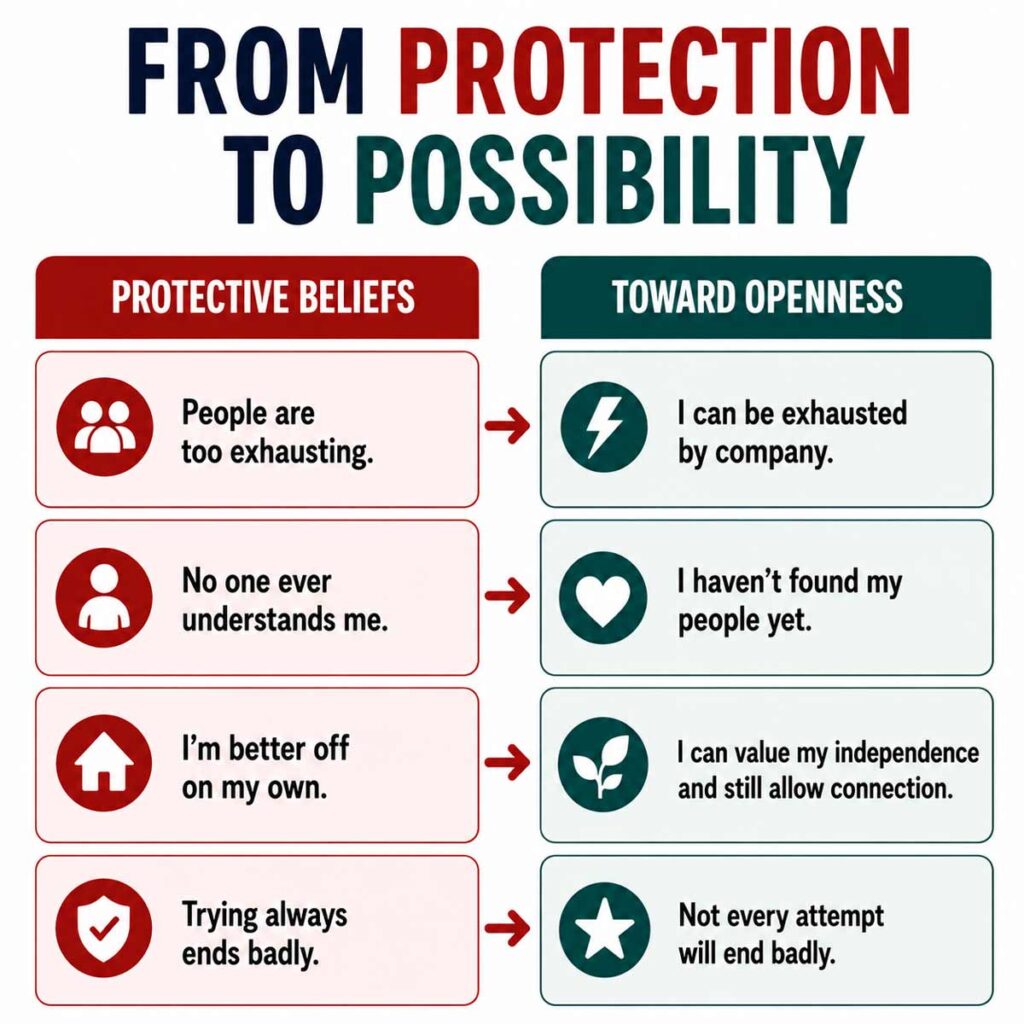
After enough painful social experiences, protective beliefs can sound like healthy boundaries: “People are too exhausting.” “No one ever understands me.” “I’m better off on my own.” “Trying always ends badly.”
Sometimes these statements are partly true. There may be people you are genuinely better off avoiding. Certain environments may be inaccessible or unsafe. Some relationships may demand far more than they give.
But it is also possible for a boundary to become so broad that it blocks every opportunity for connection.
The belief that all closeness is dangerous may protect you from rejection, but it also protects you from being known.
This is how isolation can become self-reinforcing. The less you interact with others, the fewer chances you have to experience safe connection. Without those corrective experiences, the belief that relationships always end badly remains unchallenged.
Returning to Connection Gently
Healing from neurodivergent isolation does not mean forcing yourself into crowded events, maintaining dozens of friendships, or pushing through social exhaustion.
It can begin much more gently. For example, replying to one message you have been avoiding, or sharing an honest thought with someone who has previously treated you with kindness.
Another option includes spending time in a neurodivergent-friendly group where direct communication and sensory needs are respected.
It can also help to identify what makes connection feel safer.
Perhaps you prefer communicating by text rather than phone, or meeting one person at a time. You may need plans to be made in advance, a clear end time, or permission to leave when you become overwhelmed.
These needs do not make you demanding, but help create the conditions in which genuine connection becomes possible, while leaving enough room for your full neurodivergent self.
Learning to Trust Slowly
In opening ourselves to the right people, we must also remember that safe people are not perfect. Miscommunications are inevitable in every relationship, especially across different neurotypes.
What makes someone safe isn’t that they never misunderstand us, but that they’re willing to approach those misunderstandings with curiosity and compassion, as well as a desire to repair.
In such instances, ask yourself: Can the other person listen? Can they clarify rather than accuse? Can both of you acknowledge your part without turning the interaction into a verdict on your worth?
These experiences can gradually teach the nervous system that connection is not always dangerous.
Wrap Up
Neurodivergent isolation makes sense when you have spent years feeling misunderstood, corrected, or rejected.
Withdrawal may have helped you survive environments in which being your authentic self did not feel safe. There is no shame in having developed strategies that protected you.
But those strategies do not always have to remain permanent. You can honor your need for solitude while still remaining open to connection.
Have you ever realized that your preference for being alone was partly a form of protection? What helps connection feel safer for you?
Essy Knopf is a therapist who likes to explore what it means to be neurodivergent and queer. Subscribe to get all new posts sent directly to your inbox.
When an autistic person says, “This therapy harmed me,” what happens next matters.
Are they met with curiosity and compassion? Or are they questioned and told they misunderstood what happened?
Too often, autistic people encounter responses like: “That must have been a bad provider.” “ABA isn’t like that anymore.” “You don’t understand the science.” “That wasn’t real ABA.”
These statements may sound reassuring to the person saying them. And yet, to someone describing trauma, they can feel like another form of silencing.
This is where epistemic injustice enters the conversation.
What Is Epistemic Injustice?
Epistemic injustice occurs when someone is unfairly treated as an unreliable source of knowledge. In other words, their account is given less credibility because of assumptions about who they are.
One way this might happen with autistic people is when they are cast by others as confused, overly sensitive, incapable of accurately reading situations, or unable to understand professional practices.
As a result, their firsthand experiences can be treated as less trustworthy than the explanations offered by credentialed professionals.
The professional becomes the expert on what supposedly happened. The autistic person, meanwhile, is treated as an unreliable witness to their own life.
When Credentials Outweigh Lived Experience
Professional training and research have value. However, credentials should never make someone immune to questioning.
When autistic adults describe being traumatized by behavior-based interventions, the first response should never be to audit their memories or defend the reputation of a profession, but to listen.
Yet discussions of harm often shift toward technicalities: Was the provider properly certified? Was the intervention truly ABA? Did the autistic person understand the treatment model?
These questions may be relevant. But when they are used primarily to discredit the person reporting harm, they become a form of reputation management.
The underlying message is painful: If your experience does not fit our model, your experience must be wrong.
Why Epistemic Injustice Causes Harm
Being repeatedly disbelieved can deepen shame, self-doubt, and trauma.
Many autistic people already grow up being told that their perceptions are incorrect. For example, sensory distress may be dismissed as overreacting, while attempts to set boundaries may be interpreted as defiance.
Across our lifetime, this can corrode self-trust. And when therapists and other professionals repeat this pattern, the therapy room becomes yet another environment where neurotypical interpretations are prioritized over autistic reality, and autistic safety.
Listening Does Not Mean Abandoning Science
When autistic folks share their experiences, it should be not regarded as an attack on professions or research, but rather an invitation to ask better questions.
Research data can tell us whether a measurable behavior changed, but it cannot always tell us what that change cost the person emotionally.
A child may appear more compliant in ABA therapy, for example, while becoming more afraid to say no. An autistic person may display fewer visible “problematic” traits such as stimming as a result of such interventions.
Yet underneath the performance there may be an increase in anxiety or disconnection from their identity.
Progress therefore cannot be measured only by how comfortable someone’s behavior makes the people around them. Safeguarding individual well-being is key.
What Neuroaffirming Care Looks Like
Neuroaffirming practitioners do not assume they understand an autistic person’s experience better than the person living it.
Instead, they remain open to feedback, including feedback that challenges their training. They treat lived experience as meaningful evidence rather than an obstacle to professional authority.
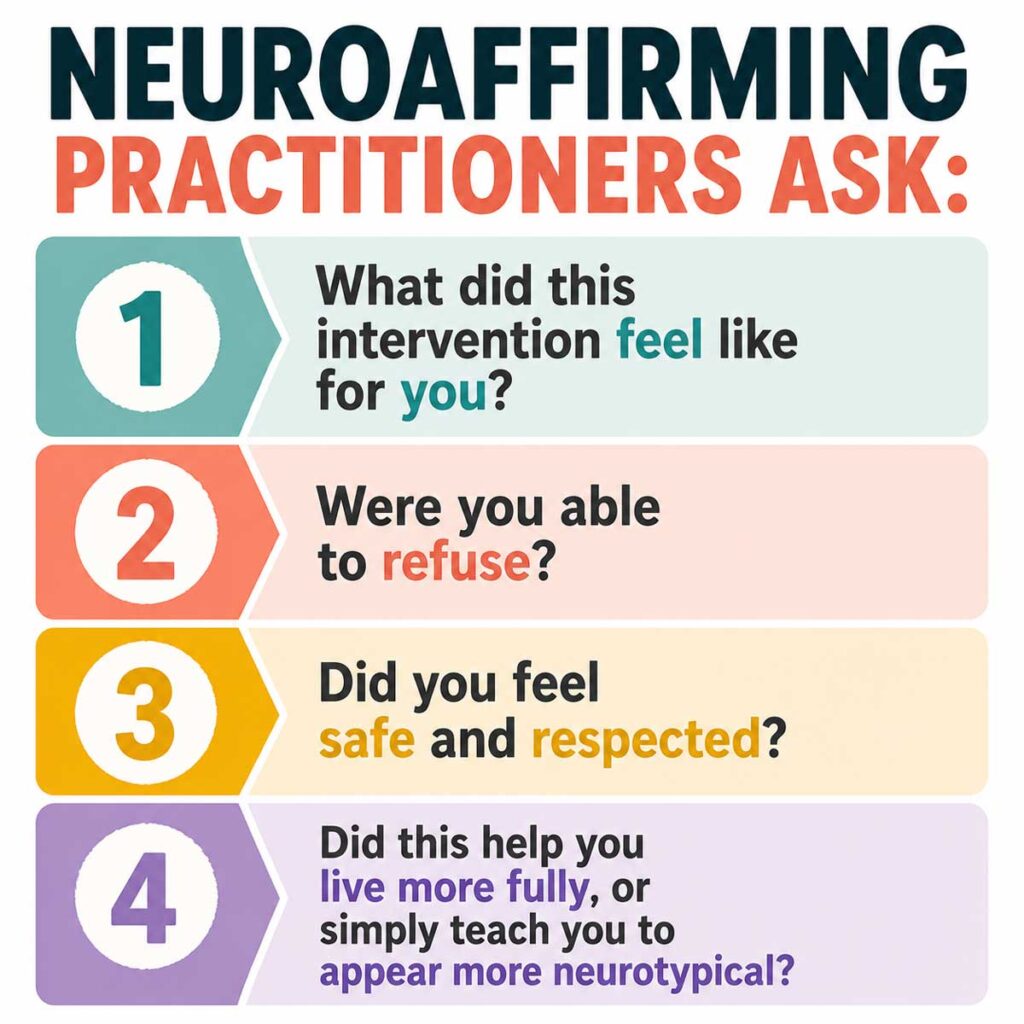
Most importantly, they ask: What did this intervention feel like for you? Were you able to refuse? Did you feel safe and respected? Did this help you live more fully, or simply teach you to appear more neurotypical?
These questions move us away from defensiveness and toward accountability.
Wrap Up
Autistic people should not have to present a courtroom case before their pain is taken seriously.
Addressing epistemic injustice begins with believing that autistic people possess valuable knowledge about their own experiences and recognizing that listening is one of the foundations of good therapy.
Have you ever felt that a professional dismissed or questioned your lived experience as an autistic person?
Essy Knopf is a therapist who likes to explore what it means to be neurodivergent and queer. Subscribe to get all new posts sent directly to your inbox.
You may have heard of the fight, flight, freeze, and fawn responses. These are natural ways our nervous systems react when we sense danger.
For many neurodivergent people, the fawn response can look like chronic people-pleasing.
Fawning is a form of submission intended to reduce a perceived threat. Figuratively speaking, it is like rolling over and showing your belly to communicate, “I’m not a danger—please don’t hurt or reject me.”
The threat does not have to be physical. It may be the risk of criticism, exclusion, humiliation, job loss, or family conflict.
Many autistic people and ADHDers learn early that pleasing others can offer protection. After being bullied or socially isolated over long periods of time, we may discover that masking our traits and accommodating everyone around us makes life feel safer.
And sometimes, it works.
Neurodivergent people-pleasing may help us remain part of a social group, maintain employment, or preserve important relationships. The problem is what happens when this coping strategy becomes our default.
When we consistently prioritize other people’s comfort, our own needs can disappear from view.
We suppress our reactions. We change how we communicate. We mask, camouflage, and compensate for our neurodivergence in the hope of being accepted.
Over time, this can leave us wondering: Who am I when I’m not performing for someone else?
There is a particular loneliness that comes from being surrounded by people who never truly see you. You may appear socially connected while privately feeling unknown, unworthy, or exhausted.
The fawn response protects us from rejection, but it may also prevent genuine connection.
Moving away from people-pleasing involves staying aware of the social context while making more room for your genuine feelings, preferences, boundaries, and needs.
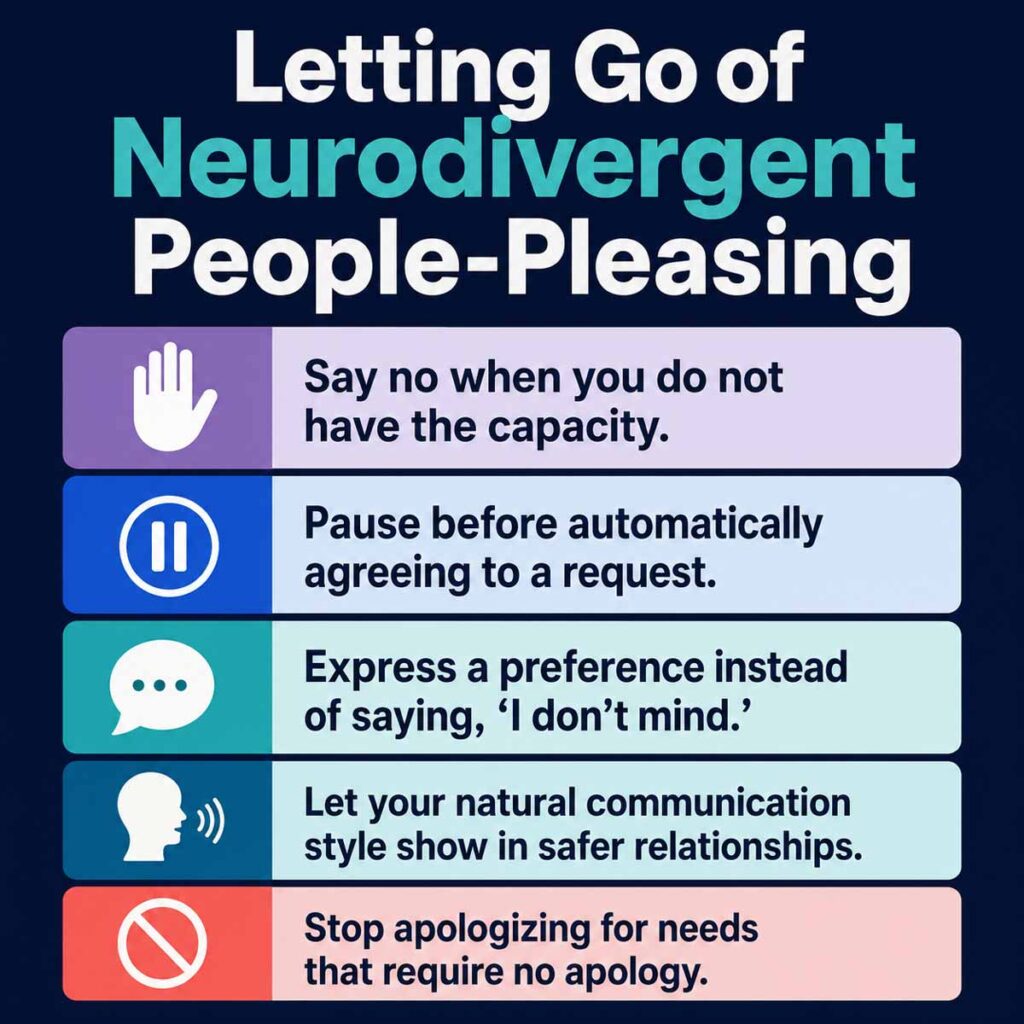
Authenticity can begin with small choices:
Saying “no” when you do not have the capacity.
Pausing before automatically agreeing to a request.
Expressing a preference instead of saying, “I don’t mind.”
Allowing your natural communication style to show in safer relationships.
Choosing not to apologize for needs that require no apology.
“No” can be a full sentence. It can also be expressed gently: “I’m not able to do that,” “That doesn’t work for me,” or “I need some time to think.”
Each honest response is an opportunity to remind yourself that your needs matter too.
Letting go of neurodivergent people-pleasing can bring shame and guilt to the surface. An inner critic may warn you that being authentic will make others angry, disappointed, or unwilling to accept you.
That critic developed for a reason: it is trying to return you to a strategy that may once have kept you safe.
Rather than fighting it, you can acknowledge its fear while still choosing a different response.
With practice, authenticity becomes less frightening. Social rejection may still happen, but it becomes easier to recognize that another person’s dislike is not proof of a personal defect.
Some people like oranges. Some prefer bananas. Some are allergic to strawberries.
You cannot appeal to everyone—and exhausting yourself through people-pleasing will not change that.
Remember that the fawn response is a coping mechanism many neurodivergent people developed while navigating environments where being different carried real social risks.
Healing involves choosing, interaction by interaction, to stop disappearing—and to let more of your authentic self be seen.
Have you struggled with fawning as a neurodivergent person?
Essy Knopf is a therapist who likes to explore what it means to be neurodivergent and queer. Subscribe to get all new posts sent directly to your inbox.