

Reclaiming yourself through neurodivergent shame resilience


Have you spent most of your life being told, directly or indirectly, that you need to tone yourself down?
Maybe you learned to explain yourself before anyone asked, apologize before anyone complained, or keep certain needs to yourself because experience taught you that expressing them would create tension.
You might have become very good at reading the room because you were always trying to work out whether someone was irritated with you.
For a lot of autistic and ADHD people, shame starts there.
It starts with being corrected often enough that you begin correcting yourself. Someone tells you that you are too ___ (insert pejorative here: sensitive, too intense, too blunt, too distracted, too much, etc.).
A teacher might decide you are lazy when you cannot get started on an assignment. A parent becomes frustrated by a sensory issue you cannot simply switch off. Other kids notice that you talk differently, move differently, or care deeply about things they do not understand, and also make sure you know they have noticed.
At some point, those reactions stop feeling like other people’s interpretations of you and start feeling like the truth.
That is where shame becomes difficult to untangle.
When shame starts sounding like your own voice
Internalized ableism rarely announces itself as such.
It sounds more like, Why can’t I just handle this? Or, I should know better by now. Or, I always make things awkward.
Sometimes it shows up before anything has even happened. You sense that somebody might be annoyed, so you start explaining. You think you may have spoken too much, so you replay the conversation afterward. Someone’s tone changes slightly and your mind immediately starts searching for what you did wrong.
After years of this, it can become hard to tell where reasonable self-reflection ends and self-surveillance begins.
There is a difference between realizing you made a mistake and deciding that the mistake says something terrible about who you are. Or between recognizing that something is difficult for you and treating that difficulty as proof of personal failure.
Yet, for autistic and ADHD people, those distinctions can get blurred very early.
If your executive functioning problems were consistently treated as carelessness, eventually you may come to believe you are careless. If your sensory needs were treated as fussiness, you may feel embarrassed by them. If people repeatedly interpreted your directness as hostility, you may second-guess yourself every time you speak plainly.
This can leave many of us with a legacy of inadequacy and shame.
Shame resilience does not mean becoming fearless
The idea of shame resilience is useful because it does not require us to somehow stop feeling shame.
That would be a strange goal anyway, since shame is a powerful social emotion, and most of us are going to experience it from time to time.
The more useful question is what happens after it appears. Do you immediately believe what it is telling you? Do you retreat, attack yourself, or change your behavior before you have even decided whether you have actually done something wrong?
Or can you stay with the discomfort long enough to become curious about it?
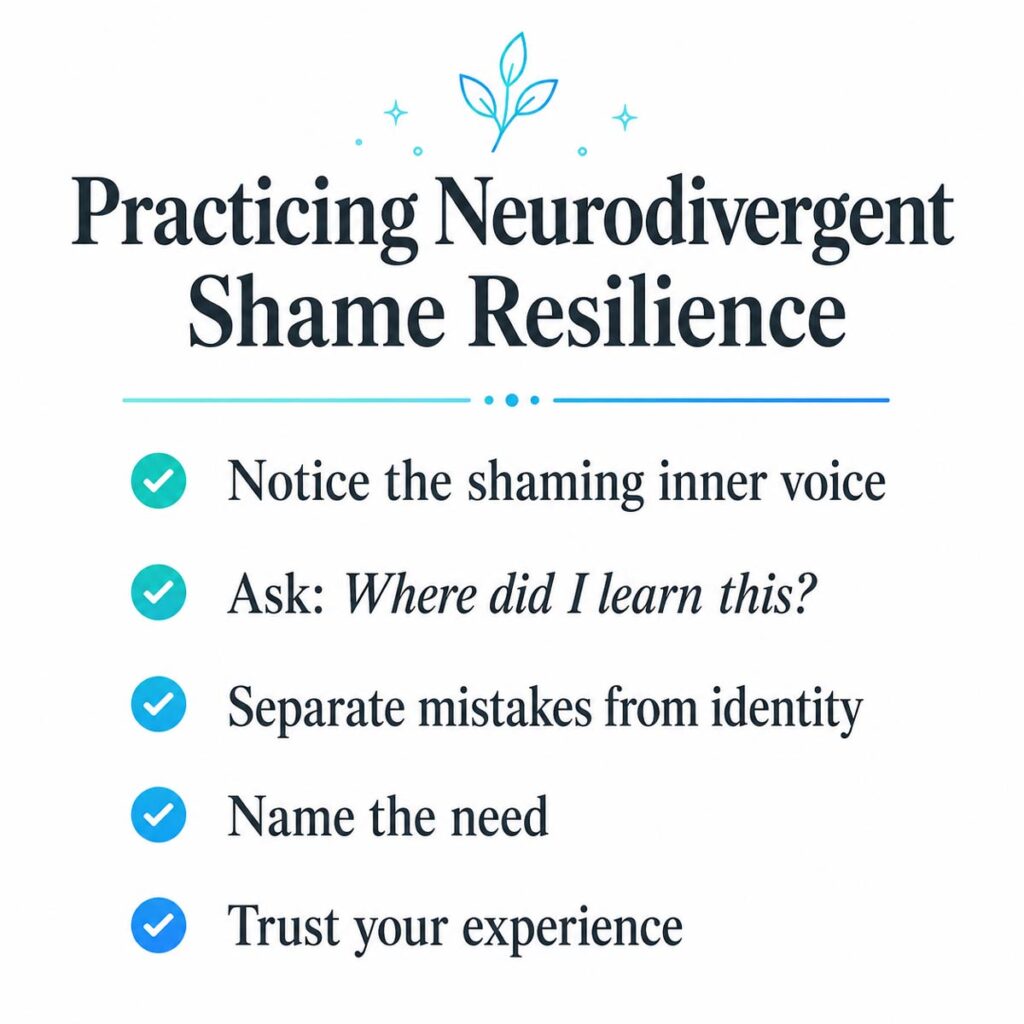
One question I find especially useful is: Where did I learn this? Not, Why am I like this? Or What is wrong with me?
Instead, we can ask ourselves: Where did I learn that needing more time makes me difficult? Where did I learn that asking for clarification makes me stupid? Where did I learn that resting before I am completely exhausted is lazy?
Recognizing that a belief has a history can make it feel a little less like an unquestionable fact.
Authenticity can feel wrong before it feels right
There is a lot of talk about “being your authentic self,” but that phrase can become almost meaningless when you have spent years trying to work out which version of yourself other people will tolerate.
For someone who has masked heavily, authenticity may not feel freeing at first. Embarrassment may even result.
For example, you might decide to tell someone that a restaurant is too loud for you rather than forcing yourself through dinner, and then spend the next hour wondering whether you were difficult.
Or you may ask for instructions to be written down instead of pretending you will remember them, only to feel self-conscious about needing that support in the first place.
Even letting yourself stim more openly, asking someone what they meant rather than guessing, or admitting that you are overwhelmed can bring up a surprising amount of discomfort.
That makes sense when hiding those things once helped you avoid criticism.
Being more authentic does not require that we abandon self-awareness or decide that our impact on other people no longer matters. But it is an invitation to no longer assume, as a starting point, that your needs and differences are the problem.
Sometimes the shame really is coming from outside
One thing I think gets lost in conversations about shame is that we often talk about it as though it exists entirely inside the individual. It does not.
Shame is social. People use it, sometimes deliberately and sometimes without much thought, to enforce what they consider normal.
Familiar examples are a child who moves too much being told to sit properly. Someone who communicates directly is criticized for their tone. Or an employee asks for an accommodation and suddenly senses that they are being seen as inconvenient.
No one has to say, “There is something wrong with you,” because they’ve communicated that message quite effectively in other ways.
Body language is sometimes all that is necessary. A pause. A look. An eye roll. Communication may also involve a joke made at your expense, or a sudden coolness that enters a conversation after you have said something in a way that was not expected.
If you have spent years noticing those reactions, it is no wonder that you become cautious.
This is why shame resilience cannot simply mean teaching yourself that everybody accepts you and that all of your fears are irrational. Sometimes people really are judgmental. Sometimes environments really are ableist.
The work is learning not to let every negative reaction automatically become evidence against yourself.
Learning not to turn every mistake into a verdict
There is another side to this, because being neuroaffirming does not mean pretending we never get things wrong. We do.
Sometimes we misunderstand someone. Sometimes we interrupt, forget something important, communicate poorly, get defensive, or hurt another person without intending to.
The problem starts when a fairly ordinary mistake becomes connected to something much bigger. We jump from I did something wrong to there is something wrong with me is shame.
For people who have lived with years of criticism around their neurodivergence, this jump can happen very quickly.
Shame resilience involves trying to stay with what actually happened. Sure—maybe you need to apologize or do things differently next time.
None of that however requires turning against yourself.
Rebuilding self-trust
A lot of this work comes back to trust.
When you have spent years checking your reactions against everyone else’s, it can be surprisingly difficult to believe your own experience.
Was that room really too loud, or am I being dramatic? Do I actually need a break, or am I being lazy? Was that comment unfair, or am I just too sensitive?
Sometimes we become so used to putting our own perceptions on trial that we barely notice we are doing it.
Rebuilding self-trust begins when we learn to validate our perceptions.
For instance, you might notice that you are overwhelmed and respond before you reach breaking point. You might tell somebody that you did not understand instead of pretending you did. You try asking for what you need and resist the urge to bury the request under three paragraphs of apology.
Then perhaps, after doing this enough times, you realize that having needs did not make you unreasonable after all.
Wrap Up
Shame can become so familiar that we mistake it for self-knowledge.
For autistic and ADHD folks who spent years without understanding their neurodivergence, some of the harshest beliefs we hold about ourselves may have begun as other people’s reactions to traits they did not understand.
Shame resilience is about becoming a little less willing to accept shame’s version of events without question.
And sometimes that begins with a very small interruption to an old thought: Hang on. Is this actually what I believe about myself, or is this something I learned to believe?
What is one thing you used to feel ashamed of that you now understand differently because you know you are autistic or ADHD?
Essy Knopf is a therapist who likes to explore what it means to be neurodivergent and queer. Subscribe to get all new posts sent directly to your inbox.
© 2026 Ehsan "Essy" Knopf. Any views or opinions represented in this blog are personal and belong solely to the blog owner and do not represent those of people, institutions or organizations that the owner may or may not be associated with in professional or personal capacity, unless explicitly stated. All content found on the EssyKnopf.com website and affiliated social media accounts were created for informational purposes only and should not be treated as a substitute for the advice of qualified medical or mental health professionals. Always follow the advice of your designated provider.