

Navigating social niceties as a neurodivergent


When I lived in LA, I frequently encountered something I called “California nice.”
Strangers would chat with me at ice cream shops, supermarkets, beaches—almost anywhere. They were often warm, open, casual, and easygoing. They talked as though we already knew each other.
And honestly? It was lovely.
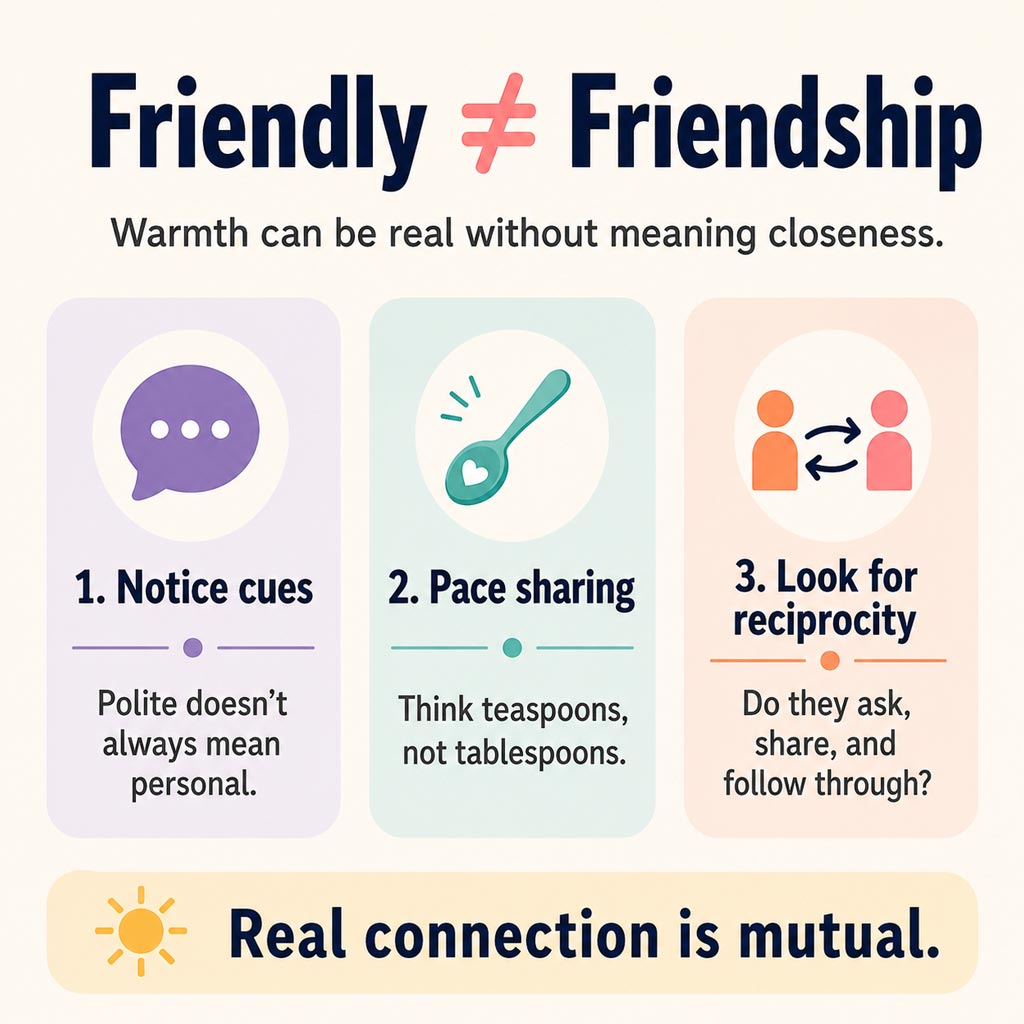
But as a neurodivergent, I learned quickly that friendliness didn’t always mean openness to friendship.
Someone might say, “We should totally hang out sometime,” and I would think, Ah. So we are absolutely not going to hang out.
Maybe they meant it, and maybe they didn’t. But I had no reliable way of knowing, so I treated it as social decoration: pleasant, but not necessarily meaningful.
The Confusion of Social Grooming
Many neurodivergents encounter some version of “California nice,” whether or not they live anywhere near California.
People smile, ask questions, say kind things, and perform warmth.
Often, it’s hard to know whether these social cues reflect genuine interest or simply ritualistic responses. Sometimes it’s just the social currency of the moment.
For autistic and ADHD people, this can be incredibly confusing. We may wonder: Is this person actually interested in me? Are they inviting closeness, or just being polite? Can I be myself here, or will that be “too much”?
The stakes can feel high because opening up to the wrong person can be painful.
Maybe we share too much too soon, start talking passionately about a special interest, or be direct, intense, blunt, darkly funny, or emotionally honest before the other person is ready.
And suddenly, what felt like connection becomes distance.
Try the Relay Race Approach
One helpful strategy is to treat conversation like a relay race.
In a relay race, you don’t hold onto the baton forever. You run your stretch, then pass it on.
Conversation can work the same way.
You share a little. They share a little. You ask something. They respond.
You offer one small piece of yourself. Then you pause and see what they do with it.
Think teaspoons, not tablespoons.
Instead of pouring out your whole inner world at once, you offer small amounts and watch for reciprocity. Do they ask follow-up questions? Do they share something personal too? Do they seem curious, comfortable, and engaged?
The key here is to pace revealing who you are so you can gather information and protect your nervous system.
Pacing Can Create Safety
For many neurodivergents, social success is about finding ways to connect that don’t require abandoning ourselves.
Pacing gives us room to notice whether someone is capable of meeting us with curiosity, respect, and care. It helps us avoid the painful experience of offering vulnerability to people who only meant to exchange politeness.
And when someone does respond warmly—when they pick up the baton and pass it back—that’s useful information.
That may be someone worth getting to know.
Wrap Up
Navigating neurotypical social niceties can feel like trying to decode a language where half the words are implied and the rules keep changing.
But with social pacing, we can move more gently, protect ourselves from unnecessary hurt, and still leave space for real connection.
Have you ever struggled to tell the difference between friendliness and genuine friendship?
Essy Knopf is a therapist who likes to explore what it means to be neurodivergent and queer. Subscribe to get all new posts sent directly to your inbox.
© 2026 Ehsan "Essy" Knopf. Any views or opinions represented in this blog are personal and belong solely to the blog owner and do not represent those of people, institutions or organizations that the owner may or may not be associated with in professional or personal capacity, unless explicitly stated. All content found on the EssyKnopf.com website and affiliated social media accounts were created for informational purposes only and should not be treated as a substitute for the advice of qualified medical or mental health professionals. Always follow the advice of your designated provider.