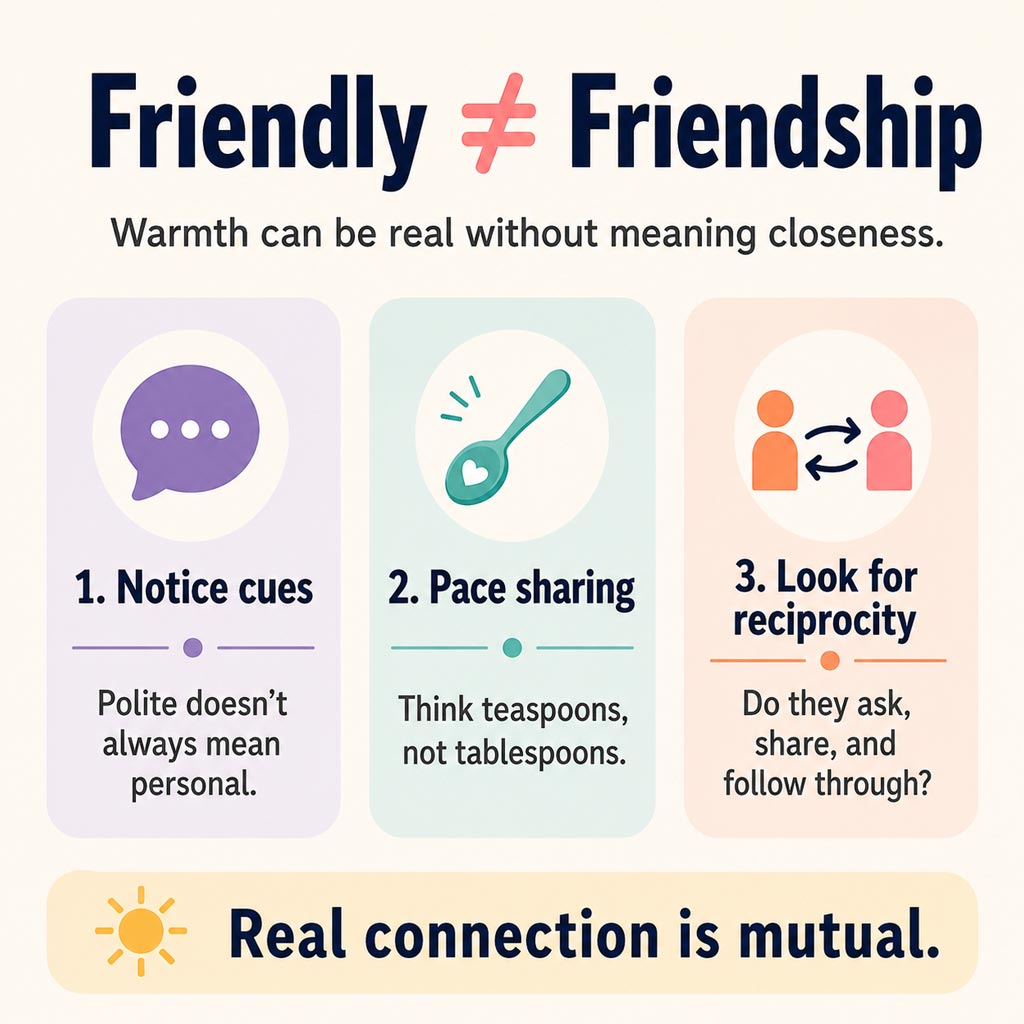

Finding connection when you’re neurodivergent


Before attending the event, you prepare a few questions in advance.
Once you’re there, you remind yourself not to interrupt, talk too much, or get carried away discussing something that interests you.
Even with all that preparation, the interaction may still feel strained.
Perhaps the other person becomes distracted or gives shorter responses. Maybe they change the subject abruptly or seem eager to end the conversation.
Afterward, it can be difficult not to wonder what went wrong.
When rejection turns into self-criticism
Repeated social difficulties can leave a lasting impression.
You may begin thinking: I talked too much. I was too intense. They must’ve thought I was strange.
These conclusions can feel convincing, particularly when they echo messages you have received over many years. Being corrected, excluded, misunderstood, or treated as socially inappropriate can gradually shape the way you as a neurodivergent person interpret later interactions.
This can also lead to you repeatedly replaying conversations. You might find yourself perseverating over others’ facial expressions, pauses, changes in tone, or particular words and trying to determine what they meant.
Although this may feel like an attempt to learn from the experience, it can easily become exhausting self-monitoring rather than useful reflection.
Social difficulties do not happen in isolation
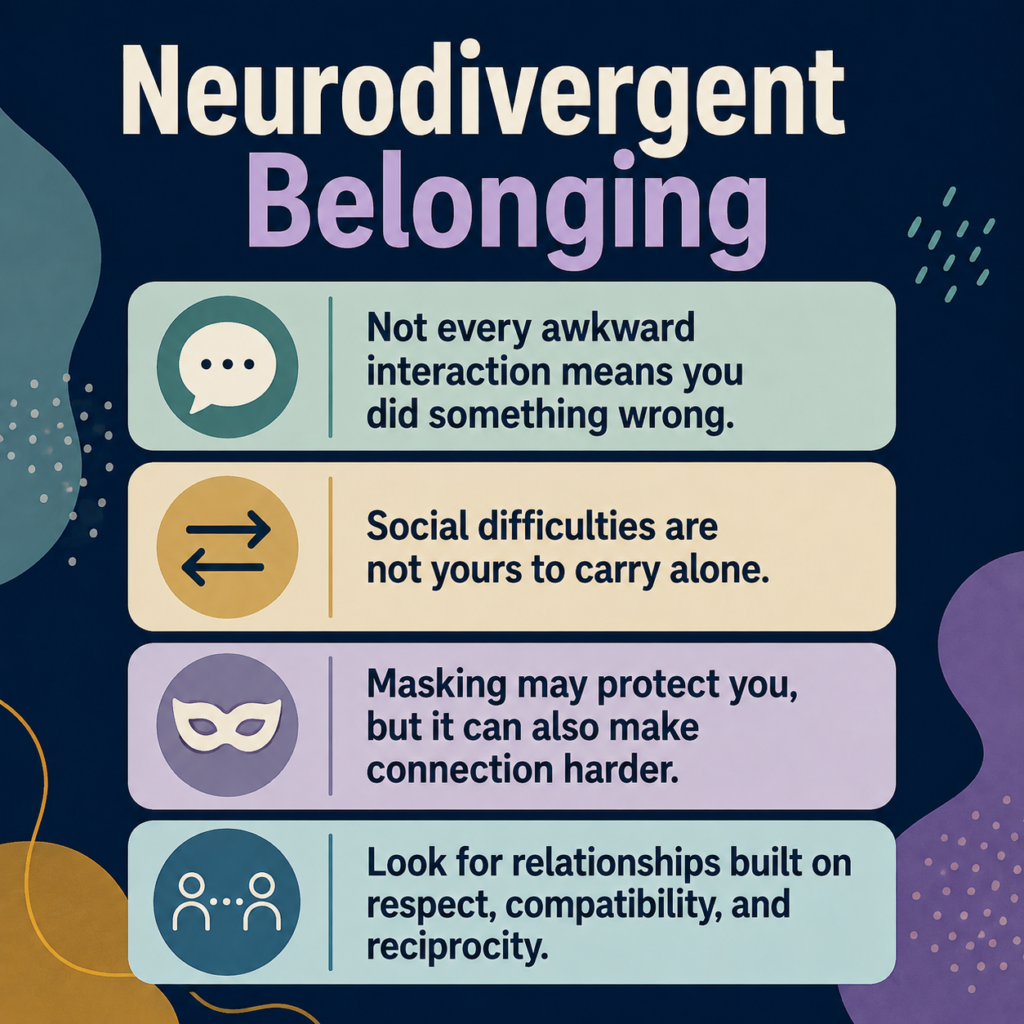
Neurodivergent people may be quick to assume that a difficult interaction reflects something they did wrong. But social communication is shaped by both people.
Your direct question may be interpreted as confrontational. Your enthusiasm may be read as being overly intense. A neurodivergent person’s indirect communication may be difficult to follow. Two people may also simply have different expectations around humor, openness, pacing, or emotional expression.
The double empathy problem offers one way of understanding this. Misunderstanding between neurodivergents and neurotypicals can be mutual rather than the result of a deficit on one side.
Not every unsuccessful interaction needs to be treated as a mistake that must be identified and corrected.
Sometimes the issue is simply a poor interpersonal fit.
Masking can complicate belonging
For people who have experienced frequent rejection, masking may become a form of protection.
As neurodivergents, we often learn to speak less, suppress stimming, avoid discussing your interests, or carefully monitor how we are coming across to avoid being socially punished.
These strategies can certainly reduce social risk, but they can also make genuine connection more difficult, because other people are interacting with a highly managed version of you.
Not that one should abandon caution or disclosing everything immediately. What I’m suggesting is that it might be possible to allow more room, gradually and selectively, for your natural communication style, interests, and preferences to be visible.
Neurodivergent belonging can prove even more difficult to build when acceptance depends entirely on concealment.
Pay attention to compatibility
It can be useful to shift attention away from whether you successfully impressed someone and toward what the interaction was actually like for you.
Were you able to speak without monitoring every sentence? Did the other person show genuine interest? Could a misunderstanding be clarified without becoming a major rupture? Did you feel respected, even when your communication styles differed?
These questions offer information about compatibility rather than social performance.
You don’t need to be equally comfortable with everyone to belong. What is needed, rather, is relationships in which difference can exist without becoming a constant source of tension or judgment.
Wrap Up
After years of difficult social experiences, an awkward interaction can easily feel like confirmation of an old belief about yourself.
It may be more useful to consider a wider range of explanations, such as anxiety, incompatible communication styles, misunderstanding, the social setting, or simply a lack of mutual connection.
Finding meaningful relationships is not only a matter of improving social skill; it also involves finding people with whom understanding, respect, and reciprocity are possible.
Essy Knopf is a therapist who likes to explore what it means to be neurodivergent and queer. Subscribe to get all new posts sent directly to your inbox.