
Recognizing harm when you’re neurodivergent and used to doubting yourself

Essy Knopf neurodivergent self-trust
Reading time: 3 minutes

You tell a friend about something hurtful someone said, only for them to surprise you by explaining that the person is stressed or probably didn’t mean it.

In fact, you already considered that. You’ve spent hours considering it. What you wanted was some acknowledgment of what happened to you.

If you’re autistic or ADHD and accustomed to having your interpretation questioned, this can feel familiar. You leave wondering whether you’ve misunderstood again, even though the same thing keeps happening.

I’ve struggled with this myself. Learning about harmful relationship patterns has helped me make sense of experiences I previously couldn’t explain. It has also raised a question: how much do we need to understand about someone before we’re allowed to protect ourselves?

When Giving the Benefit of the Doubt Becomes a Habit

If you know what it’s like to be misunderstood, you may be reluctant to judge someone else. You remember the times your words came out badly and wish someone had asked what you meant.

That generosity can make it difficult to revise your view of someone who initially seemed caring.

They tell you they respect you, then ridicule a need you’ve shared. You explain why it hurt. They say you’re too sensitive, and you start wondering how you could have explained it better.

You may wind up finding that you’re doing most of the work of keeping the relationship comfortable.

For me, neurodivergent self-trust includes allowing later experiences to change an earlier impression. Someone’s initial kindness is part of the picture. So is how they treat you when you disagree.

Why a label can feel like an answer

After enough confusing interactions, you may start researching. An article about narcissism describes something so familiar that you reread the paragraph.

There can be relief in that recognition: an experience that felt private and inexplicable suddenly has language around it.

I understand the appeal of learning everything you can. Research gives you something to work with when “trust your gut” feels unhelpful, especially if you’ve spent years being told your gut is wrong.

The difficulty comes when identifying a pattern turns into trying to establish a diagnosis. You may spend hours checking criteria while the practical question remains unanswered. Namely, what do you need to do about how this person treats you?

A personality disorder diagnosis does not establish that someone is abusive, and harmful behavior does not establish a personality disorder.

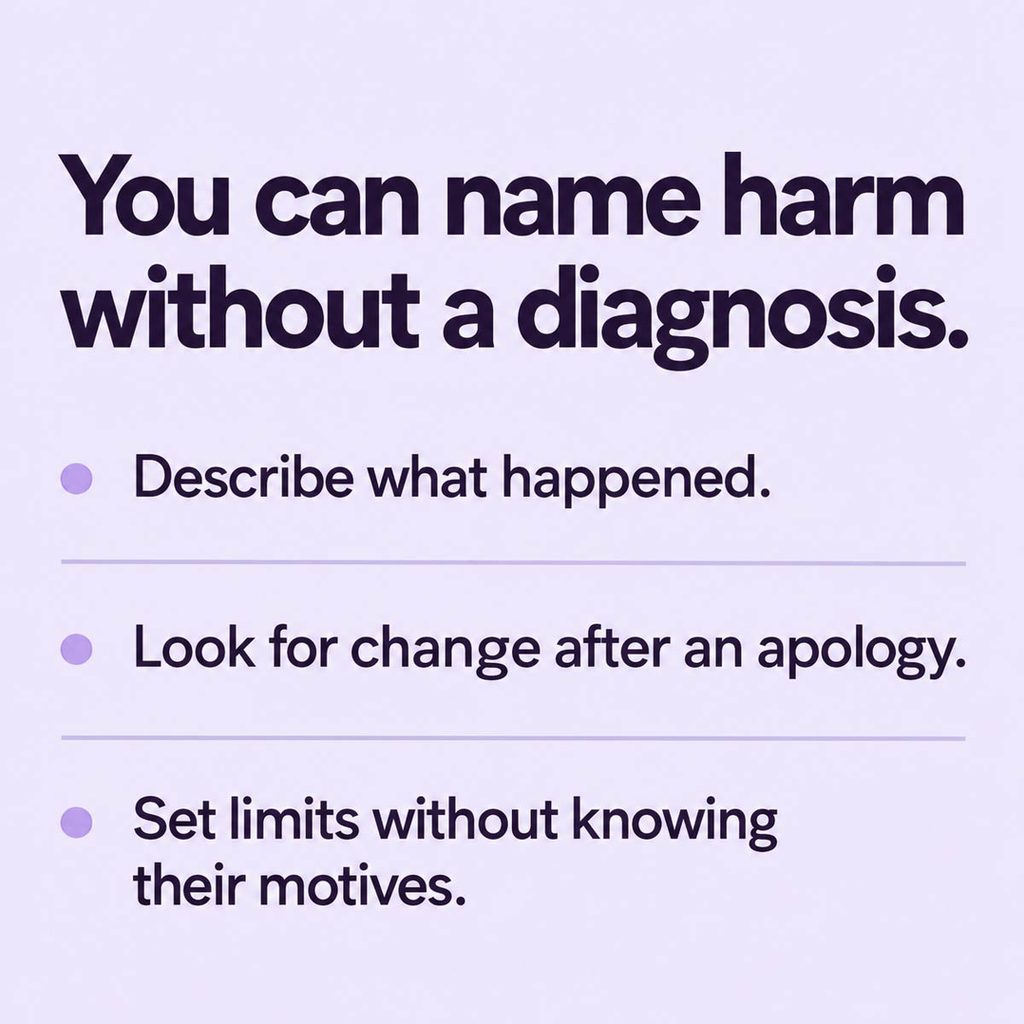
You can take the harm seriously without resolving the diagnosis.

Describe What Keeps Happening

Specific language can help you understand an experience and explain it to someone else.

“They’re toxic” leaves a lot open to interpretation. “They keep making jokes about my disability after I’ve asked them to stop” tells someone what the problem is.

You might notice that:

  • Disagreements repeatedly become attacks on your character.
  • A limit you’ve stated is treated as the beginning of a negotiation.
  • Apologies are followed by the same behavior, without meaningful change.

These observations give you something concrete to consider. You don’t have to know whether someone intended to hurt you to recognize that the behavior is continuing.

There’s also a difference between an awkward interaction and an ongoing pattern. A person can respond badly, reflect, and make a repair. What matters is whether that repair changes your experience of the relationship. A serious incident can warrant action on its own; you don’t have to wait for it to happen again.
Understanding Someone Doesn’t Settle What You Should Accept

Someone may be struggling. Their history may help explain their reactions. You can care about that and still need the behavior to stop.

When other people rush to explain their conduct, it can help to bring the conversation back to what you’re asking for: “I understand they’re having a hard time. I need you to hear that this keeps happening and is affecting me.”

The same applies to your own internal debate. You may never reach certainty about their motives. You can still decide to share less personal information, limit contact, or seek support in working out what feels manageable.

If raising a concern has led to intimidation or retaliation, you don’t owe the person another confrontation to prove you tried hard enough. Consider support from someone you trust or an abuse-informed professional before deciding your next step.

Wrap Up

Learning about harmful relationship patterns can give you language you badly needed. The useful part is what that knowledge helps you recognize and do.

Neurodivergent self-trust leaves room to reconsider your interpretation without automatically discarding it. Your account deserves attention, even when you don’t have a complete explanation for the other person’s behavior.

What helped you take a harmful pattern seriously when you were doubting yourself?

Why neurodivergent people are more vulnerable to abuse

Essy Knopfneurodivergent abuse vulnerability
Reading time: 3 minutes

Have you ever wondered if someone’s treatment of you was really abusive—or if you were just “too sensitive”?

Were you told you misunderstood, even though every part of you was screaming something felt wrong?

If so, you’re not alone—and you’re definitely not imagining it.

Neurodivergent abuse vulnerability is not a question of weakness. It’s a question of how society shapes us to ignore our instincts, misread red flags, and accept mistreatment as normal.

Let’s break down why this happens—and how to start protecting yourself.

The Hidden Ways Ableism Makes Abuse Harder to Spot

Neurodivergents (NDs) often experience delayed processing. That means we might not recognize red flags in real time. When we do realize we were hurt, we’re already doubting ourselves: Was that abuse? Or am I just being dramatic?

This is one of the ways neurodivergent abuse vulnerability shows up—when we’ve been taught not to trust ourselves.

Years of ableist messaging tell us we’re too much, too rigid, too emotional. Our discomfort must be “wrong.” And so we hesitate, minimize, and blame ourselves.

Sensory Overload: A Predator’s Playground

Think about how hard it is to make a clear decision in a loud, chaotic environment. Now imagine trying to detect manipulation or boundary violations in that state.

This is where neurodivergent abuse vulnerability becomes especially dangerous. Our nervous systems go into shutdown mode, and our ability to self-advocate is compromised.

Unfortunately, some people take advantage of this. They push limits when they know we’re overwhelmed and unable to respond. Later, when we replay the interaction in our heads, we realize: That wasn’t okay.

But in the moment? We were just trying to survive the noise.

When Boundaries Were Never Modeled—or Respected

Many NDs grew up being scolded for expressing natural traits. Whether it was stimming, speaking honestly, or needing alone time, we were told it was “wrong.”

When our needs are consistently dismissed, we lose touch with what healthy boundaries even look like.

But if we’re not taught to recognize or defend our limits, it’s far easier for others to cross them. Especially when we’ve been conditioned to equate love with tolerating discomfort.

People-Pleasing Isn’t a Personality Flaw—It’s a Survival Strategy

Masking. Apologizing. Minimizing our needs. These could be perceived as weakness, but they’re actually protective responses to a world that’s made us feel like we’re hard to love.

And they feed into neurodivergent abuse vulnerability by making it easier for others to take advantage of our silence.

We may find ourselves staying in friendships, jobs, or relationships that feel wrong—but leaving feels like we’re being “mean.” So we stay. And hurt.

Why It’s So Hard to Leave

Even when we know we’re being mistreated, taking action can feel like climbing a mountain.

Fear of abandonment and internalized self-doubt all reinforce our vulnerability to abuse. We may even worry that we’re the ones at fault: What if I’m just not good at relationships?

NDs also face extra barriers when asking for help. We might struggle to explain what’s happening in a way others understand—or get dismissed because we don’t present our pain in neurotypical (NT) ways.

This is a major reason why many of us remain in unsafe situations longer than we should.

Essy Knopf neurodivergent abuse vulnerability

You Deserve Safety—Even If It Comes in Small Steps

If something feels off, it is. Your discomfort is valid, even if your reaction was delayed. You don’t have to explain away your gut feelings or rationalize mistreatment. Neurodivergent abuse vulnerability doesn’t mean your experiences are any less real—it just means the world hasn’t made it easy for you to respond in real time.

So what can you do when you’re not sure how to act, or when it all feels too overwhelming?

Start small. You don’t need to have it all figured out. Begin by writing things down—specific situations, words, or behaviors that made you feel uncomfortable. Documenting events helps counter self-doubt and gives you something to refer back to when your mind starts second-guessing itself.

Talk to a trusted friend. Sometimes we need another perspective to validate what we already suspect. Choose someone who listens without judgment and respects your pace. It’s okay if you can’t articulate everything perfectly—just naming that something feels wrong is enough.

Practice simple boundary-setting scripts. Boundaries don’t have to be confrontational. They can be calm, clear, and gentle. Try phrases like:

  • “I need a minute to think before I respond.”
  • “I’m not comfortable with that.”
  • “Can we talk about this another time?”
  • “That didn’t feel okay to me.”

You can even write these down or rehearse them ahead of time. Having a few go-to lines ready makes it easier to respond under pressure—especially when processing takes longer or emotions feel overwhelming.

And remember: just because you didn’t say something in the moment doesn’t mean your boundary wasn’t valid. Your reaction doesn’t have to be immediate to be real.

The goal isn’t to get it “perfect.” It’s to start honoring your own needs and instincts—bit by bit.

Have you ever struggled to trust your instincts in a relationship? What helped you start setting boundaries or recognizing mistreatment for what it was?