When autistic truth is put on trial: Epistemic injustice in therapy

Essy Knopf epistemic injustice
Reading time: 3 minutes

When an autistic person says, “This therapy harmed me,” what happens next matters.

Are they met with curiosity and compassion? Or are they questioned and told they misunderstood what happened?

Too often, autistic people encounter responses like: “That must have been a bad provider.” “ABA isn’t like that anymore.” “You don’t understand the science.” “That wasn’t real ABA.”

These statements may sound reassuring to the person saying them. And yet, to someone describing trauma, they can feel like another form of silencing.

This is where epistemic injustice enters the conversation.

What Is Epistemic Injustice?

Epistemic injustice occurs when someone is unfairly treated as an unreliable source of knowledge. In other words, their account is given less credibility because of assumptions about who they are.

One way this might happen with autistic people is when they are cast by others as confused, overly sensitive, incapable of accurately reading situations, or unable to understand professional practices.

As a result, their firsthand experiences can be treated as less trustworthy than the explanations offered by credentialed professionals.

The professional becomes the expert on what supposedly happened. The autistic person, meanwhile, is treated as an unreliable witness to their own life.

When Credentials Outweigh Lived Experience

Professional training and research have value. However, credentials should never make someone immune to questioning.

When autistic adults describe being traumatized by behavior-based interventions, the first response should never be to audit their memories or defend the reputation of a profession, but to listen.

Yet discussions of harm often shift toward technicalities: Was the provider properly certified? Was the intervention truly ABA? Did the autistic person understand the treatment model?

These questions may be relevant. But when they are used primarily to discredit the person reporting harm, they become a form of reputation management.

The underlying message is painful: If your experience does not fit our model, your experience must be wrong.

Why Epistemic Injustice Causes Harm

Being repeatedly disbelieved can deepen shame, self-doubt, and trauma.

Many autistic people already grow up being told that their perceptions are incorrect. For example, sensory distress may be dismissed as overreacting, while attempts to set boundaries may be interpreted as defiance.

Across our lifetime, this can corrode self-trust. And when therapists and other professionals repeat this pattern, the therapy room becomes yet another environment where neurotypical interpretations are prioritized over autistic reality, and autistic safety.
Listening Does Not Mean Abandoning Science

When autistic folks share their experiences, it should be not regarded as an attack on professions or research, but rather an invitation to ask better questions.

Research data can tell us whether a measurable behavior changed, but it cannot always tell us what that change cost the person emotionally.

A child may appear more compliant in ABA therapy, for example, while becoming more afraid to say no. An autistic person may display fewer visible “problematic” traits such as stimming as a result of such interventions.

Yet underneath the performance there may be an increase in anxiety or disconnection from their identity.

Progress therefore cannot be measured only by how comfortable someone’s behavior makes the people around them. Safeguarding individual well-being is key.

What Neuroaffirming Care Looks Like

Neuroaffirming practitioners do not assume they understand an autistic person’s experience better than the person living it.

Instead, they remain open to feedback, including feedback that challenges their training. They treat lived experience as meaningful evidence rather than an obstacle to professional authority.

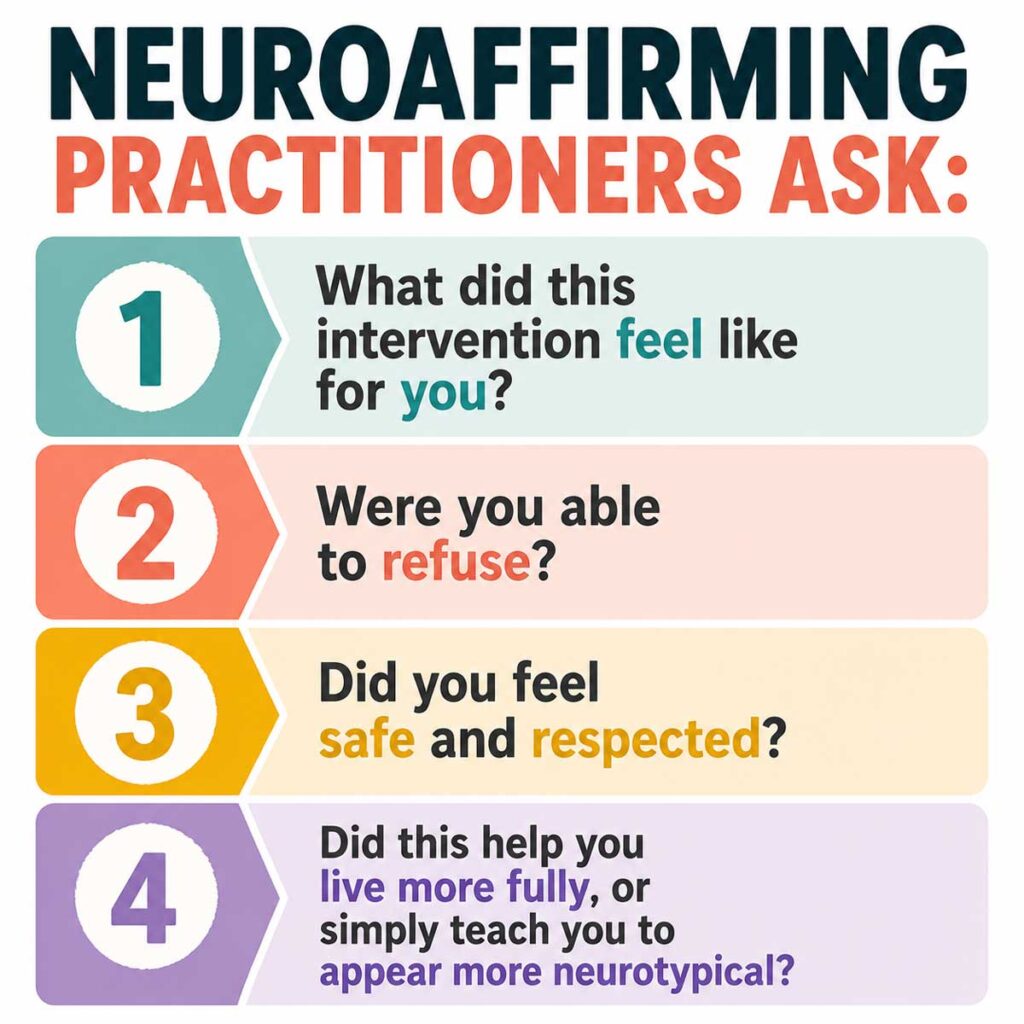
Most importantly, they ask: What did this intervention feel like for you? Were you able to refuse? Did you feel safe and respected? Did this help you live more fully, or simply teach you to appear more neurotypical?

These questions move us away from defensiveness and toward accountability.

Wrap Up

Autistic people should not have to present a courtroom case before their pain is taken seriously.

Addressing epistemic injustice begins with believing that autistic people possess valuable knowledge about their own experiences and recognizing that listening is one of the foundations of good therapy.

Have you ever felt that a professional dismissed or questioned your lived experience as an autistic person?

When neurodivergent fawning becomes self-erasure

Essy Knopf neurodivergent people pleasing
Reading time: 2 minutes

You may have heard of the fight, flight, freeze, and fawn responses. These are natural ways our nervous systems react when we sense danger.

For many neurodivergent people, the fawn response can look like chronic people-pleasing.

Fawning is a form of submission intended to reduce a perceived threat. Figuratively speaking, it is like rolling over and showing your belly to communicate, “I’m not a danger—please don’t hurt or reject me.”

The threat does not have to be physical. It may be the risk of criticism, exclusion, humiliation, job loss, or family conflict.

Many autistic people and ADHDers learn early that pleasing others can offer protection. After being bullied or socially isolated over long periods of time, we may discover that masking our traits and accommodating everyone around us makes life feel safer.

And sometimes, it works.

Neurodivergent people-pleasing may help us remain part of a social group, maintain employment, or preserve important relationships. The problem is what happens when this coping strategy becomes our default.

When we consistently prioritize other people’s comfort, our own needs can disappear from view.

We suppress our reactions. We change how we communicate. We mask, camouflage, and compensate for our neurodivergence in the hope of being accepted.

Over time, this can leave us wondering: Who am I when I’m not performing for someone else?

There is a particular loneliness that comes from being surrounded by people who never truly see you. You may appear socially connected while privately feeling unknown, unworthy, or exhausted.

The fawn response protects us from rejection, but it may also prevent genuine connection.

Moving away from people-pleasing involves staying aware of the social context while making more room for your genuine feelings, preferences, boundaries, and needs.

Authenticity can begin with small choices:

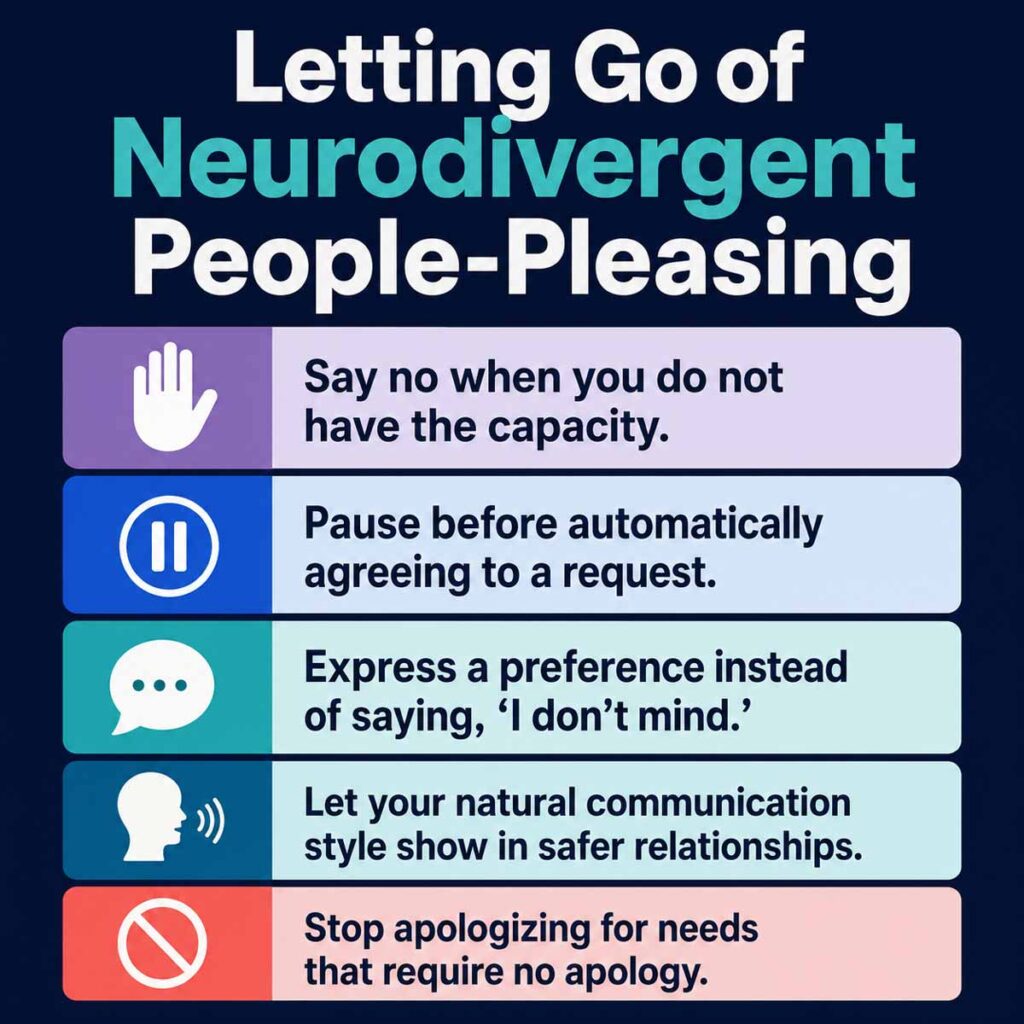
  • Saying “no” when you do not have the capacity.
  • Pausing before automatically agreeing to a request.
  • Expressing a preference instead of saying, “I don’t mind.”
  • Allowing your natural communication style to show in safer relationships.
  • Choosing not to apologize for needs that require no apology.

“No” can be a full sentence. It can also be expressed gently: “I’m not able to do that,” “That doesn’t work for me,” or “I need some time to think.”

Each honest response is an opportunity to remind yourself that your needs matter too.

Letting go of neurodivergent people-pleasing can bring shame and guilt to the surface. An inner critic may warn you that being authentic will make others angry, disappointed, or unwilling to accept you.

That critic developed for a reason: it is trying to return you to a strategy that may once have kept you safe.

Rather than fighting it, you can acknowledge its fear while still choosing a different response.

With practice, authenticity becomes less frightening. Social rejection may still happen, but it becomes easier to recognize that another person’s dislike is not proof of a personal defect.

Essy Knopf neurodivergent people-pleasing

Some people like oranges. Some prefer bananas. Some are allergic to strawberries.

You cannot appeal to everyone—and exhausting yourself through people-pleasing will not change that.

Remember that the fawn response is a coping mechanism many neurodivergent people developed while navigating environments where being different carried real social risks.

Healing involves choosing, interaction by interaction, to stop disappearing—and to let more of your authentic self be seen.

Have you struggled with fawning as a neurodivergent person?

Can generative AI replace therapy for neurodivergents?

Essy Knopf generative AI
Reading time: 2 minutes

There are valid concerns about people using generative AI, such as ChatGPT, as a substitute for therapy.

In crisis situations, it is clearly not enough. If someone is at risk of harming themselves or others, experiencing severe distress, or needing urgent medical or mental health support, they need immediate human intervention.

But for many people—especially autistic and ADHD people—generative AI can still be useful.

It can offer reflection, feedback, affirmation, and help making sense of confusing situations. Many neurodivergents have social interactions they struggle to interpret. We may leave conversations wondering, “Did I say something wrong?” or “What did that person mean?”

AI can help us slow down, organize our thoughts, and look at the situation from different angles.

This can be especially helpful between therapy sessions. Most people only see a therapist once a week, if that. A lot can happen in the days between sessions, and not every question or interaction feels big enough to save for therapy.

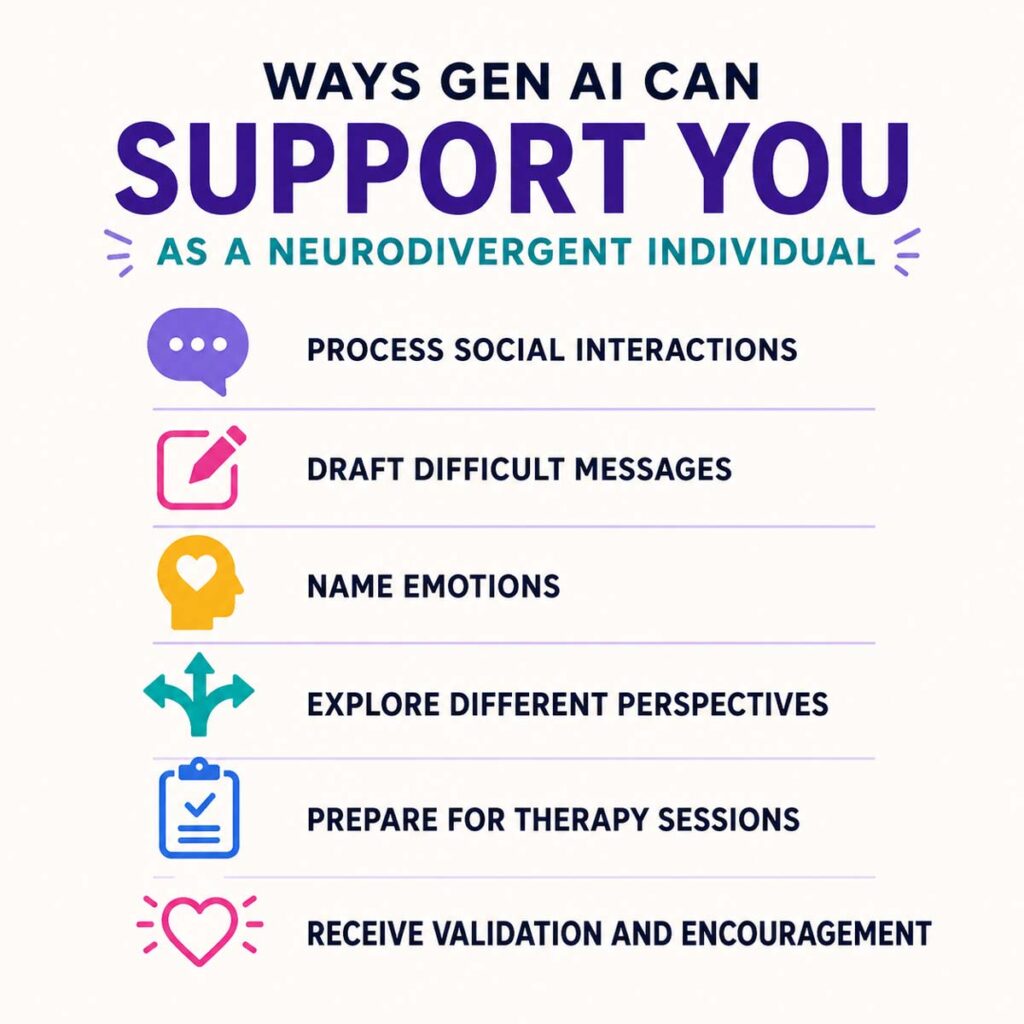
In those moments, AI can fill a gap. It can help with:

  • Processing social interactions
  • Drafting difficult messages
  • Naming emotions
  • Exploring different perspectives
  • Preparing for actual therapy sessions
  • Receiving validation and encouragement

For neurodivergents who do not have access to neuroaffirming therapy, this can be meaningful. Therapy is expensive, waitlists are long, and not every therapist understands autism or ADHD in an affirming way.

From an accessibility perspective, AI support can matter.

If someone feels less alone, more understood, or better able to cope because of AI, I do not think that should be dismissed.

At the same time, AI is not a therapist.

A trained therapist brings clinical experience, ethical responsibility, and real human attunement. They can notice tone, facial expression, body language, emotional shifts, and patterns over time.

Most importantly, therapy is a relationship.

As an attachment-oriented practitioner, I believe the relationship itself is often what heals. A safe therapist can offer co-regulation, presence, warmth, and emotional attunement in a way AI cannot.

AI can give helpful words, but it cannot fully replace the experience of being seen and supported by another human being.

AI can also be too agreeable. It may confirm your existing perspective instead of gently challenging it. This can create an echo chamber, especially when you are asking about relationships or conflict.

Which is why it’s important to ask AI to push back kindly.

Essy Knopf generative AI therapy

For example: “Can you validate my feelings but also tell me what I might be missing?” “Can you give me another possible interpretation?” “Can you offer constructive criticism in a compassionate way?”

When balanced, such tools can offer reflection, structure, and affirmation in moments when therapy is unavailable or inaccessible. Used carefully, it can help bridge the gap between needing support and being able to access it.

The key is knowing what AI can and cannot provide.

Have you used generative AI for therapy-related support? What helped, and what felt missing?

When you can’t be productive, but can’t relax either as a neurodivergent

Essy Knopf neurodivergent productivity guilt
Reading time: 2 minutes

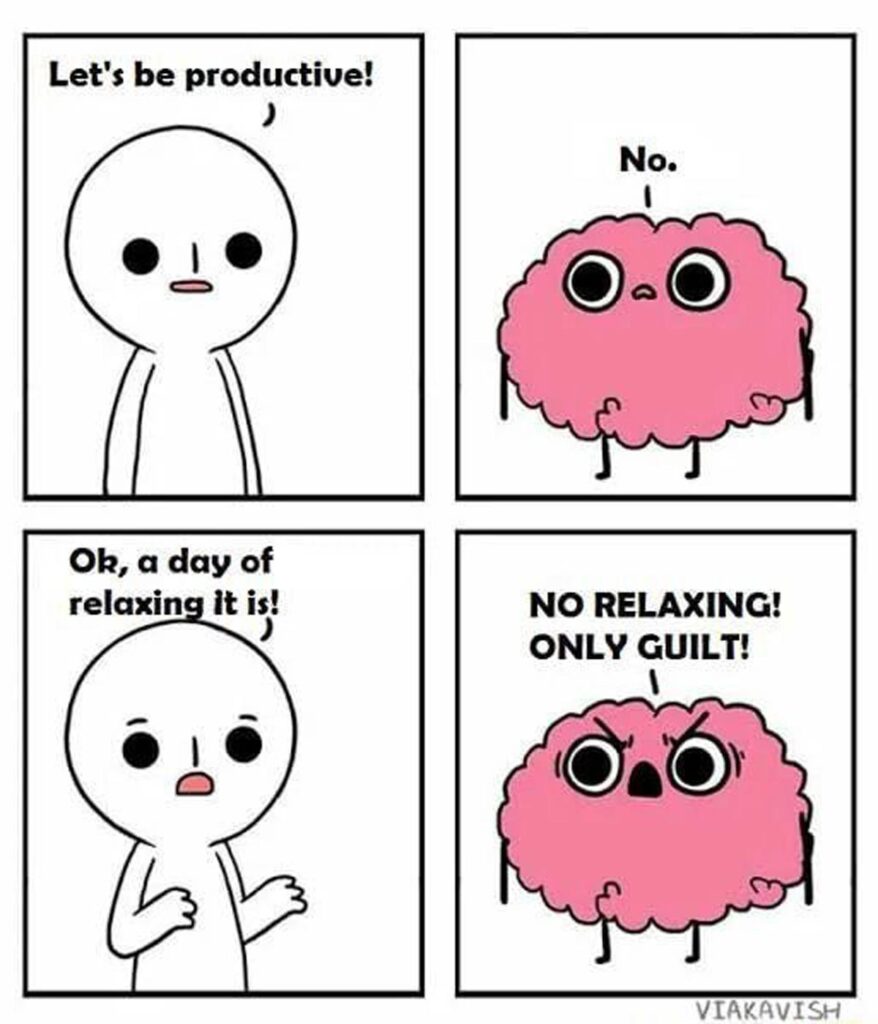
There’s a meme where someone says to their brain, “Let’s be productive.”

The brain says, “No.” So the person says, “Okay, a day of relaxing it is!”

And the brain replies, “No relaxing! Only guilt!”

If you are neurodivergent, this may feel painfully familiar.

You cannot start the task, but you also cannot enjoy the break. You are stuck in the middle: not working or resting, but feeling bad about both.

This is neurodivergent productivity guilt.

For many ADHDers and some autistics, the brain seeks stimulation, novelty, urgency, and reward. Productivity can provide that.

A deadline gives structure; a task gives direction; a completed project gives a hit of satisfaction.

Essy Knopf neurodivergent productivity guilt

So productivity goes from being a habit, to becoming a way to regulate.

Many neurodivergent people grow up feeling “behind,” “too much,” “lazy,” “scattered,” or “not good enough.”

This can be a result of internalized ableism. In such instances, productivity can become a way to compensate.

You may start to believe: If I do enough, I can prove I’m worthy. If I stay useful, no one can criticize me. If I keep producing, I won’t have to feel ashamed.

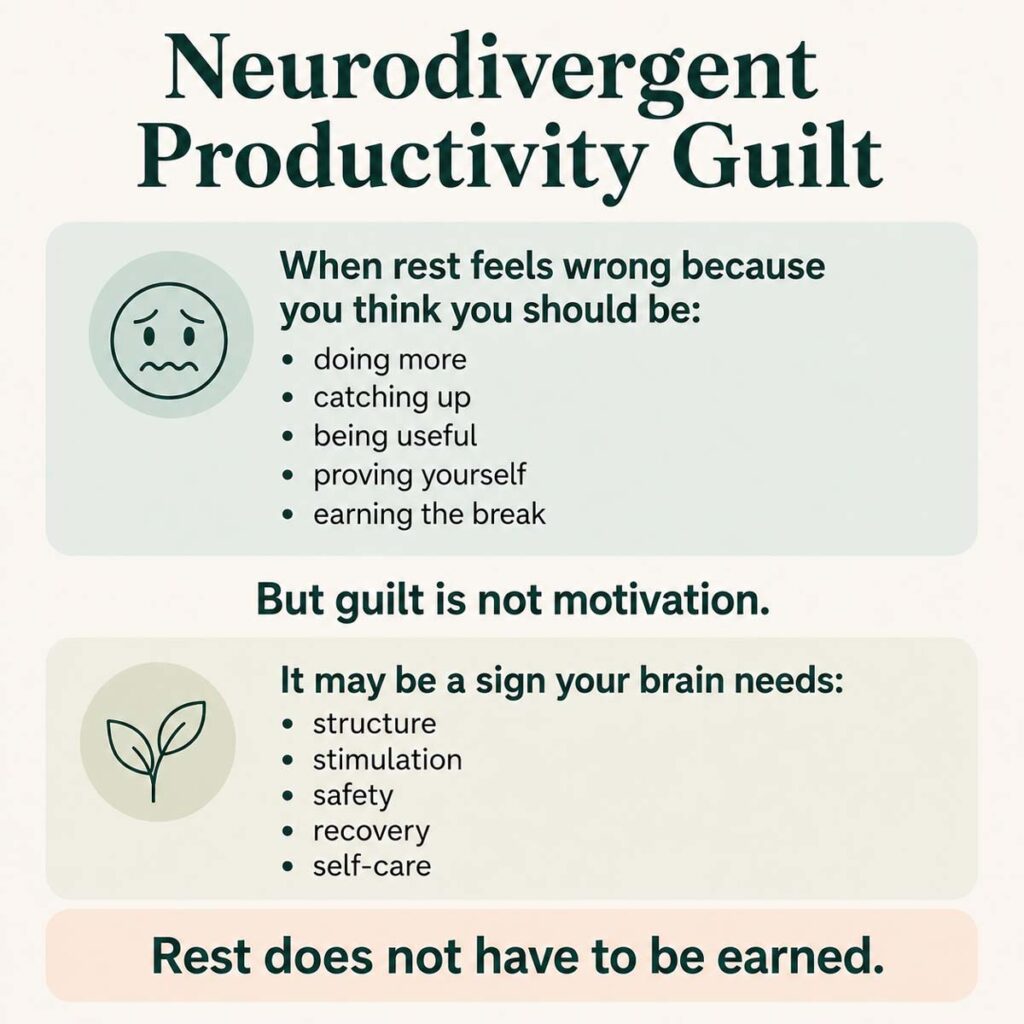
That is where neurodivergent productivity guilt becomes painful, and rest starts feeling like failure.

Unstructured time can be hard for autistic and ADHD brains.

Without a clear plan, the mind may start spinning. You may feel restless, guilty, anxious, or even empty.

Essy Knopf neurodivergent productivity guilt

It may mean your brain needs support transitioning out of “doing mode,” and that rest may need to be structured structure.

Forcing yourself into silent, motionless relaxation may not work for your brain.

Instead, try rest that still gives your nervous system something gentle to hold onto. For example, you may:

  • Listen to an audiobook while lying down.
  • Take a walk without turning it into exercise.
  • Watch a familiar show.
  • Sit outside for ten minutes.
  • Use a weighted blanket.
  • Do a low-effort hobby.
  • Play a cozy game.

Neurodivergent productivity guilt can make you feel trapped between doing and resting. But that guilt may be a sign that your brain is still learning how to feel safe when you slow down.

Have you experienced the “no productivity, no relaxing, only guilt” spiral?

Navigating social niceties as a neurodivergent

Essy Knopf neurodivergent social cues
Reading time: 2 minutes

When I lived in LA, I frequently encountered something I called “California nice.”

Strangers would chat with me at ice cream shops, supermarkets, beaches—almost anywhere. They were often warm, open, casual, and easygoing. They talked as though we already knew each other.

And honestly? It was lovely.

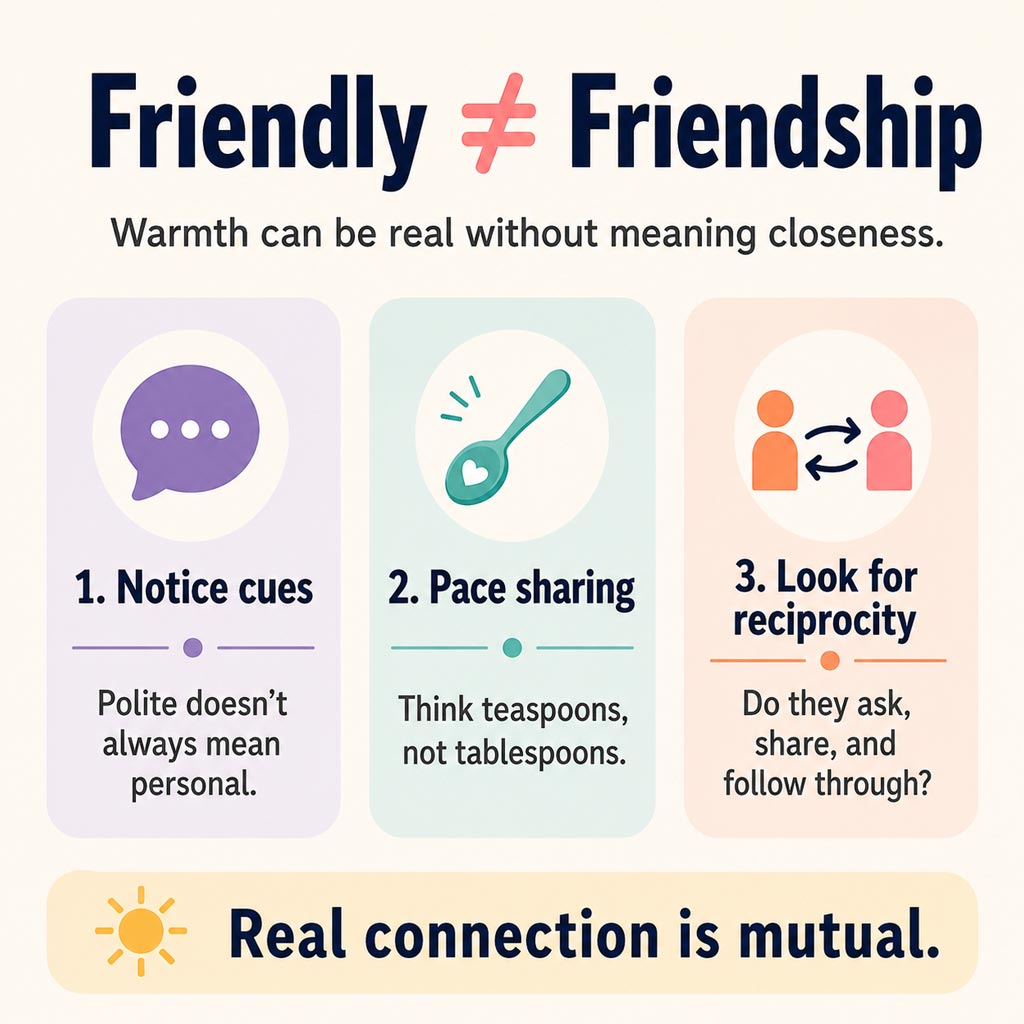
But as a neurodivergent, I learned quickly that friendliness didn’t always mean openness to friendship.

Someone might say, “We should totally hang out sometime,” and I would think, Ah. So we are absolutely not going to hang out.

Maybe they meant it, and maybe they didn’t. But I had no reliable way of knowing, so I treated it as social decoration: pleasant, but not necessarily meaningful.

The Confusion of Social Grooming

Many neurodivergents encounter some version of “California nice,” whether or not they live anywhere near California.

People smile, ask questions, say kind things, and perform warmth.

Often, it’s hard to know whether these social cues reflect genuine interest or simply ritualistic responses. Sometimes it’s just the social currency of the moment.

For autistic and ADHD people, this can be incredibly confusing. We may wonder: Is this person actually interested in me? Are they inviting closeness, or just being polite? Can I be myself here, or will that be “too much”?

The stakes can feel high because opening up to the wrong person can be painful.

Maybe we share too much too soon, start talking passionately about a special interest, or be direct, intense, blunt, darkly funny, or emotionally honest before the other person is ready.

And suddenly, what felt like connection becomes distance.

Try the Relay Race Approach

One helpful strategy is to treat conversation like a relay race.

In a relay race, you don’t hold onto the baton forever. You run your stretch, then pass it on.

Conversation can work the same way.

You share a little. They share a little. You ask something. They respond.

You offer one small piece of yourself. Then you pause and see what they do with it.

Think teaspoons, not tablespoons.

Instead of pouring out your whole inner world at once, you offer small amounts and watch for reciprocity. Do they ask follow-up questions? Do they share something personal too? Do they seem curious, comfortable, and engaged?

The key here is to pace revealing who you are so you can gather information and protect your nervous system.

Essy Knopf neurodivergent social cues

Pacing Can Create Safety

For many neurodivergents, social success is about finding ways to connect that don’t require abandoning ourselves.

Pacing gives us room to notice whether someone is capable of meeting us with curiosity, respect, and care. It helps us avoid the painful experience of offering vulnerability to people who only meant to exchange politeness.

And when someone does respond warmly—when they pick up the baton and pass it back—that’s useful information.

That may be someone worth getting to know.

Wrap Up

Navigating neurotypical social niceties can feel like trying to decode a language where half the words are implied and the rules keep changing.

But with social pacing, we can move more gently, protect ourselves from unnecessary hurt, and still leave space for real connection.

Have you ever struggled to tell the difference between friendliness and genuine friendship?

Neurodivergent cultural wealth: The hidden knowledge autistic and ADHD people carry

Essy Knopf neurodivergent cultural wealth
Reading time: 4 minutes

From an early age, many autistic and ADHD people learn to see themselves through a lens of lack.

We interrupt without meaning to—and spend the rest of the day wondering if we annoyed someone. We need three alarms to get out the door and still somehow leave our coffee on the kitchen counter. We become intensely excited about a topic, only to watch someone’s eyes glaze over halfway through our explanation.

We cry when we’re overwhelmed. Or shut down completely. We forget what we came into the room for. We miss the hidden meaning everyone else seemed to catch.

And often, we’re told these differences are problems.

By the time many of us discover we’re neurodivergent, we’ve already internalized years of criticism, misunderstanding, and pressure to be someone else. We’ve learned to mask, compensate, and apologize for taking up space.

But what if we’ve been looking through the wrong lens all along?

What Is Neurodivergent Cultural Wealth?

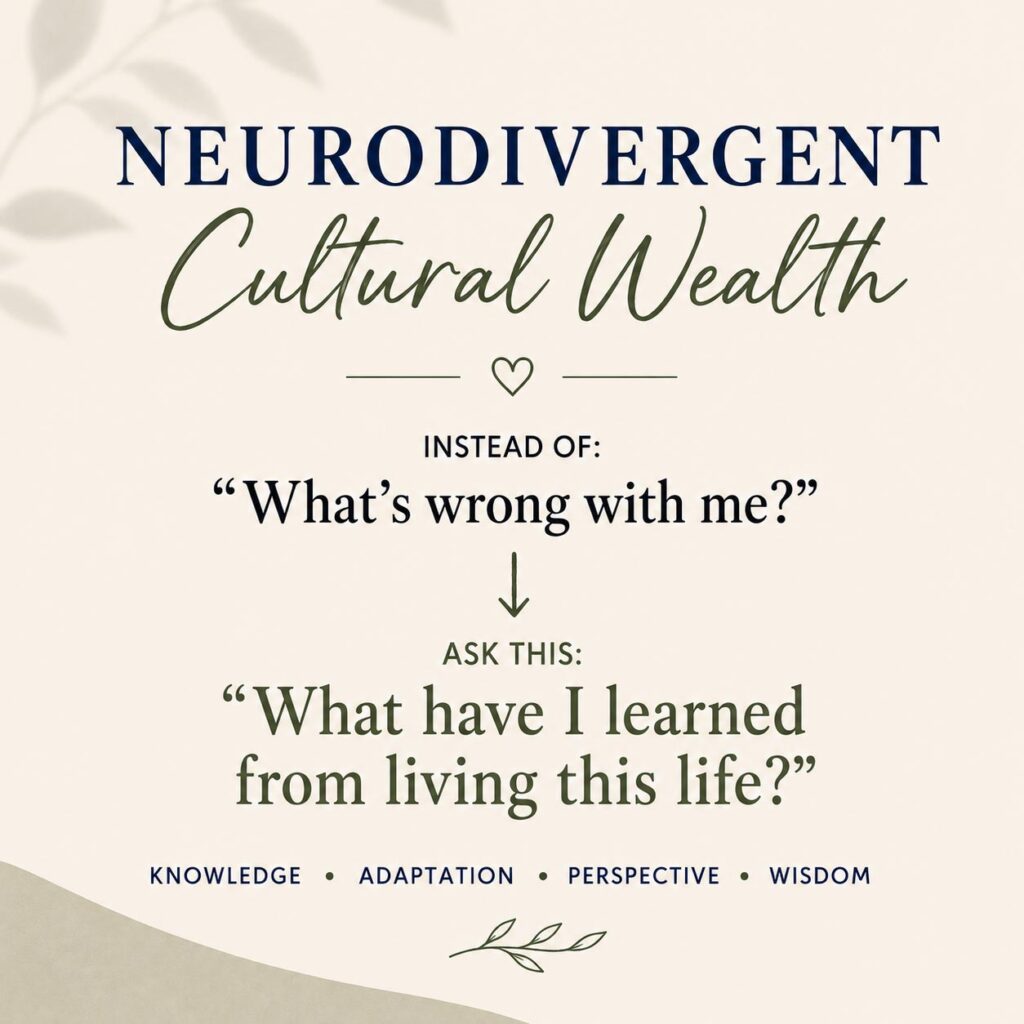
I use the term neurodivergent cultural wealth to describe the knowledge, adaptation, perspective, and wisdom that autistic and ADHD communities develop while navigating a world that often misunderstands them.

The concept is inspired by educational researcher Tara Yosso’s Community Cultural Wealth framework, which challenged the assumption that marginalized communities lack valuable forms of knowledge and resources.

Similarly, neurodivergent cultural wealth invites us to question the idea that autistic and ADHD people should primarily be understood through deficits, impairments, or limitations.

Instead, it asks a different question: What knowledge emerges from living a neurodivergent life?

What forms of wisdom are passed between members of neurodivergent communities?

What strengths develop through years of adaptation, self-discovery, and resistance?

These are the questions at the heart of neurodivergent cultural wealth.

The Problem With Deficit-Based Thinking

Much of society still views autism and ADHD through a deficit-based framework.

Schools, workplaces, healthcare systems, and even mental health services often focus on what neurodivergent people cannot do rather than what they contribute.

This perspective obscures neurodivergent cultural wealth by treating difference as deficiency.

When every challenge is highlighted while every adaptation goes unnoticed, it’s easy to overlook the remarkable forms of knowledge that autistic and ADHD people develop throughout their lives.

Knowledge Born From Adaptation

Yet neurodivergent communities have never been defined solely by struggle.

For generations, autistic and ADHD people have been adapting to environments that weren’t built with us in mind. We’ve learned to navigate sensory overload in fluorescent-lit classrooms. To survive workplaces that reward social performance over actual competence. To decode unwritten social rules that everyone else seemed to receive a handbook for.

And in the process, we’ve developed knowledge.

For example, many neurodivergent people become skilled observers. When social interactions don’t come naturally, you pay attention and look for patterns.

You begin paying attention to things many people take for granted. Sometimes it’s tone of voice. Sometimes it’s routines, social patterns, inconsistencies, or unspoken expectations.

You learn things most people never have to think about.

Similarly, many of us become experts in our own minds.

When everyday tasks seem inexplicably difficult, you start asking questions.

Why can I spend six hours researching a niche topic but struggle to answer an email?

Why does a crowded restaurant leave me exhausted?

Why do certain sounds feel unbearable?

Why does a change in routine throw off my entire day?

Years spent wrestling with these questions often lead to a level of self-understanding that isn’t always appreciated by the wider world.

This is neurodivergent cultural wealth: the knowledge that emerges from living a neurodivergent life.

The Wisdom of Community

But that knowledge isn’t developed in isolation.

One of the most powerful aspects of neurodivergent cultural wealth is what happens when neurodivergent people find one another.

Spend enough time in autistic and ADHD spaces and you’ll notice something remarkable.

Someone mentions struggling to brush their teeth consistently, and suddenly a dozen people are sharing workarounds.

Another person talks about sensory overwhelm, and others immediately understand without needing an explanation.

A third admits they’re exhausted from masking, and instead of judgment, they’re met with recognition.

What emerges from these conversations is collective wisdom.

Knowledge gets passed from one person to another. Strategies are shared. Language develops. Experiences that once felt isolating suddenly make sense.

Many of us spend years believing we’re the only ones who think a certain way.

Community reveals otherwise.

Seeing the World Differently

Neurodivergent cultural wealth also shows up in the questions we ask.

Living outside the norm often gives you a different vantage point from which to view the world.

You start noticing assumptions that others take for granted.

Why should eye contact determine whether someone is trustworthy?

Why is small talk considered a prerequisite for connection?

Why is productivity treated as a measure of human worth?

Why are some forms of communication considered valid while others are dismissed?

These questions are the product of seeing the world from a different angle.

And sometimes that different angle reveals things that everyone else has overlooked.

Beyond Deficits and Limitations

None of this means autism and ADHD are free from challenges.

Many neurodivergent people experience significant disability. Executive dysfunction, sensory sensitivities, burnout, social misunderstanding, and co-occurring mental health challenges can have a profound impact on daily life.

Recognizing neurodivergent cultural wealth isn’t about denying those realities.

Rather, it’s about refusing to let them tell the whole story.

Because when we focus exclusively on deficits, we miss something important.

We miss the resilience required to keep showing up in spaces that weren’t designed for us.

We miss the creativity involved in finding alternative ways of learning, working, and communicating.

We miss the insights that emerge from seeing the world differently.

And we miss the knowledge that neurodivergent communities have been generating and sharing all along.

Wrap Up

For much of our lives, many of us have been taught to ask: “What’s wrong with me?”

Neurodivergent cultural wealth invites a different question: “What have I learned from living this life?”

“What wisdom have I gained?

“What strengths, perspectives, and forms of knowledge have emerged because of my neurodivergence?

The answers may be far richer than we’ve been led to believe.

Download The Neurodivergent Cultural Wealth Framework

What forms of neurodivergent cultural wealth do you see in yourself or your community?

Neuroaffirming care principles: Understanding the person behind the behavior

Essy Knopf neuroaffirming care
Reading time: 2 minutes

A lot of neurodivergent people spend years being told their struggles exist entirely inside them.

The environment disappears from the conversation.

A child overwhelmed by noise becomes “disruptive.”

An exhausted employee becomes “unmotivated.”

A shutdown becomes “noncompliance.”

A person communicating directly becomes “rude.”

The context surrounding the behavior often gets ignored.

But many neurodivergent people are navigating chronic sensory stress, masking, social monitoring, unpredictability, exclusion, and nervous-system exhaustion long before they ever enter a therapist’s office or classroom.

Part of the problem is that many systems confuse functioning with well-being.

Someone may look successful while living in constant hypervigilance.

They may appear socially skilled while suppressing confusion, sensory pain, exhaustion, or panic every day.

They may be praised for coping while burning out.

After enough conversations like these, I put together Principles of Neuroaffirming Care to explore these ideas more directly.

“Outward functioning can hide enormous internal strain.”

“What gets labeled ‘high functioning’ is sometimes a person surviving through relentless self-suppression.”

“The goal is not to produce more compliant neurodivergent people.”

Many neurodivergent people learned early that acceptance depended on becoming easier for other people to manage.

So they adapted, rehearsing conversations beforehand.

Forced themselves through overwhelming environments Learned to hide distress or stopped asking for help.

Became perfectionists because mistakes often led to humiliation.

Those survival strategies can become so automatic that people stop recognizing how much effort everyday life actually requires.

Neuroaffirming care means taking those realities seriously.

It means recognizing that distress often makes sense once the environment is taken seriously too.

It means understanding that a person should not have to override their nervous system just to be treated with patience, dignity, or respect.

And it means shifting the goal of support away from normalizing people and toward helping them build lives that are sustainable, accessible, and fully their own.

Download the Full Principles of Neuroaffirming Care

What changes when we stop asking whether somebody looks functional, and start asking whether their life actually feels livable?

Why neurodivergent birthdays can feel so complicated

Essy Knopf neurodivergent loneliness
Reading time: 2 minutes

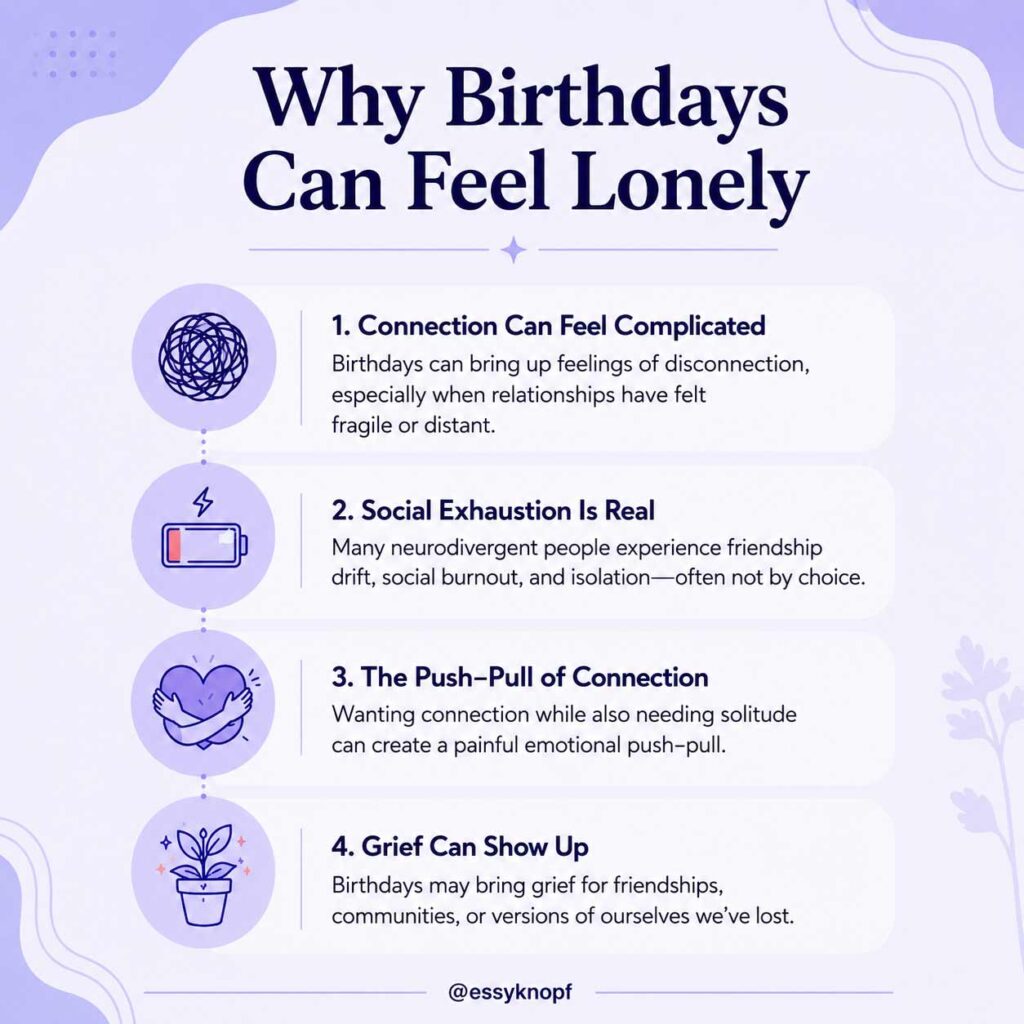
For many people, birthdays are about celebration. But for many autistics and ADHDers, they can also become reminders of how fragile connection can sometimes feel.

A birthday is rarely just about getting older. It’s about belonging. About having people to mark the occasion with. And when your relationships have often been transitory, inconsistent, or shaped by years of masking and social exhaustion, birthdays can bring complicated emotions to the surface.

Many neurodivergent people grow up feeling like outsiders. Some prefer solitude because social interaction is draining. Others want connection deeply, but struggle with social anxiety, fear of rejection, or the exhausting pressure to perform neurotypical social norms.

Then there’s friendship drift—the phenomenon where relationships fade once the shared environment that held them together disappears. School ends. Jobs change. People move away. Communication slowly becomes less frequent until one day you realize someone important is no longer part of your life.

This experience isn’t exclusive to neurodivergent people, but it can feel especially intense for those of us who already struggle to find a sense of community or social ease.

That’s where neurodivergent loneliness can hit hardest.

Birthdays can become reminders of the people who used to be there. The friendships that faded. The community you wish you had. Or the version of yourself that believed connection would someday become easier.

At the same time, many neurodivergent people genuinely need solitude to recharge. That tension—wanting connection while also feeling overwhelmed by it—can create a confusing emotional push-pull that others may not fully understand.

But birthdays don’t have to look conventional to be meaningful.

Essy Knopf neurodivergent loneliness

Sometimes celebration is quiet. For example: a favorite comfort meal, a walk in nature, time spent with one safe person, or a peaceful evening without demands or masking.

That still counts as celebrating your life.

If birthdays feel emotionally complicated for you, you’re far from alone. Neurodivergent loneliness is real and shaped by experiences that often go unseen by others.

What has your experience with birthdays been like? Have they felt joyful, lonely, overwhelming, or all three at once? Share your thoughts in the comments.

The neurodivergent manifesto: For anyone who learned to hide themselves

Essy Knopf neurodivergent manifesto
Reading time: < 1 minute

Over the years, I’ve worked with a lot of neurodivergent people carrying the same fear: that their struggles meant something was fundamentally wrong with them.

They spent years being treated like their differences were problems to fix, hide, overcome, or apologize for.

People pushing themselves to exhaustion trying to seem “normal.”

People becoming experts at looking “fine.”

People hiding overwhelm, confusion, sensory pain, emotional intensity, or support needs because they were afraid of how others would react.

After enough conversations like these, I started writing something that eventually became The Neurodivergent Manifesto.

Part of it reads:

“We are not failed neurotypical people.”

“A person can struggle and still deserve dignity.”

“We deserve lives that do not require self-erasure.”

A lot of neurodivergent people learn early that authenticity comes with consequences.

As a result, they adapt.

They monitor themselves constantly. Rehearse conversations. Hide stress. Push through overload. Suppress needs. Become whoever other people seem most comfortable with.

Essy Knopf neurodivergent manifesto

And after doing that long enough, many end up carrying a deep sense of shame without fully realizing where it came from.

The problem was never simply being different, but rather existing in environments where difference was treated like failure.

Download the Full Neurodivergent Manifesto

What would change if you no longer treated your needs, limits, or differences as something shameful?

Why explicit communication matters in neurodivergent relationships

Essy Knopf explicit communication
Reading time: 2 minutes

A lot of relationships slowly break down because crucial conversations never happen.

Needs go unspoken. Expectations remain unclear. Hurt feelings are sensed but never addressed, while frustration and emotional distance build beneath the surface.

This can be especially true in neurodivergent relationships, where communication styles may differ significantly. One person may communicate directly and literally, while the other relies more on tone, implication, or indirect emotional cues.

As a result, both people may believe they’re being clear while still misunderstanding each other completely.

This dynamic is often linked to what’s known as the double empathy problem: the idea that communication breakdowns happen both ways between neurodivergent and neurotypical people, rather than one person simply “failing” socially.

For many neurodivergent people, conflict itself can feel overwhelming. Fear of rejection, criticism, or emotional invalidation may lead us to avoid difficult conversations altogether. We might people-please, withdraw, or hope the tension simply disappears on its own.

But unspoken problems rarely stay small.

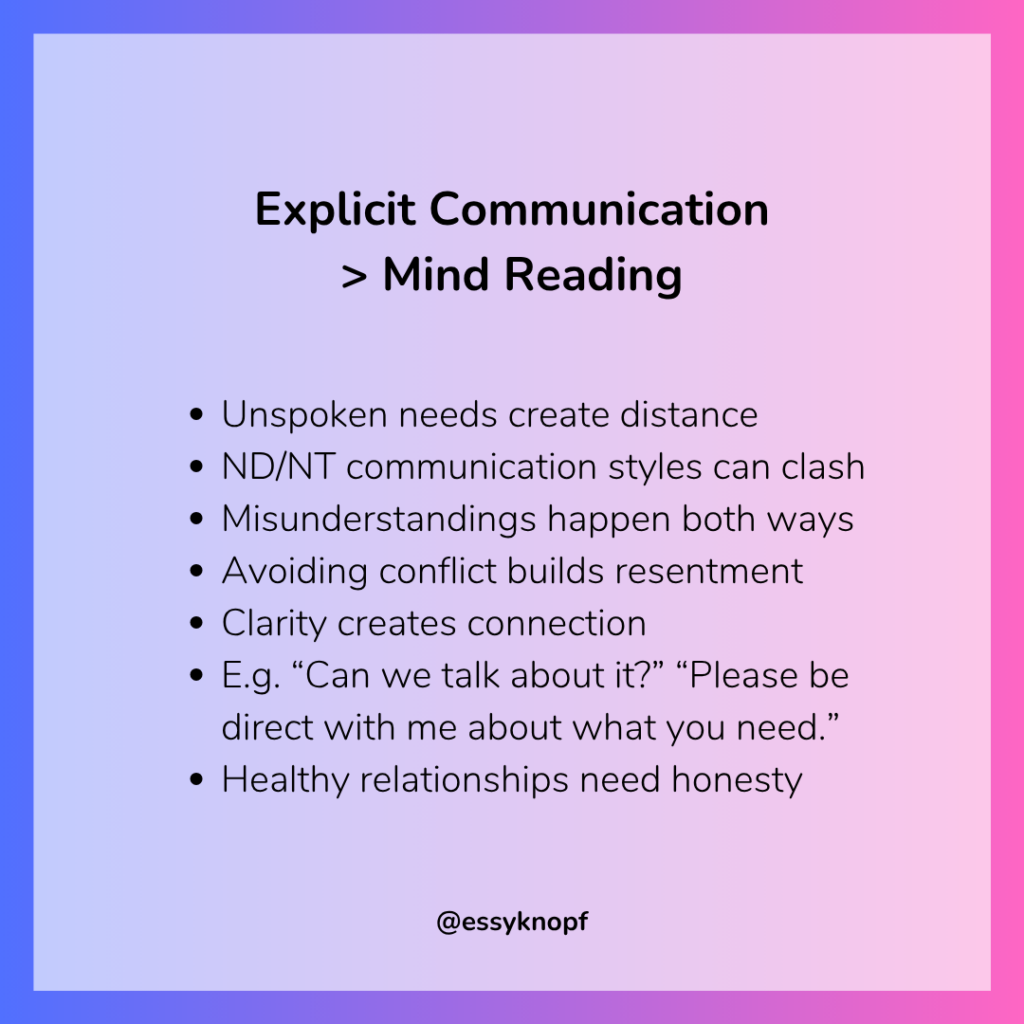
This is where explicit communication becomes so important. Saying things clearly and openly can reduce confusion and prevent resentment from growing in the background.

Sometimes that means saying:

  • “When you went quiet earlier, I started worrying you were upset with me. Was that the case?”
  • “I’m sensing tension between us, and I’d rather talk about it than make assumptions.”
  • “I need clearer communication right now because I’m struggling to read between the lines.”
  • “When plans change suddenly, I feel anxious and disconnected. Can you give me more warning next time?”
  • “I know you may not have intended it this way, but I felt hurt by what happened.”
  • “I’m feeling emotionally overwhelmed and need reassurance that we’re okay.”
  • “Can we talk about what each of us expects here instead of assuming we’re on the same page?”
  • “I’m avoiding this conversation because I’m scared of conflict, but I still think it’s important we have it.”

These conversations may feel vulnerable, especially if past experiences taught us that honesty leads to conflict or shame. That said, vulnerability also creates the possibility for understanding and repair.

Essy Knopf explicit communication

Through explicit communication, we can create enough clarity and safety that both people feel seen, heard, and emotionally understood.

Healthy relationships likewise often depend less on mind-reading and more on the willingness to communicate openly and compassionately. The conversations we avoid are sometimes the very ones that could bring us closer together.

Have you experienced communication mismatches in relationships?