

When a hug doesn’t feel comforting: Neurodivergence, touch, and consent


Someone leans in and asks, “Can I give you a hug?” It’s meant to be comforting, maybe even healing.
But instead of warmth, your nervous system responds with alarm.
Do I have to? Will I seem rude if I say no? What if they think I don’t care about them?
For many autistic and ADHD people, seemingly simple gestures like hugs, handshakes, and pats on the back come with sensory discomfort, social expectations, and a lifetime of pressure to respond the “right” way.
When Touch Comes With an Invisible Social Script
Hugs and handshakes carry meaning.
A hug might communicate affection, reassurance, or connection. A handshake might signal politeness or respect.
Because these gestures are so normalized, declining them can feel surprisingly difficult.
You may not actually want the hug—but you also don’t want to hurt someone’s feelings. Which is why you might want to say yes.
You tense your body, endure the contact, smile afterward, and hope nobody notices how uncomfortable you were.
For some neurodivergent people, this becomes another form of masking: suppressing your natural response so other people remain comfortable.
Touch Can Feel Very Different in a Neurodivergent Body
Sensory experiences vary enormously from person to person.
A hug that feels soothing to someone else might feel irritating, invasive, or overwhelming to you. A handshake introduces all kinds of unpredictable and uncomfortable sensations, such as pressure or moisture.
Even an unexpected pat on the shoulder can leave some people feeling unsettled long after the other person has forgotten it happened.
At the same time, being touch-sensitive doesn’t necessarily mean disliking all touch.
You might dislike light touch but enjoy firm pressure. You might love hugs from someone you trust but dislike being hugged unexpectedly. Or you might enjoy touch one day and find the exact same gesture unbearable when you’re already overstimulated.
The important distinction is choice.
Touch tends to feel very different when you want it, expect it, and have some control over how it happens.
The Cost of Always Saying Yes
Many neurodivergent people learn early that their boundaries will not always be understood.
We hear messages like: “It’s only a hug.” “Don’t be so sensitive.” “They’re just trying to be nice.”
Eventually, those messages can become internal ones. You may start telling yourself that refusing physical affection makes you difficult, cold, or ungrateful.
So instead of asking, What does my body actually want? you ask, What response will make everyone else comfortable?
Repeatedly overriding yourself can make it harder to recognize your own preferences at all.
That’s one of the hidden costs of masking: you can become so practiced at performing comfort that you lose touch with whether you actually feel comfortable.
Try Modulating Instead of Masking
There is another option. I call it modulating.
Masking means suppressing yourself to meet someone else’s expectations. Modulating means finding a way to participate in connection while still respecting your own needs.
Instead of enduring a hug you don’t want, you might say: “I’m not much of a hug person, but I’m really happy to see you.”
You might offer a fist bump instead of a handshake. You might prefer a side hug. Or, with someone you trust, you might explain that firm pressure feels much better than a light embrace.
Modulation gives you permission to move away from an all-or-nothing choice between complete compliance and complete withdrawal.
You can still connect. You just get to have some say in how that connection happens.
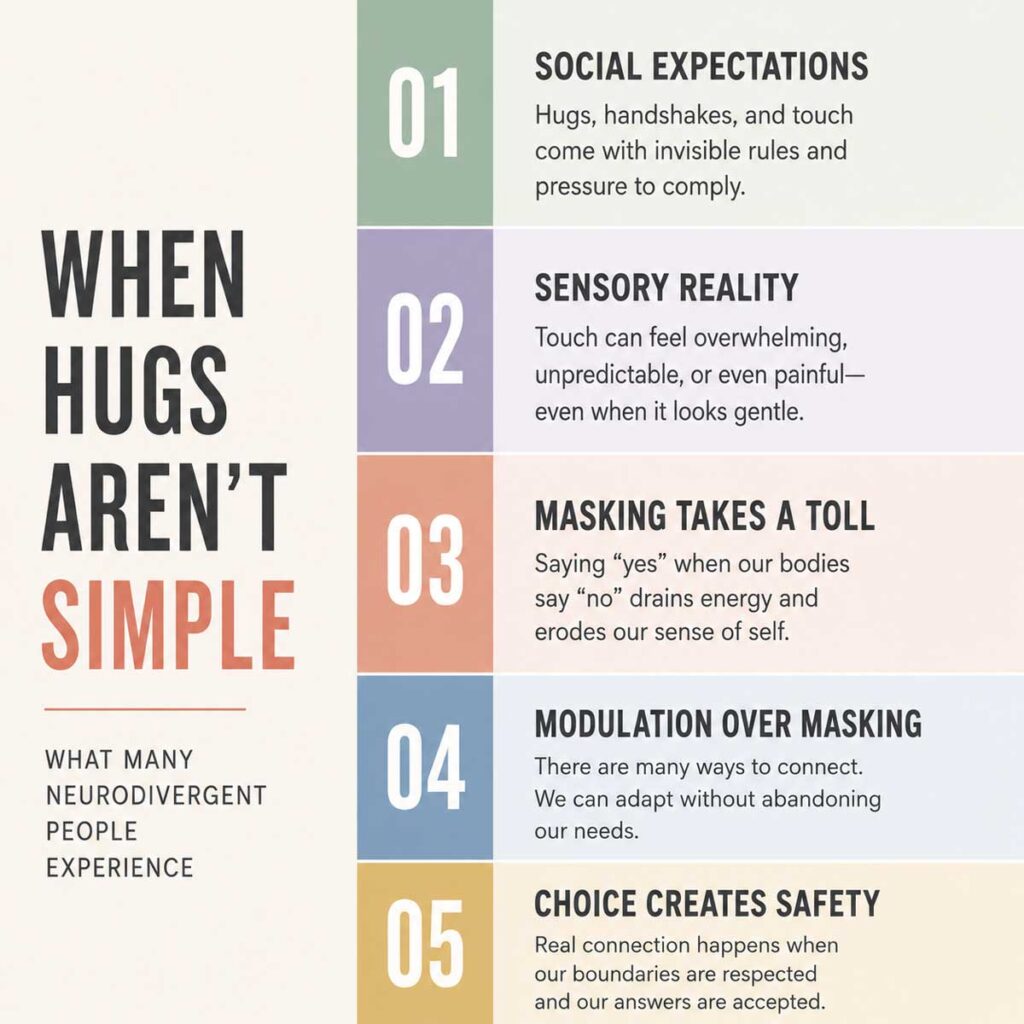
Consent Means the Answer Can Be No
Asking “Would you like a hug?” is only meaningful if saying no is genuinely acceptable.
Consent isn’t just about asking the question. It’s about respecting the answer without sulking, demanding an explanation, or treating someone’s boundary as rejection.
“No thanks.” “Not today.” “I’d rather fist bump.” Those should all be complete answers.
For neurodivergent people, creating this kind of consent culture can make relationships feel far safer.
It communicates something important: You don’t have to override your nervous system to prove that you care about me.
And that can create much more genuine intimacy than automatically performing a social ritual ever could.
Wrap Up
There is nothing inherently more loving about a hug than a wave, fist bump, smile, or heartfelt conversation.
The most meaningful form of connection is one both people can actually participate in comfortably.
Learning to identify your neurodivergent touch sensitivity—and communicate what does and doesn’t work for you—can take practice, especially after years of automatically putting other people’s comfort first.
But the people who care about you may appreciate being shown how to connect with you in a way that actually feels good.
What kind of touch feels comfortable to you—and which social gestures do you wish you felt more able to decline?
Essy Knopf is a therapist who likes to explore what it means to be neurodivergent and queer. Subscribe to get all new posts sent directly to your inbox.
© 2026 Ehsan "Essy" Knopf. Any views or opinions represented in this blog are personal and belong solely to the blog owner and do not represent those of people, institutions or organizations that the owner may or may not be associated with in professional or personal capacity, unless explicitly stated. All content found on the EssyKnopf.com website and affiliated social media accounts were created for informational purposes only and should not be treated as a substitute for the advice of qualified medical or mental health professionals. Always follow the advice of your designated provider.