

Why avoidant attachment can feel so intense for neurodivergent people


You meet someone, and the connection feels easy.
They’re warm, curious, emotionally open, and accepting of your neurodivergence. For once, you don’t feel like you’re “too much.”
Then something changes.
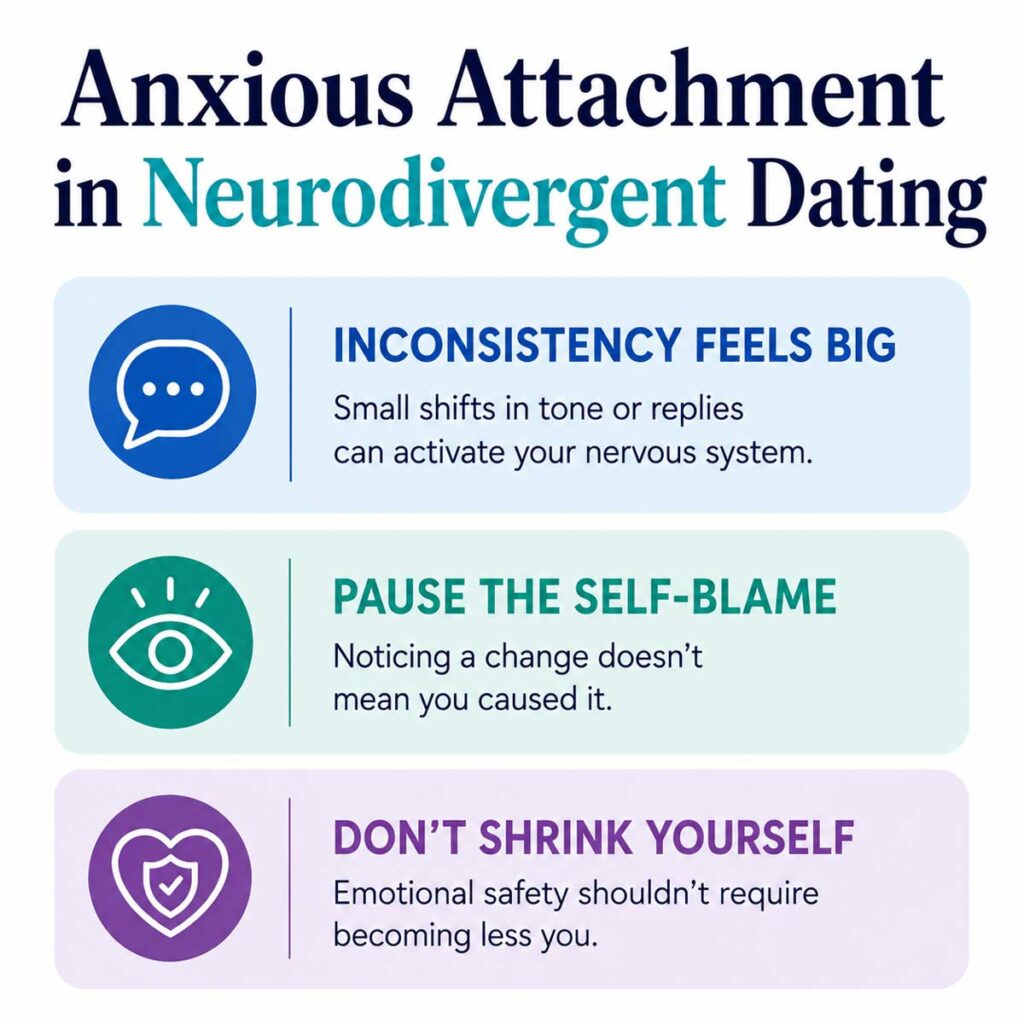
The good-morning texts disappear. Replies become shorter and plans turn vague. The warmth you felt at the beginning seems to cool.
Nothing dramatic has happened, but you notice.
And suddenly your brain starts asking: Did I overshare? Was I too intense? Did I do something wrong?
For neurodivergent people with anxious attachment, this kind of uncertainty can be deeply activating.
When your brain goes into fix-it mode
Many autistic and ADHD people are highly sensitive to changes in patterns, including tone, communication, and emotional availability.
If you’ve also experienced rejection, exclusion, or relationships where someone slowly disappeared, subtle distancing may feel like a warning sign.
So you try to fix things.
You delay your replies so you don’t seem too eager, share less, and ask for less. You become more agreeable.
Slowly, the focus shifts from: “Is this relationship working for me?” to: “How do I stop this person from leaving?”
That’s where anxious attachment can lead you toward self-abandonment.
Signs of an anxious–avoidant dynamic
Avoidant attachment doesn’t always look like someone obviously running away from intimacy.
Sometimes it looks like inconsistency.
They may be very engaged one day and emotionally distant the next. When you ask what changed, they tell you that you’re overthinking.
You try to address a problem, and they shut down or say they “don’t want to fight.”
You share something vulnerable, and they change the subject, intellectualize your feelings, or offer a response that sounds empathetic without actually feeling emotionally present.
As a result, you may begin doubting your own perceptions.
You can notice a pattern without blaming yourself
Anxiety can sometimes cause us to interpret uncertainty negatively. But that doesn’t mean every concern is imagined.
The key is separating observation from interpretation.
For example: “They’ve initiated fewer conversations this week” is an observation.
“They’re losing interest because I ruined everything” is an interpretation.
You can take what you’re noticing seriously without automatically deciding it means there is something wrong with you.
Fast intimacy isn’t always secure intimacy
Another confusing pattern can be intense closeness early in dating.
Someone might tell you: “I’ve never connected with anyone like this.” “You understand me better than anyone.”
For neurodivergent people who have spent years feeling misunderstood, that kind of recognition can be incredibly powerful.
But intensity isn’t the same thing as safety.
Emotional security develops through consistency, honesty, repair, and the willingness to stay present when things become uncomfortable.
Stop trying to earn emotional availability
Anxious attachment, in the absence of reflection, can turn dating into an audition.
You may try to become less sensitive, or eager, or demanding, or visibly neurodivergent.
And yet, emotional safety shouldn’t require you to continually shrink yourself.
Healthy relationships still involve misunderstandings, frustration, and occasional distance. The difference is that both people are willing to communicate, reconnect, and repair.
So when you notice yourself obsessing over how to keep someone interested, try asking a different question: Do I feel emotionally safe, valued, and able to be myself with this person?
That question may tell you far more than analyzing another text message ever will.
Wrap Up
If you have anxious attachment, someone pulling away can trigger much more than disappointment. It can also activate old experiences of rejection and leave you scrambling to figure out what you did wrong.
But someone else’s emotional distance is not automatically evidence that you need to change yourself.
Pay attention to patterns. Pay attention to how the relationship makes you feel. And remember that your needs matter too.
Have you ever found yourself becoming smaller or less authentic when someone started pulling away?
Essy Knopf is a therapist who likes to explore what it means to be neurodivergent and queer. Subscribe to get all new posts sent directly to your inbox.
© 2026 Ehsan "Essy" Knopf. Any views or opinions represented in this blog are personal and belong solely to the blog owner and do not represent those of people, institutions or organizations that the owner may or may not be associated with in professional or personal capacity, unless explicitly stated. All content found on the EssyKnopf.com website and affiliated social media accounts were created for informational purposes only and should not be treated as a substitute for the advice of qualified medical or mental health professionals. Always follow the advice of your designated provider.