

The neurodivergent passion cycle: Why you burn bright, then burn out


You’re sitting at your desk, flicking between tabs like they owe you something. Your phone is in your hand, but you can’t remember why.
The day feels slippery; nothing’s sticking. You’re restless, underwhelmed, and oddly tired for someone who hasn’t really done anything yet.
This is how it starts.
Before the obsession. Before the deep dive. Before the notebooks and the color-coded spreadsheets and the midnight Amazon orders, there is the ache. The stillness.
The weird, itchy emptiness that signals you’ve entered the first phase of what I call the neurodivergent passion cycle.
I’ve seen it in my clients, my community, and in myself again and again: this pattern of losing momentum, finding a spark, diving deep, and eventually drifting away.
And while it can feel confusing or even shameful, it’s not a personal failing, but a cycle that many autistic and ADHD folks move through naturally.
Phase 1: The Void
The first phase is The Void.
This is the emotional version of static. You might feel disconnected from your interests, your goals, even your identity. Tasks that once felt doable now feel slippery or irrelevant. Routines feel empty.
You scroll, you pause, you open tabs and close them again. You wonder: Is something wrong with me?
The Void is the reset before the re-ignition. The lull before the spark. A low-tide moment in the neurodivergent passion cycle, when your brain is scanning for something meaningful enough to matter again.
Phase 2: The Spark
Sometimes it’s a 2am rabbit hole on YouTube. Sometimes it’s a random conversation, a podcast episode, or a stray sentence in a book. Sometimes it’s nothing more than a vague flicker of interest that slowly intensifies.
But in a moment—however subtle—it clicks.
This is The Spark, the second phase of the neurodivergent passion cycle. And when it hits, it feels like oxygen after too long underwater.
Suddenly, something cuts through the fog. A topic, idea, or project presents itself and your brain lights up.
For many neurodivergent folks—especially those with ADHD or autistic wiring—the energy returns. The boredom lifts. You feel like you’ve re-entered your own life.
You might feel giddy, focused, even relieved. You might also feel a little frantic. The desire to act right now is real, because if you don’t, the spark might vanish. And you know what it’s like to lose a spark before it fully catches.
So you chase it.
You start a new note on your phone. You bookmark ten tabs. You scribble ideas in a notebook or voice-memo your thoughts while brushing your teeth. And maybe for the first time in days, weeks, or months, you feel genuinely alive again.
This phase of the neurodivergent passion cycle often gets mistaken for impulsivity. While others might see it as “just a passing interest,” for you, it feels like a possible identity. A calling. A new chapter. Even if it lasts only a little while, it matters.
But here’s the thing no one tells you: The Spark isn’t supposed to last forever.
Its job is to pull you out of The Void. To give you something to follow. Something to care about again. It’s the beginning of a story, and whether it becomes a long-term love or a short burst of joy, it deserves your attention.
So chase it. Let it burn bright. And know that it’s okay if you’re already dreaming big.
Because for neurodivergent brains, this is what it means to be in motion again.
Phase 3: The Deep Dive
You’ve followed the spark, and now you’re all in.
You’re devouring everything you can find. Articles. Podcasts. Reddit threads. Tutorials. Books. Product reviews. Academic journals you swore you’d never read again. Your browser history has a theme now. Your search bar knows your new obsession by name.
Welcome to The Deep Dive, the third phase of the neurodivergent passion cycle. This is where the energy shifts from curiosity to immersion.
And if you’re autistic or ADHD (or both), you might know this feeling intimately. It’s the sense of being lit up from the inside, of your thoughts aligning into something clear, vibrant, and hyper-focused.
All friction disappears. Executive functioning improves. You feel more capable, more organized, more you.
For autistics, this often resembles the early stages of a new passion. There’s structure here, logic, clarity. It brings peace. For ADHDers, this is hyperfocus at its most exhilarating.
This part of the neurodivergent passion cycle can be incredibly productive. You might be creating, building, learning, even teaching. The outside world starts to fade into the background. Your routines reorganize themselves around the interest. Time becomes slippery.
Sometimes you skip meals without noticing. Sometimes you stay up all night and wake up energized. Sometimes you get labeled “obsessive” or “intense.” But to you? It just feels necessary.
But there’s a caveat: in this phase, you can also start to disappear.
You might start canceling plans. Ignoring texts. Ghosting group chats. You do this because the outside world suddenly feels like an interruption. You’re busy building something. You’re becoming someone.
You may even begin to reshape your identity around this thing. “I’m a writer now.” “This is my path.” “This is who I’m supposed to be.” And in that moment, you mean it.
So let yourself go deep. Build, explore, create, become.
Phase 4: The Commitment
You’ve done the research. You’ve gathered the tools. You’ve built routines, created systems, maybe even reshaped your schedule to make space for this thing.
This is The Commitment phase—the fourth stage of the neurodivergent passion cycle. And it feels big.
You’ve moved from idea to identity. From hobby to habit.
You buy the higher-end version of the gear. You sign up for the class, the webinar, the certification.
You start telling people: “This is really important to me.” “This is who I am now.” “I think I’ve found it.” And maybe… you have.
For many neurodivergent people, we’re imagining a future where this interest becomes a path, a purpose, a way forward.
But here’s where things start to shift.
Because the moment you declare something—whether out loud, online, or even just to yourself—it becomes more than joy. It becomes responsibility.
You’ve claimed it. Now you have to keep it.
And for autistic and ADHD folks who’ve often struggled with consistency (or been shamed for perceived inconsistency), this can bring up anxiety.
The internal monologue starts whispering: “Don’t ruin this.” “Don’t drop it like the last one.” “You said this mattered. Now prove it.”
Even if no one else is pressuring you, you might start pressuring yourself. The initial spark of joy begins to carry weight.
Because the moment something becomes a “thing,” it feels like there’s something to lose. And with that comes rigidity. Perfectionism. Fear of messing it up.
For autistic folks, especially, there may be a deep desire to maintain structure and protect the routine that’s now built around this interest. For ADHDers, there may be a sudden urgency to “make it work” before motivation fades.
It’s still exciting, yes. Still meaningful. But a subtle tension is building.
Phase 5: The Plateau
At first, you don’t even notice it.
You sit down to work on your project, revisit your interest, or re-enter that creative flow… and something feels just a little off.
This is The Plateau, the fifth phase of the neurodivergent passion cycle.
From the outside, everything still looks the same. You’re still “doing the thing,” at least occasionally. You still talk about it. You still want to feel excited. But the effortless momentum you once had has starts to become more effortful.
For ADHDers, this might feel like the dopamine supply has been cut off. The novelty is gone. You’ve absorbed the basics. Mastered the structure. The learning curve has flattened, and with it, your motivation.
For autistics, it might feel more like sensory fatigue or cognitive saturation. The thing you loved may have required more emotional or mental energy than you realized. Now, that cost is catching up. And the scaffolding that held up your routines starts to wobble.
This phase can be incredibly disorienting. You may feel stuck between two realities: the excitement that was, and the numbness that is. And in this in-between space, shame loves to sneak in.
“Why can’t I get back into it?” “What happened to all that motivation?” “This always happens to me.”
The neurodivergent passion cycle often brings us to this juncture, where the joy fades, but the pressure remains. And because this phase rarely gets talked about, many of us misinterpret it as personal failure.
But let’s be clear: The Plateau is not failure. It’s the natural downshift after a surge of focus and engagement. It’s a signal that your brain is transitioning. Rebalancing. Resting. Searching.
What makes this phase harder is our instinct to force our way through it.
We make rigid plans. We double down on structure. We try to reignite the old fire with sheer willpower. And sometimes it works…for a while. But often, we’re just postponing the inevitable.
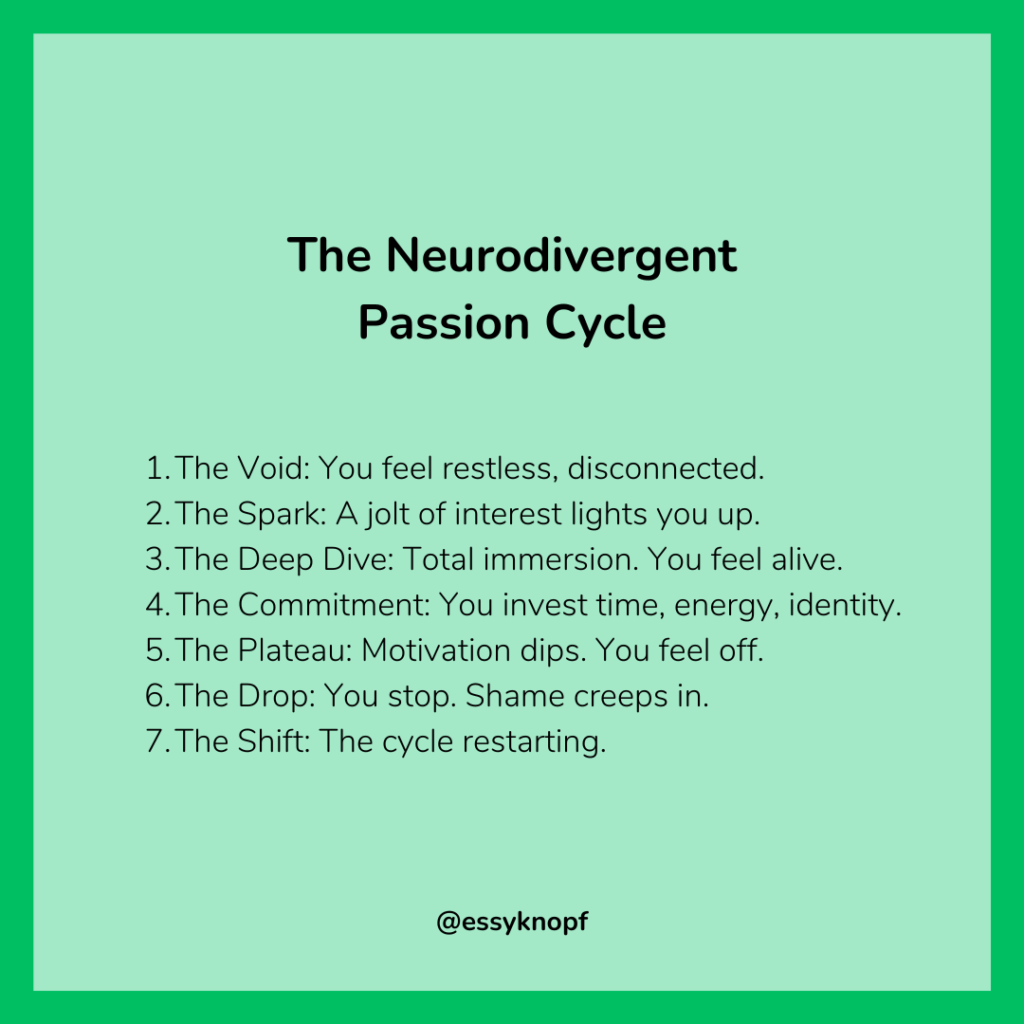
Phase 6: The Drop
You stop.
Not necessarily all at once. At first, it might look like a few skipped days. A tab you stop reopening. A tool you leave untouched on your desk. A message you meant to reply to—and didn’t.
Then suddenly, it’s been a week. Two weeks. A month. And you realize: you haven’t gone back.
This is The Drop, the sixth and most emotionally fraught stage of the neurodivergent passion cycle. Something that once made you feel alive has collapsed, leaving you with a sense of loss that can be sharper than most people realize.
You might look at the supplies you bought, the plans you made, the hours you invested, and feel a pang in your chest.
You start thinking things like: “Why do I always do this?” “Was it ever even real?” “What is wrong with me?”
The Drop often hijacks your self-worth.
For ADHDers, the crash can feel like emotional whiplash. You were finally focused, finally functioning, and now that clarity is gone. And with it, the version of yourself you liked.
For autistics, especially if the interest was deeply tied to routine or identity, the drop can leave you feeling unmoored. The structure collapses. The interest fades. The days lose shape. You might even start to question who you are without it.
And perhaps worst of all: the inner critic arrives. Loud. Familiar.
It reminds you of every unfinished project, every abandoned plan, every time someone called you “flaky” or “all over the place.”
You hear the echoes of teachers, parents, coworkers, partners: people who didn’t understand how your brain works.
Now their voices live in your own head. This is where internalized ableism shows up at full volume.
Shane tells you that your inconsistency makes you untrustworthy. That your shifts in energy make you immature. That your passions don’t count unless they last forever.
But none of that is true.
If you’re here, in The Drop, I want you to hear this clearly: Your spark was real. Your joy was real. Your momentum mattered. And the fact that it faded doesn’t erase any of that.
This is not the end of the story. It’s the space before the shift.
Phase 7: The Shift
There’s no grand reawakening. No big announcement. No Instagram-worthy comeback.
Just… a thought. A video that holds your attention a little longer than it should. A topic that makes your chest feel warm. A casual mention that leaves a trail of tabs open.
If you don’t find yourself returning to the Void, you may instead enter the Shift, the final (and first) phase of the neurodivergent passion cycle. The moment the wheel begins to turn again.
It’s subtle. Easy to miss if you’re still stuck in the shame spiral of The Drop. Your conscious mind might still be licking its wounds, replaying stories of failure or inconsistency. But your is already scanning. Already searching for what’s next.
This is the part of the cycle most often buried under self-doubt.
We tell ourselves: “I’m not allowed to start something new until I finish what I already failed.” “I always do this. What’s the point?” “Why bother if I’m just going to lose interest again?”
What’s important to recognize is that you are wired to seek. To scan. To latch onto what’s meaningful, rich, and alive. It’s how your brain reengages with the world on your terms.
For autistic and ADHD folks, The Shift is where hope returns. It represents a return to motion. To possibility. To curiosity.
That’s the gift of the neurodivergent passion cycle. It loops. It pulses. It resets.
And each time you come around again, you don’t start from zero. You start with the knowledge, growth, and insight that every past passion gave you; even the ones that felt unfinished.
What you built still mattered. What you felt was real. What you created exists.
You are not flaky. You are a seasonal creature living in a linear world.
And The Shift is your invitation to begin again, perhaps with less pressure, and more self-trust.
You don’t need to justify it. You don’t need to explain it. You just need to notice it—and allow it.
Final Thoughts
If you’ve ever lit up with a new passion, poured yourself into it, and then felt the quiet grief of watching it fade… this post was for you.
The neurodivergent passion cycle is not a glitch. It’s not evidence of failure, immaturity, or inconsistency. It’s a rhythm. A process. A deep internal pattern that so many autistic and ADHD people experience, but few are ever taught to recognize, let alone honor.
You don’t move through life in straight lines. You move in pulses. Like tides. Like seasons. Like breath.
And when you understand your cycles—when you learn to name them, trust them, work with them instead of against them—you begin to find something deeper than discipline or “follow-through.”
You find self-respect.
You begin to say: “I’m in The Void. I’m resetting.” “This is The Spark! Let’s follow it.” “Ah, the Plateau. No need to panic. Just time to pause.”
“The Drop hurts, but it’s not the end.” “The Shift is here. I’m ready to begin again.”
This is not about “fixing” the cycle. It’s about recognizing that there was never anything broken to begin with.
You don’t owe anyone permanence. You don’t owe consistency that comes at the cost of your joy.
You owe yourself grace. Curiosity. Permission to follow what lights you up, even if it’s only for a season.
Because that’s where your magic lives.
Have you experienced this cycle? What phase are you in right now?
Essy Knopf is a therapist who likes to explore what it means to be neurodivergent and queer. Subscribe to get all new posts sent directly to your inbox.
© 2026 Ehsan "Essy" Knopf. Any views or opinions represented in this blog are personal and belong solely to the blog owner and do not represent those of people, institutions or organizations that the owner may or may not be associated with in professional or personal capacity, unless explicitly stated. All content found on the EssyKnopf.com website and affiliated social media accounts were created for informational purposes only and should not be treated as a substitute for the advice of qualified medical or mental health professionals. Always follow the advice of your designated provider.