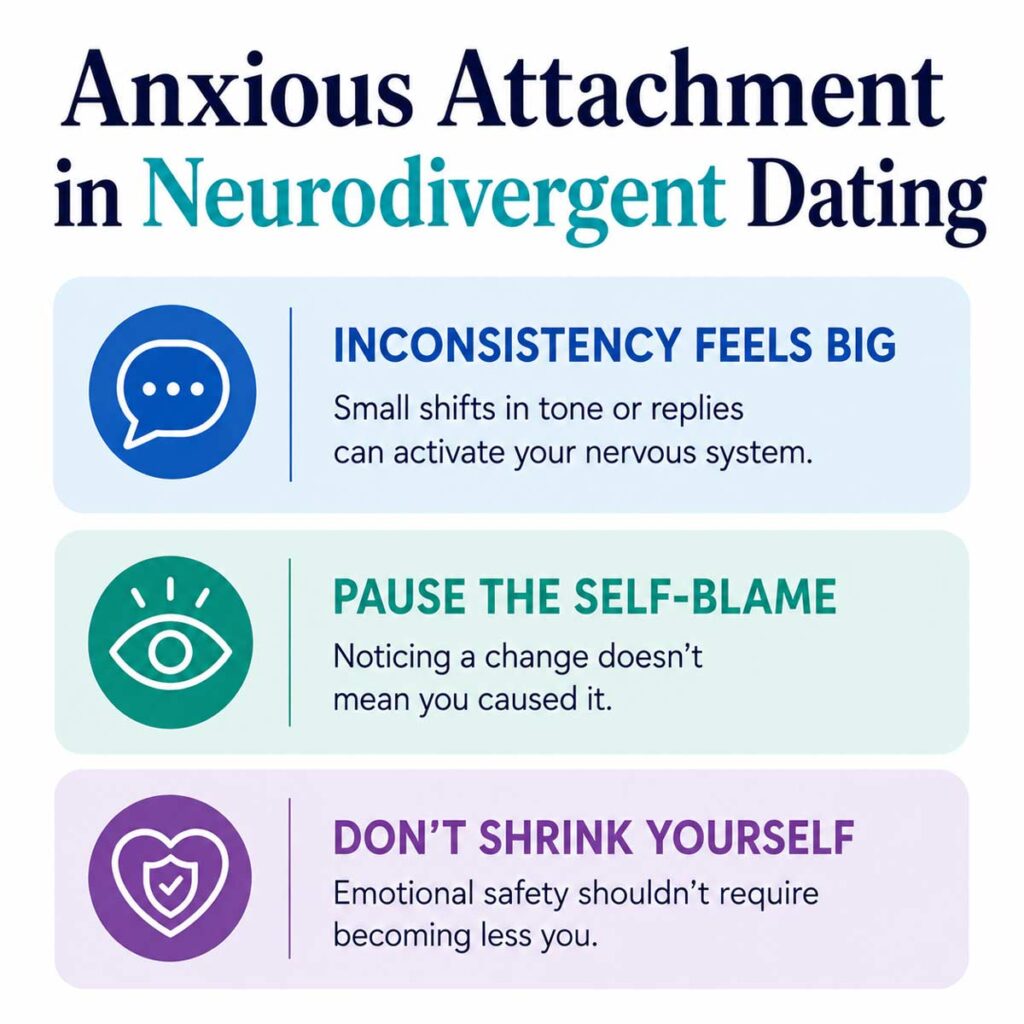
Many autistic and ADHD people are highly sensitive to changes in patterns, including tone, communication, and emotional availability.
If you’ve also experienced rejection, exclusion, or relationships where someone slowly disappeared, subtle distancing may feel like a warning sign.
So you try to fix things.
You delay your replies so you don’t seem too eager, share less, and ask for less. You become more agreeable.
Slowly, the focus shifts from: “Is this relationship working for me?” to: “How do I stop this person from leaving?”
That’s where anxious attachment can lead you toward self-abandonment.
Signs of An Anxious–Avoidant Dynamic
Avoidant attachment doesn’t always look like someone obviously running away from intimacy.
Sometimes it looks like inconsistency.
They may be very engaged one day and emotionally distant the next. When you ask what changed, they tell you that you’re overthinking.
You try to address a problem, and they shut down or say they “don’t want to fight.”
You share something vulnerable, and they change the subject, intellectualize your feelings, or offer a response that sounds empathetic without actually feeling emotionally present.
As a result, you may begin doubting your own perceptions.
You Can Notice a Pattern Without Blaming Yourself
Anxiety can sometimes cause us to interpret uncertainty negatively. But that doesn’t mean every concern is imagined.
The key is separating observation from interpretation.
For example: “They’ve initiated fewer conversations this week” is an observation.
“They’re losing interest because I ruined everything” is an interpretation.
You can take what you’re noticing seriously without automatically deciding it means there is something wrong with you.
Fast Intimacy Isn’t Always Secure Intimacy
Another confusing pattern can be intense closeness early in dating.
Someone might tell you: “I’ve never connected with anyone like this.” “You understand me better than anyone.”
For neurodivergent people who have spent years feeling misunderstood, that kind of recognition can be incredibly powerful.
But intensity isn’t the same thing as safety.
Emotional security develops through consistency, honesty, repair, and the willingness to stay present when things become uncomfortable.
Stop Trying to Earn Emotional Availability
Anxious attachment, in the absence of reflection, can turn dating into an audition.
You may try to become less sensitive, or eager, or demanding, or visibly neurodivergent.
And yet, emotional safety shouldn’t require you to continually shrink yourself.
Healthy relationships still involve misunderstandings, frustration, and occasional distance. The difference is that both people are willing to communicate, reconnect, and repair.
So when you notice yourself obsessing over how to keep someone interested, try asking a different question: Do I feel emotionally safe, valued, and able to be myself with this person?
That question may tell you far more than analyzing another text message ever will.
Wrap Up
If you have anxious attachment, someone pulling away can trigger much more than disappointment. It can also activate old experiences of rejection and leave you scrambling to figure out what you did wrong.
But someone else’s emotional distance is not automatically evidence that you need to change yourself.
Pay attention to patterns. Pay attention to how the relationship makes you feel. And remember that your needs matter too.
Have you ever found yourself becoming smaller or less authentic when someone started pulling away?
Essy Knopf is a therapist who likes to explore what it means to be neurodivergent and queer. Subscribe to get all new posts sent directly to your inbox.
Have you spent most of your life being told, directly or indirectly, that you need to tone yourself down?
Maybe you learned to explain yourself before anyone asked, apologize before anyone complained, or keep certain needs to yourself because experience taught you that expressing them would create tension.
You might have become very good at reading the room because you were always trying to work out whether someone was irritated with you.
It starts with being corrected often enough that you begin correcting yourself. Someone tells you that you are too ___ (insert pejorative here: sensitive, too intense, too blunt, too distracted, too much, etc.).
A teacher might decide you are lazy when you cannot get started on an assignment. A parent becomes frustrated by a sensory issue you cannot simply switch off. Other kids notice that you talk differently, move differently, or care deeply about things they do not understand, and also make sure you know they have noticed.
At some point, those reactions stop feeling like other people’s interpretations of you and start feeling like the truth.
That is where shame becomes difficult to untangle.
When Shame Starts Sounding Like Your Own Voice
Internalized ableism rarely announces itself as such.
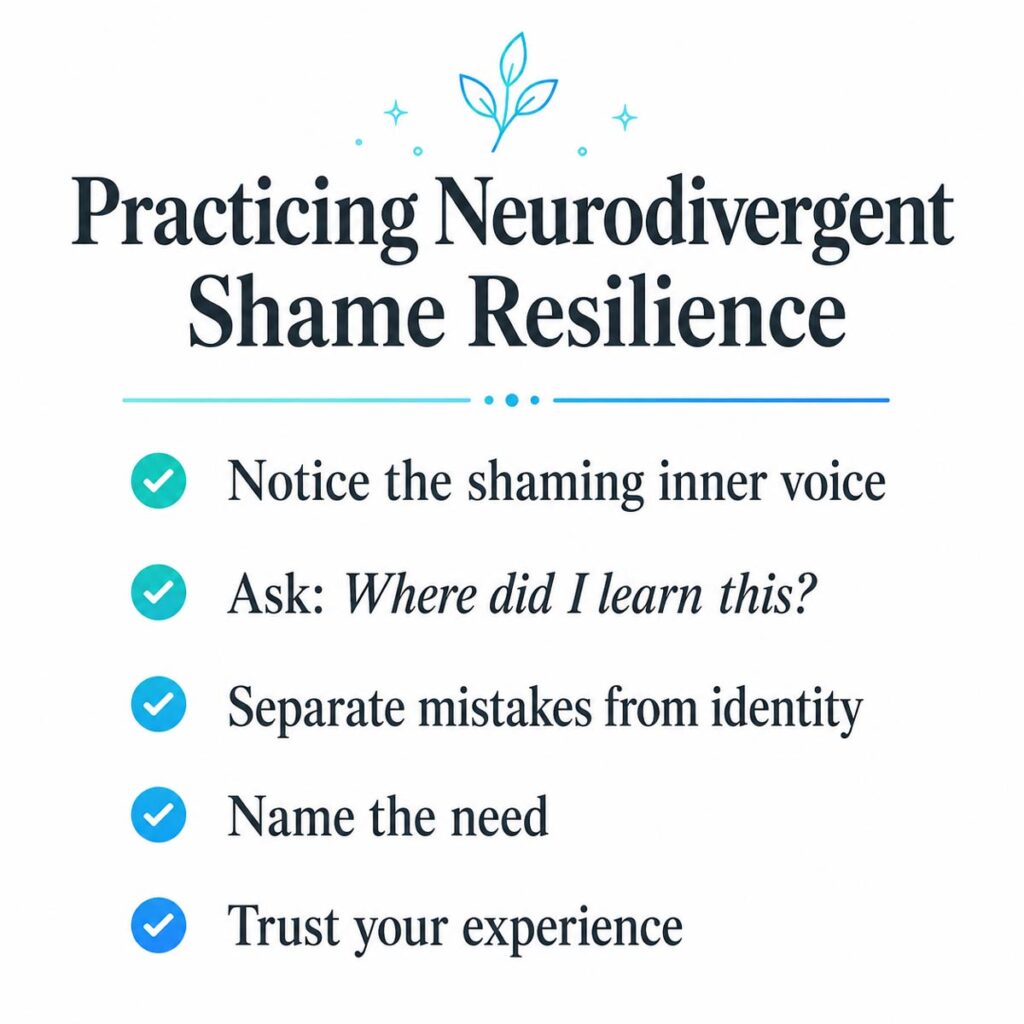
It sounds more like, Why can’t I just handle this? Or, I should know better by now. Or, I always make things awkward.
Sometimes it shows up before anything has even happened. You sense that somebody might be annoyed, so you start explaining. You think you may have spoken too much, so you replay the conversation afterward. Someone’s tone changes slightly and your mind immediately starts searching for what you did wrong.
After years of this, it can become hard to tell where reasonable self-reflection ends and self-surveillance begins.
There is a difference between realizing you made a mistake and deciding that the mistake says something terrible about who you are. Or between recognizing that something is difficult for you and treating that difficulty as proof of personal failure.
Yet, for autistic and ADHD people, those distinctions can get blurred very early.
If your executive functioning problems were consistently treated as carelessness, eventually you may come to believe you are careless. If your sensory needs were treated as fussiness, you may feel embarrassed by them. If people repeatedly interpreted your directness as hostility, you may second-guess yourself every time you speak plainly.
This can leave many of us with a legacy of inadequacy and shame.
Shame Resilience Does Not Mean Becoming Fearless
The idea of shame resilience is useful because it does not require us to somehow stop feeling shame.
That would be a strange goal anyway, since shame is a powerful social emotion, and most of us are going to experience it from time to time.
The more useful question is what happens after it appears. Do you immediately believe what it is telling you? Do you retreat, attack yourself, or change your behavior before you have even decided whether you have actually done something wrong?
Or can you stay with the discomfort long enough to become curious about it?
One question I find especially useful is: Where did I learn this? Not, Why am I like this? Or What is wrong with me?
Instead, we can ask ourselves: Where did I learn that needing more time makes me difficult? Where did I learn that asking for clarification makes me stupid? Where did I learn that resting before I am completely exhausted is lazy?
Recognizing that a belief has a history can make it feel a little less like an unquestionable fact.
Authenticity Can Feel Wrong Before It Feels Right
There is a lot of talk about “being your authentic self,” but that phrase can become almost meaningless when you have spent years trying to work out which version of yourself other people will tolerate.
For someone who has masked heavily, authenticity may not feel freeing at first. Embarrassment may even result.
For example, you might decide to tell someone that a restaurant is too loud for you rather than forcing yourself through dinner, and then spend the next hour wondering whether you were difficult.
Or you may ask for instructions to be written down instead of pretending you will remember them, only to feel self-conscious about needing that support in the first place.
Even letting yourself stim more openly, asking someone what they meant rather than guessing, or admitting that you are overwhelmed can bring up a surprising amount of discomfort.
That makes sense when hiding those things once helped you avoid criticism.
Being more authentic does not require that we abandon self-awareness or decide that our impact on other people no longer matters. But it is an invitation to no longer assume, as a starting point, that your needs and differences are the problem.
Sometimes the Shame Really Is Coming From Outside
One thing I think gets lost in conversations about shame is that we often talk about it as though it exists entirely inside the individual. It does not.
Shame is social. People use it, sometimes deliberately and sometimes without much thought, to enforce what they consider normal.
Familiar examples are a child who moves too much being told to sit properly. Someone who communicates directly is criticized for their tone. Or an employee asks for an accommodation and suddenly senses that they are being seen as inconvenient.
No one has to say, “There is something wrong with you,” because they’ve communicated that message quite effectively in other ways.
Body language is sometimes all that is necessary. A pause. A look. An eye roll. Communication may also involve a joke made at your expense, or a sudden coolness that enters a conversation after you have said something in a way that was not expected.
If you have spent years noticing those reactions, it is no wonder that you become cautious.
This is why shame resilience cannot simply mean teaching yourself that everybody accepts you and that all of your fears are irrational. Sometimes people really are judgmental. Sometimes environments really are ableist.
The work is learning not to let every negative reaction automatically become evidence against yourself.
Learning Not to Turn Every Mistake Into a Verdict
There is another side to this, because being neuroaffirming does not mean pretending we never get things wrong. We do.
Sometimes we misunderstand someone. Sometimes we interrupt, forget something important, communicate poorly, get defensive, or hurt another person without intending to.
The problem starts when a fairly ordinary mistake becomes connected to something much bigger. We jump from I did something wrong to there is something wrong with me is shame.
For people who have lived with years of criticism around their neurodivergence, this jump can happen very quickly.
Shame resilience involves trying to stay with what actually happened. Sure—maybe you need to apologize or do things differently next time.
None of that however requires turning against yourself.
Rebuilding Self-Trust
A lot of this work comes back to trust.
When you have spent years checking your reactions against everyone else’s, it can be surprisingly difficult to believe your own experience.
Was that room really too loud, or am I being dramatic? Do I actually need a break, or am I being lazy? Was that comment unfair, or am I just too sensitive?
Sometimes we become so used to putting our own perceptions on trial that we barely notice we are doing it.
Rebuilding self-trust begins when we learn to validate our perceptions.
For instance, you might notice that you are overwhelmed and respond before you reach breaking point. You might tell somebody that you did not understand instead of pretending you did. You try asking for what you need and resist the urge to bury the request under three paragraphs of apology.
Then perhaps, after doing this enough times, you realize that having needs did not make you unreasonable after all.
Wrap Up
Shame can become so familiar that we mistake it for self-knowledge.
For autistic and ADHD folks who spent years without understanding their neurodivergence, some of the harshest beliefs we hold about ourselves may have begun as other people’s reactions to traits they did not understand.
Shame resilience is about becoming a little less willing to accept shame’s version of events without question.
And sometimes that begins with a very small interruption to an old thought: Hang on. Is this actually what I believe about myself, or is this something I learned to believe?
What is one thing you used to feel ashamed of that you now understand differently because you know you are autistic or ADHD?
Essy Knopf is a therapist who likes to explore what it means to be neurodivergent and queer. Subscribe to get all new posts sent directly to your inbox.
For many autistic and ADHD people, loneliness develops slowly.
It can begin with being corrected for speaking too honestly, mocked for stimming, excluded from a group, or criticized for missing an unwritten social rule. When these experiences happen repeatedly, they can change the way we approach other people.
We learn to expect rejection before it arrives.
We might hesitate before sending a message, or decline invitations because we assume we will feel awkward or overwhelmed. We stop sharing the parts of ourselves that have been misunderstood.
We may tell ourselves, “I just prefer being alone.” And perhaps we do.
Many neurodivergent people genuinely enjoy solitude. Being alone can mean freedom from masking, social pressure, sensory overload, and the exhausting task of monitoring how other people are reacting to us.
But it is still worth asking: Is this solitude restoring me, or is it shrinking my world?
When Isolation Becomes Protection
Neurodivergent isolation is often both a lifestyle preference and an adaptation.
When connection has repeatedly led to embarrassment, correction, punishment, or rejection, the nervous system learns that distance is safer. Avoiding people becomes a way of preventing future pain.
But beneath the withdrawal, there may still be a wish for connection.
You may want someone to ask how your day was; who understands your communication style, respects your sensory needs, and does not require you to perform a more socially acceptable version of yourself.
Why Connection Can Feel So Risky
What might stop you from seeking such a connection is being told across your lifetime that your natural way of being is wrong.
Perhaps you were described as too sensitive, too intense, too quiet, too blunt, or too emotional. Maybe you were punished for behavior you did not realize was considered inappropriate. You may have been left out without explanation or told to “try harder” socially without receiving any useful guidance.
These experiences can create a heightened sensitivity to rejection.
You may interpret a friend replying briefly as proof that they are angry, or a delayed text as evidence that the relationship is ending.
In such cases, your nervous system is trying to protect you by spotting danger early.
The difficulty is that it may begin to react to all neutral situations as though rejection has already happened.
This can make relationships feel like constant work. Instead of simply being present, you may find yourself analyzing tone, facial expressions, pauses, punctuation, and every word you said afterward.
Even positive interactions can become exhausting.
The Hidden Appeal of Solitude
When you are alone, there is much less to decode.
You can stim without wondering whether someone finds it strange, or spend time with your interests without worrying that you are talking too much or neglecting others. You can choose your lighting, sound level, clothing, food, and routine.
Solitude can be deeply regulating.
For this reason, the goal should never be to pressure neurodivergent people into becoming more social. More social contact is not automatically better, especially when that contact requires masking or exposes someone to continued mistreatment.
The real question is whether one’s current level of solitude is chosen freely.
Healthy solitude usually leaves you feeling calmer, clearer, or more energized. Protective isolation can initially feel peaceful, but may also leave you feeling disconnected or resigned.
Many of us end up telling ourselves that we don’t need anyone, while secretly grieving the absence of meaningful relationships.
When Boundaries Hide Grief
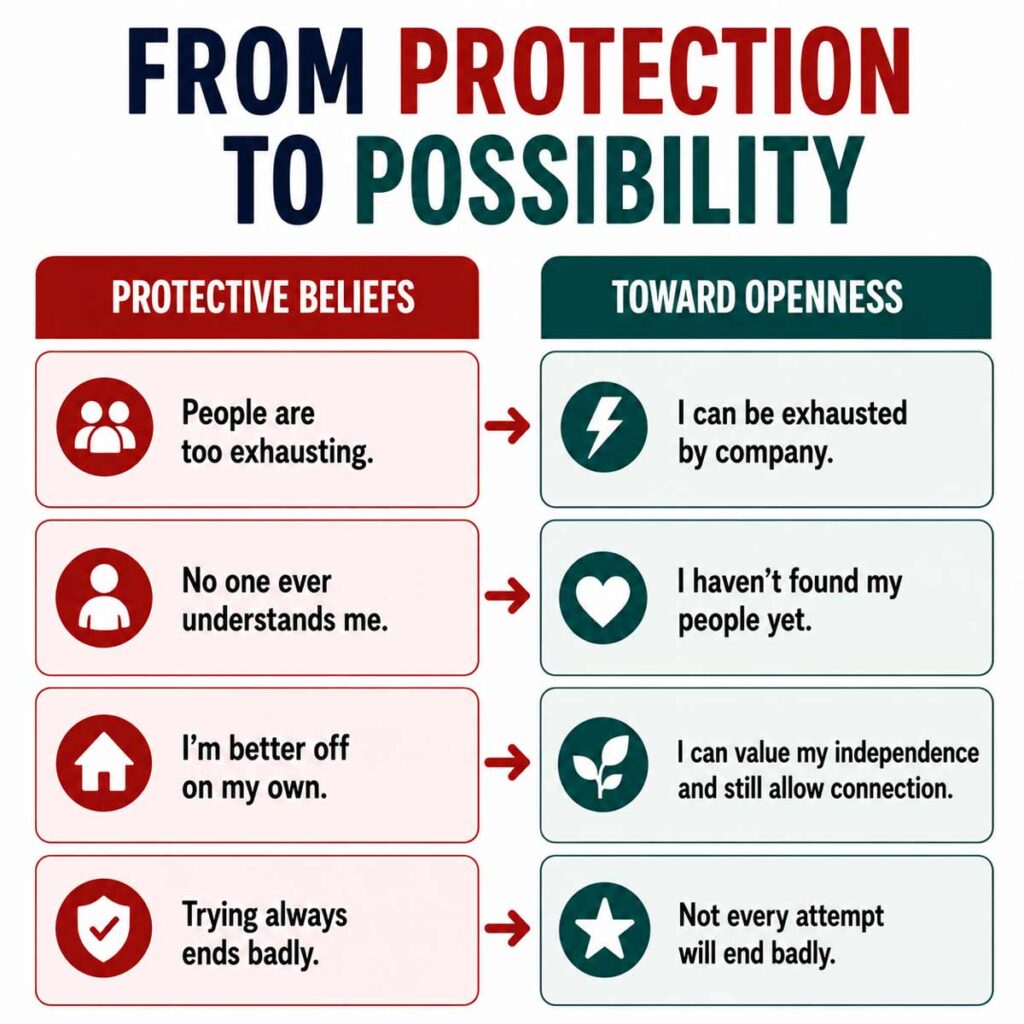
After enough painful social experiences, protective beliefs can sound like healthy boundaries: “People are too exhausting.” “No one ever understands me.” “I’m better off on my own.” “Trying always ends badly.”
Sometimes these statements are partly true. There may be people you are genuinely better off avoiding. Certain environments may be inaccessible or unsafe. Some relationships may demand far more than they give.
But it is also possible for a boundary to become so broad that it blocks every opportunity for connection.
The belief that all closeness is dangerous may protect you from rejection, but it also protects you from being known.
This is how isolation can become self-reinforcing. The less you interact with others, the fewer chances you have to experience safe connection. Without those corrective experiences, the belief that relationships always end badly remains unchallenged.
Returning to Connection Gently
Healing from neurodivergent isolation does not mean forcing yourself into crowded events, maintaining dozens of friendships, or pushing through social exhaustion.
It can begin much more gently. For example, replying to one message you have been avoiding, or sharing an honest thought with someone who has previously treated you with kindness.
Another option includes spending time in a neurodivergent-friendly group where direct communication and sensory needs are respected.
It can also help to identify what makes connection feel safer.
Perhaps you prefer communicating by text rather than phone, or meeting one person at a time. You may need plans to be made in advance, a clear end time, or permission to leave when you become overwhelmed.
These needs do not make you demanding, but help create the conditions in which genuine connection becomes possible, while leaving enough room for your full neurodivergent self.
Learning to Trust Slowly
In opening ourselves to the right people, we must also remember that safe people are not perfect. Miscommunications are inevitable in every relationship, especially across different neurotypes.
What makes someone safe isn’t that they never misunderstand us, but that they’re willing to approach those misunderstandings with curiosity and compassion, as well as a desire to repair.
In such instances, ask yourself: Can the other person listen? Can they clarify rather than accuse? Can both of you acknowledge your part without turning the interaction into a verdict on your worth?
These experiences can gradually teach the nervous system that connection is not always dangerous.
Wrap Up
Neurodivergent isolation makes sense when you have spent years feeling misunderstood, corrected, or rejected.
Withdrawal may have helped you survive environments in which being your authentic self did not feel safe. There is no shame in having developed strategies that protected you.
But those strategies do not always have to remain permanent. You can honor your need for solitude while still remaining open to connection.
Have you ever realized that your preference for being alone was partly a form of protection? What helps connection feel safer for you?
Essy Knopf is a therapist who likes to explore what it means to be neurodivergent and queer. Subscribe to get all new posts sent directly to your inbox.
From an early age, many autistic and ADHD people learn to see themselves through a lens of lack.
We interrupt without meaning to—and spend the rest of the day wondering if we annoyed someone. We need three alarms to get out the door and still somehow leave our coffee on the kitchen counter. We become intensely excited about a topic, only to watch someone’s eyes glaze over halfway through our explanation.
We cry when we’re overwhelmed. Or shut down completely. We forget what we came into the room for. We miss the hidden meaning everyone else seemed to catch.
And often, we’re told these differences are problems.
By the time many of us discover we’re neurodivergent, we’ve already internalized years of criticism, misunderstanding, and pressure to be someone else. We’ve learned to mask, compensate, and apologize for taking up space.
But what if we’ve been looking through the wrong lens all along?
What Is Neurodivergent Cultural Wealth?
I use the term neurodivergent cultural wealth to describe the knowledge, adaptation, perspective, and wisdom that autistic and ADHD communities develop while navigating a world that often misunderstands them.
The concept is inspired by educational researcher Tara Yosso’s Community Cultural Wealth framework, which challenged the assumption that marginalized communities lack valuable forms of knowledge and resources.
Similarly, neurodivergent cultural wealth invites us to question the idea that autistic and ADHD people should primarily be understood through deficits, impairments, or limitations.
Instead, it asks a different question: What knowledge emerges from living a neurodivergent life?
What forms of wisdom are passed between members of neurodivergent communities?
What strengths develop through years of adaptation, self-discovery, and resistance?
These are the questions at the heart of neurodivergent cultural wealth.
The Problem With Deficit-Based Thinking
Much of society still views autism and ADHD through a deficit-based framework.
Schools, workplaces, healthcare systems, and even mental health services often focus on what neurodivergent people cannot do rather than what they contribute.
This perspective obscures neurodivergent cultural wealth by treating difference as deficiency.
When every challenge is highlighted while every adaptation goes unnoticed, it’s easy to overlook the remarkable forms of knowledge that autistic and ADHD people develop throughout their lives.
Knowledge Born From Adaptation
Yet neurodivergent communities have never been defined solely by struggle.
For generations, autistic and ADHD people have been adapting to environments that weren’t built with us in mind. We’ve learned to navigate sensory overload in fluorescent-lit classrooms. To survive workplaces that reward social performance over actual competence. To decode unwritten social rules that everyone else seemed to receive a handbook for.
And in the process, we’ve developed knowledge.
For example, many neurodivergent people become skilled observers. When social interactions don’t come naturally, you pay attention and look for patterns.
You begin paying attention to things many people take for granted. Sometimes it’s tone of voice. Sometimes it’s routines, social patterns, inconsistencies, or unspoken expectations.
You learn things most people never have to think about.
Similarly, many of us become experts in our own minds.
When everyday tasks seem inexplicably difficult, you start asking questions.
Why can I spend six hours researching a niche topic but struggle to answer an email?
Why does a crowded restaurant leave me exhausted?
Why do certain sounds feel unbearable?
Why does a change in routine throw off my entire day?
Years spent wrestling with these questions often lead to a level of self-understanding that isn’t always appreciated by the wider world.
This is neurodivergent cultural wealth: the knowledge that emerges from living a neurodivergent life.
The Wisdom of Community
But that knowledge isn’t developed in isolation.
One of the most powerful aspects of neurodivergent cultural wealth is what happens when neurodivergent people find one another.
Spend enough time in autistic and ADHD spaces and you’ll notice something remarkable.
Someone mentions struggling to brush their teeth consistently, and suddenly a dozen people are sharing workarounds.
Another person talks about sensory overwhelm, and others immediately understand without needing an explanation.
A third admits they’re exhausted from masking, and instead of judgment, they’re met with recognition.
What emerges from these conversations is collective wisdom.
Knowledge gets passed from one person to another. Strategies are shared. Language develops. Experiences that once felt isolating suddenly make sense.
Many of us spend years believing we’re the only ones who think a certain way.
Community reveals otherwise.
Seeing the World Differently
Neurodivergent cultural wealth also shows up in the questions we ask.
Living outside the norm often gives you a different vantage point from which to view the world.
You start noticing assumptions that others take for granted.
Why should eye contact determine whether someone is trustworthy?
Why is small talk considered a prerequisite for connection?
Why is productivity treated as a measure of human worth?
Why are some forms of communication considered valid while others are dismissed?
These questions are the product of seeing the world from a different angle.
And sometimes that different angle reveals things that everyone else has overlooked.
Beyond Deficits and Limitations
None of this means autism and ADHD are free from challenges.
Many neurodivergent people experience significant disability. Executive dysfunction, sensory sensitivities, burnout, social misunderstanding, and co-occurring mental health challenges can have a profound impact on daily life.
Recognizing neurodivergent cultural wealth isn’t about denying those realities.
Rather, it’s about refusing to let them tell the whole story.
Because when we focus exclusively on deficits, we miss something important.
We miss the resilience required to keep showing up in spaces that weren’t designed for us.
We miss the creativity involved in finding alternative ways of learning, working, and communicating.
We miss the insights that emerge from seeing the world differently.
And we miss the knowledge that neurodivergent communities have been generating and sharing all along.
Wrap Up
For much of our lives, many of us have been taught to ask: “What’s wrong with me?”
Neurodivergent cultural wealth invites a different question: “What have I learned from living this life?”
“What wisdom have I gained?
“What strengths, perspectives, and forms of knowledge have emerged because of my neurodivergence?
The answers may be far richer than we’ve been led to believe.
Essy Knopf is a therapist who likes to explore what it means to be neurodivergent and queer. Subscribe to get all new posts sent directly to your inbox.