

Neurodivergent communication: When you know what you mean but the words come out wrong


For a long time, I tried to get through speaking as quickly as possible. I’d rush or mumble, or keep what I said so short that people had to ask me to repeat it. Then I’d feel even more self-conscious, because now everyone was waiting for me to say it again.
I think some of that started with the reactions I got growing up as a neurodivergent kid. I would say something blunt or poorly timed, miss what the conversation was about, or unintentionally offend someone. After enough experiences like that, I became very careful about drawing attention to myself.
Keeping my contributions brief felt safer. Unfortunately, it also made it harder for people to understand me.
Here’s a look inside some common challenges with communication as a neurodivergent person.
Trying to speak while checking everything you say
That discomfort followed me into adulthood, particularly when I had to speak in front of a group. I wanted to contribute, but I was conscious of how easily something could come out wrong to the point of rippling anxiety.
Even when I knew the subject, I could struggle to explain it. That was especially frustrating. I could formulate the idea in my head, so why couldn’t I say it?
Once I stumbled, I’d start thinking about how I sounded. Was I making sense? Had I used the right word? While I was checking, I still had a sentence to finish.
I wanted to come across as someone who knew what they were talking about. Instead, I sometimes rushed through the explanation and left out something the listener needed to follow it.
My thoughts have already moved on
There’s another difficulty that happens even when I’m comfortable. I might blurt something impulsively without considering how it might be received.
Or, I’ll be halfway through explaining something when another idea occurs to me. I can see how it connects, and I want to include it before I forget, but I haven’t finished the first point yet. This is ADHD associative thinking at its best.
Sometimes, because of my hyperactivity, I speed up to fit everything in. Other times, I tangent to the new idea without explaining the connection. What feels connected in my head can sound like a sudden change of subject to someone listening.
I also mix up words and phrases. Once, instead of saying something was “a piece of cake,” I said it was “a cup of tea.” My friend’s first language wasn’t English, and they later repeated it back to me. I had to explain that I’d taught them the wrong expression.
I can laugh about that one. It’s harder when the word that comes out is inappropriate or suggests something I don’t mean. Then I’m trying to correct it while feeling embarrassed that I said it at all.
“Just slow down” is difficult advice for me. I’m often speaking quickly because I’m trying to hold on to a thought. If I wait, I might lose it, care of my impaired working memory (executive dysfunction, hello!). But rushing can make the explanation harder to follow, so I end up having to explain it again anyway.
What I could actually work on
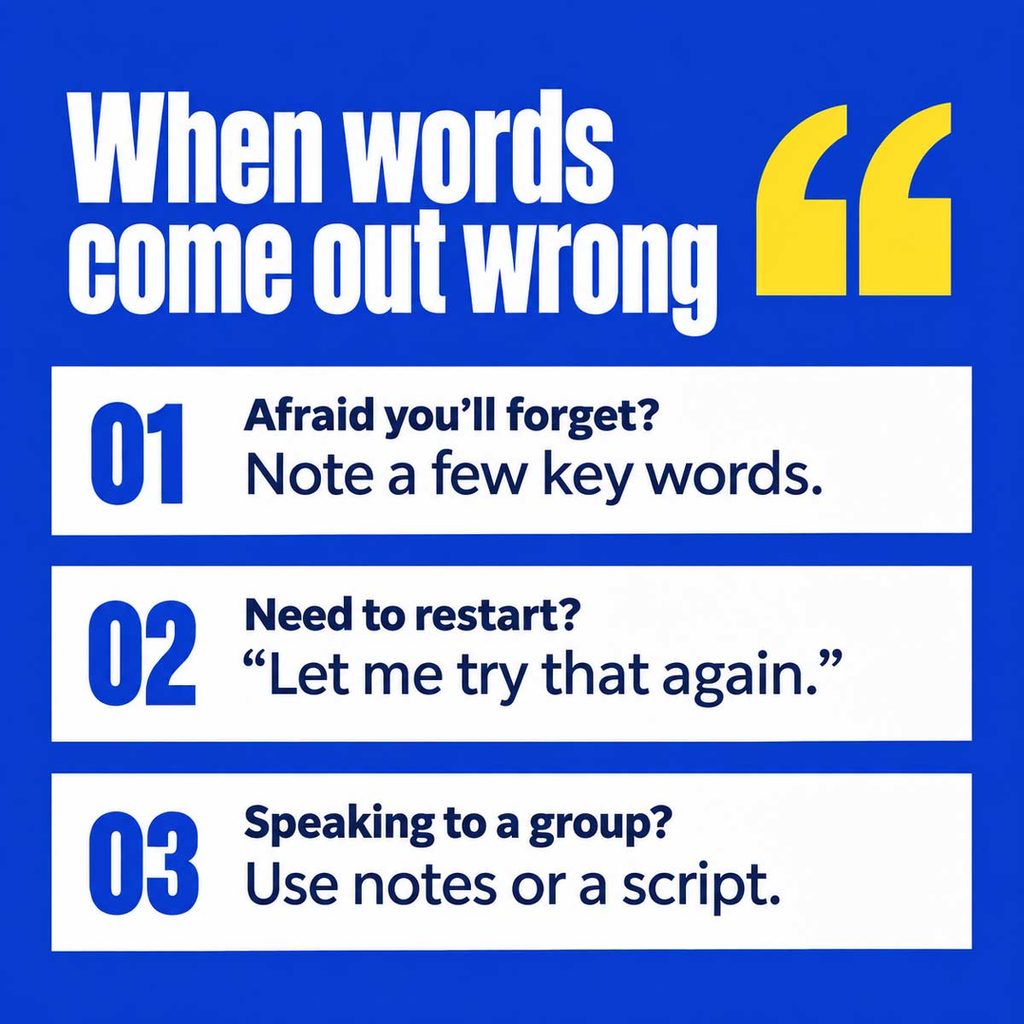
I eventually decided I didn’t want that discomfort to keep limiting me. I took public speaking classes and tried improv to get more comfortable responding without having everything prepared.
Recording videos for my YouTube channel gave me a different kind of practice. I could listen back and hear where I’d rushed or mumbled. That gave me something specific to work on, rather than simply deciding I was bad at speaking.
I worked on pacing and articulation. I paid attention to my intonation, too, because the way I used my voice didn’t always convey what I intended.
There’s a balance here. I don’t want to spend every conversation trying to sound like somebody else. But I do want people to understand me, including people whose communication styles differ from mine. Having more control over my delivery gives me more choice about how I get a point across.
Why I still use scripts
For many of my longer videos, I write a script. That lets me work out the order of my ideas before I have to speak them. I can also remove the tangents that seemed relevant when I started but didn’t end up adding much.
I like being concise, probably partly because of my background in journalism. When I’m speaking spontaneously, though, I can find myself explaining several connections before I get to the point I originally wanted to make.
A script takes some of that work out of the moment. For a shorter conversation or presentation, a few notes might be enough to remind me what I wanted to cover.
Practice has helped me speak more comfortably without a script, too. I still stumble. Sometimes the wrong word comes out, and I have to stop and say some version of, “That wasn’t what I meant. Let me try again.”
I’m more willing to do that now. Earlier in my life, I might have tried to rush past the mistake because acknowledging it felt even more embarrassing.
Wrap Up
Speaking has become easier for me, although I still have moments when I know exactly what I mean and can’t seem to get it out properly. I can work on my pacing, but I also need time to finish a thought without feeling that a pause or correction will count against me.
That’s something listeners can help with. Let me finish, and ask if something doesn’t make sense. I’d much rather clarify what I meant than have someone draw a conclusion from a word I didn’t intend to use.
Do you rush because you’re worried you’ll forget what you want to say?
Essy Knopf is a therapist who likes to explore what it means to be neurodivergent and queer. Subscribe to get all new posts sent directly to your inbox.