

Struggling to self-organize? The neurodivergent gear system might be why

Ever had a day where your brain simply refuses to cooperate?
You’re sitting in front of your to-do list, willing yourself to get started, but instead, you’re doomscrolling, staring at the wall, or bouncing between five half-finished tasks.
Then, the next day? You’re a whirlwind of productivity. Laundry’s done, inbox zeroed, meals prepped, water consumed. You feel clear, capable, maybe even unstoppable.
Same brain. Completely different state.
If you’re autistic, ADHD, or both, you likely know this cycle all too well. And you’ve probably internalized some painful messages about it: “Why can’t I just do the thing?” “Why am I like this?” “Everyone else seems to function just fine.”
While typically it’s described as a problem related to lack of motivation, discipline, willpower, or time management, it’s about dopamine regulation, executive functioning, and the way your neurodivergent brain shifts gears. Enter: the neurodivergent gear system.
This is a framework I use to explain the different mental states we cycle through. Each “gear” represents a unique mix of energy, focus, mood, and executive function. Learning to recognize what gear you’re in is the first step toward moving through your day with more self-compassion and less shame.
Because when you understand how your brain operates, you stop asking, “What’s wrong with me?”
And start asking, “What kind of support do I need right now?”
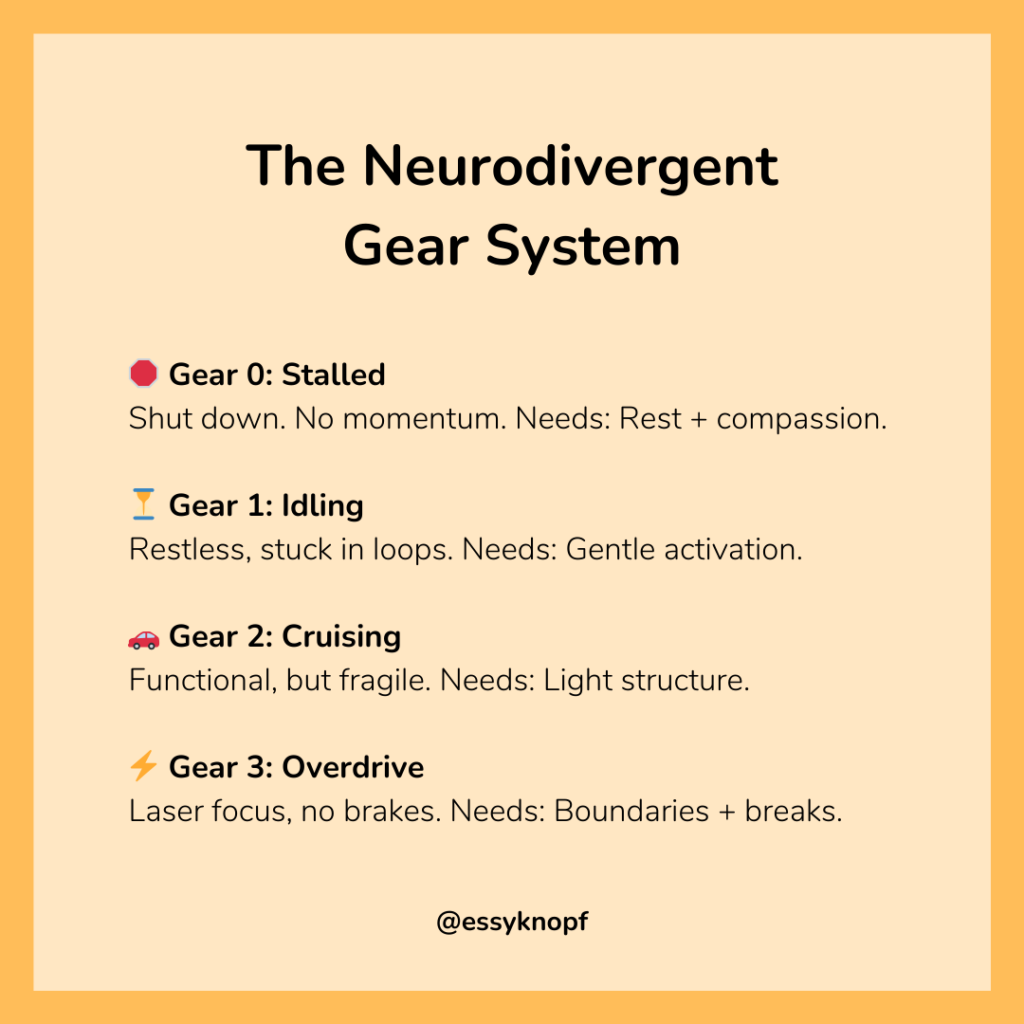
Gear 0: Stalled
Imagine trying to start a car with no fuel. You turn the key, press the gas, but nothing happens. That’s Gear 0: the Stalled state.
The lights are on, but nobody’s home. The idea of doing even one small task—brushing your teeth, replying to a text, making food—feels completely out of reach.
And worst of all? You don’t know how to get unstuck.
What Gear 0 Feels Like
- Emotional numbness or shutdown
- Anxious paralysis or depressive fog
- Overwhelm at even the smallest responsibilities
- Shame, guilt, or a loop of negative self-talk
- A sense that time is passing, but you can’t start
From the outside, Gear 0 might look like procrastination. But inside, it’s more like internal collapse. For many neurodivergent folks, this state is chronic.
And in a society that values constant output, stalled can feel unforgivable.
Why This Happens
In Gear 0, dopamine is low, executive functioning is offline, and your nervous system may be in freeze mode. You may want to act, but your brain and body are in full shutdown.
You might hear yourself saying: “What is wrong with me?” “Why can’t I just get up?” “Everyone else manages. Why can’t I?”
But those questions are grounded in neuronormative expectations. The neurodivergent gear system reframes this experience not as failure, but as a biological state that requires care, not punishment.
How to Support Yourself in Gear 0
Gear 0 doesn’t respond to logic, pep talks, or productivity hacks. It responds to compassion and tiny sparks of activation.
Wiggle your fingers. Stretch one arm. Open a window. The smallest action is still movement. Try weighted blanket, soft textures, calming sounds, safe smells—anything that brings comfort to your nervous system. Or ask yourself: “What would help a little right now?” instead of “What should I be doing?”
And if nothing helps? That’s okay too. You’re not lazy. You’re not broken. You’re stalled. And stalled engines need time, fuel, and kindness to restart.
Gear 1: Idling
You’re not frozen anymore, but you’re definitely not going anywhere. Welcome to Gear 1: the Idling state.
The engine is technically running, but you’re stuck in neutral, buzzing with restless energy, yet unable to translate that into motion. You want to do something, anything, but your brain won’t cooperate. So you bounce from tab to tab, room to room, task to task… accomplishing exactly nothing.
This is the torture chamber of executive dysfunction. And it’s exhausting.
What Gear 1 Feels Like
- Restless, jittery, uncomfortable in your own skin
- Too anxious to relax, too foggy to focus
- Aware of your responsibilities, but unable to begin
- Constantly distracted, abandoning one task for another
- Loud inner critic, whispering: “You’re wasting time.”
Sound familiar?
You might start to pay a bill, then remember an email, then open your calendar, then look up new planners… and boom, 45 minutes have vanished and nothing’s actually done.
What’s Actually Happening
In Gear 1, your brain is seeking dopamine but not finding enough of it to initiate or sustain meaningful action. So it chases micro-hits: scrolling, snacking, fidgeting, YouTube rabbit holes.
This is your brain trying to self-regulate with whatever stimulation it can find.
It’s frustrating. It’s confusing. And it’s where shame likes to sneak in the side door: “You had time. Why didn’t you use it?” “You’re so disorganized.” “You’re doing this to yourself.”
That shame? It keeps the cycle going.
The neurodivergent gear system teaches us to recognize this state not as a moral failure, but as a mismatch: you have the intention to act, but not the neurochemical bridge to get there.
How to Support Yourself in Gear 1
The key is gentle activation, not forcing productivity.
Try:
- Body doubling: Work alongside a friend (in person or virtually)
- Timers: Try “just five minutes”—even one minute counts
- Permission to start messy: Skip perfection. Begin in scraps.
- External structure: Lists, sticky notes, or soft deadlines can anchor your drifting mind
And remember: the goal isn’t to leap to Gear 3. It’s to inch from 1 to 2. From scattered to slightly engaged. Even a tiny shift matters.
Gear 2: Cruising
Something clicks. You’ve taken that first step. Maybe you’ve brushed your teeth. Opened the document. Replied to that one email. And suddenly, you’re in it.
Welcome to Gear 2: the Cruising state. This is where things feel… okay. Not amazing. Not terrible. But doable. There’s just enough dopamine to get through tasks, and just enough focus to keep the momentum going.
It’s functional focus. And for many neurodivergent folks, this gear is the sweet spot.
What Gear 2 Feels Like
- You’re moving steadily through tasks, maybe even enjoying them
- You still get distracted, but not derailed
- You’re managing your energy (barely), but you’re in motion
- Your mood might be flat, neutral, or cautiously optimistic
- You feel “like yourself” again. Just… more fragile
It’s the gear where you realize: “Oh. I’m not broken. I’m just a person who needs different conditions to function.”
The Delicate Balance of Gear 2
The neurodivergent gear system identifies Gear 2 as a transitional state. You’re no longer stuck, but you’re not fully locked in. It’s like cruising at a safe speed down an empty road, but knowing one red light, one interruption, one loud noise… could send you back to Gear 1 or even stall you out.
That makes this the perfect moment to support your state, so you can keep going without tipping into burnout or distraction.
How to Support Yourself in Gear 2
This is not the time to load your plate with high-stakes tasks. Instead, sustain the rhythm with just enough structure and support.
Try:
- Loose plans: A simple “next few steps” list, instead of a rigid schedule
- Soft accountability: Check-ins with a friend, or co-working platforms like Focusmate
- Lean into flow: If you’re vibing with a task, ride the wave, even if it’s not the “most important” thing on your list
- Hold space for breaks: Don’t wait for burnout. Rest before you need it
Also, be mindful of the inner critic that loves to whisper: “This isn’t real productivity.” “You’re not doing enough.” “You’re barely keeping up.”
Don’t let that voice steal your progress. Gear 2 is where sustainable momentum lives.
Gear 3: Overdrive
You’re in the zone. Ideas are flowing, tasks are flying off your list, time is melting away, and everything just clicks. You feel competent, confident… even euphoric.
This is Gear 3: Overdrive.
It’s the state that every productivity guru seems to worship, and the one many neurodivergent folks wish they could live in forever. Because here? You finally feel like you’re functioning the way everyone expects you to function all the time.
But here’s the thing: Gear 3 isn’t sustainable.
What Gear 3 Feels Like
- Laser-focused attention, possibly to the point of forgetting to eat, drink, or rest
- High energy, fast thinking, and a sense of “flow”
- Creative breakthroughs, fast problem-solving, intense clarity
- A strong urge to finish everything while the momentum lasts
- A total disregard for time, physical needs, or future burnout
Overdrive can feel amazing. That’s why it’s so seductive. Especially for ADHDers, this is the gear of hyperfocus, and it often comes with a rush of relief.
You’re finally “doing the thing.” You feel powerful. Capable. Normal.
Why Overdrive Isn’t the Goal
Let’s be clear: there is nothing wrong with experiencing Overdrive. But problems show up when we try to live here.
This gear is often triggered by:
- Urgency (deadlines, last-minute pressure)
- Novelty (new ideas, exciting projects)
- Passion (deep interest or personal relevance)
- Panic (avoidance catch-up, “everything’s on fire” mode)
The neurodivergent gear system reminds us that these bursts of energy are signs that your brain is flooded with just enough dopamine to lock on… for now.
But what comes up must come down. And if we don’t pace ourselves, Gear 3 will eject us hard into a crash.

The Risks of Staying Too Long in Overdrive
We skip meals. Ignore fatigue. Cancel breaks. Delay rest. Push through red flags. Why?
Because we’ve been taught that this version of ourselves—the one that performs—is the real us. Everything else feels like failure.
So we tell ourselves: “I’ll rest later.” “I just need to get this one last thing done…” “This is the only time I’ve had this kind of focus. I have to take advantage of it.”
But this mentality leads directly to burnout. Overdrive without boundaries can thus become self-abandonment.
How to Support Yourself in Gear 3
The goal here is to honor it without losing yourself in it.
Try:
- Set limits before you begin (e.g., “I’ll work for 90 minutes, then take a real break”)
- Leave notes for Future You (sticky notes that say “Please rest. You deserve it.”)
- Schedule body needs (hydration, food, movement) as non-negotiables
- Watch for signs of mental fatigue: confusion, irritability, forgetfulness. Stop there, not two hours later
You’re not sabotaging yourself by slowing down. You’re protecting your ability to keep showing up tomorrow.
Because Gear 3 is a gift, but it’s not a place to live.
Downshifting: The Crash After the Clarity
One minute, you’re flying: locked in, productive, present. The next? You’re staring at the screen, blinking slowly, completely disconnected.
What just happened? Welcome to Downshifting: the often-sudden, deeply disorienting transition out of one gear into a lower state.
For many neurodivergent people, this is one of the hardest parts of the cycle.
What Downshifting Feels Like
- Brain fog settling in like a heavy mist
- Emotional flatness, irritability, or inexplicable sadness
- Losing your train of thought mid-task
- Feeling mentally blank but physically wired, or vice versa
- A sudden inability to care about the thing that had you so focused minutes ago
Downshifting can hit like emotional whiplash. You were fine—even thriving—and now you’re dazed, frustrated, or spiraling.
What’s Really Going On
When you’ve been in Overdrive, you’ve likely burned through a ton of dopamine, emotional energy, and executive function. Your brain reaches a tipping point and pulls the brakes for you.
You didn’t “ruin it.” You didn’t “lose momentum.” You didn’t “self-sabotage.” You simply ran out of fuel.
In the neurodivergent gear system, Downshifting isn’t a backslide. It’s a necessary transition: your brain trying to recover from a high-output state.
But because we often don’t get any warning signs, it can feel like a betrayal: “Why can’t I just keep going?” “I was doing so well. What changed?” “I must have done something wrong.”
And that’s where shame tries to take over, unless we name what’s really happening.
How to Support Yourself While Downshifting
The most important thing? Resist the urge to push through. Instead, focus on soothing your nervous system and resetting gently.
Try:
- Name it: “I’m downshifting right now. I didn’t fail. I’m transitioning.”
- Offer comfort, not correction: Cozy clothes, warm drinks, movement, silence. Whatever helps you reset
- Embrace soft stops: Give yourself permission to stop without finishing. Not everything has to be done to be valuable.
- Compassionate self-talk: “I worked hard. I need care now, not criticism.”
The neurodivergent gear system reminds us that even rest states are part of the cycle. The crash is a signal that your brain needs something different now.
Final Thoughts: Learning Your Rhythm
So… what gear are you in right now?
- Are you stalled in Gear 0, unable to get moving and feeling swallowed by shame?
- Idling in Gear 1, buzzing with restless energy but unable to act?
- Cruising in Gear 2, functioning steadily and managing your pace?
- Flying in Gear 3, riding the high of hyperfocus and finally feeling “on”?
- Or maybe you’re downshifting, wondering where the focus went and why you suddenly feel so flat?
Wherever you are, it’s okay. You’re cycling through a neurodivergent gear system that reflects how your brain naturally shifts through different states of attention, energy, and regulation.
And when you learn to name those states, you also learn how to support them: Instead of “I’m lazy,” you say, “I think I’m in Gear 1. I need some soft structure.”
Instead of “I ruined my flow,” you say, “I’m downshifting. What would comfort look like right now?” Instead of “Why can’t I be like this all the time?” you say, “Gear 3 was a gift, but I don’t have to live there.”
This isn’t about becoming more productive or fixing yourself. It’s about honoring the rhythm of your neurodivergent brain, with curiosity instead of shame.
Because once you stop fighting your gears, you can start driving your own way.
What gear are you in today? Share in the comments. And if you have your own personal strategies for shifting gears (or staying gentle while stalled), I’d love to hear them.
Essy Knopf is a therapist who likes to explore what it means to be neurodivergent and queer. Subscribe to get all new posts sent directly to your inbox.
© 2026 Ehsan "Essy" Knopf. Any views or opinions represented in this blog are personal and belong solely to the blog owner and do not represent those of people, institutions or organizations that the owner may or may not be associated with in professional or personal capacity, unless explicitly stated. All content found on the EssyKnopf.com website and affiliated social media accounts were created for informational purposes only and should not be treated as a substitute for the advice of qualified medical or mental health professionals. Always follow the advice of your designated provider.