

When autistic truth is put on trial: Epistemic injustice in therapy


When an autistic person says, “This therapy harmed me,” what happens next matters.
Are they met with curiosity and compassion? Or are they questioned and told they misunderstood what happened?
Too often, autistic people encounter responses like: “That must have been a bad provider.” “ABA isn’t like that anymore.” “You don’t understand the science.” “That wasn’t real ABA.”
These statements may sound reassuring to the person saying them. And yet, to someone describing trauma, they can feel like another form of silencing.
This is where epistemic injustice enters the conversation.
What Is Epistemic Injustice?
Epistemic injustice occurs when someone is unfairly treated as an unreliable source of knowledge. In other words, their account is given less credibility because of assumptions about who they are.
One way this might happen with autistic people is when they are cast by others as confused, overly sensitive, incapable of accurately reading situations, or unable to understand professional practices.
As a result, their firsthand experiences can be treated as less trustworthy than the explanations offered by credentialed professionals.
The professional becomes the expert on what supposedly happened. The autistic person, meanwhile, is treated as an unreliable witness to their own life.
When Credentials Outweigh Lived Experience
Professional training and research have value. However, credentials should never make someone immune to questioning.
When autistic adults describe being traumatized by behavior-based interventions, the first response should never be to audit their memories or defend the reputation of a profession, but to listen.
Yet discussions of harm often shift toward technicalities: Was the provider properly certified? Was the intervention truly ABA? Did the autistic person understand the treatment model?
These questions may be relevant. But when they are used primarily to discredit the person reporting harm, they become a form of reputation management.
The underlying message is painful: If your experience does not fit our model, your experience must be wrong.
Why Epistemic Injustice Causes Harm
Being repeatedly disbelieved can deepen shame, self-doubt, and trauma.
Many autistic people already grow up being told that their perceptions are incorrect. For example, sensory distress may be dismissed as overreacting, while attempts to set boundaries may be interpreted as defiance.
Across our lifetime, this can corrode self-trust. And when therapists and other professionals repeat this pattern, the therapy room becomes yet another environment where neurotypical interpretations are prioritized over autistic reality, and autistic safety.
Listening Does Not Mean Abandoning Science
When autistic folks share their experiences, it should be not regarded as an attack on professions or research, but rather an invitation to ask better questions.
Research data can tell us whether a measurable behavior changed, but it cannot always tell us what that change cost the person emotionally.
A child may appear more compliant in ABA therapy, for example, while becoming more afraid to say no. An autistic person may display fewer visible “problematic” traits such as stimming as a result of such interventions.
Yet underneath the performance there may be an increase in anxiety or disconnection from their identity.
Progress therefore cannot be measured only by how comfortable someone’s behavior makes the people around them. Safeguarding individual well-being is key.
What Neuroaffirming Care Looks Like
Neuroaffirming practitioners do not assume they understand an autistic person’s experience better than the person living it.
Instead, they remain open to feedback, including feedback that challenges their training. They treat lived experience as meaningful evidence rather than an obstacle to professional authority.
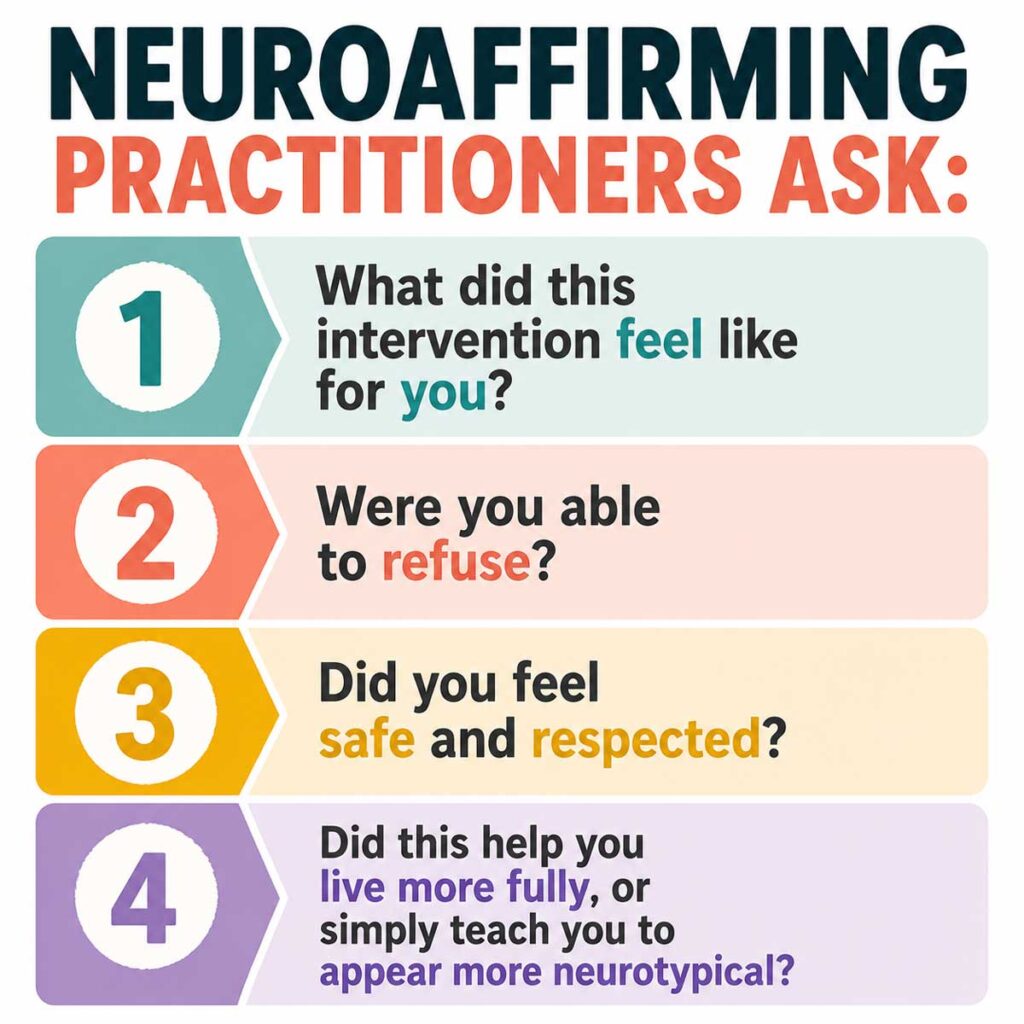
Most importantly, they ask: What did this intervention feel like for you? Were you able to refuse? Did you feel safe and respected? Did this help you live more fully, or simply teach you to appear more neurotypical?
These questions move us away from defensiveness and toward accountability.
Wrap Up
Autistic people should not have to present a courtroom case before their pain is taken seriously.
Addressing epistemic injustice begins with believing that autistic people possess valuable knowledge about their own experiences and recognizing that listening is one of the foundations of good therapy.
Have you ever felt that a professional dismissed or questioned your lived experience as an autistic person?
Essy Knopf is a therapist who likes to explore what it means to be neurodivergent and queer. Subscribe to get all new posts sent directly to your inbox.