

Unmasking isn’t a moment—it’s a practice

For those of us who are autistic, ADHD, or otherwise neurodivergent, “unmasking” is often painted as a single, bold event. Like ripping off a disguise to reveal your true self underneath: finally free, finally whole.
But that’s not the reality for most of us.
Unmasking isn’t one grand gesture. It’s not a viral social media post. It’s not telling your boss about your diagnosis or suddenly deciding you’ll stim publicly from now on. Those might be parts of the process. But the real work is quieter, slower, and very personal.
Unmasking is the ongoing practice of getting closer to your neurodivergent authenticity. It’s about noticing the habits you picked up to stay safe. The ways you’ve made yourself small to be accepted. And it’s about asking, day by day, “Is this who I really am, or is this who I’ve had to be?”
This post is for anyone sitting in that question.
We’ll talk about what masking actually looks like, why it was necessary, and what unmasking can mean as a rhythm, return, and reclamation.
What Masking Really Is (and Isn’t)
Masking is something many neurodivergent people learn to do—often without realizing it—because it helps us survive. It’s a highly skilled, adaptive response to a world that tends to reward sameness and penalize difference.
When we talk about masking, we’re talking about the suppression or editing of our natural behaviors in order to avoid conflict, blend in, or stay emotionally and physically safe. It can be deliberate: like scripting what you’ll say before a conversation. But more often, it’s automatic. Your nervous system just does it before you even realize.
You might:
- Monitor your tone to avoid sounding “rude”
- Laugh at jokes you don’t understand (or don’t find funny)
- Sit on your hands so you don’t stim
- Pretend to follow a conversation you’re totally lost in
- Say “yes” when you desperately want to say “no”
- Dress to blend in, even if the fabric feels wrong on your skin
These might sound like small adjustments. But over time, they chip away at your sense of self. The gap between who you are internally and how you show up externally starts to widen. And eventually, it becomes hard to tell where the mask ends, and where you begin.
And because masking becomes so normalized, unmasking doesn’t always look dramatic. Sometimes, it’s just… subtle. Almost invisible. Like:
- Leaving a group chat without apologizing
- Letting yourself stim in public
- Wearing headphones even when people stare
- Saying “I need a minute” instead of rushing to respond
- Letting yourself cry when you’re overwhelmed, instead of powering through
And sometimes? Unmasking is simply noticing the urge to mask and choosing not to.
That’s the beginning of reclaiming neurodivergent authenticity. Not with fireworks, but with small acts of self-permission. Because while masking might have helped you survive, unmasking is how you begin to live.
Why It’s So Hard to Stop
If masking is so exhausting, why is it so hard to stop?
The answer is simple and heartbreaking: because it kept you safe.
Masking is an adaptation. It’s what you did, or still do, to avoid being hurt, rejected, or misunderstood. It helped you stay employed. Stay liked. Stay connected. Stay out of trouble.
Maybe you masked to avoid being bullied at school. Maybe you did it so your parents wouldn’t call you “too much.” Maybe you wanted to make friends, or just not be punished for existing the way you are. Maybe you didn’t even realize you were doing it… until you burned out.
You didn’t choose to mask because you didn’t like yourself. You masked because the world told you, directly or indirectly, that your unfiltered, unedited self wasn’t acceptable.
In a society built around neurotypical expectations, masking becomes the toll we pay for proximity to belonging. And over time, the mask starts to feel like “just the way I am.”
But here’s the thing: dropping the mask shifts how you relate to others, and it also changes how others relate to you.
Suddenly, you’re no longer the “easy one.” You’re not the people-pleaser, the always-agreeable friend, the chill coworker who never complains. You start setting boundaries. You speak up. You stim, say no, take breaks. You let your truth show.
And not everyone is ready for that.
Unmasking puts your neurodivergent authenticity on display. And sometimes, that means facing discomfort or rejection from others who were only ever comfortable with the masked version of you.
That’s why unmasking has to be a choice, rather than an obligation. It has to come from safety, not pressure. And safety isn’t just about logic. It’s about the body. Your nervous system has to feel safe enough to let the mask come down.
So if you find yourself frustrated, wondering why you can’t just “be real already,” take a breath. Offer yourself some compassion.
You’re still surviving, and that deserves to be honored. And the path back to neurodivergent authenticity begins with honoring every single version of you that helped keep you safe.
What Unmasking Really Looks Like
“Unmasking” sounds kind of glamorous. It’s easy to imagine it as a single, life-altering choice. A brave declaration. A before-and-after story with a clear transformation.
But real unmasking is rarely that cinematic.
Most of the time, unmasking looks awkward. Uneven. Vulnerable. Sometimes it’s incredibly freeing. Other times, it feels uncomfortable, exposing—even risky.
Sometimes unmasking is saying, “I don’t get it,” instead of pretending you do. Sometimes it’s showing up in clothes that feel right in your body, even if they make you stand out.
Sometimes it’s canceling plans and telling the truth about why: “I’m overwhelmed.” “I need rest.” “I’m not up for it today.”
It might look like:
- Speaking at your natural cadence, even if people talk over you
- Letting yourself stim openly
- Using scripts because they help, not because you’re performing
- Asking for what you need, without guilt or apology
Other times? Unmasking might mean choosing not to unmask. Because there are still environments—workplaces, family gatherings, classrooms—where masking remains protective. And that’s okay.
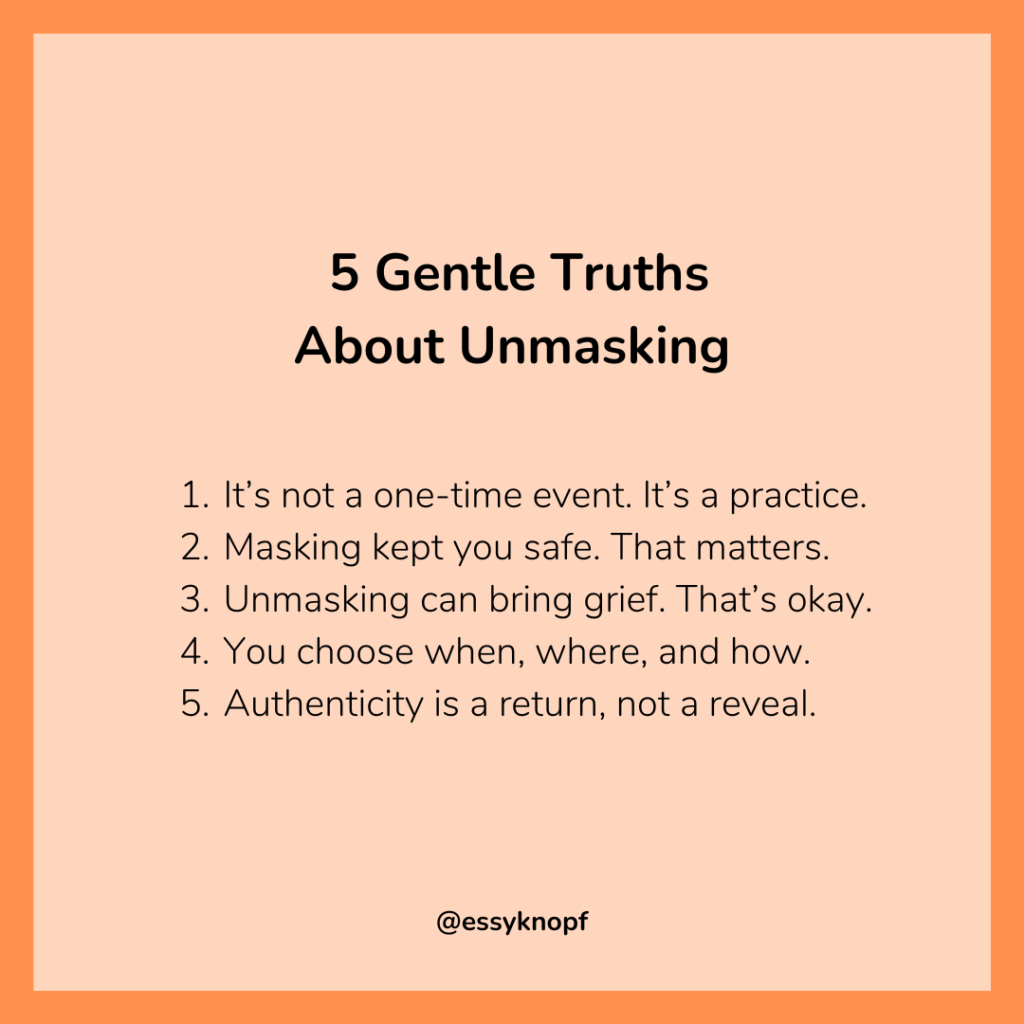
Unmasking isn’t about being completely transparent with everyone, all the time. It’s about agency.
It’s about knowing: “I’m masking right now, and I understand why.” And then asking: “Do I want to keep doing it in this moment? Or is there space for something more honest?”
That’s the core of neurodivergent authenticity. There’s no checklist. No badge. No one-size-fits-all roadmap.
But here’s something to look for: those quiet moments when your body exhales. When you laugh and don’t monitor the sound. When you leave a conversation feeling full instead of drained.
That’s how you know you’re heading in the right direction. Not toward some ideal version of your “real self,” but toward something more grounded, gentler, more you.
The Grief Beneath the Freedom
Unmasking is often framed as liberating, and it can be. But what we don’t talk about enough is that even freedom comes with grief.
Because every time you let go of a mask, you’re also acknowledging why it was there in the first place.
You’re reclaiming your truth, and you’re facing the hard reality that your truth was once unsafe. That you had to hide, shrink, or contort yourself to be accepted. That parts of you were only allowed conditionally… or not at all.
And that hurts.
You might grieve the years you spent trying to be “easy. The friendships that only worked because you were performing. The younger you who learned it wasn’t safe to be fully seen
That grief can feel disorienting. You may find yourself wondering, “Why didn’t I figure this out sooner?” or “How much of my life did I spend playing a role?” You may question your past: Was any of that real? Did they love me, or just the mask I wore?
Grief is part of the process of reconnecting with your neurodivergent authenticity. Because being honest with yourself sometimes means mourning the years you couldn’t be.
And yet… joy can still show up. Often, it tiptoes in alongside the grief.
Like the first time you stim in public and realize no one’s watching, or that you don’t care if they are. Like the first time you say no and feel relief instead of guilt. Like the first time someone meets your unfiltered self and stays.
Unmasking isn’t clean or linear. It’s layered. One moment, you’re laughing with wild, unmonitored freedom. The next, you’re grieving how long it took to feel that free.
And both are true. Both are sacred. Because each moment of pain you move through clears space; space for rest, for softness, for self-recognition.
And eventually, you start to feel it: “Oh. This is what it’s like to belong to myself.”
Unmasking as an Ongoing Practice
If you’re waiting for the moment when you’re “fully unmasked,” you might be waiting a while.
Because unmasking isn’t a set destination, but a practice you return to, again and again, with care.
Some days, you’ll show up fully, speaking freely, stimming openly, asking for what you need without second-guessing. Other days, you’ll go quiet. You’ll mask again out of habit, fear, or self-preservation. And that doesn’t make you a failure.
We don’t achieve some ideal version of your “real self” per se, but we do cultivate awareness. About tuning into your body, your instincts, your patterns, and making choices from a place of self-trust.
It’s asking yourself, in a moment of tension or discomfort: “Is this necessary right now?” “Or is this a habit I’m ready to shift?”
Over time, you begin to recognize the mask in real time. You notice when you’re bracing. When you’re adjusting. When you’re hiding… even just a little.
And in that noticing, something opens up. Choice. Softness. Space.
You begin to anchor your decisions in care for your nervous system. And through that, neurodivergent authenticity starts to feel less like a performance and more like a returning.
That’s the shift.
It’s not that you never mask again. It’s that when you do, you understand why. And when you don’t, you feel the difference. The breath. The relief. The honesty.
And when others meet you there, in your unmasked self, something sacred happens. You begin to experience a kind of connection that isn’t conditional. That doesn’t require efforting. That simply is.
So if you’re still figuring it out—still unlearning, still re-learning—you’re not behind. You’re right on time. You’re living the practice.
Keep noticing. Keep asking. Keep choosing.
Unmasking Rewrites the Past
Here’s something no one warns you about: unmasking can shift your relationships, and not always in the way you hope.
Sometimes, when you begin to show up more honestly, the people who were comfortable with the masked version of you… start to pull away.
Maybe they say, “You’ve changed.” Maybe they get frustrated when you start setting boundaries. Maybe they miss the version of you who never said no, never asked for space, never made things “complicated.”
And that can be deeply painful.
Because even if those connections weren’t fully authentic, they still gave you moments of belonging. They still mattered. And grieving them is valid.
But here’s the hard truth: if someone only accepts you on the condition that you remain small, agreeable, or self-denying, then their love is not love. It’s a contract.
A contract that says: “I like you… as long as you don’t inconvenience me. As long as you keep pretending.”
Breaking that contract is hard. But it’s also necessary.
Because every time you choose neurodivergent authenticity over appeasement, you create space. Space for the people who want the real you. The version who stims. Who sets boundaries. Who asks questions. Who needs breaks. Who doesn’t always smile when it’s expected.
You make room for friendships built on reciprocity, not performance.
It’s okay if the people who were drawn to your mask struggle with your truth. It doesn’t mean you’re doing unmasking wrong. It means it’s working.
Yes, it may come with loneliness, especially at first. But over time, something beautiful happens: you start to find your people. Or they find you. And the connection you create isn’t built on roles, but on resonance.
These are the people who don’t flinch when you stim. Who listen when you say, “I’m overstimulated.” Who celebrate your boundaries instead of resisting them. Who make you feel like you don’t have to explain or apologize for being exactly as you are.
And that? That’s worth the risk.
Final Thoughts
Unmasking isn’t about arriving at some perfected version of your true self. It’s not about never blending in, never adapting, or never struggling again.
It’s about recognizing your patterns with compassion. It’s about making choices rooted in self-awareness instead of self-erasure. And it’s about returning to your neurodivergent authenticity, in whatever way feels possible today.
There’s no rush. No right pace. No need to be fearless.
You can be soft. You can be scared. You can be figuring it out as you go. That is the process.
So if you’re somewhere in the messy middle—still masking sometimes, still unmasking in small ways—you’re not behind.
You’re becoming.
What has unmasking looked like for you?
Essy Knopf is a therapist who likes to explore what it means to be neurodivergent and queer. Subscribe to get all new posts sent directly to your inbox.
© 2026 Ehsan "Essy" Knopf. Any views or opinions represented in this blog are personal and belong solely to the blog owner and do not represent those of people, institutions or organizations that the owner may or may not be associated with in professional or personal capacity, unless explicitly stated. All content found on the EssyKnopf.com website and affiliated social media accounts were created for informational purposes only and should not be treated as a substitute for the advice of qualified medical or mental health professionals. Always follow the advice of your designated provider.