You agree to stay a little longer, even though the restaurant noise is making it hard to think. Your friend wants to tell you something, and you don’t want them to feel brushed off. So you keep listening and hope they finish soon.
Later, you’re exhausted and irritated. You wanted to spend time with them, but you also wanted to leave half an hour ago.
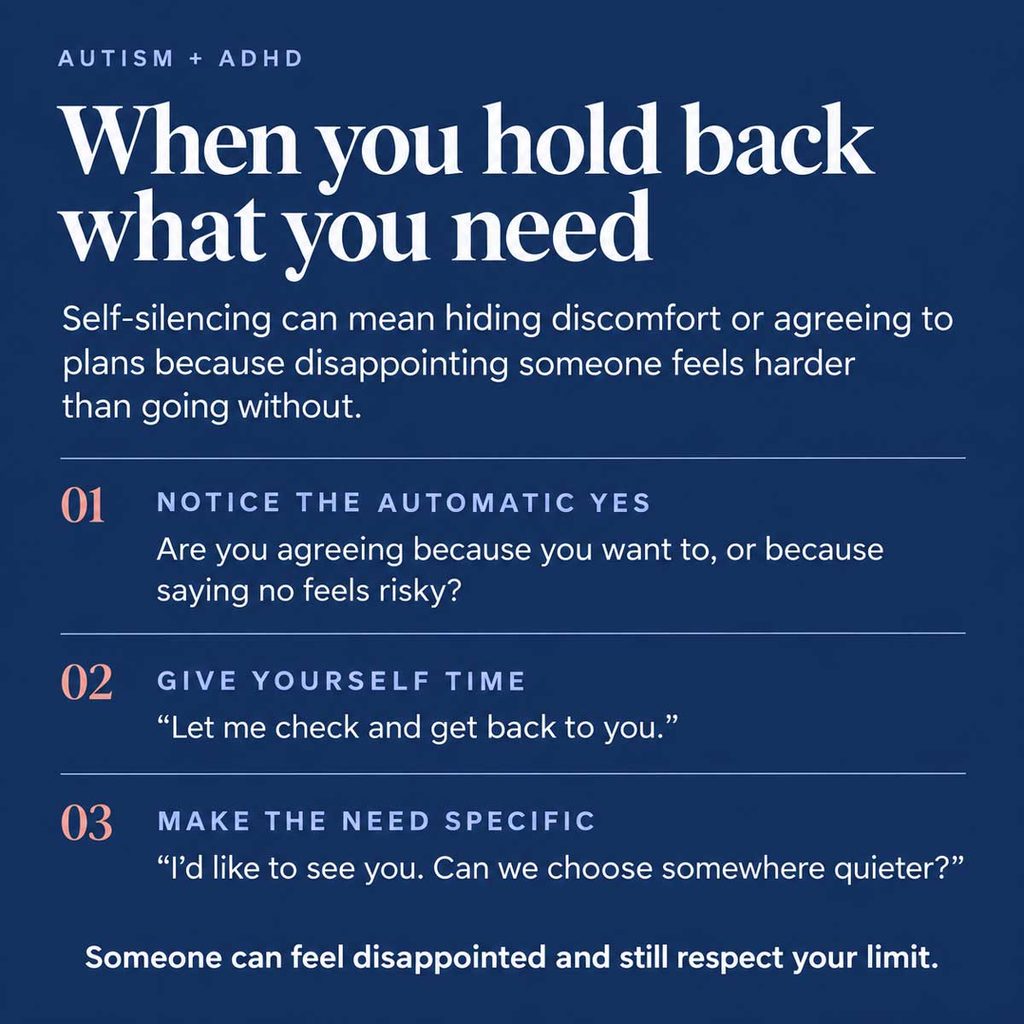
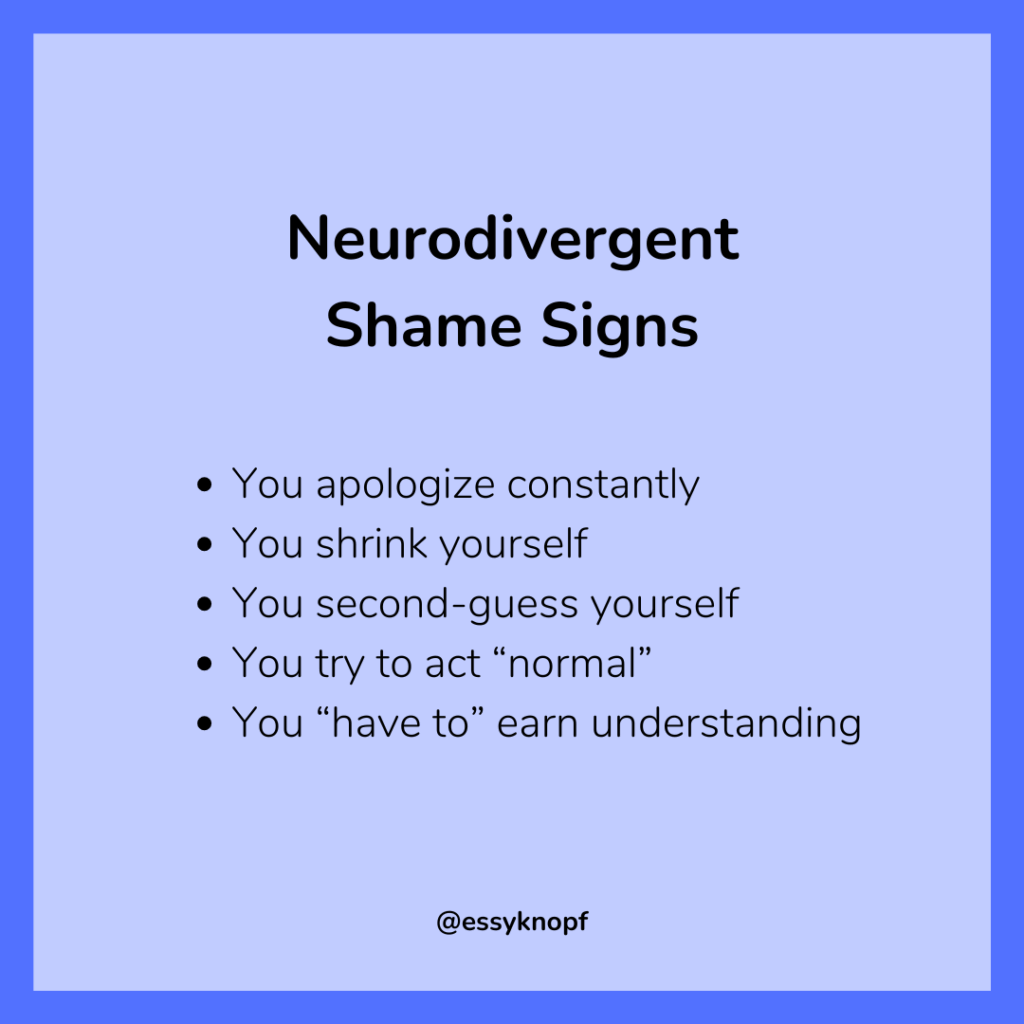
This is one way neurodivergent self-silencing can show up: you hold back what you need because someone else’s possible disappointment feels more urgent. Sometimes you agree so quickly that you only recognize your discomfort afterward.
Asking for quiet becomes an apology, while leaving a gathering requires reassurance that you had a good time. You might even stay somewhere uncomfortable because saying nothing seems easier than convincing someone you aren’t rejecting them.
This can overlap with masking, particularly when you’re concealing discomfort or managing your expression to meet social expectations. Those adjustments may help you get through an interaction, which is part of what makes them difficult to reconsider.
Other people’s responses can reinforce the habit. Someone may describe you as easygoing without realizing how often you’re agreeing to things you don’t want.
After a while, you can find yourself wondering whether they would still enjoy your company if you asked for more.
Caring can take effort without being fake
Some autistic and ADHD adults need time to work out what they feel or how they want to respond. If a friend shares something painful while you’re overwhelmed, you may care about them and still struggle to find words.
Choosing a thoughtful response doesn’t make your concern artificial. Nor does needing a moment mean you lack empathy.
The pressure comes when you believe you must respond immediately, regardless of your capacity. You start worrying about whether your face looks sympathetic enough instead of listening to what the person is saying. Meanwhile, your own need for a pause goes unspoken.
A flat voice or quiet expression doesn’t necessarily reveal how much you care. You might be concentrating or tired; it may simply be how you communicate.
Saying, “I’m listening; I just need a moment to take that in,” gives the other person some context without requiring you to conceal what’s happening for you.
The difficult part is allowing disappointment
When you’re accustomed to holding back, another person’s disappointment can feel like evidence that you should have kept quiet.
But a friend can wish you’d stayed longer and still respect your decision to leave. You can care about that disappointment without changing your answer.
Waiting until nobody minds your boundary may mean never setting it. Even considerate people won’t always want the same thing you do.
What tells you more is how they respond. Do they accept your answer, even reluctantly? Or do they keep pressing until you give in?
You can explain your needs clearly. The other person’s willingness to respect them remains their responsibility.
Give yourself time before agreeing
A useful place to begin is with the moment before your automatic yes.
“I’ll check and get back to you” gives you time to consider whether you actually want to go and what it would require. You don’t have to decide while watching someone’s face for signs of disappointment.
For plans you do want, try stating a limit early: “I’d love to come. I can stay for about an hour.” That may feel easier than waiting until you’re overwhelmed and trying to explain why you suddenly need to leave.
If you notice your discomfort only afterward, that information still helps. You might realize that dinner works better somewhere quieter, or that you need a shorter visit next time. You can use what you learned without criticizing yourself for not speaking up sooner.
Start with someone who has shown they can respect a request. You don’t need to disclose more or drop protective habits around someone who repeatedly punishes you for expressing needs.
When a person accepts your limit, give yourself a chance to notice. You asked for something, and the relationship continued. You don’t have to follow that with an apology.
Wrap Up
Neurodivergent self-silencing can be difficult to notice when you’ve become used to checking what everyone else wants first. Making room for your own needs starts with considering them before you commit.
The next time you feel yourself saying yes automatically, give yourself a moment. You may still choose yes, but you’ll have had a chance to include yourself in the decision.
Essy Knopf is a therapist who likes to explore what it means to be neurodivergent and queer. Subscribe to get all new posts sent directly to your inbox.
Over the years, I’ve worked with a lot of neurodivergent people carrying the same fear: that their struggles meant something was fundamentally wrong with them.
They spent years being treated like their differences were problems to fix, hide, overcome, or apologize for.
People pushing themselves to exhaustion trying to seem “normal.”
People becoming experts at looking “fine.”
People hiding overwhelm, confusion, sensory pain, emotional intensity, or support needs because they were afraid of how others would react.
After enough conversations like these, I started writing something that eventually became The Neurodivergent Manifesto.
Part of it reads:
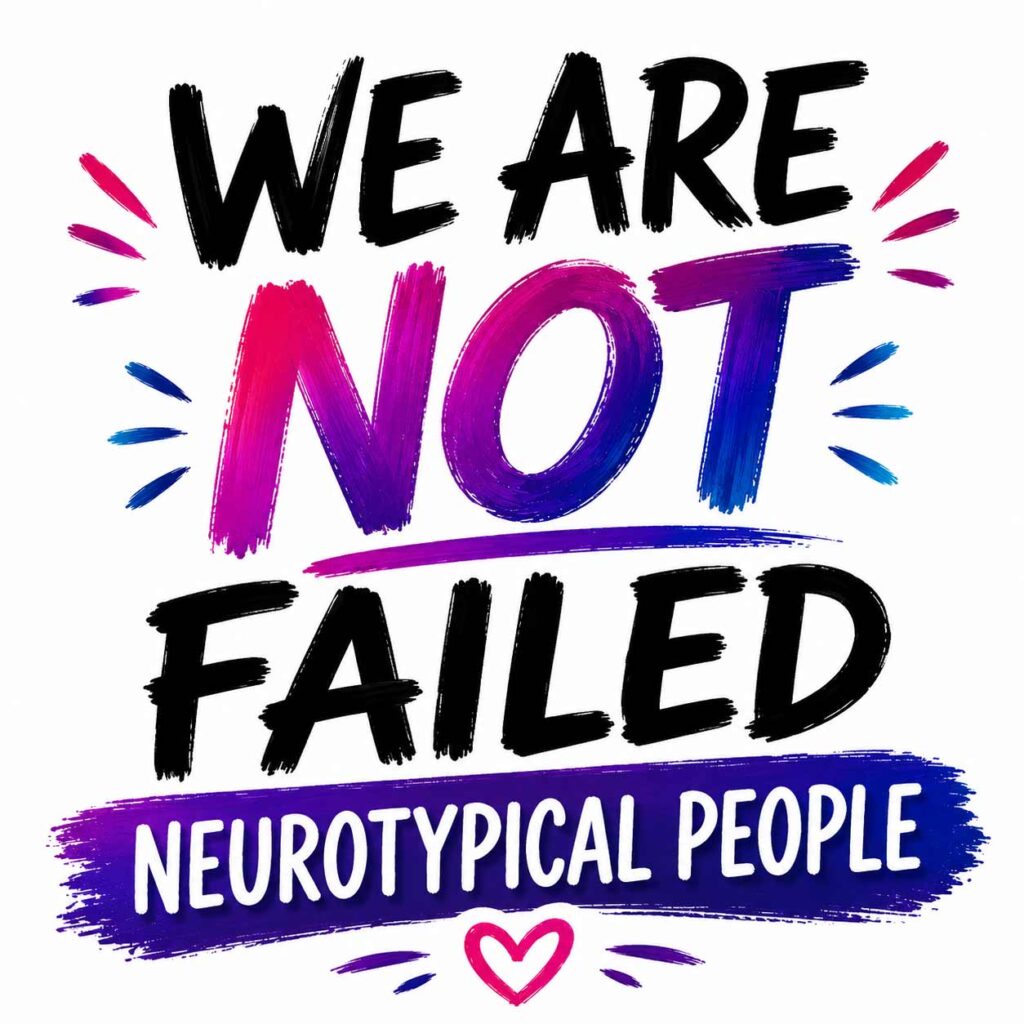
“We are not failed neurotypical people.”
“A person can struggle and still deserve dignity.”
“We deserve lives that do not require self-erasure.”
A lot of neurodivergent people learn early that authenticity comes with consequences.
As a result, they adapt.
They monitor themselves constantly. Rehearse conversations. Hide stress. Push through overload. Suppress needs. Become whoever other people seem most comfortable with.
And after doing that long enough, many end up carrying a deep sense of shame without fully realizing where it came from.
The problem was never simply being different, but rather existing in environments where difference was treated like failure.
Essy Knopf is a therapist who likes to explore what it means to be neurodivergent and queer. Subscribe to get all new posts sent directly to your inbox.
Have you spent most of your life carrying experiences that few people ever see? If you’re autistic, ADHD, chronically ill, or some combination of all three, there’s a good chance you already know what that feels like.
You live with a dozen intersecting realities—sensory sensitivities, executive dysfunction, fatigue, chronic pain, mental health conditions—and yet you’re constantly asked to condense all of that into one simple explanation. A label. A sentence. Something that fits the narrative people already expect to hear.
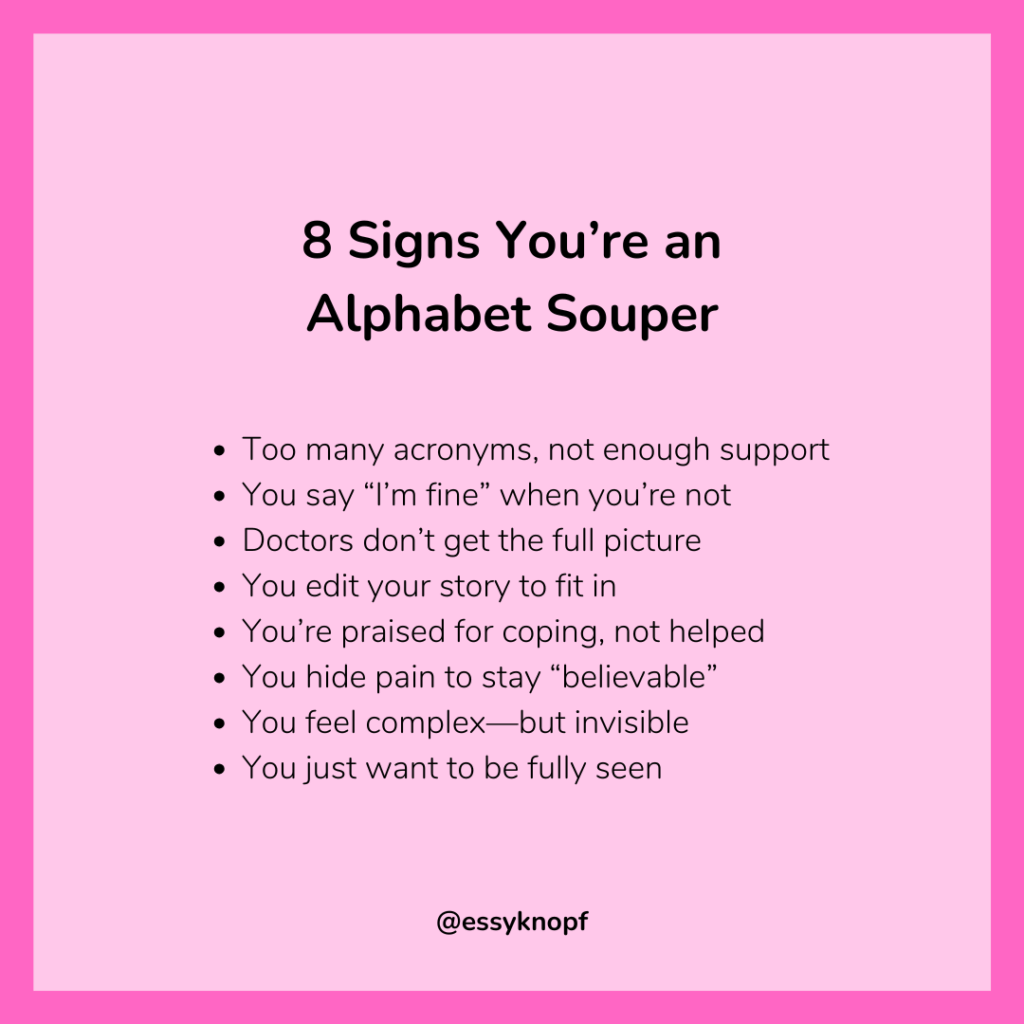
That’s why I use the term “alphabet souper.”
It’s my shorthand for a life shaped by diagnosis codes, misunderstood symptoms, and invisible struggles. It refers to the long string of acronyms many of us carry: ADHD, ASD, HSD, POTS, MCAS, IBS, C-PTSD, etc.—and more. Each one might explain a single piece of our reality, but none tell the full story. And most of the time, no one even asks.
Being an alphabet souper means living with neurodivergence and co-occurring challenges, while constantly being expected to explain it all in a way that’s easy for others to understand.
We become experts at this. Not because we want to. Because we’ve had to.
The Pressure to Be Legible
When you’re an alphabet souper, you quickly learn that complexity makes people uncomfortable. Most of the world is calibrated for simplicity. Single diagnoses. Clear causes. Easy fixes. But alphabet soupers don’t fit that mold.
Instead, we live at the intersection of multiple systems that don’t work the way they’re “supposed to.” Our experiences don’t follow a single diagnostic narrative. We might be managing sensory overwhelm, executive dysfunction, chronic illness flare-ups, social anxiety, and trauma, all in a single afternoon.
And yet, when we speak about our reality, we often feel pressure to streamline it. To reduce it to something legible. Something people will recognize. Something that sounds familiar enough not to raise eyebrows or questions we’re too tired to answer.
So we adapt. We learn to talk about our conditions in bite-sized chunks. We avoid going into detail. We measure our words against other people’s attention spans and comfort levels. We edit our stories because we know what happens when we don’t.
The more challenges you carry as an alphabet souper, the more invisible labor goes into appearing “manageable.” This is about more than masking. It’s about shaping your whole presence around what others can emotionally or intellectually tolerate.
Masking Runs Deeper Than People Think
When people talk about masking, they often imagine it as something surface-level: suppressing stims, mimicking facial expressions, mirroring tone. But for many of us living as an alphabet souper, masking runs far deeper.
We mask pain. We mask confusion. We mask the crashing of multiple internal systems while calmly nodding through a conversation. We become fluent in scripting—even basic interactions—because improvising takes energy we often don’t have.
And the longer we mask, the harder it becomes to remember what’s underneath.
Being an alphabet souper means juggling neurodivergence and co-occurring conditions that interact in unpredictable ways. Maybe it’s brain fog from POTS, overlaid with executive dysfunction from ADHD, while also managing the social load of masking autistic traits. On paper, we might look “functional.” But the cost of looking that way is rarely visible to others, and often invisible even to ourselves.
Masking becomes muscle memory. We’ve done it for so long, it can feel automatic. Expected. Sometimes even praised.
But here’s the truth: that praise is hollow. Because it usually comes from people who don’t see the after-effects. They don’t see the crash after we’ve held it together for too long. They don’t see the shutdowns, the flares, the hours lost trying to regulate. They see us as “resilient”, but they never asked what it cost.
For an alphabet souper, masking isn’t just about fitting in. It’s about managing other people’s reactions so we don’t lose support, credibility, or connection. And that’s a heavy ask, especially when you’re already carrying so much.
Complexity Isn’t a Defect
In a world that rewards neat categories and predictable narratives, being an alphabet souper often feels like you’re doing life wrong. You’re neurodivergent and you’re also navigating chronic illness, trauma, sensory processing differences, mental health struggles, and no one seems to know what to do with all that at once.
You get responses like, “That’s a lot,” or “Have you tried yoga?” You see the subtle wince when you bring up yet another acronym. You notice how people start to disengage when your story doesn’t have a simple ending or a tidy explanation.
There’s a widespread belief—sometimes unspoken, sometimes very loud—that if you have too many issues, you must be exaggerating. Or dramatic. Or maybe even difficult. But complexity isn’t a personal failing. It’s just reality for many of us.
Being an alphabet souper means that no single diagnosis explains everything, but each one adds to the picture. It’s layered. And those layers influence how we experience the world, how we communicate, how we move through each day.
But complexity makes systems freeze up. Medical professionals don’t know which part to treat first. Friends don’t know how to respond. Coworkers stop inviting you to things.
And so, out of self-protection, we start to censor. We pick the “most relatable” diagnosis to talk about and leave the others off the list. We say we’re “just tired” when we’re in full autonomic dysregulation. We avoid bringing up that a food sensitivity triggered a three-day spiral because it sounds too strange, too much.
We internalize the idea that to be supported, we must be simple.
But being an alphabet souper means embracing complexity, because denying it costs us more than anyone else. Denying it keeps us alone.
A Thousand Small Losses
Grief isn’t always loud. For an alphabet souper, it’s often subtle, cumulative: an echo that builds over time.
It starts with the doctor who dismisses your symptoms because your tests came back “normal.” The therapist who focuses on one diagnosis but ignores the others. The friend who changes the subject when you try to explain what a flare day really feels like.
None of these are big moments on their own. But together, they form a pattern. A long trail of interactions where your reality was too complex, too inconvenient, or simply too misunderstood.
When you’re an alphabet souper, the losses add up: the connection that fizzled out after you were “too honest”; the job interview that went silent after you disclosed; the look someone gave you when you tried to explain how everything overlaps—how your sensory overload makes your GI symptoms worse, which then spikes your anxiety, which makes your executive dysfunction spiral.
You learn not to go there, because you’ve learned most people don’t want to know.
You start skipping details. Leaving things out. Not mentioning the acronym you just got added to your file. That information, after all, could cost you in social currency.
Every time you withhold a part of your story, there’s a loss. A missed opportunity for understanding. A part of yourself that stays hidden.
And the hardest part? Even when you’re surrounded by people, you can feel deeply alone. Because no one sees the full version of you. Few people have stayed long enough—or listened closely enough—to hold your whole story.
That’s the ache many alphabet soupers carry: the longing to be known and believed, without having to shrink their truth to fit someone else’s comfort zone.
Final Thoughts
If you’ve ever felt like your story had too many moving parts to explain—if you’ve ever watched someone’s eyes glaze over as you tried to name what you’re carrying—you’re not alone. You’re likely an alphabet souper, navigating a world that doesn’t know how to hold the weight of complexity without trying to simplify, fix, or ignore it.
Being an alphabet souper means you’ve had to become your own translator, advocate, and interpreter, often in spaces that demand silence or performance over truth. That’s exhausting. And you deserve better.
You deserve to take up space with your full story, and not just the parts that are easy for others to digest. You deserve support that doesn’t disappear when the list of challenges gets longer. You deserve to say, “I’m struggling,” without having to earn that struggle’s legitimacy.
And above all, you deserve to be known without having to be explained.
Are you an alphabet souper too? Have you ever had to simplify your truth just to stay connected or believed?
Essy Knopf is a therapist who likes to explore what it means to be neurodivergent and queer. Subscribe to get all new posts sent directly to your inbox.
There’s a tension I carry in my body, like a coiled spring.
It shows up in the way I brace before I speak. The way I rehearse sentences in my head before I open my mouth. The way I watch for micro-reactions: a raised brow, a stifled sigh, a slight pause in someone’s tone.
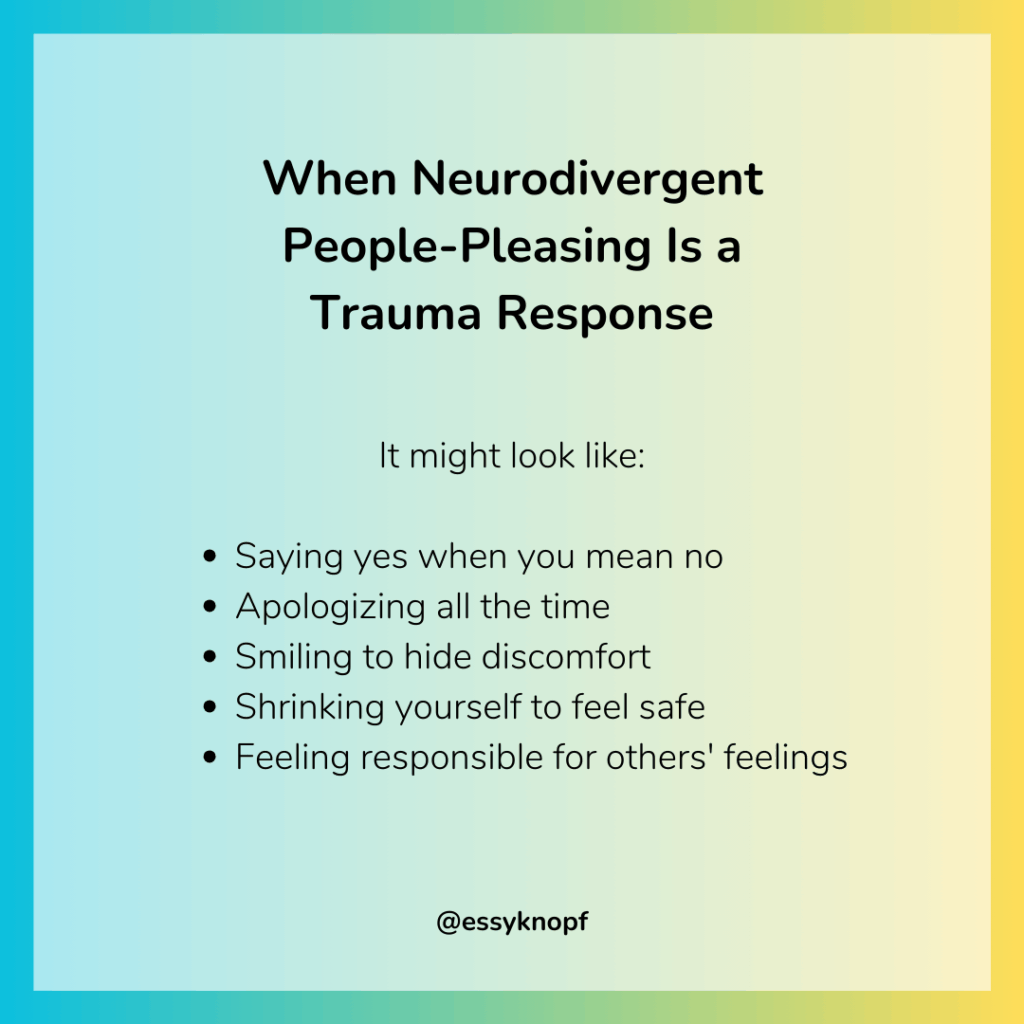
This is a learned posture of hypervigilance. A physical manifestation of years spent in what I now recognize as neurodivergent people-pleasing mode.
This behavior becomes our default when we’ve learned—early, often, and painfully—that our natural ways of being tend to invite misunderstanding, correction, or outright rejection. And even when those things aren’t happening in the moment, our bodies don’t forget.
The world may not be attacking us, but we’re still braced for the blow.
For many autistic and ADHD folks, this is the result of trauma; a deep-seated nervous system adaptation to a society that consistently sends the message: “You’re doing it wrong.”
Today, I want to talk about that: what it’s like to live in a constant state of neurodivergent people-pleasing, how it shapes our social lives, and what healing might begin to look like.
The Hidden Trauma Behind Neurodivergent People-Pleasing
When we talk about trauma, most people think of a singular, catastrophic event: a car crash, a violent assault, a natural disaster. But for many autistic and ADHD folks, trauma doesn’t arrive in one big wave. It’s a steady accumulation.
This is complex trauma. The kind that builds slowly, invisibly, over years of being misread, dismissed, or shamed for being different. It’s the slow drip of social rejection. The chronic sense of not belonging. The pain of having your true self constantly questioned, corrected, or ignored.
It’s being the child who was “too sensitive,” “too blunt,” “too loud,” “too weird.” The teen who masked so well they disappeared. The adult who performs normalcy so convincingly that their pain goes unseen.
These experiences don’t just hurt in the moment. They rewire your nervous system. Over time, your brain begins to anticipate judgment. You learn to preemptively scan every room, every face, every word. You rehearse. You shrink. You hide. You brace.
And the most insidious part? Much of what causes this trauma is praised by others.
Like staying quiet in class. Like forcing eye contact while your whole body screamed “no.” Like over-apologizing, over-explaining, over-functioning, just to prove you deserve to take up space.
This is the essence of neurodivergent people-pleasing: performing social acceptability at the expense of your own regulation. Adapting so thoroughly that others never see your distress. Being rewarded for suppressing yourself so effectively that you forget what authentic expression even feels like.
These survival strategies are reflexes, shaped by a thousand tiny lessons: that your comfort makes others uncomfortable, that your truth is too much, that your presence needs softening, shrinking, smoothing over.
But just because it’s common doesn’t mean it’s harmless. Neurodivergent people-pleasing often leads to chronic burnout, disconnection, and shame. Because when you’re constantly performing safety for others, there’s no room to experience it for yourself.
Empathy in People-Pleasing Mode Doesn’t Always Look How You Expect
When you’ve been punished for reacting the “wrong” way too many times, your brain learns to pause. To scan. To script. One of the ways we overcompensate in neurodivergent people-pleasing is by performing a pantomime of empathy.
In many situations that call for it, we may find that our brain is still buffering. Our nervous system might be flooded. Our emotional access might be delayed. Or we may not even know what we’re feeling, because alexithymia and overwhelm can block the emotional signals entirely.
So instead of feeling it in real-time, we run a mental checklist: What would comfort me if I were them? What tone feels safe? What’s the right facial expression to make them feel heard?
What you see on the outside might look like empathy. And in a way, it is. It’s intentional. It’s effortful. It’s us overfunctioning so we can show up, even if we’re still catching up inside.
We’ve learned to perform empathy in a way others recognize. And when we do it well, it usually lands. But it doesn’t feel authentic. It feels like a mask. A role we’ve rehearsed so often that we can do it on autopilot, but never without cost.
And when we’re the one in pain? When we drop the mask and don’t receive that same attunement in return? It stings. It affirms that we must keep performing to stay safe. That neurodivergent people-pleasing is not optional… it’s required.
Flat Doesn’t Mean Unfeeling: The Protective Stillness of People-Pleasing
Sometimes in conversation, we go quiet. Our voice flattens. Our face stops moving. Our answers shrink to short, clipped replies.
To someone on the outside, it might look like we’re annoyed, shut down, or checked out.
But what’s really happening is this: we’re trying to keep ourselves safe.
When you live in the cycle of neurodivergent people-pleasing, your nervous system is constantly monitoring for overload—social, emotional, sensory. And when it gets to be too much, your body does what it needs to do to stay regulated: it goes still.
We adopt a “bratty resting face,” which is often just a freeze response.
It can be triggered by a variety of factors: bright lights and too much background noise; a conversation that’s moving too fast to track; the fear of saying the wrong thing; the emotional weight of alexithymia (feeling something big but having no name for it).
We freeze also because moving might make things worse. We shrink our expressions to minimize risk. We quiet our tone, monitor our posture, try to reduce any variables that might be misread.
Ironically, it’s that effort to appear neutral that often gets misread the most. People ask, “Are you okay?” with a tone that suggests we’re not. They say, “You seem mad,” when we’re doing our best to hold it together. We may have even been told, “You looked like you hated me,” when we were actually doing everything in our power not to melt down in front of someone.
When we mask our overwhelm, we often still get it wrong. Because even silence can be judged. Even neutrality can be seen as hostility.
And so the cycle reinforces itself. We learn that even our coping strategies are risky. That even self-protection makes us vulnerable.
That’s the exhausting paradox of neurodivergent people-pleasing: you’re constantly adapting to avoid being misunderstood, only to be misunderstood anyway.
Hypervigilance As a People-Pleasing Strategy
“Did I say too much?” “Was that the wrong tone?” “Are they mad at me?” “Should I apologize, just in case?”
If these thoughts run on a loop in your mind after even the most casual social interaction, you’re not alone. And you’re not overthinking.
Most of us didn’t wake up one day with this hyper-awareness. We learned it.
We were the kids who asked blunt questions and got scolded for being rude. The teens who didn’t pick up on sarcasm or subtle cues, and got laughed at or excluded. The adults who are still told we’re “too much,” “too direct,” “too intense,” or “too sensitive.”
So we began to monitor ourselves. Every word. Every gesture. Every pause.
We rehearse conversations before they happen. We translate our natural language into something “acceptable.” We apologize for things that haven’t even gone wrong. This is how neurodivergent people-pleasing operates: as a finely-tuned, hypervigilant attempt to stay safe.
And when rejection still comes? We internalize it. It must be us. We’re broken. Dangerous. Too much.
When Intentions Are Misread, the Shame Stays
If you’re autistic or ADHD, chances are you’ve had this moment: you say something you think is helpful. Or curious. Or neutral. And suddenly someone pulls away. Their expression changes. The air in the room shifts.
And you’re left frozen with one burning question: “What did I do wrong?”
It’s a deeply familiar pain. One that activates every learned instinct of neurodivergent people-pleasing. We scramble to clarify, explain, backpedal, soothe.
But often, our attempts to clarify are seen as making it worse. We get told we’re being defensive. That we’re “making excuses.” That we’re “overreacting.”
When all we’re doing is reacting exactly the way someone would if they’ve been through this a thousand times before.
So now, when something feels off in a social moment, we panic. We rush to fix it. We over-explain. It might seem like we’re trying to deflect blame, when we’re really trying to preserve connection.
Because one misstep can feel like the end of a relationship. And often, it is.
What follows is a shame spiral: replaying the conversation on loop, analyzing every word, every glance, and wondering how we got it so wrong—again. And over time, that spiral deepens.
This is the long shadow of neurodivergent people-pleasing. Even when our intentions are good, even when our hearts are in the right place, our words might still be misunderstood. And the pain of that is cumulative.
From People-Pleasing to Safety: Reclaiming What Was Stolen
When you’ve spent years in neurodivergent people-pleasing mode, bracing for every social blow, scanning for signs you’ve messed up, scripting your every move, it’s easy to forget what safety even feels like.
Even calm moments can feel like ticking clocks. Even kind people can feel like question marks. Your body doesn’t know how to let go; only how to prepare.
Healing starts not in huge life changes, but in tiny moments. Like when you stim freely and no one makes it weird; you go monotone and no one assumes you’re mad; you say something awkward, and someone laughs with you, not at you; you freeze, and instead of demanding an explanation, someone gives you time.
These are the cracks in the armor. The beginnings of trust. Sometimes it starts with others. But more often, it has to start with you.
With choosing self-compassion instead of shame. With letting yourself pause without apologizing. With reminding yourself: “I’m not too much. I’m not defective. I’m just wired differently. And I’m doing the best I can.”
All of us deserve relationships where we don’t have to constantly manage risk. Where our differences aren’t liabilities, but part of how we exist in the world.
Yes, there will still be people who misunderstand. But there will also be people who don’t need you to perform for their comfort. Who see your flat voice, your delayed response, your stims, your blunt honesty—and lean in.
Final Thoughts
If socializing has always felt like a tightrope walk, you’re not alone.
You’ve just spent too long in neurodivergent people-pleasing mode, a state your nervous system learned to keep you safe in a world that didn’t always feel safe for people like you. And the fact that you’re still here, still trying, still reaching for connection? That’s resilience.
You don’t need to keep proving your worth through performance. You deserve connection that doesn’t demand translation. You deserve to exhale.
Have you found yourself stuck in neurodivergent people-pleasing too? What helped you start to feel safe again?
Essy Knopf is a therapist who likes to explore what it means to be neurodivergent and queer. Subscribe to get all new posts sent directly to your inbox.
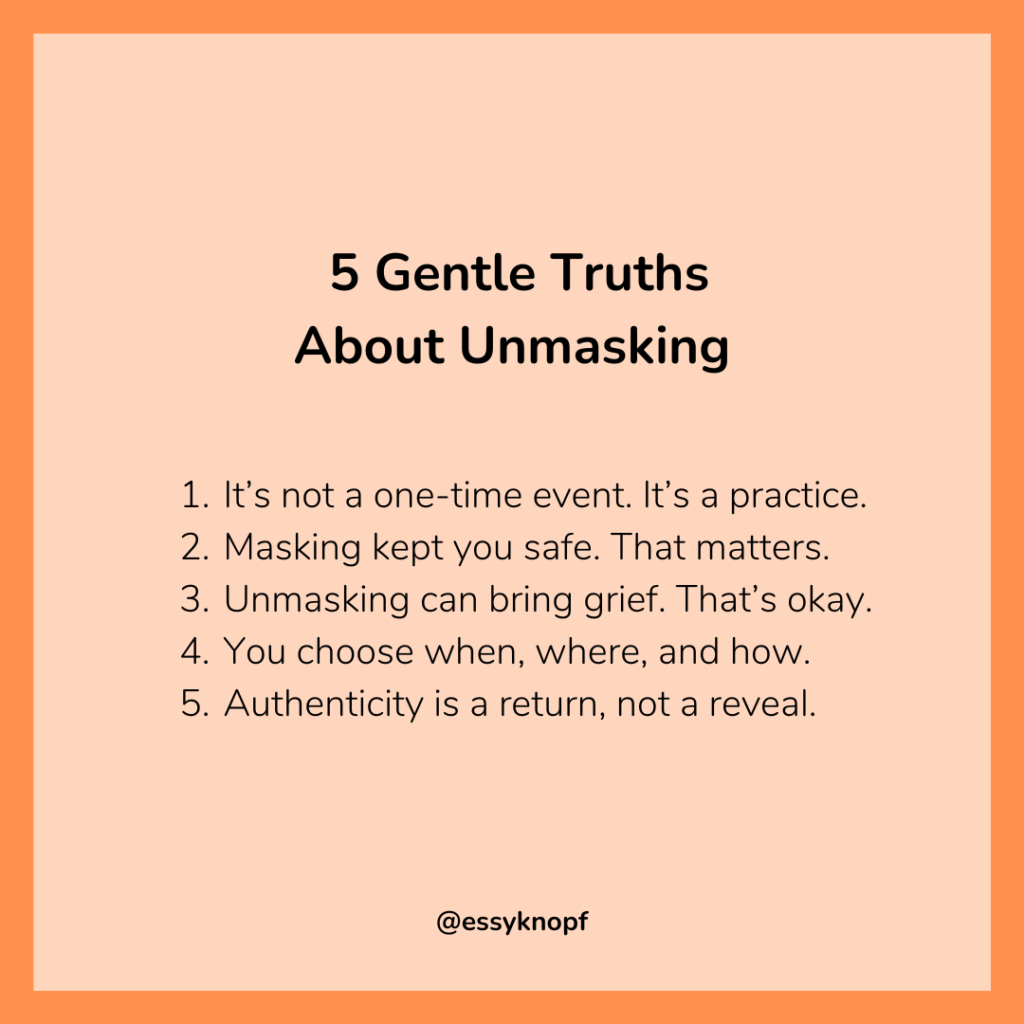
For those of us who are autistic, ADHD, or otherwise neurodivergent, “unmasking” is often painted as a single, bold event. Like ripping off a disguise to reveal your true self underneath: finally free, finally whole.
But that’s not the reality for most of us.
Unmasking isn’t one grand gesture. It’s not a viral social media post. It’s not telling your boss about your diagnosis or suddenly deciding you’ll stim publicly from now on. Those might be parts of the process. But the real work is quieter, slower, and very personal.
Unmasking is the ongoing practice of getting closer to your neurodivergent authenticity. It’s about noticing the habits you picked up to stay safe. The ways you’ve made yourself small to be accepted. And it’s about asking, day by day, “Is this who I really am, or is this who I’ve had to be?”
This post is for anyone sitting in that question.
We’ll talk about what masking actually looks like, why it was necessary, and what unmasking can mean as a rhythm, return, and reclamation.
What Masking Really Is (and Isn’t)
Masking is something many neurodivergent people learn to do—often without realizing it—because it helps us survive. It’s a highly skilled, adaptive response to a world that tends to reward sameness and penalize difference.
When we talk about masking, we’re talking about the suppression or editing of our natural behaviors in order to avoid conflict, blend in, or stay emotionally and physically safe. It can be deliberate: like scripting what you’ll say before a conversation. But more often, it’s automatic. Your nervous system just does it before you even realize.
You might:
Monitor your tone to avoid sounding “rude”
Laugh at jokes you don’t understand (or don’t find funny)
Sit on your hands so you don’t stim
Pretend to follow a conversation you’re totally lost in
Say “yes” when you desperately want to say “no”
Dress to blend in, even if the fabric feels wrong on your skin
These might sound like small adjustments. But over time, they chip away at your sense of self. The gap between who you are internally and how you show up externally starts to widen. And eventually, it becomes hard to tell where the mask ends, and where you begin.
And because masking becomes so normalized, unmasking doesn’t always look dramatic. Sometimes, it’s just… subtle. Almost invisible. Like:
Leaving a group chat without apologizing
Letting yourself stim in public
Wearing headphones even when people stare
Saying “I need a minute” instead of rushing to respond
Letting yourself cry when you’re overwhelmed, instead of powering through
And sometimes? Unmasking is simply noticing the urge to mask and choosing not to.
That’s the beginning of reclaiming neurodivergent authenticity. Not with fireworks, but with small acts of self-permission. Because while masking might have helped you survive, unmasking is how you begin to live.
Why It’s So Hard to Stop
If masking is so exhausting, why is it so hard to stop?
The answer is simple and heartbreaking: because it kept you safe.
Masking is an adaptation. It’s what you did, or still do, to avoid being hurt, rejected, or misunderstood. It helped you stay employed. Stay liked. Stay connected. Stay out of trouble.
Maybe you masked to avoid being bullied at school. Maybe you did it so your parents wouldn’t call you “too much.” Maybe you wanted to make friends, or just not be punished for existing the way you are. Maybe you didn’t even realize you were doing it… until you burned out.
You didn’t choose to mask because you didn’t like yourself. You masked because the world told you, directly or indirectly, that your unfiltered, unedited self wasn’t acceptable.
In a society built around neurotypical expectations, masking becomes the toll we pay for proximity to belonging. And over time, the mask starts to feel like “just the way I am.”
But here’s the thing: dropping the mask shifts how you relate to others, and it also changes how others relate to you.
Suddenly, you’re no longer the “easy one.” You’re not the people-pleaser, the always-agreeable friend, the chill coworker who never complains. You start setting boundaries. You speak up. You stim, say no, take breaks. You let your truth show.
And not everyone is ready for that.
Unmasking puts your neurodivergent authenticity on display. And sometimes, that means facing discomfort or rejection from others who were only ever comfortable with the masked version of you.
That’s why unmasking has to be a choice, rather than an obligation. It has to come from safety, not pressure. And safety isn’t just about logic. It’s about the body. Your nervous system has to feel safe enough to let the mask come down.
So if you find yourself frustrated, wondering why you can’t just “be real already,” take a breath. Offer yourself some compassion.
You’re still surviving, and that deserves to be honored. And the path back to neurodivergent authenticity begins with honoring every single version of you that helped keep you safe.
What Unmasking Really Looks Like
“Unmasking” sounds kind of glamorous. It’s easy to imagine it as a single, life-altering choice. A brave declaration. A before-and-after story with a clear transformation.
But real unmasking is rarely that cinematic.
Most of the time, unmasking looks awkward. Uneven. Vulnerable. Sometimes it’s incredibly freeing. Other times, it feels uncomfortable, exposing—even risky.
Sometimes unmasking is saying, “I don’t get it,” instead of pretending you do. Sometimes it’s showing up in clothes that feel right in your body, even if they make you stand out.
Sometimes it’s canceling plans and telling the truth about why: “I’m overwhelmed.” “I need rest.” “I’m not up for it today.”
It might look like:
Speaking at your natural cadence, even if people talk over you
Letting yourself stim openly
Using scripts because they help, not because you’re performing
Asking for what you need, without guilt or apology
Other times? Unmasking might mean choosing not to unmask. Because there are still environments—workplaces, family gatherings, classrooms—where masking remains protective. And that’s okay.
Unmasking isn’t about being completely transparent with everyone, all the time. It’s about agency.
It’s about knowing: “I’m masking right now, and I understand why.” And then asking: “Do I want to keep doing it in this moment? Or is there space for something more honest?”
That’s the core of neurodivergent authenticity. There’s no checklist. No badge. No one-size-fits-all roadmap.
But here’s something to look for: those quiet moments when your body exhales. When you laugh and don’t monitor the sound. When you leave a conversation feeling full instead of drained.
That’s how you know you’re heading in the right direction. Not toward some ideal version of your “real self,” but toward something more grounded, gentler, more you.
The Grief Beneath the Freedom
Unmasking is often framed as liberating, and it can be. But what we don’t talk about enough is that even freedom comes with grief.
Because every time you let go of a mask, you’re also acknowledging why it was there in the first place.
You’re reclaiming your truth, and you’re facing the hard reality that your truth was once unsafe. That you had to hide, shrink, or contort yourself to be accepted. That parts of you were only allowed conditionally… or not at all.
And that hurts.
You might grieve the years you spent trying to be “easy. The friendships that only worked because you were performing. The younger you who learned it wasn’t safe to be fully seen
That grief can feel disorienting. You may find yourself wondering, “Why didn’t I figure this out sooner?” or “How much of my life did I spend playing a role?” You may question your past: Was any of that real? Did they love me, or just the mask I wore?
Grief is part of the process of reconnecting with your neurodivergent authenticity. Because being honest with yourself sometimes means mourning the years you couldn’t be.
And yet… joy can still show up. Often, it tiptoes in alongside the grief.
Like the first time you stim in public and realize no one’s watching, or that you don’t care if they are. Like the first time you say no and feel relief instead of guilt. Like the first time someone meets your unfiltered self and stays.
Unmasking isn’t clean or linear. It’s layered. One moment, you’re laughing with wild, unmonitored freedom. The next, you’re grieving how long it took to feel that free.
And both are true. Both are sacred. Because each moment of pain you move through clears space; space for rest, for softness, for self-recognition.
And eventually, you start to feel it: “Oh. This is what it’s like to belong to myself.”
Unmasking as an Ongoing Practice
If you’re waiting for the moment when you’re “fully unmasked,” you might be waiting a while.
Because unmasking isn’t a set destination, but a practice you return to, again and again, with care.
Some days, you’ll show up fully, speaking freely, stimming openly, asking for what you need without second-guessing. Other days, you’ll go quiet. You’ll mask again out of habit, fear, or self-preservation. And that doesn’t make you a failure.
We don’t achieve some ideal version of your “real self” per se, but we do cultivate awareness. About tuning into your body, your instincts, your patterns, and making choices from a place of self-trust.
It’s asking yourself, in a moment of tension or discomfort: “Is this necessary right now?” “Or is this a habit I’m ready to shift?”
Over time, you begin to recognize the mask in real time. You notice when you’re bracing. When you’re adjusting. When you’re hiding… even just a little.
And in that noticing, something opens up. Choice. Softness. Space.
You begin to anchor your decisions in care for your nervous system. And through that, neurodivergent authenticity starts to feel less like a performance and more like a returning.
That’s the shift.
It’s not that you never mask again. It’s that when you do, you understand why. And when you don’t, you feel the difference. The breath. The relief. The honesty.
And when others meet you there, in your unmasked self, something sacred happens. You begin to experience a kind of connection that isn’t conditional. That doesn’t require efforting. That simply is.
So if you’re still figuring it out—still unlearning, still re-learning—you’re not behind. You’re right on time. You’re living the practice.
Keep noticing. Keep asking. Keep choosing.
Unmasking Rewrites the Past
Here’s something no one warns you about: unmasking can shift your relationships, and not always in the way you hope.
Sometimes, when you begin to show up more honestly, the people who were comfortable with the masked version of you… start to pull away.
Maybe they say, “You’ve changed.” Maybe they get frustrated when you start setting boundaries. Maybe they miss the version of you who never said no, never asked for space, never made things “complicated.”
And that can be deeply painful.
Because even if those connections weren’t fully authentic, they still gave you moments of belonging. They still mattered. And grieving them is valid.
But here’s the hard truth: if someone only accepts you on the condition that you remain small, agreeable, or self-denying, then their love is not love. It’s a contract.
A contract that says: “I like you… as long as you don’t inconvenience me. As long as you keep pretending.”
Breaking that contract is hard. But it’s also necessary.
Because every time you choose neurodivergent authenticity over appeasement, you create space. Space for the people who want the real you. The version who stims. Who sets boundaries. Who asks questions. Who needs breaks. Who doesn’t always smile when it’s expected.
You make room for friendships built on reciprocity, not performance.
It’s okay if the people who were drawn to your mask struggle with your truth. It doesn’t mean you’re doing unmasking wrong. It means it’s working.
Yes, it may come with loneliness, especially at first. But over time, something beautiful happens: you start to find your people. Or they find you. And the connection you create isn’t built on roles, but on resonance.
These are the people who don’t flinch when you stim. Who listen when you say, “I’m overstimulated.” Who celebrate your boundaries instead of resisting them. Who make you feel like you don’t have to explain or apologize for being exactly as you are.
And that? That’s worth the risk.
Final Thoughts
Unmasking isn’t about arriving at some perfected version of your true self. It’s not about never blending in, never adapting, or never struggling again.
It’s about recognizing your patterns with compassion. It’s about making choices rooted in self-awareness instead of self-erasure. And it’s about returning to your neurodivergent authenticity, in whatever way feels possible today.
There’s no rush. No right pace. No need to be fearless.
You can be soft. You can be scared. You can be figuring it out as you go. That is the process.
So if you’re somewhere in the messy middle—still masking sometimes, still unmasking in small ways—you’re not behind.
Essy Knopf is a therapist who likes to explore what it means to be neurodivergent and queer. Subscribe to get all new posts sent directly to your inbox.
Let me ask you something that rarely gets asked: Where in your body do you hold your mask?
Is it in your jaw, clenched tight from too many polite smiles? In your chest, where the tension builds every time you pretend to be calm when you’re anything but?
In your gut, coiled and uneasy from constantly overanalyzing what you just said, how you said it, and whether it came across “normal” enough?
For many neurodivergent people, masking is something our nervous systems learn to do. Constantly. Until it becomes a default state. Until it becomes our baseline.
This is what I call neurodivergent survival mode. A state where we’re fighting to exist in environments that feel unsafe in subtle, persistent ways.
And most of the time? We don’t even realize we’re doing it. We just know we’re tired, anxious, burnt out, or shutting down.
Masking Is a Nervous System Strategy
When people talk about masking, they usually focus on the outward signs: making eye contact even when it feels unnatural, managing your tone to sound “friendly” enough, suppressing stims like hand-flapping or rocking, forcing yourself through small talk to avoid seeming “rude.”
But masking is far more than social performance. It’s not just about what you do, but rather about what your nervous system has learned to expect. And fear.
For neurodivergent people, masking is a survival response. It starts early, often after the first time someone tells you to “stop being weird,” “calm down,” or “act normal.” That moment doesn’t just register in your mind.
Masking Lives in the Body: Understanding Neurodivergent Survival Mode
When people talk about masking, they often picture something mental or behavioral: memorizing scripts, forcing eye contact, mimicking social norms, smiling when it hurts.
But for neurodivergent people, masking is a physiological adaptation. It’s your body doing whatever it must to keep you “safe” in a world that punishes difference.
The first time you were corrected for your tone. Or laughed at for a meltdown. Or told you were too much, too intense, too emotional. That moment taught your nervous system a rule: “Being myself isn’t safe.” And once that lesson sinks in, your body doesn’t wait for logic. It responds to perceived threat on autopilot.
This is neurodivergent survival mode. And it shows up in one of four primary responses your nervous system initiates without conscious thought:
Fight: You feel irritated or defensive. You argue, interrupt, over-explain.
Flight: You shut down. You ghost, log off, or mentally check out. You leave before you can be left.
Freeze: You go still. Your brain fogs. Speech vanishes. You might nod along, but you can’t access language or action.
Fawn: You get extra nice. You smile when you want to cry. You agree even when it hurts. You over-function, over-apologize, over-accommodate, because pleasing feels safer than being seen.
These responses become daily rituals for many neurodivergent folks. We live in systems where misunderstanding, overstimulation, and invalidation are routine. Which means the “threat” our bodies are trying to navigate is social harm, sensory overload, or emotional dismissal.
So if you’re constantly contorting just to make others comfortable, your nervous system never really gets to relax. Even in “safe” spaces, you stay on edge. Even in silence, your body is bracing. Over time, this survival mode becomes background noise. Normal. Expected. Invisible.
Until something breaks. Or you do.
When Survival Mode Becomes a Lifestyle
For most people, fight-or-flight is a response to immediate danger. For example, a car swerves, a loud noise, a sudden confrontation. Many neurodivergents find themselves perpetually trapped int his state.
You might wake up already bracing, heart rate elevated before you’ve even had coffee. Or you might walk into a room scanning for tone, posture, and mood like your wellbeing depends on it.
You might go through a workday rehearsing every message, every sentence, every micro-expression, only to come home and collapse, unable to answer a simple “How was your day?”
This is the invisible reality of neurodivergent survival mode. And while it may have helped you survive certain environments (school, family, the workplace), long-term, it takes a toll.
Here’s what chronic survival mode can look like in the body:
Digestive issues that flare under stress
Tension headaches and jaw pain from clenching
Fatigue that sleep doesn’t fix
Trouble falling asleep, or waking up already exhausted
Executive dysfunction that leaves you unable to start, plan, or follow through
Sensory intolerance that intensifies the more burnt out you get
Emotional volatility or total shutdowns over things that “shouldn’t” be a big deal
And here’s the cruel twist: the better you are at masking, the more likely you are to be overlooked, dismissed, or misread. Because you’re still smiling. Still meeting deadlines. Still saying “I’m fine.”
But underneath that mask? Your nervous system is in overdrive. Your body is screaming for rest, regulation, relief. And no one sees it. Maybe not even you.
When You Can’t Fake It Anymore
Maybe you’ve said things like: “I’m just tired all the time.” “I thought I was fine until I hit a wall.” “I don’t know why I can’t handle things like I used to.”
That wall you hit? It’s your nervous system waving a white flag, saying: “I can’t keep pretending. I need help.”
For neurodivergent people, this moment often comes without warning, or rather, without recognized warning. Because the signs were there all along, just buried beneath years of performance.
By the time burnout sets in, the symptoms are everywhere:
Your memory starts to glitch. Names, dates, basic words go missing
Your ability to initiate tasks evaporates, even for things you enjoy
Conversations become draining, even with people you love
Your fuse shortens, or disappears completely
Rest no longer feels restful; nothing feels replenishing
These can all be signs of nervous system collapse. Your body is no longer running on stress hormones and adrenaline. It’s run out. And when it does, it stops letting you mask.
You might find yourself crying unexpectedly, snapping at small things, needing to cancel plans, or freezing mid-task. And suddenly, the coping strategies that used to “work” no longer do.
That’s the thing about neurodivergent survival mode: it doesn’t ask for permission to shut down. It just does. Because at some point, the mask gets too heavy. And your body decides: “Survival means stopping now.”
Unmasking Begins in the Body
When you’ve spent years masking—holding tension, bracing for rejection, filtering every word—it’s easy to think the fix must be cognitive. That you can journal or analyze your way out. That if you just understood yourself better, the burnout would lift.
You see, masking is both a habit of the mind and a pattern in the body.
Your jaw tightens before you speak. Your shoulders tense when someone walks in the room. You hold your breath during Zoom calls or group chats. You smile on autopilot, even when you’re crumbling inside.
These are data points; your body’s way of saying, “This feels unsafe.”
Unmasking begins when we read these data points and respond with compassion.
It might look like:
Noticing when you say “yes” but feel “no” in your chest
Allowing yourself to stim, rock, pace, fidget, without explanation
Taking a break before your body demands one
Feeling yourself breathe all the way down to your belly—for the first time in years
These small acts tell your nervous system: I’m listening now. I don’t need you to be on high alert all the time.
This is how you begin to exit neurodivergent survival mode: by reintroducing safety from the inside out.
By reclaiming the option to choose when, where, and how you show up.
What Safety Actually Feels Like
So what happens when the body begins to feel safe again? When masking isn’t your only survival strategy? When you’re no longer performing at every turn just to stay accepted?
Something subtle but profound starts to shift. You move from coping to connecting.
Because here’s what many neurodivergent people never get told: it’s nearly impossible to experience real connection, whether with yourself or others, when you’re in survival mode.
Survival narrows your field of vision. It makes every interaction feel like a potential threat. You scan for tone. You edit your reactions. You rehearse your lines. In short: you’re managing the risk of rejection.
But when your nervous system feels safe? When regulation becomes more familiar than vigilance?
Everything softens.
You hear what someone’s saying instead of planning your next sentence
You notice you’re overstimulated and step away before you shut down
You ask for clarity instead of pretending to understand
You receive care without guilt; offer care without depletion
You say what you actually mean, not what you think they want to hear
This is where unmasking becomes relational, and you start experiencing safety while being yourself.
You stop filtering everything through the question, “Will this make me weird?” You stop bracing every time someone texts, “Can we talk?” You stop leaving conversations with a shame hangover and imaginary apologies.
And maybe—just maybe—you begin to feel liked for the version of you that’s honest. Present. Embodied. Enough.
That shift doesn’t happen overnight. It’s slow. Uneven. Sometimes scary. But it’s real.
We Heal in Safe Company
When you’ve spent your life being told you’re too much, too sensitive, too intense, it’s easy to assume that healing must be a solo project. You’ve learned to mask for safety, but also for acceptance. So unmasking can feel like a risk no one else should be responsible for.
But you didn’t learn to mask in isolation. You were taught—through subtle cues, outright punishments, and daily misunderstandings—that who you are is a problem to be fixed.
And so it makes sense that healing won’t happen in isolation either. In fact, it can’t.
To unlearn survival mode, we need evidence that the world is safer than it once was. And the nervous system doesn’t learn that through logic. It learns through felt experience, especially in relationships.
Maybe that looks like:
A friend who lets you stim without comment
A therapist who doesn’t rush your words, or pathologize your silence
A partner who lets you take breaks mid-conversation without taking it personally
A coworker who honors your need for clarity, or quiet, or processing time
Even a pet who shares space with you, no questions asked
These moments may seem small, but to a nervous system that’s spent years in survival, they’re revolutionary. They say: “You don’t have to perform here.” “You’re not being judged.” “You can stay.”
And every time your body receives that message and nothing bad happens, it recalibrates. It learns. It heals.
This is the slow, sacred work of exiting neurodivergent survival mode. Not just through solitude or introspection, but through co-regulation; experiences of being safe with someone.
If that feels foreign, that’s okay. It means your nervous system hasn’t had enough practice with safety.
But you can begin now by seeking or creating even one space where the mask can loosen, where you can breathe, where you don’t have to explain why something hurts.
And maybe, in that space, your body will finally believe: You’re allowed to be here, exactly as you are.
Final Thoughts
You may have heard the phrase, “The body keeps the score.” It’s often used to describe how trauma lives on in the nervous system, and how the body remembers things the mind tries to forget.
But here’s something just as true: the body doesn’t just keep the score. It keeps the truth.
It knows when your smile is a shield. It knows when your “I’m fine” is a freeze response. It knows when you’re pushing through exhaustion because you don’t feel like you’re allowed to stop.
And maybe most importantly, it remembers who you were before the mask. Before you had to contort and filter and apologize just to be allowed to stay.
Even if you don’t remember that version of yourself. Even if it’s buried under decades of performance. Even if you’ve never known what it feels like to be fully, safely you, your body does.
So if you’re exhausted… If your fuse is short… If you feel like you’re unraveling for no clear reason…
Please hear this: your nervous system learned to protect you in the only ways it could. And now? It might be asking to try something new.
Not all at once. Not overnight. But slowly. Gently. Deliberately.
Because the body that carried your survival also holds the blueprint for your healing. And maybe—for the first time—it’s finally safe enough to listen.
Have you been stuck in neurodivergent survival mode? Where in your body do you feel it most? What helps you come back to yourself?
Essy Knopf is a therapist who likes to explore what it means to be neurodivergent and queer. Subscribe to get all new posts sent directly to your inbox.
What if your “time management issues” aren’t a character flaw, but a sign that your brain doesn’t fit the rigid 9-to-5 mold? What if your “emotional outbursts” aren’t overreactions, but honest responses to environments that overwhelm your senses and invalidate your experience?
What if everything you’ve internalized as “failure” is actually the fallout of surviving a world designed for someone else’s brain?
Here’s the thing: most neurodivergent people are taught from a young age to look inward when things go wrong. Struggling in school? You must not be trying hard enough. Burned out at work? You should just manage your time better. Feeling overwhelmed in relationships? You’re too sensitive. Too intense. Too much.
We’re told, again and again, that if we just changed ourselves, we’d be okay. But what if the real issue isn’t you at all?
What if the root cause of your distress is ableism: a system that punishes difference, labels needs as “inconvenience,” and expects you to mask, shrink, and override your reality just to be accepted?
Ableism is cultural. A lens through which institutions, from school to healthcare, see your behavior not as a clue to what you need, but as something to suppress.
And when those structures refuse to adapt, the burden falls on you to compensate, overextend, and contort yourself into shapes that don’t fit.
Internalized Ableism: The System Moves In
When we talk about ableism, it’s easy to imagine it as something external: the teacher who punished you for fidgeting. The boss who rolled their eyes when you asked for written instructions. The friend who said you were “too much.”
But what happens after years of those messages?
Eventually, ableism doesn’t need to come from the outside anymore, because you’ve absorbed it. You carry it inside. It becomes the voice in your head that criticizes you before anyone else can.
You tell yourself not to take a sensory break, even though your body is screaming for one. You rewrite your needs into “preferences.” You talk yourself out of asking for accommodations because you’re afraid of being seen as difficult, ungrateful, dramatic, or weak.
You say things like:
“It’s probably not that big of a deal.”
“Other people have it worse.”
“I should be able to handle this.”
“I just need to try harder.”
Sound familiar?
This is what happens when you learn, over and over, that being your full self isn’t safe. That disclosing your diagnosis might cost you your job. That saying “I can’t” will be met with “You must.” That asking for help might end in rejection, ridicule, or silence.
And the system loves this. Because the more you self-silence, the less pressure there is for change.
You become “resilient.” “High functioning.” “So inspiring.” But what they really mean is: thank you for not making us adapt.
It’s important to name this for what it is: conditional acceptance. And conditional acceptance always comes at a cost to your body, your mental health, your self-trust, your identity.
Every time you say yes when you mean no… Every time you swallow your discomfort… Every time you prioritize someone else’s comfort over your own pain… You reinforce the lie: I can only belong if I’m less like me.
And here’s the most painful part: if you’ve been doing this long enough, you may not even realize it’s happening. The mask becomes second nature. The self-erasure feels normal.
You Can’t Self-Help Your Way Out of Ableism
When you’re struggling—exhausted, shut down, overwhelmed—what’s the first thing you tell yourself?
“I need to get it together.” “I should be more disciplined.” “I just need better routines, better habits, better coping skills.”
And what do well-meaning people around you say?
“Have you tried time blocking?” “Just practice mindfulness.” “Maybe a gratitude journal would help.”
These tools aren’t inherently bad. For some, they’re helpful. And yet, you can’t self-help your way out of ableism; can’t fix what was never yours to carry.
The pressure to improve, manage, and optimize yourself often becomes another layer of internalized ableism. It says, “Your struggles are your fault, and therefore your responsibility to solve.” It assumes the system is neutral and that your job is to adapt.
But what if the system is the source of harm?
You can’t, for example, organize your way out of executive dysfunction caused by an unaccommodating environment. You can’t meditate your way out of constant sensory assault. And you can’t therapy your way out of being gaslit by the healthcare system.
Individual distress in such instances should be recontextualized as systemic failure.
When you try strategy after strategy and still feel like you’re falling short, it’s often because the target keeps moving. You’re expected to “function” in a society that equates normalcy with neurotypicality, and punishes anything else.
This is how ableism disguises itself as advice. It pushes wellness solutions that ignore the root cause of burnout. It labels you “resistant” or “noncompliant” when you can’t conform to expectations that were never realistic to begin with.
And here’s the kicker: when those strategies fail, it only deepens the shame.
But maybe you were never meant to get better at surviving this system. Maybe you were meant to question the system itself.
Structural Ableism Creates Individual Shame
If you’ve ever thought, “Everyone else seems to be coping. So why can’t I?” If you’ve ever been told, “That’s just how it is. You need to adjust.” If you’ve ever sat in a classroom, office, or doctor’s exam room feeling like the alien in the room—you’re not alone. And you’re not the problem.
This is what structural ableism does: it creates systems that are rigid, exclusionary, and hostile to neurodivergent needs, then blames individuals for not thriving within them.
In school, you’re expected to sit still, be quiet, and learn in one specific way. If you can’t, you’re labeled disruptive, defiant, or behind.
In the workplace, sensory hellscapes like open-plan offices are normalized. Back-to-back meetings, phone calls, last-minute deadlines—it’s all part of the job. And if you can’t keep up? You’re lazy. Unreliable. Not a team player.
In healthcare, your symptoms are often minimized. Your sensory needs misunderstood. Your communication style pathologized. You might be told you’re “too sensitive” or “too articulate to be autistic.” And when the prescribed treatments don’t help, the blame is placed back on you.
Over and over, the message is: You’re the common denominator. But that’s a lie. A deeply ableist lie.
The truth is: most of these systems weren’t designed for neurodivergents. They were designed for uniformity. For efficiency. For people who conform easily to norms most NDs were never wired for.
So of course we struggle. Of course we mask. Of course we burn out. And then, in the wake of that pain, shame creeps in.
Because ableist systems convince you those needs are unreasonable. They call your reactions overreactions. Your coping mechanisms “bad behavior.” Your breakdowns a sign of weakness or immaturity.
Eventually, you stop seeing the system as the problem. You turn the critique inward. You see your struggle as a flaw in your character, not the context.
This is how systemic oppression becomes self-blame. This is how ableism gets inside your head.
But naming this shame for what it is? That’s where healing begins.
Grieving What Ableism Took
There’s a moment, for many of us, when things start to click. When we realize our distress wasn’t personal failure. When we start connecting the dots: the shutdowns, the burnout, the chronic self-doubt… were never just about us.
They were responses. Reactions. Survival strategies.
And in that moment of clarity, right after the relief, comes the grief. Once you see ableism clearly, you also see what it’s cost you.
You see the childhood version of yourself, trying so hard to be “good,” to fit in, to stop getting in trouble. You remember how satisfied your teachers were when you stopped fidgeting, never knowing that praise came at the expense of your self-trust.
You see the friendships you bent yourself into shapes to maintain. The workplaces where you pushed past every limit because asking for help felt too risky. The relationships where you apologized for your needs until you stopped expressing them altogether.
You remember telling yourself, “I just need to try harder,” when what you really needed was rest. Or space. Or acceptance.
Grief shows up in these memories like a ghost: the version of you that never got to thrive. The you that could have existed, if only someone had made space. This grief is real. And it is valid.
Ableism taught you to internalize the very real obstacles you face as shame. It taught you to suppress your brilliance to be palatable. It taught you that love, safety, and success were contingent on how well you could perform.
Self-recognition happens when we stop gaslighting ourselves and begin to tell the truth: That wasn’t fair. I should never have had to work that hard just to feel safe.
And as painful as grief is, it’s also sacred. Grief makes space for reclamation. It gives us permission to say: “I deserved better.” “I was never the problem.” “I want more for myself now.”.
From Survival to Reclamation
So what happens after the grief? After the shock of realizing you were adapting, not failing. After mourning the years spent chasing acceptance through exhaustion. After naming ableism as the real culprit.
You reclaim. You begin to take back what the system convinced you to give up: your needs, your voice, your right to take up space.
Reclamation starts with a pause before you say yes. With a deep breath before you push through the pain. With the question: Does this actually work for me?
It’s noticing where you’ve been masking by default. It’s choosing to stim in public. It’s letting yourself say “I don’t know,” “I need a break,” or simply “No.”
And each of those acts, however small, is resistance. Because in a world steeped in ableism, authenticity is rebellion.
Reclamation is also relational. You stop twisting yourself to meet other people’s expectations and start expecting people to meet you halfway.
You start to ask:
What would friendship look like if I didn’t have to perform for it?
What would work look like if I didn’t have to sacrifice my nervous system to be productive?
What would therapy look like if I didn’t have to mask to be believed?
These are the questions ableism tries to keep you from asking, because they threaten the status quo.
And here’s something else: the more you reclaim, the more space you create for others to do the same.
When you say, “This doesn’t work for me,” out loud, it’s a signal flare to others who are still trying to survive in silence.
When you treat your needs with respect, you remind the people around you that they can, too.
This is how we reshape culture: by interrupting the performance. By telling a new story. By living our truth, even when it shakes the foundation we were taught to stand on.
The World Wasn’t Built for You—But It Can Change
Here’s something every neurodivergent person knows, even if they’ve never said it out loud:
The world wasn’t built with us in mind. Not for our sensory needs. Not for our communication styles. Not for our pacing, our focus, our honesty, or our depth.
It was built for standardization. For sameness. For people who don’t flinch at fluorescent lights, who can interpret social cues without a second thought, who can filter noise and sit still and speak in subtext.
This world was built for neuronormativity, and that’s another word for structural ableism.
So when you burn out… When you struggle to keep up… When you fall behind in systems that reward only the fastest, loudest, or most compliant… That’s not on you.
But just because the world wasn’t built for you doesn’t mean it can’t change.
Systems are made of people. And people can learn. And people—especially people like you—can lead.
Every time you:
Choose rest over relentless productivity
Set a boundary without apology
Disclose your access needs with confidence
Affirm someone else’s neurodivergence instead of correcting it
…you’re reshaping the culture. You’re disrupting the myth that “normal” is the goal. You’re challenging the ableist idea that success must come at the cost of self-erasure. You’re living proof that thriving requires inclusion.
This is what systemic change looks like: not just policy shifts or public statements (though those matter too), but choosing authenticity over approval. Of saying, “This is what I need, and I’m not going to apologize for it.”
So if you’ve been waiting for permission to stop performing, this is it. If you’ve been waiting for a sign that it’s okay to take up space, this is it.
And if you’ve been waiting for someone to tell you, you were never the problem, this is it.
Final Thoughts
Ableism wants you to believe you’re the problem. It wants you to shrink. To strive. To stay silent.
Meanwhile, you’ve been surviving in an environment that was never designed to support your mind, your needs, or your brilliance.
And despite all that—you’re still here. You’ve adapted. Masked. Navigated. Endured. That resilience is extraordinary.
But you deserve more than resilience. You deserve rest. Safety. Authenticity. Connection. You deserve systems that bend with you,not against you.
Healing deepens when we stop mistaking survival strategies for personal flaws, and we name ableism as the source of harm. And it expands when we reclaim our voice and use it to build something better.
So if you’re feeling grief, anger, or even relief right now, that’s okay. That means you’re waking up. And that’s powerful.
What’s one belief about yourself you’re ready to let go of? One story you’ve outgrown?
Essy Knopf is a therapist who likes to explore what it means to be neurodivergent and queer. Subscribe to get all new posts sent directly to your inbox.
How much of your personality is shaped by the fear that people will leave?
Not because you’re rude. Not because you don’t care about others. But because deep down, a part of you suspects that if people really saw you—your intensity, your honesty, your deep emotional currents, your very neurodivergence—they’d quickly slip away.
You’ve likely learned to scan every social interaction for danger signs. You second-guess that message you sent. You keep the group chat light, even when you’re going through something hard. You’re funny, but not too weird. Kind, but not too needy. Thoughtful, but never demanding.
You might say things like, “Sorry, I’m rambling,” when you were just excited. Or, “I totally understand if you’re busy,” even when you’re aching for a reply. You keep your joy small. Your opinions mild. Your needs…minimal.
All to avoid the moment when someone might think: “Ugh. Too much.”
This is what rejection sensitivity can look like in daily life. Sometimes, it’s subtle: a quiet shrinking of the self, over and over again, in service of conditional acceptance.
What Rejection Sensitivity Really Is
Rejection sensitivity isn’t just “taking things too personally.” It’s not about being dramatic, oversensitive, or emotionally immature, though you’ve probably been told some version of that before.
It’s a deeply embodied response. A nervous system reaction, not just a mental one. And it’s often born from years, sometimes decades, of subtle (and not-so-subtle) social injuries.
If you’re ADHD, you might know this experience as rejection sensitive dysphoria (RSD), a term used to describe the intense emotional pain that even perceived rejection can bring.
RSD isn’t in the DSM, but it’s widely recognized in ADHD spaces because it’s so incredibly common. If you’re autistic, you might not have a neat label for it. But you know what it feels like.
It’s the sudden drop in your stomach when a message is left on “read.” The hours you spend replaying a conversation, wondering if you said something wrong. The crushing shame after someone sighs or makes a face, even if they weren’t reacting to you. The total shutdown after a tiny social misstep.
Rejection sensitivity means your nervous system treats social disconnection like a threat. It is often a response to teasing, exclusion, and misunderstandings that were never cleared up. The way your intensity got misread as aggression, your honesty mistaken for rudeness, your silence taken as disinterest.
You may have learned early on: If I show up fully, I will be rejected.
And so, your brain started working overtime to protect you. Not from lions or fires, but from the pain of being misunderstood. Misjudged. Left.
That protection became hypervigilance: constantly scanning for eyerolls, clipped tones, silences that might mean you’re no longer welcome. You may not even realize you’re doing it, until your chest tightens, your thoughts race, your face burns with shame.
This is rejection sensitivity. People might say it’s “just in your head,” but truth be told, it’s also in your body.
You’re Not Broken. You’re Trying to Survive
What you’re experiencing—this fear, this overthinking, this sense that you’re always on the verge of getting it wrong—leads you to protect yourself in the only ways you know how: by shrinking, by guessing, by performing.
As a result, you try so hard to stay connected in a world that made you feel like connection was something you had to earn.
Rejection sensitivity is not a character flaw. It’s what happens when your core need for belonging has been repeatedly met with confusion, punishment, or silence.
You’ve likely spent years decoding social cues like a second language. Years trying to translate your tone, your timing, your truth into something palatable. And maybe you got really good at it. But over time, it taught you that the real you might not be lovable. So you tucked that self away.
But the more you contort yourself to avoid rejection, the more you begin to internalize it.
You over-apologize when you’ve done nothing wrong. You downplay your feelings to keep others comfortable.
You talk yourself out of expressing needs before you even try. You tiptoe through conversations, scanning for signs that someone’s pulling away.
And when something does go wrong—when someone’s distant, or doesn’t respond, or seems annoyed—it confirms what you feared all along: “See? I knew I was too much.”
So you withdraw. Or shut down. Or ghost them before they ghost you.
But here’s what often gets missed: these may seem like “bad habits” or “immature reactions,” but they’re actually protective strategies. And they’ve probably helped you survive some really hard things.
So no. You’re not broken. You’re someone who’s been trying, so hard, for so long, to feel safe in a world that didn’t make space for you.
How Healing Begins
If rejection sensitivity is just your nervous system trying to protect you, then healing can’t come from self-criticism.
It doesn’t come either from forcing yourself to “toughen up” or grow a thicker skin. It doesn’t come from trying harder to be “easygoing.” And it definitely doesn’t come from pretending not to care.
You’ve already tried all that. And it left you exhausted, disconnected, and quietly grieving the parts of yourself you buried.
Healing starts in a different place: safety. Not the safety of never being rejected again, but the kind where you can stay connected to yourself, even when fear flares.
Because rejection sensitivity lives in the body, the work is often slow, steady, and rooted in practice.
Here are a few ways to begin:
1. Name the Pattern Without Shame
The next time your thoughts start spiraling, replaying a conversation, reading into a text, preparing an apology just in case, pause.
Put a gentle hand over your heart or your chest and say to yourself: “This is rejection sensitivity. I’m not in danger. I’m just triggered.”
You don’t have to fully believe it. But say it anyway.
Naming what’s happening brings awareness. And awareness brings space. And space is what helps you step out of the loop, instead of getting swept up in it.
2. Regulate Before You Ruminate
When your nervous system is in fight-or-flight, no amount of reasoning will work. Logic can’t get through the alarm bells.
So before you try to “think it through,” start with your body. For example:
Try holding something warm.
Try lengthening your exhales.
Try putting gentle pressure on your chest, or lying under a weighted blanket.
Try stimming, moving in a way that feels soothing, like rocking or tapping.
These actions speak directly to your nervous system, telling it: You’re safe. You’re okay. You can settle now.
And once your body feels calmer, your mind becomes clearer, and your inner critic a little quieter.
3. Build Relationships That Can Hold the Real You
You need spaces where you don’t have to filter yourself, shrink yourself, or mask just to stay welcome. For example:
That might be one trusted friend.
A neurodivergent peer group.
A therapist who gets it.
A space where your intensity is understood.
Start small. You don’t have to bare your soul. Let someone see a little more of you, the parts you usually hide. And when they stay? Let your nervous system breathe that in.
Because over time, repeated moments of safety become new wiring. They become evidence: Maybe I can be real… and still be loved.
4. Validate the Original Wound
So many of us want to move forward without looking back. But rejection sensitivity often has roots in earlier pain: younger versions of you who were left out, shamed, or misunderstood.
You don’t need to relive those moments. But you do need to acknowledge them.
Try saying: “Of course I fear rejection. I was rejected.” “Of course this hurts. It’s hurt for a long time.” “I’m not exaggerating. I’m remembering.”
You don’t heal shame by denying it. You heal it by bringing compassion to the parts of you that were never offered any.
Healing is slow. Nonlinear. Sometimes frustrating. But every time you pause instead of spiral… Every time you stay present with the discomfort… Every time you let yourself be seen, even when you’re scared…
You are creating a new possibility: I don’t have to disappear to stay safe. I can stay, as me.
Final Thoughts
If no one ever told you this before, let me say it now, clearly and without condition: you are someone whose nervous system has been shaped by real experiences, and whose longing for connection has never been the problem.
Rejection sensitivity is not a sign that you’re flawed. It’s a sign that you care. Deeply. It’s a sign that you’ve been hurt, and still show up anyway. It’s a sign that you crave authenticity, even in a world that hasn’t always welcomed it.
And that sensitivity is not something to fix or erase. It’s the doorway to your empathy, your truth-telling, your passion, your presence.
The parts of you that feel too intense… too tender… too honest? Those are the parts that make you who you are.
Belonging shouldn’t depend on perfect timing, flawless communication, or unshakable emotional regulation. It shouldn’t require that you always be agreeable, quiet, or easy.
Real belonging shouldn’t involve auditioning for acceptance, but arriving exactly as you are.
It’s built on mutuality. On people who see you, and stay. And yes, those people exist.
People who won’t flinch when your voice wavers with feeling. Who won’t pull away when you ask for clarity. Who see your honesty as a gift, not a threat. Who welcome your intensity not despite it, but because it’s real.
But here’s the twist: before you can truly receive that kind of acceptance from others, you may need to offer a little more of it to yourself.
To say: “Even when I’m scared, I still deserve love.” “Even when I’m triggered, I am still worthy.” “Even when I get it wrong, I still belong.”
Because you do.
How has rejection sensitivity shown up in your relationships? How have you learned to navigate it, or are you just starting to?
Essy Knopf is a therapist who likes to explore what it means to be neurodivergent and queer. Subscribe to get all new posts sent directly to your inbox.
Who are you when you’re under pressure? When you’re in a room where your words are measured, your tone is policed, your very presence feels too loud or too weird or too much?
For many neurodivergents, we learn early that who we are isn’t always welcome. So we adapt. We camouflage. We create a version of ourselves designed to blend in.
Maybe you became the quiet one, the agreeable one, the overachiever. Maybe you tried to be invisible… or, just as often, indispensable.
This is the beginning of the false self: a carefully constructed identity built not from joy or authenticity, but from necessity. It starts as protection. But eventually, the performance gets so convincing, even we begin to believe it’s who we are.
And then something even deeper happens: we lose trust in our real self. We wonder why connection feels empty. We stop believing our natural instincts are valid.
That loss is the slow fading of neurodivergent self-worth; a disconnect so normalized we often don’t even know it’s happening.
The Birth of the False Self
Psychologist Carl Rogers spoke of the “false self” as a protective persona; something we construct when the real us feels unacceptable.
For neurodivergents, this construction often begins young, as the result of subtle, consistent signals that tell us: You don’t quite fit here.
Maybe you were the kid who was told to “stop being so dramatic” when you cried. Or you were scolded for flapping, rocking, or bouncing your legs.
Maybe adults praised your “maturity” when really, you were just dissociating. Or you were the student who got labeled a problem for asking “too many questions” or “talking too much about bugs.”
None of those moments feel like major traumas at the time, but they add up. Over time, the message becomes clear: You can stay, but only if you perform. You can belong—but not like that.
So we begin to mold ourselves. We tone it down. We rehearse our facial expressions. We memorize the “right” answers, the “right” responses.
We laugh when we’re confused, smile when we’re overwhelmed, and apologize just for existing too loudly.
Eventually, the line between the real us and the performed version begins to blur. And the more we hide, the harder it becomes to believe there’s anything worthwhile underneath the mask.
This is when our neurodivergent self-worth begins to fracture, and we start to abandon authenticity.
Trauma in a Thousand Cuts
When most people hear the word “trauma,” they picture something catastrophic: a car accident, a natural disaster, a violent event. But for many neurodivergent folks, trauma arrives slowly, in pieces.
It shows up in eyerolls when you share your special interest. In teachers who tell you to “use your words” when you’re frozen in shutdown. In group projects where no one listens to your ideas. In friendships that end the moment you stop masking.
This is complex PTSD, or C-PTSD: a type of trauma that develops from the accumulation of chronic invalidation, shame, and exclusion. The gradual erosion of safety.
Eventually, the world starts to feel like an unsafe place. So our nervous system adapts. We live in survival mode:
Flight from conversations that feel too intimate
Freeze when we’re put on the spot
Fawn when someone seems disappointed in us
Fight with ourselves, internally, when we “mess up” being neurotypical
In this state, it becomes hard to tell what’s us and what’s fear. And instead of asking, “Why was I treated this way?”, we start asking, “What’s wrong with me?”
This is one of the most devastating impacts of C-PTSD: the way it warps our self-image. The way it disconnects us from our value. The way it convinces us that our neurodivergent self-worth is conditional; that we are only lovable when we are hidden, quiet, or small.
Internalized Ableism: The Enemy Within
Ableism isn’t always loud. It doesn’t always look like bullying or name-calling. Sometimes, it slips into our lives disguised as “feedback,” “concern,” or “normal expectations.”
“Don’t be so sensitive.” “You really should know that by now.” “Everyone else manages. Why can’t you?” “You’re overreacting again.” “It’s not that hard.”
We hear these words enough times, from enough people, and eventually… we internalize them.
That’s internalized ableism: the process by which we absorb society’s discomfort with our differences and turn it inward. It becomes a private narrative. A rulebook written in shame.
We monitor our own body language. We question whether we’re allowed to say no. We convince ourselves our needs are unreasonable or childish. We treat our natural responses as something to suppress, sanitize, or apologize for.
And the more we self-police, the more disconnected we become from our true feelings. Our intuition. Our limits. We override what our body and brain are trying to tell us, because somewhere along the line, we started believing that our way of being is wrong.
And with every suppressed need, every censored impulse, every moment we say “I’m fine” when we’re not… our neurodivergent self-worth takes another hit.
We find ourselves no longer sure which parts of ourselves are real, and which parts were sculpted to be accepted.
But here’s what matters: That voice in your head? It didn’t start with you. You didn’t invent these criticisms, but you did inherit them.
And you have permission to start questioning them now.
The Voice of the Inner Critic
It shows up just before we speak in a meeting, whispering, “Don’t say that—you’ll sound weird.”
It chimes in after a social interaction: “You talked too much. You made it awkward. They’re probably annoyed.”
It panics when we set a boundary: “You’re being difficult. They’ll leave you.”
That voice—that critical, anxious, rule-obsessed voice—is the inner critic. And for many neurodivergent people, it’s a constant companion.
It might sound like a parent who didn’t understand you. A teacher who was quick to shame. Peers who laughed when you flapped your hands, stimmed, or spaced out. A boss who said you weren’t a “culture fit.” Or a therapist who said, “You can’t be autistic—you make eye contact.”
Over time, those voices blur together. They become internalized, replaying again and again until they sound like our own thoughts.
But here’s what’s important: that voice didn’t come from nowhere. It was learned. Conditioned. Built from repetition. It’s your survival instinct, shaped by rejection.
The inner critic is afraid of being too visible. Afraid of being vulnerable. Afraid of the hurt that once followed your authenticity.
So it tries to protect you. But in doing so, it reinforces the very mask that’s keeping you disconnected.
The first step in softening the critic is to recognizeit. To notice when it shows up. To name it. To say: “I see you. I know why you’re here. But I’m not in danger anymore.”
This is a powerful turning point.
Each time we respond with compassion instead of compliance, the critic loses just a little bit of power. And in that softening, there’s room for something else to grow: the voice of self-trust. Self-kindness.
This is the foundation of neurodivergent self-worth.
Grieving the Cost of Disconnection
The journey back to yourself isn’t always filled with joy. Sometimes, it begins with heartbreak.
Because once you start unmasking—once you begin to peel back the layers of who you had to become to survive—you start to see what it cost you.
You grieve the friendships that were built on performance, not presence. You grieve the creativity you shut down just to be taken seriously. You grieve the younger version of yourself who learned to apologize for existing. You grieve the time—years, sometimes decades—spent being “easy,” “pleasant,” “productive”… instead of being real.
This grief is sacred. It means you’re finally noticing the places where you abandoned yourself in the name of belonging. It means your nervous system is starting to feel safe enough to remember what it once had to forget.
And this remembering? It’s messy. It’s tender. But it’s necessary.
Reclaiming your neurodivergent self-worth is about uncovering what’s been there all along, buried beneath layers of compliance and performance.
It’s realizing that you were never the problem. That the way you move, feel, think, and love was never broken… just misunderstood.
And maybe, for the first time, you start to believe that safety isn’t something one has to earn through self-erasure, but something we build by accepting ourselves exactly as we are.
Final Thoughts
Being neurodivergent does not mean we are inherently defective, but rather that we were born into a world that wasn’t built to understand our kind of brilliance.
And so, like so many neurodivergents, we adapt. We craft a false self: an incredible, intelligent strategy designed to protect ourselves. We learned to read the room to make ourselves smaller, softer, easier to handle.
And that strategy worked. It helped us survive. But survival is not the same as wholeness.
And now—maybe for the first time—you’re allowed to want more. Not just peace, but presence. Not just acceptance, but connection. Not just coping, but clarity.
Not just survival, but self-worth: authentic, unconditional, neurodivergent self-worth.
Will you wake up tomorrow unmasked, healed, and free? No. Healing doesn’t work like that. But you might pause before apologizing for something you didn’t do.
You might speak a truth instead of swallowing it.
You might hear the inner critic and choose to answer with kindness instead of obedience.
And with each act of truth, you take a step closer to yourself. Toward the recognition that you don’t need to disappear to be loved. That you don’t need to perform to be worthy.
That you were never too much. You were always enough. Exactly as you are.
Essy Knopf is a therapist who likes to explore what it means to be neurodivergent and queer. Subscribe to get all new posts sent directly to your inbox.
Have you ever caught yourself mid-sentence and thought, “Wait, don’t say that. That’s too much”? Or forced a smile you didn’t feel, nodded when you disagreed, or laughed along to avoid standing out?
Of course you have, because you’re human. We all adjust in social situations. But if you’re autistic or ADHD, that adjustment might not feel optional. It might feel essential. To keep your job. Avoid conflict. Be liked. Stay safe.
And that effort—that constant self-monitoring—can lead to something deeper and far more exhausting: masking burnout.
Masking burnout is what happens when we spend so much time and energy performing as someone we’re not, we lose touch with who we actually are. It’s the emotional and physical toll of living behind a mask you were never meant to wear in the first place.
Where Masking Begins: The Lessons We Don’t Know We’re Learning
Masking doesn’t start when we get a job or go to college. It begins long before that, usually in childhood, and often without us even realizing it.
Maybe it starts with a teacher giving us a look when we speak out of turn. Or a parent sighing when we ask another question that seems “weird.” Or a classmate calling us “too much” for sharing a special interest they don’t understand. These aren’t always overtly cruel moments, but they teach us something profound: “Be less like yourself, and more like them.”
For many autistic and ADHD kids, social rejection comes from simply being different. Maybe you spoke too bluntly. Reacted too quietly. Flapped your hands or fidgeted. These things were natural to you, but they weren’t seen as “normal.” And so, little by little, you learned to shrink.
That’s where the mask begins to form as a matter of survival. You start scanning for the behaviors that get praised… and hiding the ones that don’t. You become a master of adaptation, often before you can even name what you’re doing.
Over time, this performance becomes automatic. You stop asking, “What do I want to say or do?” and instead ask, “What’s going to keep me safe?”
The problem is: the more automatic it becomes, the harder it is to take the mask off. When the effort to constantly reshape yourself becomes unsustainable, masking burnout ensues. Because you’ve been doing it for so long, you can’t remember who you were before.
The Performance Never Ends: When the Mask Becomes Your Identity
Sociologist Erving Goffman once said that life is like a stage, and we are all actors playing different roles. There’s the front stage, where we present ourselves to others at work, in school, online. And then there’s the backstage, where we can be real. Relaxed. Unfiltered.
But if you’re neurodivergent, that backstage often doesn’t exist. The performance doesn’t stop when the audience leaves, because the audience is everywhere. Sometimes, it’s your boss. Your partner. Your family. Sometimes, it’s you.
We keep monitoring our tone. Replaying conversations. Rehearsing future ones. We wonder if we were too much. Not enough. Too intense. Too awkward. We do it so automatically that it stops feeling like a choice. It just is.
Even when we’re alone, we might still be following a script: a collection of unspoken social rules we’ve picked up over a lifetime of trial and error. Smile, but not too big. Laugh, but not too loud. Ask questions, but not too many. Hide the stimming. Don’t talk about your special interest unless they ask. Don’t be weird.
But here’s the thing: social scripts written by neurotypicals rarely include neurodivergent voices. We’re forced to memorize a play that was never written for us.
And when we finally master it, the applause we get—”You’re so well-spoken!” “You seem totally fine!”—becomes another reminder that no one sees the real us.
Behind the mask, we’re exhausted. But we’re also afraid. Because if we stop performing… will we still be accepted?
Masking, Camouflaging, and Compensating: Three Paths to Burnout
By now, you’ve probably realized that “masking” isn’t just one thing. It’s a collection of behaviors—often unconscious—that we use to navigate a world that wasn’t built with us in mind.
Let’s break it down:
Masking
This is when we actively suppress or hide parts of ourselves that might be judged or rejected. Maybe you flap your hands when excited, but stop when someone gives you a look.
Maybe you’re overwhelmed, but instead of asking for a break, you smile and say you’re fine. You force eye contact even though it makes your skin crawl. You sit still when your body is begging to move.
Masking is about avoiding notice. It’s fear-driven. And for many of us, it starts so early we don’t even know we’re doing it.
Camouflaging
This goes a step further: it’s imitating neurotypical behavior to blend in. We laugh at the right time. Mirror others’ body language. Memorize small talk. Say “I’m good, how are you?” even when we’re dissociating. We train ourselves in facial expressions and tone so as to seem “normal.”
Camouflaging is about being liked, accepted, hired, or included. It’s strategic. And it’s also exhausting.
Compensating
This is when we build elaborate mental workarounds to overcome the challenges we face, like sensory overload, executive dysfunction, or social confusion.
If you struggle with auditory processing, you might stall with a vague response until you figure out what was said. If you can’t read facial expressions easily, you might memorize “emotional cheat codes.” You use reminders, scripts, and backup plans just to keep up with what others do effortlessly.
Compensating is about keeping up appearances. But it often means over-functioning to the point of depletion.
Each of these behaviors might help us survive in specific settings. But together, they create an overwhelming cognitive load. We’re constantly monitoring, adjusting, and self-policing.
And that’s how masking burnout creeps in, until we’re running on fumes and wondering why everything feels so hard, including the basics, like getting out of bed or replying to a friend.
Because it’s not just the mask that’s heavy. It’s the silence underneath it.
When You Become the Mask: Internalized Ableism and Identity Loss
At first, masking can feel like a skill. A secret weapon. It helps us avoid conflict, earn praise, survive social minefields.
But over time, something happens. We stop remembering where the mask ends and we begin.
Eventually, you stop pushing back. You stop asking if the system is flawed and start believing you are.
This is internalized ableism: when the world’s discomfort with neurodivergence becomes your own. You become your own harshest critic. You pre-reject yourself to soften the blow. You police your behavior before anyone else can. You perform not just to be liked, but to avoid being hated by others and yourself.
And here’s the heartbreaking part: the more skilled you are at hiding, the harder it becomes to advocate for your needs. Because you’ve trained everyone—and maybe even yourself—to believe you’re fine.
This is why so many neurodivergents don’t ask for help. Why we hesitate to disclose. Why we don’t speak up even when we’re breaking inside.
Because we’ve absorbed a lie: “If you need help, you’re weak. If you struggle, it’s your fault. If you stop performing, you’ll lose everything.”
And that lie costs us everything: our relationships, our joy, our mental health… and our sense of self.
The Hidden Costs of Masking Burnout
At first, masking might seem like a solution. A way to fit in. To get through the day. To stay safe.
But masking isn’t free. It comes at a cost, and most of that cost is hidden. Behind every polished sentence and carefully timed smile is a nervous system running on overdrive. Behind every compliment about how “well you’re doing” is a body in survival mode. Behind every quiet “I’m fine” is someone who’s absolutely not fine.
Masking can lead to a state of chronic hypervigilance. And the longer you stay in that state, the more your system starts to break down.
Here’s what masking burnout can look like:
Chronic exhaustion. No amount of rest seems to help.
Emotional numbing or dissociation. You go through the motions but feel detached from everything.
Shutdowns or meltdowns. Often delayed until you’re finally alone.
Social withdrawal. Even from people you love, because you just don’t have the energy to pretend anymore.
Imposter syndrome. Wondering if your success is real or just the result of good acting.
Crippling self-doubt. Constantly questioning whether people like the real you, or just your mask.
The longer you wear the mask, the heavier it becomes. And the more it fuses with your skin, the harder it is to believe there was ever someone real underneath it.
This is the core of masking burnout: you’re working harder than ever just to stay afloat — and no one even sees you sinking.
What Unmasking Actually Looks Like
Here’s the truth: most of us can’t just tear off the mask and walk away, because much of the time it’s still protecting us.
In certain workplaces, families, or social circles, the mask is a shield. A survival strategy.
But if the mask has started to suffocate you—if you no longer remember who’s underneath—that’s where unmasking begins.
And no, unmasking doesn’t mean oversharing. It doesn’t mean rejecting structure or becoming radically raw in every interaction. It means reconnecting with yourself, little by little, in places where it’s safe.
It can look like:
Letting yourself stim (even if just at home) without apology.
Asking a friend to text instead of call.
Speaking at your natural pace, even if it’s slower or more animated than others expect.
Saying “I don’t have capacity for that right now,” instead of forcing yourself to say yes.
Taking a break before you crash.
Pausing to ask yourself, “What would I do right now if I wasn’t trying to be ‘appropriate’?”
Unmasking often starts quietly. Privately, through a thousand small choices that say, “I deserve to be real. And with each act of truth, the weight of masking burnout lifts.
You don’t have to bulldoze your whole life to begin healing. Just make space—even five minutes a day—where your nervous system can exhale and your body doesn’t have to perform.
That version of you beneath the mask? They’ve been waiting.
Final Thoughts
Masking might have helped you survive. But survival isn’t the same as connection. It’s not the same as peace.
If you’ve been living behind a mask for so long that you’re not sure who you are anymore, you’re not alone. And you’re not defective. You’ve been adapting to a world that didn’t make space for your way of being.
But healing is possible. Bit by bit, you can begin to reclaim your energy, your truth, and your identity.
Masking burnout is real. But it’s not permanent. There is a self beneath the performance. And they are not too much. Not too weird. Not too sensitive. And they deserve to breathe.
Have you experienced masking burnout? What does unmasking, even in small moments, look like for you?
Essy Knopf is a therapist who likes to explore what it means to be neurodivergent and queer. Subscribe to get all new posts sent directly to your inbox.