

Neurodivergent social fatigue: The pain of wanting connection and needing solitude


There’s something gutting about seeing friends gather without you, even when you know you would’ve struggled to be there.
Maybe you were already drained. Maybe the setting would’ve been too loud, too bright, too unpredictable. Maybe you knew it would take days to recover. And still, when no one asks if you want to come, it stings.
That sting isn’t about the party itself. It’s about not being seen. Not being remembered.
Sometimes, when an invitation does arrive, a different kind of discomfort shows up. You feel dread creeping in. You start bargaining with yourself: could you go for just an hour? Could you make it work somehow?
The guilt of wanting to decline battles the fear of missing out. You want to be part of things. You want to say yes. But you also know what it’s going to cost.
This kind of tension wears you down. Invitations start to feel more like pressure than possibility. You wonder if saying no too often means people will eventually stop asking.
And when they do, you tell yourself you saw it coming. But it still hurts.
This is a core feature of neurodivergent social fatigue: the emotional conflict between desire for connection and the protective pull of solitude.
When Socializing Costs More Than It Gives
For many autistic and ADHD folks, socializing isn’t just showing up and having fun. It’s navigating complex terrain: planning, scripting, adjusting, and recovering. It’s effortful. Sometimes deeply draining.
Days in advance, the mental logistics begin. What’s the lighting like? Who’ll be there? What will I say? Will I have to explain why I’m not eating what everyone else is?
Once you arrive, sensory input starts to pile up. Bright lights, background chatter, music layered over conversation. You feel your nervous system go into high alert.
You smile. You laugh. You nod at the right moments. But internally, you’re juggling a dozen tasks at once. This is the side of neurodivergent social fatigue that others often don’t see.
And then comes the crash. The mask comes off. You lie still. You cancel plans. You fall into a loop of analyzing every word you said.
This is the hidden cost of connection. One that builds over time. And one that leaves you feeling like the “you” people see isn’t the whole you at all.
Feeling Left Out of Things We Didn’t Want to Attend
You see the photos: dinners, parties, spontaneous hangouts. Everyone smiling, shoulder to shoulder. And it hits—hard. This is what makes social comparison so dangerous.
You likely wouldn’t have gone. But no one asked. And that absence feels loud.
You try to reason with yourself. You remember all the events you turned down. All the times you needed space more than company. And yet, your heart still aches with loneliness.
That ache is familiar to anyone who’s lived with neurodivergent social fatigue. The pain that you weren’t thought of. That you don’t belong in the same way others do.
The Middle Place of Half-Belonging
There’s a quiet, hard-to-name place where many autistic and ADHD people live; a space between isolation and inclusion. You’re not totally alone. But you’re not fully held, either.
You have friends. You care about people. Some care deeply about you. But you still feel slightly out of orbit, like you’re never quite central in anyone’s world.
You’re rarely the first person someone calls. You don’t get added to the spontaneous group chat. If you don’t initiate, things often just… don’t happen.
So you become the one who plans. Who checks in. Who coordinates based on your bandwidth. It gives you a measure of control, and also reminds you of how little comes your way unless you ask.
When you stop reaching out, the quiet that follows feels unmistakable.
That quiet feeds into the sense that your social needs are inconvenient. That your boundaries are too high-maintenance. That others are happy to include you, but only if it’s easy.
This is a subtle, but deeply felt part of neurodivergent social fatigue: the slow accumulation of near-invisible reminders that your presence is optional. That people enjoy you, but don’t depend on you. That you’re liked, but not always remembered.
And somehow, almost-belonging can feel more painful than being entirely on your own.
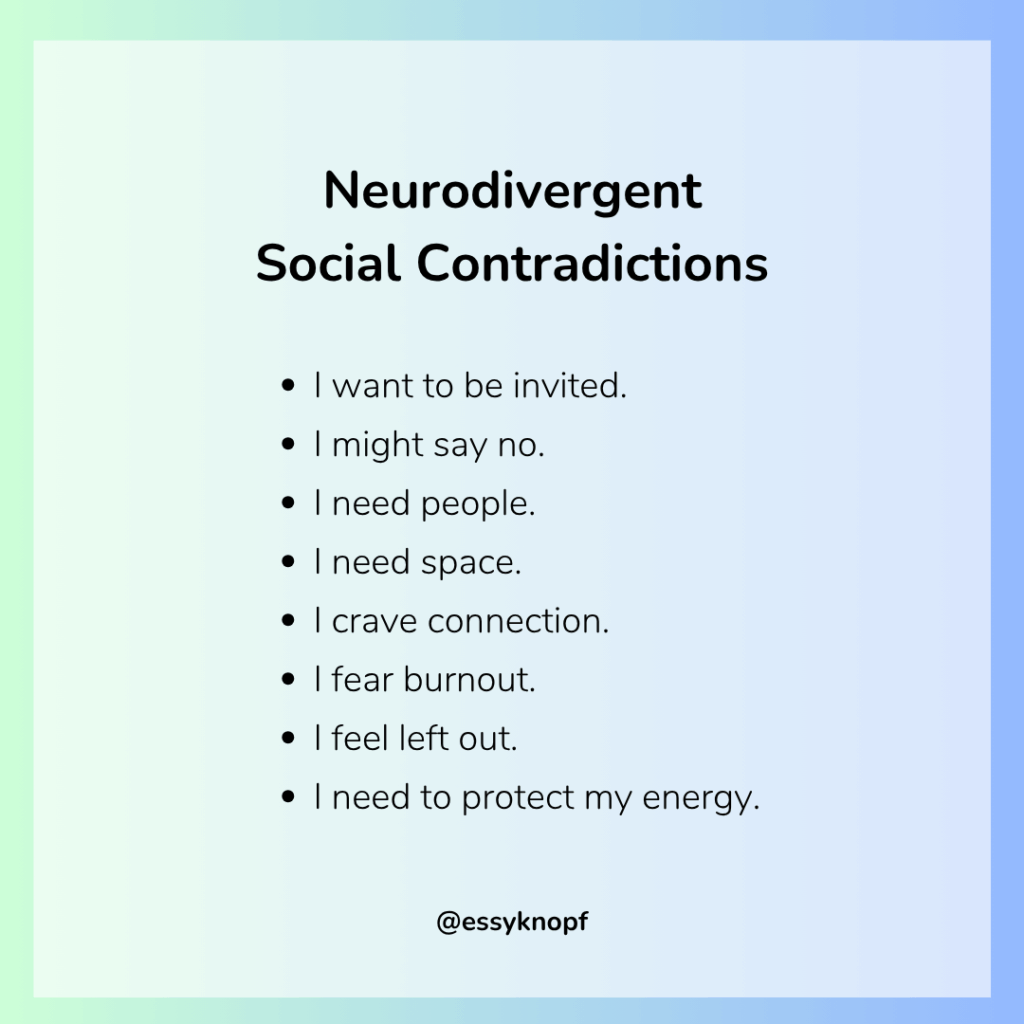
Making Peace with the Contradiction
Some days, connection feels worth chasing. Other days, the idea of texting back or being “on” for anyone feels impossible.
Your needs shift. Your energy changes. And your ability to tolerate discomfort doesn’t always line up with your desire for closeness.
There’s nothing wrong with you for needing space. There’s nothing wrong with you for wanting closeness, either. These aren’t failures. They’re just your reality.
For those living with neurodivergent social fatigue, one of the most healing practices can be this: letting both truths exist. “I’m sad I wasn’t there.” And also, “I needed to stay home.” Both are real. Both matter.
Sometimes peace comes through small, manageable bridges: quiet hangouts with one trusted person, short calls with a friend who doesn’t need small talk, messages exchanged at your own pace.
You begin to build a rhythm that honors your nervous system, without giving up on connection entirely.
And slowly, maybe, you stop chasing the idea of a perfectly fitting social life. You start noticing what feels good, even if it doesn’t look like everyone else’s version of “normal.”
Final Thoughts
Living with neurodivergent social fatigue means constantly balancing between craving connection and preserving your energy. That’s a heavy emotional lift—especially when the world moves faster, louder, and more casually than you do.
If you’ve felt like you’re always the one adapting, adjusting, bracing, you’re not alone.
You’re doing the best you can to meet your needs while still showing up. That deserves recognition. That deserves care.
Imagine how much gentler life would feel if people understood this. If “no” didn’t mean goodbye. If solitude wasn’t taken personally. If invitations came with room for nuance.
We’re not fully there yet, but by talking about this contradiction, by honoring our limits and longings side by side, we inch closer to the world we need.
So if you’re navigating neurodivergent social fatigue—if you’re walking that thin line between connection and protection—I see you. And your way of being in the world makes complete sense.
Have you wrestled with the challenge of neurodivergent social fatigue in your own life?
Essy Knopf is a therapist who likes to explore what it means to be neurodivergent and queer. Subscribe to get all new posts sent directly to your inbox.
© 2026 Ehsan "Essy" Knopf. Any views or opinions represented in this blog are personal and belong solely to the blog owner and do not represent those of people, institutions or organizations that the owner may or may not be associated with in professional or personal capacity, unless explicitly stated. All content found on the EssyKnopf.com website and affiliated social media accounts were created for informational purposes only and should not be treated as a substitute for the advice of qualified medical or mental health professionals. Always follow the advice of your designated provider.