

Overcoming social anxiety as a neurodivergent


If you’re autistic or an ADHDer, chances are you’ve struggled with social anxiety—not the average nerves before a party, but the kind that can feel paralyzing. The kind that makes you rehearse conversations in your head for days or avoid even basic interactions out of fear of rejection or judgment.
And that fear is often rooted in lived experience. For many neurodivergents (NDs), social anxiety isn’t just about being shy—it’s the result of a lifetime of being misunderstood, criticized, or excluded.
So we learn to mask. We mimic, edit, and shrink ourselves to appear more “normal.” But this constant self-monitoring takes a toll on our mental health and our self-worth.
Why Social Anxiety Runs So Deep for Us
ND brains often process social information differently. We may miss subtext, struggle with timing, or communicate in ways others find too blunt or too intense.
These differences can lead to painful interactions where our intentions are misunderstood. Instead of grace, we get correction—or worse, exclusion. Over time, these experiences hardwire fear into our brains. Social anxiety becomes a survival response.
Add rejection sensitivity into the mix, and even small missteps can feel catastrophic. It’s no wonder many of us would rather stay home than risk getting it wrong again.
The Trap of Avoidance
Avoiding social situations might feel like relief in the moment—but it also reinforces social anxiety over time. We lose the chance to practice, to build tolerance for discomfort, and to develop confidence.
The less we engage, the more our fears grow. Eventually, even a simple interaction—like saying hello to a cashier—can feel overwhelming. And when we do brave the social world, the pressure to get it “right” makes it hard to be present or authentic.
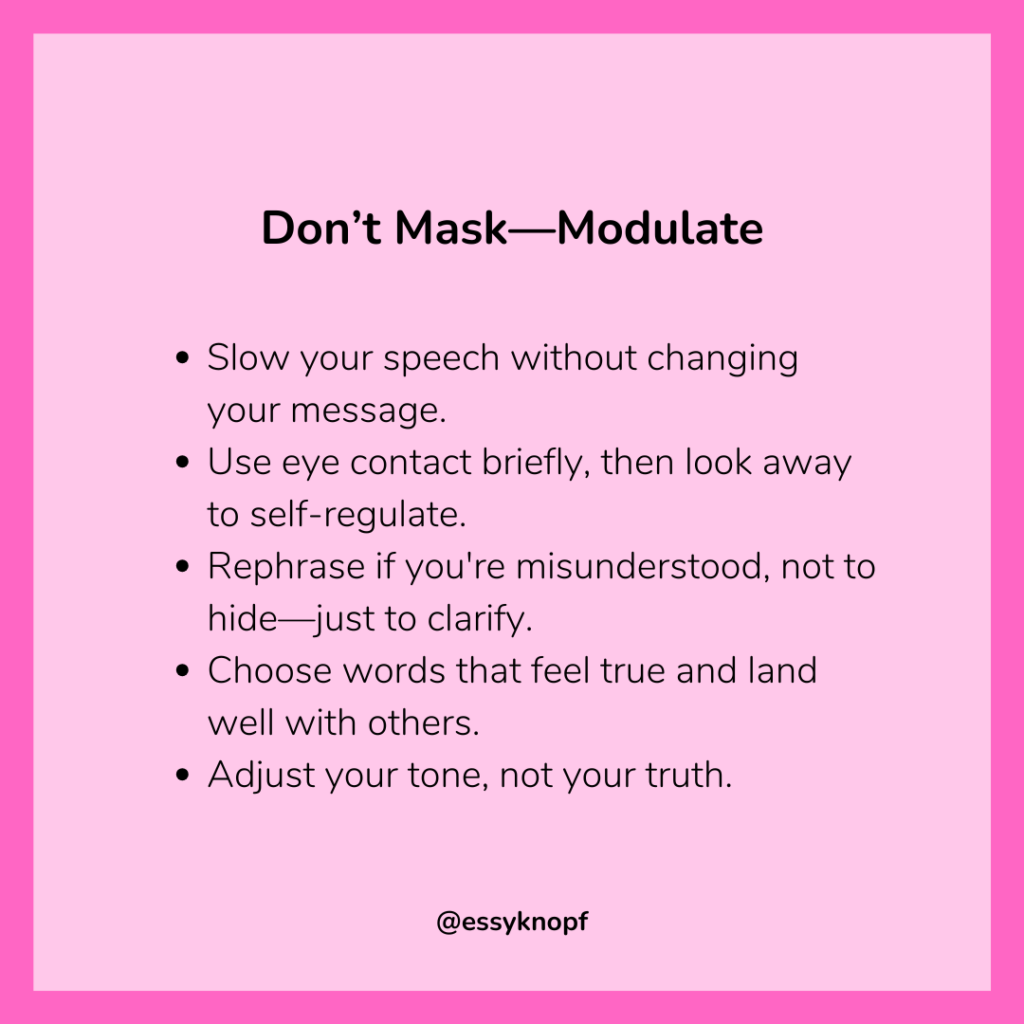
Modulating Is Not Masking
What’s the alternative? Modulation. It means learning to adjust your communication style without erasing yourself. Think of it as picking up a second language—you don’t abandon your native tongue, but you gain a tool that helps you connect more effectively.
By practicing modulation, you can reduce social anxiety without compromising your authenticity. You’re not pretending—you’re expanding your skills.
Progress Starts Small
Start with manageable social risks. Say “hi” to someone in your building. Practice making small talk in a low-pressure setting. Try a new activity that nudges you out of your comfort zone—like a class or club—where socializing is structured and shared.
And yes, mistakes will happen. But with each interaction, you build resilience. You teach your brain that social anxiety doesn’t have to be a stop sign—it can be a signal to slow down, breathe, and move forward anyway.
Reclaiming Your Confidence
Every ND deserves to feel confident in their ability to connect. That doesn’t mean faking it forever—it means learning what works for you and giving yourself permission to show up, imperfectly but bravely.
So this week, try one small thing that challenges your social anxiety. And when you do, celebrate the effort—not just the outcome.
Have you found ways to manage social anxiety that work for you? Let me know in the comments.
Essy Knopf is a therapist who likes to explore what it means to be neurodivergent and queer. Subscribe to get all new posts sent directly to your inbox.
© 2026 Ehsan "Essy" Knopf. Any views or opinions represented in this blog are personal and belong solely to the blog owner and do not represent those of people, institutions or organizations that the owner may or may not be associated with in professional or personal capacity, unless explicitly stated. All content found on the EssyKnopf.com website and affiliated social media accounts were created for informational purposes only and should not be treated as a substitute for the advice of qualified medical or mental health professionals. Always follow the advice of your designated provider.