

Neurodivergent perseveration: When your brain won’t let go (and how to gently take the wheel back)


Ever feel like the hardest part of a tough situation… is what your brain won’t stop saying afterward? That, my friend, is neurodivergent perseveration.
It’s the sticky, looping thought patterns that so many of us—especially those who are autistic and ADHD—struggle with. Even after the moment has passed. Even when nothing went “wrong.”
Let’s unpack what neurodivergent perseveration actually is, how it shows up in everyday life, and what you can do when your brain just won’t let something go.
What Is Neurodivergent Perseveration?
It’s a kind of overthinking that doesn’t feel optional. It’s when your brain gets stuck on a thought, a fear, or a regret, and keeps chewing it over long after it’s helpful—or relevant.
It’s common in both autistic and ADHD brains, and often shows up as:
- Worry – Spiraling about the future. “What if I mess this up?” “What if they hate me?” It’s that anxious preparation that never leads to peace—only paralysis.
- Rumination – Replaying the past. “Why did I say that?” “I always ruin things.” It’s not reflection—it’s self-punishment.
- Obsessions – Intense mental fixations. These are sharp, intrusive thoughts that won’t quit, whether or not they’re based in reality.
Sometimes they overlap, feeding into each other in a cycle that feels impossible to break. That’s the heart of neurodivergent perseveration.
Everyday Examples
- You go on a date, and afterward your brain spirals with analysis: “Did I talk too much? Did they think I was weird?” → Rumination
- You get neutral feedback at work and suddenly you’re spiraling: “They hate me. I’m going to be fired.” → Obsessive thinking
- You’re about to leave the house but can’t stop worrying: “What if I forget something? What if I crash?” → Worry
For many autistics, perseveration can focus on social interactions, routines, or sensory experiences. For ADHDers, it often revolves around inaction, overstimulation, or rejection sensitivity.
But however it shows up, the result is the same: your brain is working overtime, and you’re not getting anywhere.
Why Does Neurodivergent Perseveration Happen?
Because your brain is trying to protect you. It’s looking for certainty, for control, for relief from shame or fear. But it’s like revving your engine in neutral—it makes a lot of noise but doesn’t take you anywhere.
What makes it so tricky is that it feels productive. You think, “If I just figure this out, I’ll feel better.” But you rarely do. That’s because the real driver isn’t logic—it’s emotion. Often, shame is riding shotgun.
Shame Is the Fuel That Keeps the Loop Spinning
If you’ve been misunderstood, corrected, or rejected your whole life, your brain starts expecting that kind of treatment. So any small mistake becomes a “confirmation” that you are too much, too different, too wrong.
Neurodivergent perseveration becomes a punishment loop. Not because you need to learn from something—but because you feel like you need to pay for it.
That’s not learning. That’s trauma.
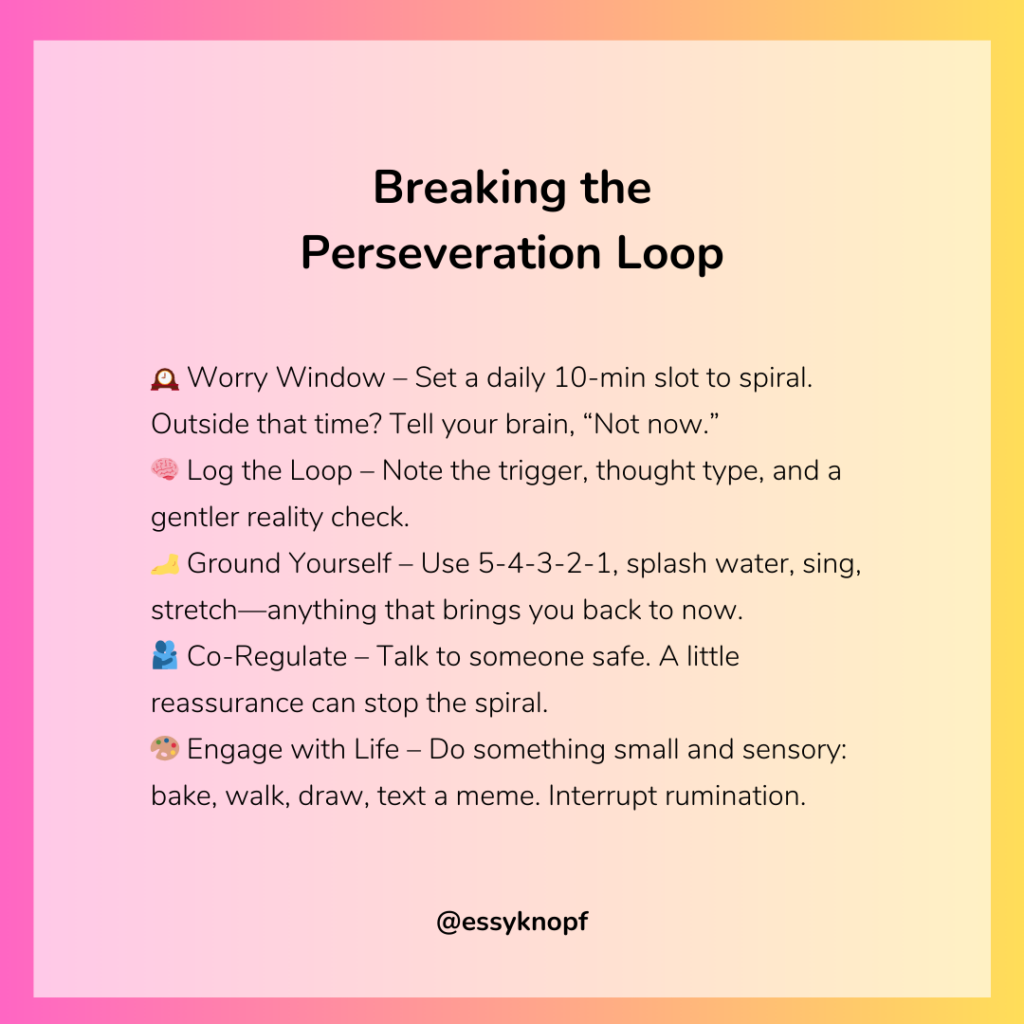
What Helps Break the Perseveration Loop?
Let’s be real: you probably won’t stop all neurodivergent perseveration. But you can start unhooking from it. Here’s how:
🕰 Schedule a “Worry Window”
Set a 10-minute slot each day. That’s when you’re allowed to spiral. The rest of the day? You tell your brain: “Not now. Later.” Simple, powerful, and surprisingly effective.
🧠 Log the loop
Use a 3-part journaling tool:
- Trigger: What started the thought?
- Type: Is it worry, rumination, or obsession?
- Reality check: What’s a gentler, more grounded perspective?
🦶 Ground yourself
Try 5-4-3-2-1 sensory grounding. Or splash your face with cold water. Or sing. Or walk. Anything that reminds you: “I’m here. I’m okay. I’m safe.”
🫂 Co-regulate
Ask a trusted friend: “Can I run something by you? I think I’m spiraling.” Even one reassuring response can interrupt the pattern. You don’t have to do this alone.
🎨 Engage with life
Neurodivergent perseveration thrives in inactivity. So do something—even if it’s small. Bake. Color. Move. Send a meme. Let life anchor you.
The Heart of It: Your Brain Thinks Perseveration Will Keep You Safe
It says: “If I think this through enough, I can avoid the pain.” But often, the overthinking is the pain.
So here’s your gentle reminder: You don’t need to control every variable. You don’t need to think your way out of every fear.
You can pause. You can breathe. You can say: “Thanks, brain. I know you’re trying to help. But I’ve got this now.”
That’s the real antidote to neurodivergent perseveration—not perfection. Not certainty. But self-trust.
Have you noticed patterns of perseveration in your own life? What helps you unhook from the loop—or what makes it harder?
Essy Knopf is a therapist who likes to explore what it means to be neurodivergent and queer. Subscribe to get all new posts sent directly to your inbox.
© 2026 Ehsan "Essy" Knopf. Any views or opinions represented in this blog are personal and belong solely to the blog owner and do not represent those of people, institutions or organizations that the owner may or may not be associated with in professional or personal capacity, unless explicitly stated. All content found on the EssyKnopf.com website and affiliated social media accounts were created for informational purposes only and should not be treated as a substitute for the advice of qualified medical or mental health professionals. Always follow the advice of your designated provider.