Neurodivergent cultural wealth: The hidden knowledge autistic and ADHD people carry

Essy Knopf neurodivergent cultural wealth
Reading time: 4 minutes

From an early age, many autistic and ADHD people learn to see themselves through a lens of lack.

We interrupt without meaning to—and spend the rest of the day wondering if we annoyed someone. We need three alarms to get out the door and still somehow leave our coffee on the kitchen counter. We become intensely excited about a topic, only to watch someone’s eyes glaze over halfway through our explanation.

We cry when we’re overwhelmed. Or shut down completely. We forget what we came into the room for. We miss the hidden meaning everyone else seemed to catch.

And often, we’re told these differences are problems.

By the time many of us discover we’re neurodivergent, we’ve already internalized years of criticism, misunderstanding, and pressure to be someone else. We’ve learned to mask, compensate, and apologize for taking up space.

But what if we’ve been looking through the wrong lens all along?

What Is Neurodivergent Cultural Wealth?

I use the term neurodivergent cultural wealth to describe the knowledge, adaptation, perspective, and wisdom that autistic and ADHD communities develop while navigating a world that often misunderstands them.

The concept is inspired by educational researcher Tara Yosso’s Community Cultural Wealth framework, which challenged the assumption that marginalized communities lack valuable forms of knowledge and resources.

Similarly, neurodivergent cultural wealth invites us to question the idea that autistic and ADHD people should primarily be understood through deficits, impairments, or limitations.

Instead, it asks a different question: What knowledge emerges from living a neurodivergent life?

What forms of wisdom are passed between members of neurodivergent communities?

What strengths develop through years of adaptation, self-discovery, and resistance?

These are the questions at the heart of neurodivergent cultural wealth.

The Problem With Deficit-Based Thinking

Much of society still views autism and ADHD through a deficit-based framework.

Schools, workplaces, healthcare systems, and even mental health services often focus on what neurodivergent people cannot do rather than what they contribute.

This perspective obscures neurodivergent cultural wealth by treating difference as deficiency.

When every challenge is highlighted while every adaptation goes unnoticed, it’s easy to overlook the remarkable forms of knowledge that autistic and ADHD people develop throughout their lives.

Knowledge Born From Adaptation

Yet neurodivergent communities have never been defined solely by struggle.

For generations, autistic and ADHD people have been adapting to environments that weren’t built with us in mind. We’ve learned to navigate sensory overload in fluorescent-lit classrooms. To survive workplaces that reward social performance over actual competence. To decode unwritten social rules that everyone else seemed to receive a handbook for.

And in the process, we’ve developed knowledge.

For example, many neurodivergent people become skilled observers. When social interactions don’t come naturally, you pay attention and look for patterns.

You begin paying attention to things many people take for granted. Sometimes it’s tone of voice. Sometimes it’s routines, social patterns, inconsistencies, or unspoken expectations.

You learn things most people never have to think about.

Similarly, many of us become experts in our own minds.

When everyday tasks seem inexplicably difficult, you start asking questions.

Why can I spend six hours researching a niche topic but struggle to answer an email?

Why does a crowded restaurant leave me exhausted?

Why do certain sounds feel unbearable?

Why does a change in routine throw off my entire day?

Years spent wrestling with these questions often lead to a level of self-understanding that isn’t always appreciated by the wider world.

This is neurodivergent cultural wealth: the knowledge that emerges from living a neurodivergent life.
The Wisdom of Community

But that knowledge isn’t developed in isolation.

One of the most powerful aspects of neurodivergent cultural wealth is what happens when neurodivergent people find one another.

Spend enough time in autistic and ADHD spaces and you’ll notice something remarkable.

Someone mentions struggling to brush their teeth consistently, and suddenly a dozen people are sharing workarounds.

Another person talks about sensory overwhelm, and others immediately understand without needing an explanation.

A third admits they’re exhausted from masking, and instead of judgment, they’re met with recognition.

What emerges from these conversations is collective wisdom.

Knowledge gets passed from one person to another. Strategies are shared. Language develops. Experiences that once felt isolating suddenly make sense.

Many of us spend years believing we’re the only ones who think a certain way.

Community reveals otherwise.

Seeing the World Differently

Neurodivergent cultural wealth also shows up in the questions we ask.

Living outside the norm often gives you a different vantage point from which to view the world.

You start noticing assumptions that others take for granted.

Why should eye contact determine whether someone is trustworthy?

Why is small talk considered a prerequisite for connection?

Why is productivity treated as a measure of human worth?

Why are some forms of communication considered valid while others are dismissed?

These questions are the product of seeing the world from a different angle.

And sometimes that different angle reveals things that everyone else has overlooked.

Beyond Deficits and Limitations

None of this means autism and ADHD are free from challenges.

Many neurodivergent people experience significant disability. Executive dysfunction, sensory sensitivities, burnout, social misunderstanding, and co-occurring mental health challenges can have a profound impact on daily life.

Recognizing neurodivergent cultural wealth isn’t about denying those realities.

Rather, it’s about refusing to let them tell the whole story.

Because when we focus exclusively on deficits, we miss something important.

We miss the resilience required to keep showing up in spaces that weren’t designed for us.

We miss the creativity involved in finding alternative ways of learning, working, and communicating.

We miss the insights that emerge from seeing the world differently.

And we miss the knowledge that neurodivergent communities have been generating and sharing all along.

Wrap Up

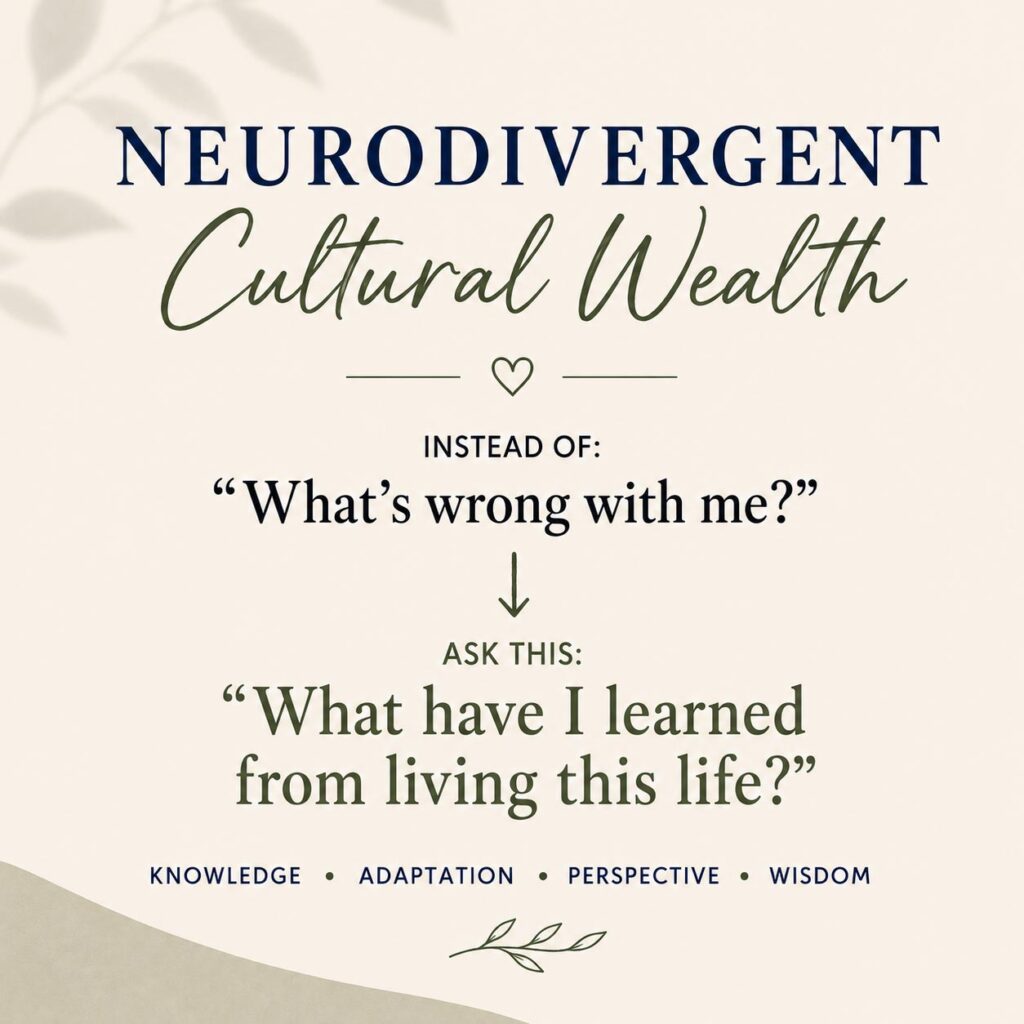
For much of our lives, many of us have been taught to ask: “What’s wrong with me?”

Neurodivergent cultural wealth invites a different question: “What have I learned from living this life?”

“What wisdom have I gained?

“What strengths, perspectives, and forms of knowledge have emerged because of my neurodivergence?

The answers may be far richer than we’ve been led to believe.

Download The Neurodivergent Cultural Wealth Framework

What forms of neurodivergent cultural wealth do you see in yourself or your community?

Embracing a multi-passionate life as a neurodivergent

Essy Knopf multi-passionate
Reading time: 4 minutes

If you’re autistic or ADHD, you probably have a long list of interests and passions. Maybe you’ve been called “flaky” for switching career paths, or perhaps you’ve been criticized for not “sticking with one thing.” The truth is, being multi-passionate is a natural part of neurodivergence.

Many of us thrive on novelty, diving deep into different fields and skill sets with intense focus. While this ability can lead to a wealth of knowledge and experience, it can also leave us feeling torn between multiple career paths, unsure where to direct our energy. When society tells us we must pick one passion and stick with it for life, it can feel suffocating. But what if our ability to engage in multiple passions isn’t a weakness—but a strength?

Society often encourages specialization—picking a single career and staying with it for life. But for many neurodivergent (ND) folks, that can feel like an impossible demand. Our curiosity drives us to explore, learn, and master different skills. And yet, this trait is often misunderstood. Instead of being seen as ambitious, adaptable, and dynamic, we’re sometimes mislabeled as indecisive, unreliable, or lacking focus.

In this post, I’ll share my personal journey as a multi-passionate ND, the challenges I’ve faced, and the strategies I’ve used to find balance and fulfillment. Whether you’re struggling with career decisions, feeling overwhelmed by your many interests, or simply looking for validation that your way of being is okay—you’re not alone.

The Challenges of Being Multi-Passionate

Feeling Pulled in Multiple Directions

It’s common for NDs to have multiple career aspirations. You might love writing, filmmaking, science, and therapy all at once. It can feel overwhelming trying to decide where to focus your time and energy. Sometimes, we dive headfirst into one passion, only to find ourselves drawn to another soon after. This cycle of shifting focus can make us feel like we’re never making real progress.

Society’s Expectations Regarding Being Multi-passionate

Many people see job-hopping or changing interests as a lack of commitment. But for NDs, our drive to explore is an essential part of who we are. The traditional career path doesn’t always work for a multi-passionate individual. Instead of being encouraged to pursue a variety of interests, we’re often told to “just pick something” and “stick with it.” But forcing ourselves into a linear career path that doesn’t align with how our brains work can lead to frustration and burnout.

Burnout and Decision Fatigue

Diving deep into multiple passions can be exhausting. It’s easy to overcommit and stretch yourself too thin, leading to burnout. The mental load of deciding where to invest our time and energy can be overwhelming. The pressure to make the “right” choice often leads to decision paralysis, leaving us stuck in a cycle of starting and stopping projects without feeling like we’re getting anywhere.

Finding Balance: How to Thrive as a Multi-Passionate Neurodivergent

Reframe It as a Strength

Your ability to learn quickly, adapt, and explore diverse fields is an asset! Embrace your curiosity and use it to your advantage as a multi-passionate person. Instead of viewing your shifting interests as a flaw, recognize that your ability to see connections between different disciplines makes you a creative problem solver and an innovative thinker.

Look for Overlaps Between Your Interests

Can you combine passions into a unique career path? For example, if like me you love writing and psychology, maybe you can become a therapist who blogs. If you enjoy filmmaking and social work, you could create educational content about mental health.

Sometimes, the key to fulfillment isn’t choosing one passion over another but finding ways to integrate them into a career or lifestyle that allows you to engage with multiple interests simultaneously.

Adopt the “Ikigai” Framework

The Japanese concept of ikigai suggests that fulfillment comes from work that:

  • You love (your passion)
  • You’re good at (your vocation)
  • The world needs (your mission)
  • Pays you well (your profession)

If you can find a career that incorporates all four, you’re on the right track as a multi-passionate person! Rather than limiting yourself to just one pursuit, think about how you can create a career that aligns with your multiple passions and strengths.

Essy Knopf multi-passionate neurodivergent

Create a Passion Portfolio

Instead of choosing just one passion, consider how you can balance multiple interests over time. You don’t have to do everything at once—some passions can be hobbies, side projects, or long-term goals. A passion portfolio allows a multi-passionate individual to honor all their interests.

Think of your career and life as a buffet or combo platter rather than a set menu. You can sample different interests at different times, and it’s okay if your focus shifts. Allow yourself the flexibility to evolve.

Set Boundaries to Avoid Burnout

Prioritize rest and self-care. Give yourself permission to slow down and enjoy each passion without rushing to turn it into a career. Being multi-passionate doesn’t mean you have to do everything at once! Establishing healthy boundaries—such as time-blocking your passions, scheduling breaks, and recognizing when to step back—can help prevent burnout.

Redefining Success on Your Terms

Traditional career advice doesn’t always fit NDs. Instead of forcing yourself to fit into a mold that wasn’t designed for you, embrace the unique way your brain works as a multi-passionate ND. Success doesn’t have to mean climbing a single corporate ladder—it can mean crafting a fulfilling life that allows you to explore, create, and grow in multiple areas.

You are not “flaky” or “inconsistent”—you are passionate, curious, and adaptable. Your multi-passionate nature is a gift, and when harnessed effectively, it can lead to a rich, fulfilling life.

What about you? What are your passions, and how have you navigated the challenges of being multi-passionate? Let’s chat in the comments!

The secret to building neurodivergent self-esteem? ‘Strengths awareness’

self-esteem confidence strengths autism Essy Knopf
Reading time: 5 minutes

Many of the messages we get as neurodivergents (NDs) living in an ableist society remind us that we’re different. And this difference, more often than not, is treated as a negative—at the cost of our self-esteem.

When confronted with the unique traits and behavior of NDs, many neurotypicals (NTs) typically respond with discomfort, annoyance, hostility, and even vilification.

Sometimes they do it out of ignorance—a knee-jerk reaction to something they don’t understand. They may also simply view autism and ADHD as a “deficit” or “fault” that needs to be corrected.

Acknowledging areas for growth

There is a tendency within the ND community to react defensively to the “neurodiversity-as-deficit” paradigm by casting being ND exclusively as a strength. 

Given many of us feel that being ND is an intrinsic part of our identity, it makes sense that we should feel compelled to defend it. 

Personally speaking, I would much sooner rather celebrate my strengths than look at myself through the lens of inferiority.

At the same time, I recognize that being ND can come with some downsides. For example, I find my various sensory sensitivities to be a nuisance. And I wish I could form and sustain relationships with the ease enjoyed by many NTs.

Should I treat these downsides as a reflection of my worth? Definitely not. That said, I do think there is value in recognizing our personal areas for growth. For me, this is developing stronger social skills.

Self-esteem starts with acknowledging strengths

Areas of growth aside, I think there is merit in focusing on strengths. Being autistic, for example, can convey quite a few. For example:

  1. We enjoy peer relationships characterized by absolute loyalty and impeccable dependability
  2. We are free of sexist, “age-ist”, or culturalist biases; able to regard others at “face value”
  3. We are willing to share our mind, irrespective of social context or adherence to personal beliefs
  4. We have an ability to pursue personal theory or perspective despite conflicting evidence
  5. We seek an audience or friends capable of enthusiasm for unique interests and topics
  6. We take consideration of details and spend time discussing a topic that may not be of primary interest
  7. We listen without continual judgment or assumption
  8. We are interested primarily in significant contributions to conversation, preferring to avoid “ritualistic small talk”, or socially trivial statements and superficial conversation.
  9. We seek sincere, positive, genuine friends with an unassuming sense of humor

And as employees, we are also known to be: reliable, persistent, perfectionists, easily able to identify errors, technically able, and to have a sense of social justice and integrity.1

We are also willing to question protocols, can be highly accurate, attentive to detail, logical, conscientious, knowledgeable, original in problem-solving, honest, and likely to thrive on routine and clear expectations.

In a majority of situations, these qualities are quite beneficial. They also contradict the ND-as-deficit paradigm.

Are you ‘strengths blind’?

Strengths vary from individual to individual, and may manifest physically, mentally, emotionally, socially, or spiritually.2

We may not be aware of those strengths and how they may have helped us to cope with the challenges of day-to-day life. But they’re still there, regardless.

Failing to recognize our strengths is called being “strengths blind”. Four factors can prevent us from seeing them.

Firstly, there’s a lack of awareness of said strengths, resulting from not practicing self-awareness or feeling disconnected from our identity.

Secondly, we may not see our strengths as meaningful. Thirdly, we may downplay them as ordinary, rather than extraordinary.

And fourthly, we may overuse our strengths to the point that they create problems. One commonly overused autistic strength for instance is passion. 

To elaborate: autistics can have something of a reputation for wanting to share knowledge about their areas of interest, even with the most casual of acquaintances.

If we’re not careful, we may end up talking at length and scarcely allow the other person to get a word in edge wise.

In fact, we can become so caught up in the act of sharing that we fail to take notice of the subtle—and not-so-subtle clues—that the other person is getting annoyed, or feeling frustrated and overwhelmed.

Yet in moderation, this character strength can be hugely advantageous. Passion for instance can enable us to become leading specialists in our chosen fields.

Putting our strengths into practice

So, how do we overcome strength blindness? By increasing awareness of our strengths. We can start doing this by reaching out to our closest friends and family members and asking them what they like most about us.

Their responses should give you a clear idea of what you excel at. Alternatively, you can take this character strengths and virtues questionnaire.

Some common strengths or qualities are creativity, curiosity, judgment, love of learning, perspective, bravery, perseverance, honesty, zeal, love, kindness, social intelligence, teamwork, and fairness.

Other qualities are leadership, forgiveness, humility, prudence, self-regulation, appreciation of beauty, and excellence, gratitude, hope, humor, and spirituality.

The great thing about character strengths is that most are not in any way shaped by our being ND.3 (Small caveat: many autistics may struggle with social intelligence and teamwork, and yet we also love to learn and are very curious.)

Once you’ve identified our strengths, select your topmost three. Now ask yourself, what activities do you do in service of those strengths?

Chances are when you do those activities, you’ll feel great about yourself. Why? Because they are impactful, and because they provide satisfaction. 

self-esteem autism Essy Knopf

Strengths-based habits improve self-esteem

If you’re struggling with self-esteem issues, make a conscious plan to do at least one of the three activities when you feel down or like you’re struggling. Not only will this affirm your strengths, but it will also improve your self-esteem.

If love is one of your strengths, perform a kind act for someone, such as buying a friend a gift. If appreciation of beauty is a strength, visit an art gallery or public garden. 

If creativity is a strength, pick up a pen or paintbrush and start creating.

Of course, doing the occasional activity can only take you so far. If we really want to grow our self-esteem, we should make these activities into habits.

Set aside a regular time in which to do each of the activities you identified. Incorporate them into your daily or weekly schedule, until they become habitual.

Wrap up

Why is making activities into habits important? Because habits create a powerful snowball effect.

The more we exercise our strengths, the more they feel like a part of our character. The more we orient our character around our strengths, the more capable we feel.

The more capable we feel, the greater our sense of self-worth. The greater our sense of self-worth, the more likely we are to embrace our strengths. And so the cycle goes.

What are some of your strengths, and how do you express them? 

And what’s one new habit you could commit to over the coming week to develop awareness of your strengths? Share your responses in the comments.