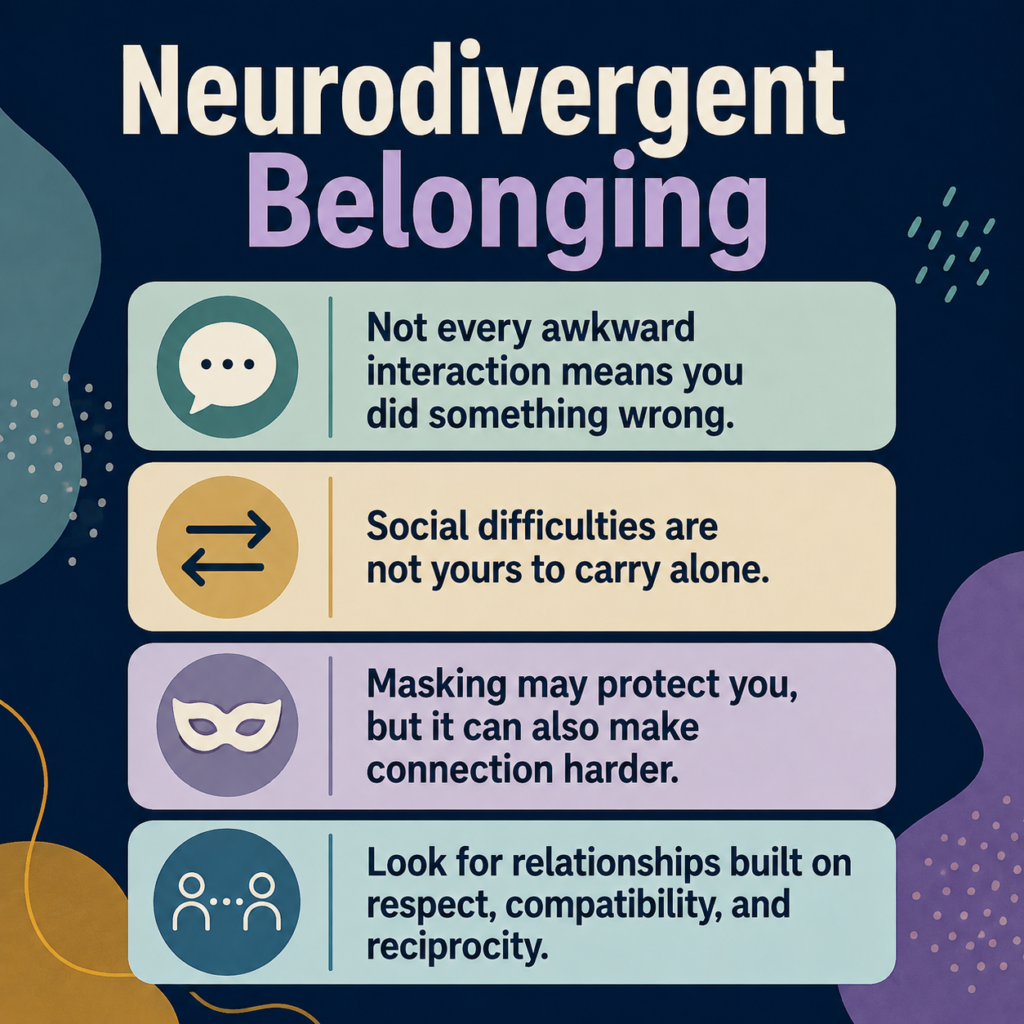

Why do I always have to explain myself? Autism, ADHD, and being misunderstood


Have you ever left a conversation feeling fine, then started wondering whether something you said sounded rude?
By the time you get home, you’re considering sending a message to explain yourself. You don’t actually know whether the other person was offended. And yet leaving it alone feels risky.
For many autistic and ADHD adults, being misunderstood is familiar enough that we start preparing for it before it happens.
For example, we may qualify a question so it doesn’t sound like criticism. Or we may explain why we need time alone, then reassure the person that we enjoyed seeing them. Sometimes the explanation gets longer than whatever we originally wanted to say.
It can be hard to enjoy their company when we’re also reviewing our own performance.
When you start questioning your own intentions
There’s a difference between knowing you’re interested and knowing how to make that interest recognizable to someone else in a social interaction.
You might look away because it helps you listen, then remember that someone once accused you of ignoring them for doing exactly that. So you make yourself look back, even though you’re now finding it harder to follow the conversation.
Your attention shifts from what works for you to what will reassure them.
American sociologist and writer W. E. B. Du Bois explored a particular form of divided self-awareness through his concept of double consciousness: the experience of being Black in a racist society and seeing oneself through the judgments of the dominant white culture.
Although rooted in a distinct experience of racism, his account offers a useful way to think about neurodivergent masking: how we can become so accustomed to seeing ourselves through other people’s judgments that we begin to distrust our own understanding of ourselves.
You know you asked a sincere question, but someone heard a challenge. Now you’re wondering whether you were being difficult without realizing it.
When this happens repeatedly, knowing what you meant can stop feeling like enough. You start anticipating how you’ll be interpreted and adjusting yourself before you’ve even spoken.
How you end up doing the repair work
If your questions were treated as backtalk growing up, it makes sense that you might explain why you’re asking. If people regularly mistook your expression for anger, you may have learned to smile when you didn’t feel like smiling.
Those adjustments may have helped. They may still help. The difficulty is that you can become accustomed to making them whether or not the person in front of you needs them.
A friend gets quiet, and you start searching for what you did wrong. Perhaps they’re tired. Perhaps something you said did bother them. You don’t yet know, but you’re already working on an apology.
This is where I think we need to ask more of the people around us.
Autistic researcher Damian Milton’s double empathy problem describes how autistic and non-autistic people can struggle to understand each other across differences in experience and perspective.
It challenges the assumption that a misunderstanding must originate with the autistic person. The framework was developed around autism, though the question of shared effort may also resonate with ADHD readers.
Consider what happens when someone assumes your directness means you’re annoyed. You can explain what you meant, but they also need to be willing to reconsider their interpretation. If they continue treating their first impression as more reliable than your explanation, there’s a limit to what further explaining can accomplish.
Of course, we can hurt people without intending to. And we still need to listen when someone tells us that happened. But there should be room in that conversation for them to listen to us, too.
The conversation ends, but you’re still in it
Sometimes the most tiring part comes after social interactions. You’re making dinner and remembering a pause before someone answered you. You wonder whether you interrupted them. You pick up your phone, reread the message you’ve drafted, and decide it sounds excessive.
Then you wonder whether saying nothing would be worse.
Overexplaining can become a way of trying to settle that uncertainty. If you provide enough context, perhaps you can prevent someone from coming away with an impression of you that feels painfully wrong.
But you can’t always explain your way into feeling certain about what another person thinks. And the more time you spend trying, the less attention you may have for your own experience of the interaction.
Did you enjoy yourself? Were you comfortable? Did they make an effort to understand you?
These are questions that deserve some consideration before you spend hours deciding how to make yourself easier for others.
Letting someone else do their part
I don’t think “just stop caring what people think” is particularly helpful advice here. Other people’s judgments can affect our relationships and our jobs. Some of us have good reasons to be careful.
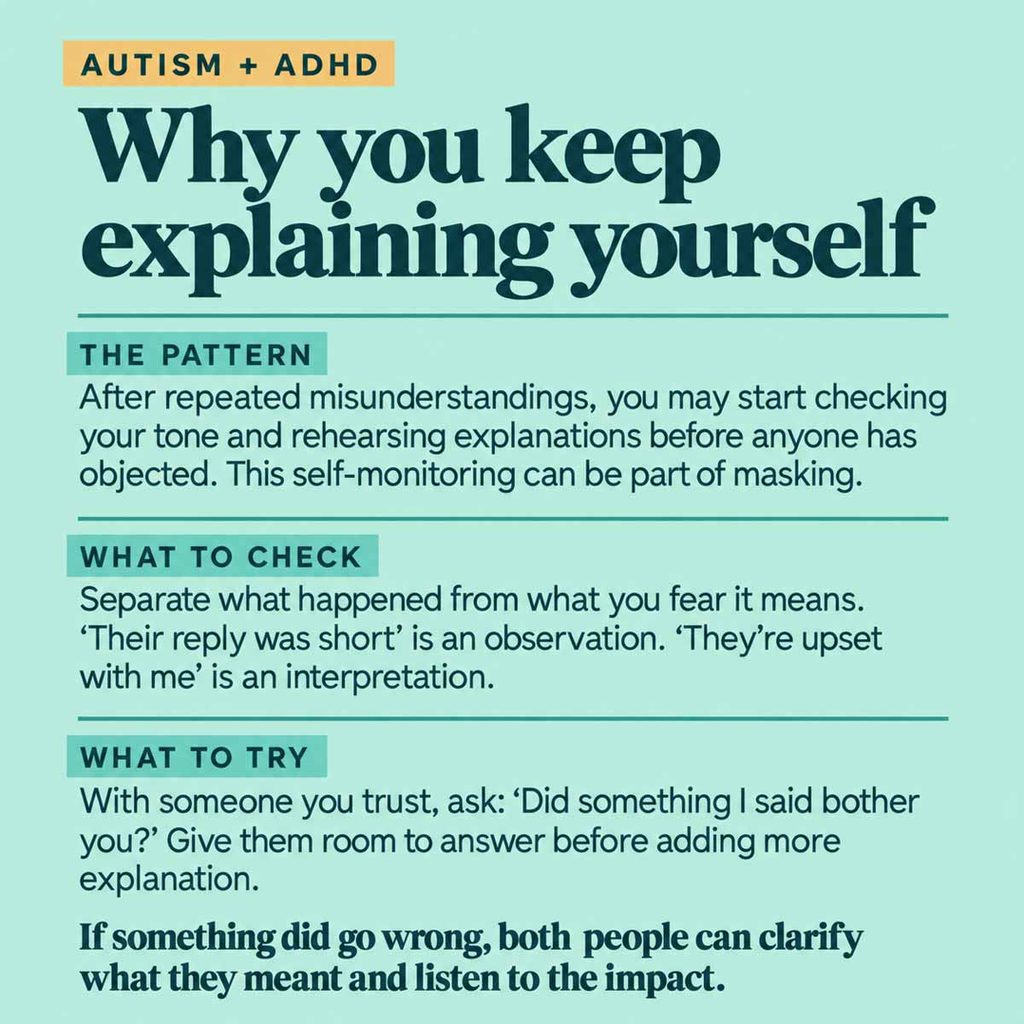
A more manageable starting point is to notice when you’re responding to something that happened and when you’re responding to something you fear happened. Another person’s short reply might make you uneasy, but it doesn’t tell you much by itself.
With someone you trust, you could ask, “Did that come across differently from how I intended?” That gives them a chance to tell you, rather than leaving you to construct both sides of the conversation.
You can also ask for an adjustment that would make future conversations easier: “Sometimes my voice sounds flat when I’m concentrating. If you think I’m upset, please ask.”
Then notice what they do with that information. Someone who wants to understand you may still get it wrong, but over time you should see some willingness to check their assumptions. You shouldn’t need to deliver the same explanation indefinitely.
There may also be people with whom you already feel less pressure to monitor yourself. Think about what they do that helps. Perhaps they take your questions at face value, or tell you plainly when something bothers them. That can give you a clearer sense of what to ask for in other relationships.
Wrap Up
It takes practice to leave a conversation alone when you’re used to reviewing everything you said. You may still feel the urge to send another explanation, even with people who have given you no reason to worry.
You can take that slowly. Start with someone who has shown they’ll ask when they’re unsure, and give them a chance to follow through. Being understood becomes a little less exhausting when you can trust the other person to participate.
Do you find yourself explaining more than you wanted to because you’re afraid of being misunderstood?
Essy Knopf is a therapist who likes to explore what it means to be neurodivergent and queer. Subscribe to get all new posts sent directly to your inbox.