
When neurodivergent fawning becomes self-erasure


You may have heard of the fight, flight, freeze, and fawn responses. These are natural ways our nervous systems react when we sense danger.
For many neurodivergent people, the fawn response can look like chronic people-pleasing.
Fawning is a form of submission intended to reduce a perceived threat. Figuratively speaking, it is like rolling over and showing your belly to communicate, “I’m not a danger—please don’t hurt or reject me.”
The threat does not have to be physical. It may be the risk of criticism, exclusion, humiliation, job loss, or family conflict.
Many autistic people and ADHDers learn early that pleasing others can offer protection. After being bullied or socially isolated over long periods of time, we may discover that masking our traits and accommodating everyone around us makes life feel safer.
And sometimes, it works.
Neurodivergent people-pleasing may help us remain part of a social group, maintain employment, or preserve important relationships. The problem is what happens when this coping strategy becomes our default.
When we consistently prioritize other people’s comfort, our own needs can disappear from view.
We suppress our reactions. We change how we communicate. We mask, camouflage, and compensate for our neurodivergence in the hope of being accepted.
Over time, this can leave us wondering: Who am I when I’m not performing for someone else?
There is a particular loneliness that comes from being surrounded by people who never truly see you. You may appear socially connected while privately feeling unknown, unworthy, or exhausted.
The fawn response protects us from rejection, but it may also prevent genuine connection.
Moving away from people-pleasing involves staying aware of the social context while making more room for your genuine feelings, preferences, boundaries, and needs.
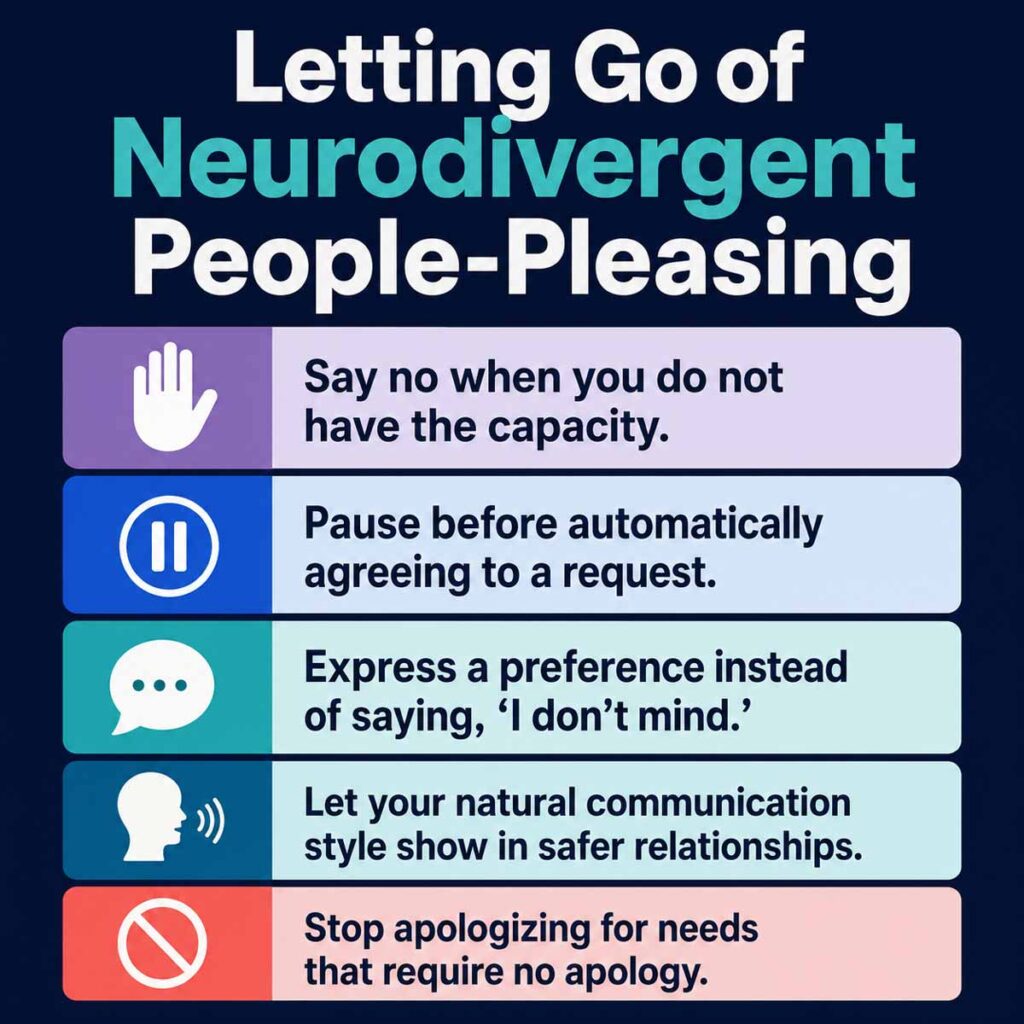
Authenticity can begin with small choices:
- Saying “no” when you do not have the capacity.
- Pausing before automatically agreeing to a request.
- Expressing a preference instead of saying, “I don’t mind.”
- Allowing your natural communication style to show in safer relationships.
- Choosing not to apologize for needs that require no apology.
“No” can be a full sentence. It can also be expressed gently: “I’m not able to do that,” “That doesn’t work for me,” or “I need some time to think.”
Each honest response is an opportunity to remind yourself that your needs matter too.
Letting go of neurodivergent people-pleasing can bring shame and guilt to the surface. An inner critic may warn you that being authentic will make others angry, disappointed, or unwilling to accept you.
That critic developed for a reason: it is trying to return you to a strategy that may once have kept you safe.
Rather than fighting it, you can acknowledge its fear while still choosing a different response.
With practice, authenticity becomes less frightening. Social rejection may still happen, but it becomes easier to recognize that another person’s dislike is not proof of a personal defect.
Some people like oranges. Some prefer bananas. Some are allergic to strawberries.
You cannot appeal to everyone—and exhausting yourself through people-pleasing will not change that.
Remember that the fawn response is a coping mechanism many neurodivergent people developed while navigating environments where being different carried real social risks.
Healing involves choosing, interaction by interaction, to stop disappearing—and to let more of your authentic self be seen.
Have you struggled with fawning as a neurodivergent person?
Essy Knopf is a therapist who likes to explore what it means to be neurodivergent and queer. Subscribe to get all new posts sent directly to your inbox.