
When rest feels like failure: Understanding neurodivergent dopamine crashes

Essy Knopf dopamine crashes
Reading time: 10 minutes

You make it through the week: meetings, deadlines, errands, everything on your list. You tell yourself, “Just get to Saturday.” And then, it arrives. No alarms. No emails. No obligations. A full day to yourself. Freedom.

But instead of relief, you feel an invisible weight pressing on your chest. You wander the house without purpose. You open your phone and scroll without focus. You think, This should feel good. Why doesn’t it?

A subtle dread creeps in. You start to feel unmoored, like you’ve slipped out of sync with the world. There’s nothing anchoring you, and instead of feeling free, you feel lost. Tired, even though you slept. Sad, even though nothing’s wrong. Irritable, but without a clear trigger.

This strange shift can feel so personal, like a flaw in your character. But for many neurodivergents, especially ADHDers and autistics, what you’re experiencing isn’t laziness or emotional instability, but rather a dopamine crash: a neurological dip that often follows periods of high stimulation or intense focus.

And when it hits, it sets the stage for something even more destabilizing: The Inventory.

The Inventory: When the Brain Turns Inward (and on You)

The Inventory doesn’t ask for permission. It doesn’t arrive with warning signs or knock gently on the door. It just appears, and suddenly, your brain is running an audit of your entire existence.

You’re lying in bed, or sitting on the couch, maybe halfway through a cup of tea. Then it begins: Am I doing enough with my life? Am I falling behind? Why don’t I feel closer to my friends? When was the last time I felt truly happy?

This is The Inventory. And it rarely pulls punches. It sifts through your relationships, your career, your body, your dreams… everything you’ve ever wanted or failed at. It’s as if your mind is trying to organize emotional clutter with the efficiency of a tax auditor on a deadline.

And sometimes, it hits on truths. Maybe you do want deeper friendships. Maybe your job is unfulfilling. These aren’t imaginary complaints. But what makes The Inventory so overwhelming is when it shows up.

You weren’t feeling this way yesterday. In fact, you might have been laughing, feeling connected, energized, even hopeful. What changed? The stimulation stopped. The dopamine dropped.

And that’s the crucial clue: The Inventory doesn’t start because your life fell apart. It starts because your brain, suddenly low on dopamine, is trying to explain the internal discomfort. It misreads chemistry as crisis. It turns a biological dip into an existential one.

When you understand this, it doesn’t erase the discomfort, but it can disrupt the spiral. Because The Inventory is often a sign that your nervous system is dysregulated and looking for meaning in the silence.

The Real Culprit: Dopamine Dysregulation

To understand what’s happening during these emotional plunges, we need to talk about dopamine. Dopamine is a neurotransmitter that helps us feel motivated, curious, and emotionally alive. It’s the chemical behind the little spark we feel when we start a project, connect with someone, or even just finish a to-do list.

For neurotypicals, dopamine flows relatively consistently. For many neurodivergent folks, especially autistics and ADHDers, dopamine is… spikier. It’s less like a gentle stream and more like a faucet someone keeps forgetting to turn on.

That means we might feel flat or irritable in the absence of stimulation, and euphoric, engaged, or even hyper-functional when we’re riding a dopamine high. And when that high ends—whether it’s after a project, a social event, or just the daily busyness of life—we crash.

You might feel heavy-limbed, foggy, or like you’re moving through molasses. Your interest in things you normally love evaporates. Your tolerance for noise, mess, or interruption drops to zero.

Because from the outside, nothing’s wrong. No crisis. No tragedy. And yet your body and brain are reacting like you’re in distress.

That’s the nature of dopamine dysregulation. Your brain has the chemicals it needs to feel balanced. And when it doesn’t? It tries to make sense of the imbalance. That’s where The Inventory comes in. It offers explanations—harsh ones—for what is, at its core, a neurological shift.

Recognizing this doesn’t make the crash go away. But it can give it shape. And with shape, you can begin to respond with understanding instead of self-judgment.

Dopamine Farming: How We Cope Without Knowing

When our brains are running low on dopamine, they don’t just sit back and suffer. They hustle. They scavenge. They adapt. This survival mode often leads us to something I call dopamine farming: the unconscious practice of seeking out tiny, fast hits of stimulation to offset the internal crash.

You’ve probably done it without even realizing. Maybe you open five tabs at once, scroll three different apps in rotation, snack even when you’re not hungry, or dive into an hours-long TikTok rabbit hole. This is your attempt to self-regulate.

Some of this is benign. Some of it is even creative, like switching between hobbies, dancing in the kitchen, or watching three episodes of your comfort show in a row. These can be gentle ways of topping up a depleted brain.

But not all dopamine farming is sustainable. For many neurodivergents, especially those with ADHD, the farming can become compulsive. What starts as a coping mechanism can spiral into overstimulation or burnout. You keep clicking, watching, doing, hoping to find the thing that gives you that little “zing.” And when nothing works? The crash hits harder.

The real catch is this: dopamine farming builds tolerance. That new app that gave you joy last week? It’s boring now. That hobby you used to love? You can’t get into it. You need more, faster, louder. And eventually, there’s nothing left to mine.

This is a strategy your brain has developed to stay afloat in a neurotypical world that rarely offers the kind of stimulation and structure you actually need.

And like all survival strategies, it works… until it doesn’t. Recognizing your farming patterns can help you shift from unconscious reaction to intentional support. You don’t need to give up dopamine farming altogether. You just need to diversify your crops.

Mountains and Irons: The Dopamine Management Strategies

If dopamine farming is the day-to-day survival method, then chasing mountains and juggling irons is the long game.

Many neurodivergent folks don’t just manage their dopamine dips with short-term fixes. We build systems around stimulation. Enter the “Many Mountains” and “Many Irons” strategies.

“Many Mountains” is about always having a summit in sight. Finish one big project? Immediately start planning the next. Hit a milestone? Start scouting for another goal to climb toward. There’s a thrill in the chase: the novelty, urgency, sense of progress. Each peak gives us a fresh burst of dopamine.

But it’s not really about reaching the top. It’s about the movement. Because stillness, for many of us, feels like sinking.

“Many Irons,” on the other hand, looks like having ten tasks in progress at any given time. You bounce between projects, rarely finishing one before another lights up your brain. Each switch keeps your mental energy flowing just enough to avoid the dreaded crash.

For a while, these strategies work. They make us productive, engaged, even creatively prolific. We might even feel proud of our momentum. But they’re also exhausting.

Climbing endless mountains can leave you burnt out before you realize it. Juggling too many irons can lead to overwhelm, paralysis, or deep emotional fatigue. Yet, when we stop, we’re faced with that old dread: the crash, the emptiness, the Inventory. So we keep moving.

There’s no shame in using these strategies. They’re ingenious, in their own way. But they’re not sustainable alone. The trick is to notice when the drive to do becomes a desperate attempt to avoid feeling. That’s when it might be time to shift from chasing peaks to cultivating balance.

When Work Becomes the Only Dopamine Source

Let’s talk about one of the most socially sanctioned—and most invisible—forms of dopamine farming: workaholism.

For many neurodivergent people, work can become our identity. It’s the one place where structure, praise, urgency, and clear goals collide to create a steady dopamine drip. And in a world where rest feels threatening and downtime feels dangerous, work becomes a lifeline.

But it’s a lifeline that’s wrapped in chains.

You start checking emails in bed. Skipping meals to finish “just one more thing.” You tell yourself you’ll rest after this project, and then immediately start the next one. You say yes to every opportunity, not because you want to, but because you’re afraid of what will surface in the silence if you say no.

And the world around you rewards it. Promotions, praise, validation—they reinforce the cycle. People call you driven, disciplined, passionate. But underneath the accolades, you’re running scared.

For many of us, workaholism isn’t ambition. It’s protection. From stillness. From shame. From the Inventory. From the crash.

It’s even trickier when you’ve tied your self-worth to what you produce. If you’ve spent a lifetime being praised for performance rather than presence, it can feel like your only value is in your output. So the idea of stopping—even for a day—feels like risking your entire identity.

But you are not your productivity. You are not only as good as your last deliverable.

Managing this behavior doesn’t always necessitate quitting your job or abandoning your passions. Sometimes, it’s about diversifying your dopamine sources.

The Crash: Not a Mood, a Pattern

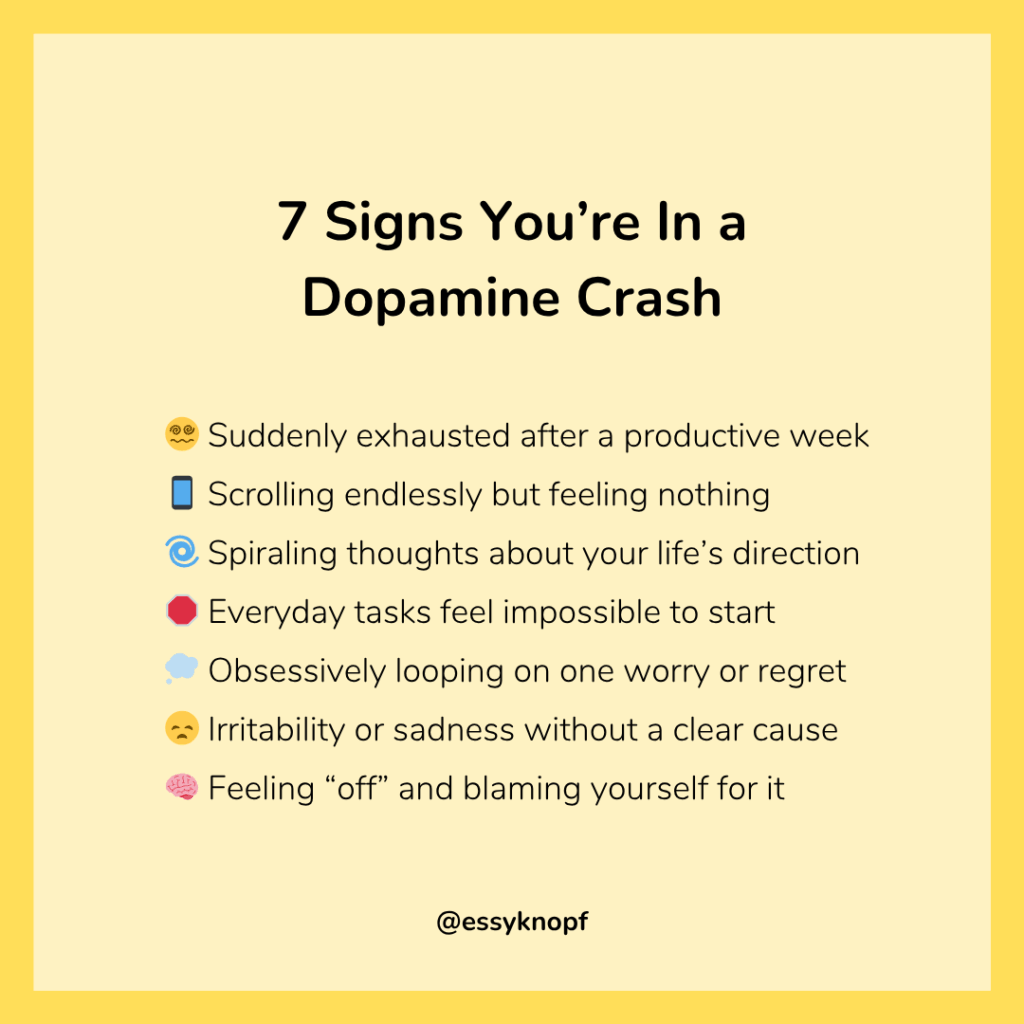
The crash involves a full-body, full-brain shutdown that can leave you feeling hollow, heavy, or like someone pulled the plug on your internal power source.

You might suddenly find everyday tasks insurmountable. Dishes, emails, even getting dressed can feel like climbing a mountain in fog. Your energy disappears without warning. Things you usually enjoy feel distant, lifeless. You might lie in bed for hours, not sleeping, just stuck. Maybe you scroll endlessly or start a show, only to abandon it minutes later. Nothing satisfies.

And then, as if on cue, the self-criticism kicks in: You’re lazy. You’re failing. You’re wasting your life. You start to panic.

This is the dopamine crash. I have described it as a neurological rubber band effect: your brain, after being stretched to its limit with constant stimulation, snapping back into depletion.

For many, this happens on weekends. You’ve over-functioned all week, masking distress, pushing through executive dysfunction, sprinting on fumes. And when the structure disappears? So does your ability to function.

I call it the “post-work plunge.” You spend the week sprinting through treacle, doing everything you can to keep up. Then Saturday hits… and you drop. You hit a wall. The quiet becomes a void, and the void becomes unbearable.

In response, you might instinctively self-medicate with dopamine sources, like junk food, social media, and retail therapy. But instead of feeling better, you often feel worse. Because what your brain needs is recovery, and not more stimulation.

And yet, the worst part might not be the crash itself, but what you tell yourself about the crash. That it means something’s wrong with you. That you’re broken. That everyone else is managing life better.

But this is a pattern—a neurological, predictable pattern. And if you can name it, you can start to break the shame that feeds it.
Essy Knopf dopamine crashes

Perseveration: When the Brain Won’t Let Go

If dopamine crashes set the stage for emotional spirals, perseveration is what keeps you stuck in the loop.

Perseveration is that sticky, relentless mental looping where your brain grabs onto a thought and won’t let go. Like chewing on the same worry again and again, even when you know it’s hurting you. Even when you desperately want to stop.

Maybe it’s a fear: What if I never get my life together? Maybe it’s a regret: I shouldn’t have said that. I ruined everything. Maybe it’s a judgment: I’m a failure.

You might know rationally that it’s just a thought. But in that moment, it feels like truth. It feels urgent. Like your brain is trying to solve something, except it’s a puzzle with no solution. Just an infinite loop.

Perseveration is especially brutal during a crash, because your cognitive defenses are already down. Your dopamine is depleted, your executive function is compromised, and your emotional regulation is offline. So when your brain reaches for something to make sense of the discomfort, it often grabs the worst possible narrative, and hits replay.

It’s also deeply physical. Your stomach might tighten. Your chest may ache. Your thoughts blur into background static, except for that one thought, sharp and loud and impossible to shake.

Trying to fight it often makes it worse. Trying to logic your way out? Exhausting.

Perseveration is a symptom of neurodivergence, and often of a nervous system in distress. Of a brain trying to regulate without the chemicals it needs.

So What Helps?

If you’ve seen yourself in these patterns—dopamine crashes, endless inventories, work spirals, perseveration—I want you to know this: you’re navigating a complex, beautiful, and often misunderstood brain in a world that rarely supports how it functions.

This isn’t about trying harder. It’s about trying differently. Supporting your nervous system instead of shaming it. Creating structures that prevent the crash, or soften the fall.

Here are some strategies that can help:

1. Recognize the Pattern

Begin by noticing when the crash tends to hit. Is it after a long week? After finishing a big project? On slow Sunday mornings? Write it down. Track it. See if you can spot the rhythm. This awareness doesn’t stop the crash—but it gives you a foothold in it. It reminds you: This is a cycle. It’s not permanent.

2. Reframe the Narrative

When the Inventory starts, try to pause. Remind yourself: These thoughts might be a chemical response, not an existential crisis. You’re not forbidden from having needs or growth edges. But maybe this isn’t the best moment to decide your life needs a total overhaul. Let your brain recover before trying to interpret what it’s telling you.

3. Schedule Balanced Downtime

Free time doesn’t have to mean empty time. Try building a soft structure into your rest: a planned phone call, a favorite café, a slow walk with music. Include some low-key novelty. I like to mix things, such as video games for engagement, and a casual hangout for connection. It’s like scaffolding for your nervous system.

4. Set Limits on Work

Especially if work is your main dopamine source, boundaries are essential. Start small: no work emails after 7 PM. No “just checking” something on weekends. This boundary will feel uncomfortable at first. You’ll feel the pull to check, to do, to prove. But over time, your system will learn: I can rest and still be okay.

5. Use the “Many Mountains / Many Irons” Strategically

Not all multi-tasking is bad. Not all ambition is avoidance. The key is intention. Ask yourself: Which mountains energize me? Which irons actually nourish me? Are you building something meaningful, or just trying to outrun the crash?

6. Consider Medical Support

For some people, stimulant medication (under medical supervision) can significantly reduce the intensity of dopamine crashes. If this resonates, speak with a neurodivergent-aware psychiatrist. The goal isn’t to “fix” you. It’s to support your brain in functioning with more ease.

7. Mindfulness & Self-Compassion

Practices like journaling, movement, or breathwork can help you stay present and interrupt loops. But more than anything: be kind to yourself. When you crash, don’t ask, What’s wrong with me? Try asking, What does my nervous system need right now?

Sometimes the answer is stimulation. Sometimes it’s stillness. Sometimes, it’s just softness.

Final Thoughts: There’s a Name for This

If you’ve ever found yourself spiraling the moment life slows down—if rest feels more like a breakdown than a break—you’re not imagining it. You’re likely experiencing the very real, very misunderstood phenomenon of dopamine dysregulation.

This isn’t a personal failing. It’s not a sign that you’re too sensitive, too dramatic, or too lazy. It’s a reflection of how your brain is wired, and how hard it’s working to keep you upright in a world that doesn’t always meet your needs.

When we understand this, something powerful happens: we stop blaming ourselves. We start noticing patterns. And from there, we can create rhythms that honor our neurotype, where stimulation doesn’t have to lead to burnout, and rest doesn’t have to lead to collapse.

This is the work of self-understanding. Not pushing through, but tuning in. Building a life where you don’t need to chase productivity to feel okay. Where rest is allowed. Where balance is possible, even if it looks different for you than it does for others.

You don’t have to live at the mercy of the crash. You can learn to soften it. To ride it out. To meet it with compassion, instead of panic.

What does your crash look like? How do you notice it starting—and what helps you navigate it?

Neurodivergent perseveration: When your brain won’t let go (and how to gently take the wheel back)

Essy Knopf neurodivergent perseveration
Reading time: 3 minutes

Ever feel like the hardest part of a tough situation… is what your brain won’t stop saying afterward? That, my friend, is neurodivergent perseveration.

It’s the sticky, looping thought patterns that so many of us—especially those who are autistic and ADHD—struggle with. Even after the moment has passed. Even when nothing went “wrong.”

Let’s unpack what neurodivergent perseveration actually is, how it shows up in everyday life, and what you can do when your brain just won’t let something go.

What Is Neurodivergent Perseveration?

It’s a kind of overthinking that doesn’t feel optional. It’s when your brain gets stuck on a thought, a fear, or a regret, and keeps chewing it over long after it’s helpful—or relevant.

It’s common in both autistic and ADHD brains, and often shows up as:

  • Worry – Spiraling about the future. “What if I mess this up?” “What if they hate me?” It’s that anxious preparation that never leads to peace—only paralysis.
  • Rumination – Replaying the past. “Why did I say that?” “I always ruin things.” It’s not reflection—it’s self-punishment.
  • Obsessions – Intense mental fixations. These are sharp, intrusive thoughts that won’t quit, whether or not they’re based in reality.

Sometimes they overlap, feeding into each other in a cycle that feels impossible to break. That’s the heart of neurodivergent perseveration.

Everyday Examples

  • You go on a date, and afterward your brain spirals with analysis: “Did I talk too much? Did they think I was weird?” → Rumination
  • You get neutral feedback at work and suddenly you’re spiraling: “They hate me. I’m going to be fired.” → Obsessive thinking
  • You’re about to leave the house but can’t stop worrying: “What if I forget something? What if I crash?” → Worry

For many autistics, perseveration can focus on social interactions, routines, or sensory experiences. For ADHDers, it often revolves around inaction, overstimulation, or rejection sensitivity.

But however it shows up, the result is the same: your brain is working overtime, and you’re not getting anywhere.

Why Does Neurodivergent Perseveration Happen?

Because your brain is trying to protect you. It’s looking for certainty, for control, for relief from shame or fear. But it’s like revving your engine in neutral—it makes a lot of noise but doesn’t take you anywhere.

What makes it so tricky is that it feels productive. You think, “If I just figure this out, I’ll feel better.” But you rarely do. That’s because the real driver isn’t logic—it’s emotion. Often, shame is riding shotgun.

Shame Is the Fuel That Keeps the Loop Spinning

If you’ve been misunderstood, corrected, or rejected your whole life, your brain starts expecting that kind of treatment. So any small mistake becomes a “confirmation” that you are too much, too different, too wrong.

Neurodivergent perseveration becomes a punishment loop. Not because you need to learn from something—but because you feel like you need to pay for it.

That’s not learning. That’s trauma.

Essy Knopf neurodivergent perseveration

What Helps Break the Perseveration Loop?

Let’s be real: you probably won’t stop all neurodivergent perseveration. But you can start unhooking from it. Here’s how:

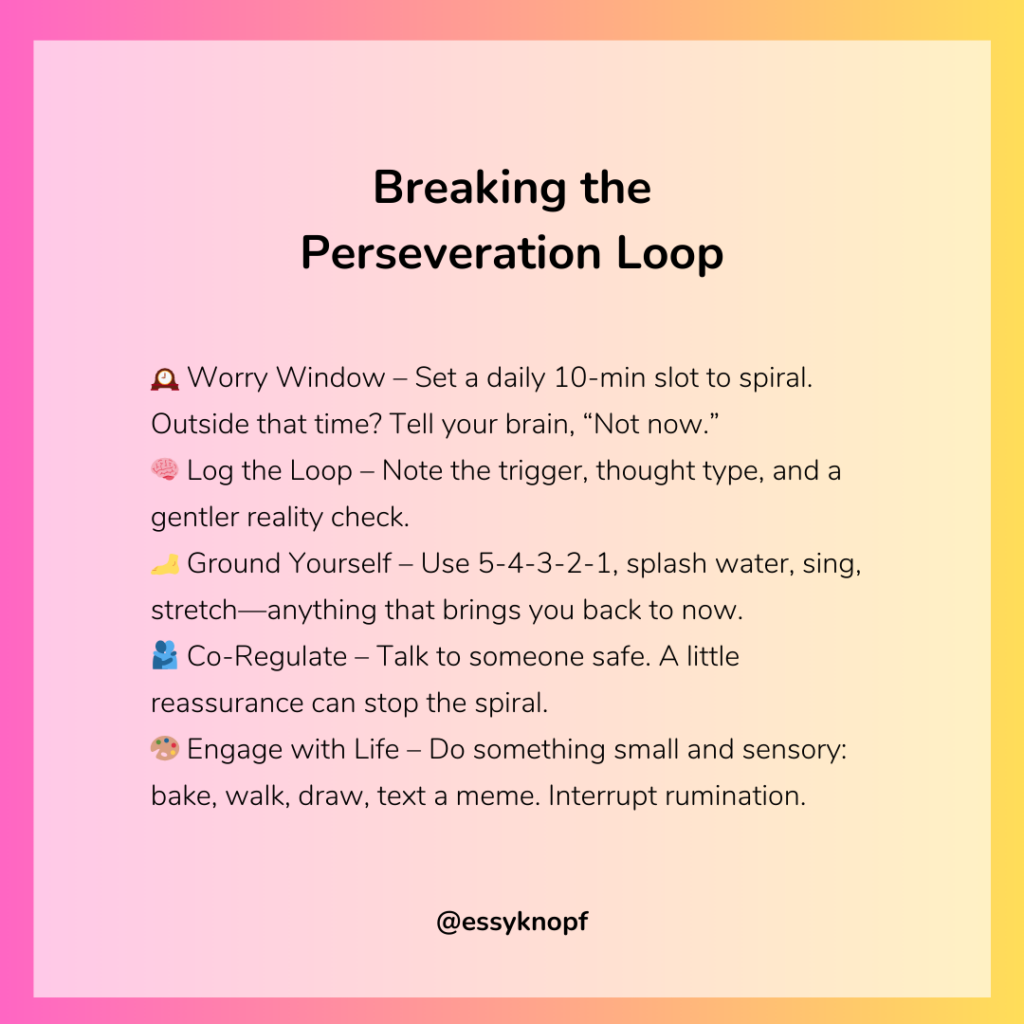
🕰 Schedule a “Worry Window”

Set a 10-minute slot each day. That’s when you’re allowed to spiral. The rest of the day? You tell your brain: “Not now. Later.” Simple, powerful, and surprisingly effective.

🧠 Log the loop

Use a 3-part journaling tool:

  • Trigger: What started the thought?
  • Type: Is it worry, rumination, or obsession?
  • Reality check: What’s a gentler, more grounded perspective?

🦶 Ground yourself

Try 5-4-3-2-1 sensory grounding. Or splash your face with cold water. Or sing. Or walk. Anything that reminds you: “I’m here. I’m okay. I’m safe.”

🫂 Co-regulate

Ask a trusted friend: “Can I run something by you? I think I’m spiraling.” Even one reassuring response can interrupt the pattern. You don’t have to do this alone.

🎨 Engage with life

Neurodivergent perseveration thrives in inactivity. So do something—even if it’s small. Bake. Color. Move. Send a meme. Let life anchor you.

The Heart of It: Your Brain Thinks Perseveration Will Keep You Safe

It says: “If I think this through enough, I can avoid the pain.” But often, the overthinking is the pain.

So here’s your gentle reminder: You don’t need to control every variable. You don’t need to think your way out of every fear.

You can pause. You can breathe. You can say: “Thanks, brain. I know you’re trying to help. But I’ve got this now.”

That’s the real antidote to neurodivergent perseveration—not perfection. Not certainty. But self-trust.

Have you noticed patterns of perseveration in your own life? What helps you unhook from the loop—or what makes it harder?

Overcoming social anxiety as a neurodivergent

Essy Knopf social anxiety
Reading time: 2 minutes

If you’re autistic or an ADHDer, chances are you’ve struggled with social anxiety—not the average nerves before a party, but the kind that can feel paralyzing. The kind that makes you rehearse conversations in your head for days or avoid even basic interactions out of fear of rejection or judgment.

And that fear is often rooted in lived experience. For many neurodivergents (NDs), social anxiety isn’t just about being shy—it’s the result of a lifetime of being misunderstood, criticized, or excluded.

So we learn to mask. We mimic, edit, and shrink ourselves to appear more “normal.” But this constant self-monitoring takes a toll on our mental health and our self-worth.

Why Social Anxiety Runs So Deep for Us

ND brains often process social information differently. We may miss subtext, struggle with timing, or communicate in ways others find too blunt or too intense.

These differences can lead to painful interactions where our intentions are misunderstood. Instead of grace, we get correction—or worse, exclusion. Over time, these experiences hardwire fear into our brains. Social anxiety becomes a survival response.

Add rejection sensitivity into the mix, and even small missteps can feel catastrophic. It’s no wonder many of us would rather stay home than risk getting it wrong again.

The Trap of Avoidance

Avoiding social situations might feel like relief in the moment—but it also reinforces social anxiety over time. We lose the chance to practice, to build tolerance for discomfort, and to develop confidence.

The less we engage, the more our fears grow. Eventually, even a simple interaction—like saying hello to a cashier—can feel overwhelming. And when we do brave the social world, the pressure to get it “right” makes it hard to be present or authentic.

Essy Knopf neurodivergent social anxiety

Modulating Is Not Masking

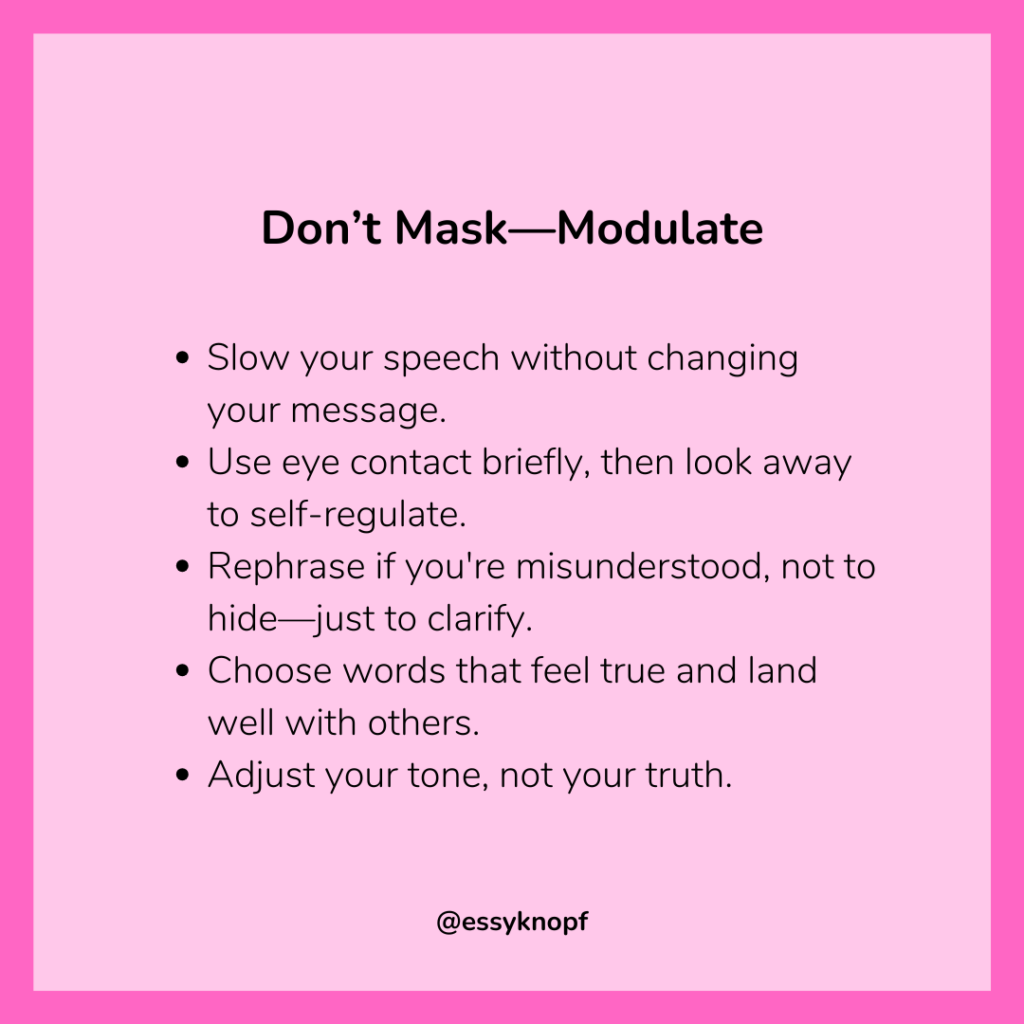
What’s the alternative? Modulation. It means learning to adjust your communication style without erasing yourself. Think of it as picking up a second language—you don’t abandon your native tongue, but you gain a tool that helps you connect more effectively.

By practicing modulation, you can reduce social anxiety without compromising your authenticity. You’re not pretending—you’re expanding your skills.

Progress Starts Small

Start with manageable social risks. Say “hi” to someone in your building. Practice making small talk in a low-pressure setting. Try a new activity that nudges you out of your comfort zone—like a class or club—where socializing is structured and shared.

And yes, mistakes will happen. But with each interaction, you build resilience. You teach your brain that social anxiety doesn’t have to be a stop sign—it can be a signal to slow down, breathe, and move forward anyway.

Reclaiming Your Confidence

Every ND deserves to feel confident in their ability to connect. That doesn’t mean faking it forever—it means learning what works for you and giving yourself permission to show up, imperfectly but bravely.

So this week, try one small thing that challenges your social anxiety. And when you do, celebrate the effort—not just the outcome.

Have you found ways to manage social anxiety that work for you? Let me know in the comments.

Why setting limits as a neurodivergent person is crucial

essy knopf low self esteem
Reading time: 7 minutes

Disrespectful people, pushy people, abusive people—chances are all of us have at one point in our lives encountered them.

Sometimes we skate by, unharmed. Other times, we’re left with a sour taste in our mouths, bruised feelings, and a sense of injustice.

We may start to think that we’re being actively targeted because of our being autistic and/or ADHD. And the sad truth is we might be entirely correct.

Underdeveloped social skills are a common neurodivergent (ND) trait. Not only does this mean many of us struggle to make and keep friends—but it also means we lose out on the many protections friendship can afford.

NDs may also struggle to understand when someone is or isn’t being their friend. For example, autistics have been found to have a more deliberative (and effortful) thinking style that impacts their ability to rapidly and automatically intuit others’ intentions.1

When we experience bullying and manipulation, we may not only fail to understand what’s going on until it’s too late—we may also struggle to stand up for ourselves.

Often, this is because we suffer from low self-esteem, which is a byproduct of living in an ableist society.

Low self-esteem: a recipe for exploitation

Society constantly sends NDs signals that we are defective, unworthy, and unloveable.

Many of us are criticized for thinking or behaving differently. We’re told we’re are too honest, too blunt, too insensitive, too difficult to follow, too spacey, too weird.

It’s dismissals and criticisms like this that leave us prone to self-doubt and undercuts our ability to be self-reliant.

Thus, when confronted with difficult situations, we second-guess our own feelings and thoughts, spiraling into helplessness. We struggle to find the courage to speak our feelings of pain and anger.

This is because we are fighting two battles. The first is the battle to validate and accept our perceptions of the situation at hand.

When we are taught by NTs that our very frame of reference is invalid, allowing ourselves to believe what we know and feel to be true can conjure guilt, shame, discomfort, and anxiety.

The second battle involves standing up and demanding respect. For NDs, that respect is often denied us. Neurotypicals (NTs) refuse to hear us out, thus creating and reinforcing our negative core belief of unworthiness.

There is also the concern that if we do advocate for ourselves, the other person may retaliate. The penalties can be especially severe if that person occupies a position of power, as is so often the case with bullies, abusers, and manipulators.

There is always the possibility that we will be heard. The person who has aggressed against us may listen and adjust their behavior.

Those who harbor ill intentions may decide that we aren’t worth the effort after all, and move on.

Should we fail to adequately set limits, these toxic individuals will likely linger. And if you’re dealing with someone with a taste for manipulation, they won’t surrender control so easily. 

There’s always the possibility they may redouble their efforts, using deflection and personal attacks in the hopes of sapping your resistance.

In these instances, standing up for one’s self can feel possible. But keeping ourselves safe begins with knowing when and how to say “no”.

The seven ‘buttons’ used by bullies, abusers, and manipulators

In Who’s Pulling Your Strings?, Harriet B. Braiker describes seven behavioral “buttons” that difficult people routinely press to pressure and coerce their victims.

It is only by becoming aware of those buttons, Braiker argues, that we can resist manipulators’ control tactics.

1. The disease-to-please: People with this challenge have made their self-worth conditional upon others’ acceptance. Sound familiar?

People-pleasers typically say or do whatever they think is necessary to garner’s approval. How do we beat this habit? By flipping the script.

Start by saying and doing what is authentic and feels right to you.

2. Approval and acceptance addiction: Are you overly nice? It’s common for NDs to overcompensate in order to avoid rejection and abandonment.

Manipulators are known to leverage this fear, withdrawing approval and acceptance to force you into complying with their demands.

If this happens, roll with it. You can’t control whether or not someone decides to write your name in their “good books”.

3. Fear of negative emotions: As an ND, you may often experience anger and sadness and yet deny yourself full expression, so as to de-escalate, avoid conflict, and protect other people’s feelings.

But expressing negative emotions in many cases is justified. If someone punches you in the arm, you have a right to cry out in pain and anger.

You also have a right to tell them how they’ve hurt you and to demand an apology or restitution. If you don’t make it clear to the other person that their behavior is unacceptable, if you don’t clarify your expectations regarding their behavior going forward, it’ll likely continue.

Avoiding and burying your negative emotions means the limit won’t be set, and you’ll be left wide open to a second attack.

4. Lack of assertiveness: People-pleasing as I’ve noted can be a common trait among ND folks, and one often preyed upon by manipulative individuals.

If this is something you struggle with, flex your assertiveness muscles. State your needs and make clear requests. Make it a daily practice. Little by little, you’ll learn to stand up for yourself.

5. The vanishing self: ND folks may have an unclear sense of identity and core values. This is because everything they are and believe in is assaulted by ableist society and NTs on an almost daily basis.

Ableist society wants us to believe that our opinions don’t count and that invisibility is the only way we’ll ever be accepted.

We can start to push back on this by self-advocating. Prioritize your own needs and desires before a manipulator can convince you to prioritize theirs. 

6. Low self-reliance: Ableist society tries to convince NDs that their entire way of being is inherently wrong. It teaches us that the only way to acceptance is through conformity.

This can lead to disorientation and dependency. But so long as we are relying wholly on the input and advice of others, rather than what we ourselves know to be true, we remain vulnerable to manipulation.

Recognize that the only perspective that ultimately matters is your own. The life you choose to design for yourself should not be according to someone else’s specifications. It should be according to your own.

7. External locus of control: Those with an external locus of control believe that forces outside of themselves are ultimately responsible for determining the course of their lives.

No surprise that many of us should feel this way, given how what is and isn’t acceptable is so often determined by NTs.

By reclaiming the right to decide for ourselves, we can recenter the locus of control within our own hearts and minds.

Essy Knopf low self-esteem victimhood

From low self-esteem to high self-esteem

Bullies, abusers, and manipulators as I’ve already discussed love to take advantage of folks with low self-esteem, which their victims in turn take as confirmation that they deserve this kind of treatment.

Self-esteem, you could say, is in some ways relational. Others can either damage it, or they can assist with its repair. Seeking a trusting, supportive relationship with a therapist or loved one is one way we can heal our sense of self-worth.

Regardless, the task of pushing back against manipulators will ultimately fall to us. Confrontation, however frightening, is sometimes necessary. And sometimes, it may be as simple as making explicit requests. 

“I” statements are helpful here. For example, “I feel disrespected when you name-call. I’m asking that this behavior stop.”

Remember, you have a right to make reasonable requests and for them to be acknowledged. You are under no terms required to explain or defend yourself.

What you want when confronting a manipulator is a commitment to change. Make it a win-win proposition: “Respect me, and our interaction/relationship can continue.”

If, however, the other person won’t accept an outcome short of win-lose, lose-win, or lose-lose, be prepared to pivot.

Try these magic phrases

Some aggressors respond to feeling threatened by double-downing or escalating. This may take the form of deflecting, projecting, shaming, verbal abuse, and overly dramatic reactions.

Know these individuals may try to confuse the issue, gaslight you by playing the victim, and/or evade any responsibility. Many even feed off conflict, and anything you say or do that plays into this will count as a win in their books.

Be sure to name any attacks on your person the instant they happen. Send a clear message to the aggressor that you won’t stand for this treatment. 

Hold fast to your conviction that no harm has been done by your speaking up. Your goal here is to protect yourself, not the manipulator’s feelings—which probably weren’t in jeopardy to begin with.

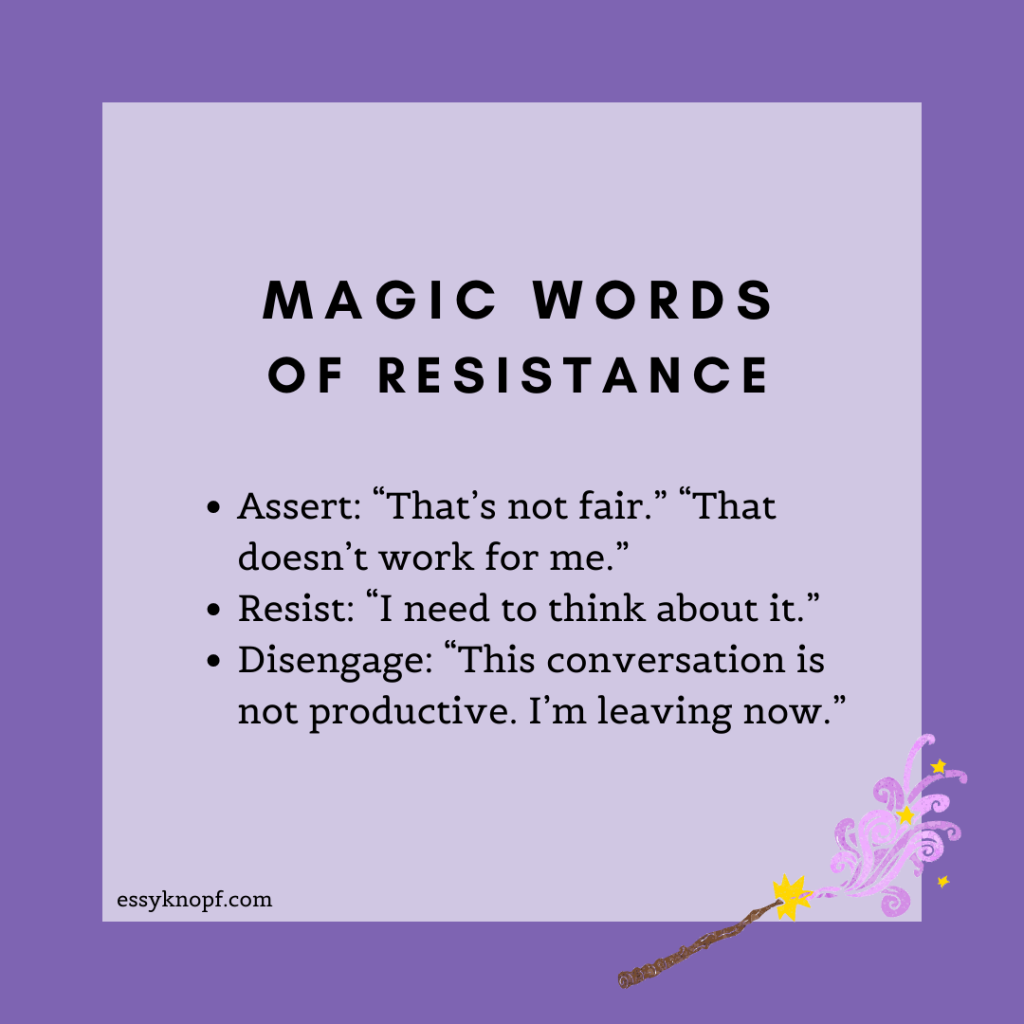
Do not be drawn into a point-for-point debate. Instead, assert yourself by saying: “That doesn’t work for me.” “That’s not fair.” 

Resist any attempts by the manipulator to wrangle for control by delaying your response by asking for time. For example, “I need to think about it.”

If they try to force an argument, disengage: “This conversation is not productive. I’m leaving now.” 

If you’re feeling thrown off balance by the manipulators’ tactics, it’s okay to break off the exchange completely. Tell them: “Actually now is not a good time.” A straight “no” will even suffice, followed by your departure.

And it’s perfectly acceptable to shut down the lines of communication until the other person agrees to follow rules of common courtesy.

If you’d like to try out some of these lines but are worried you might fumble the delivery, practice them by yourself or roleplay with a friend until you feel 100% comfortable saying them on cue.

Reappraising low self-esteem

These kinds of situations and encounters can inflame existing feelings of low self-worth. Address this head-on by checking in with yourself immediately afterward.

How are you feeling about what just went down? Were you fair in your conduct? Did you really behave unjustly, as the manipulator would have you believe? 

Imagine for a moment it was your friend making the same request you just made. Would you have listened to them? Would you have been open to change? If your answer is “yes”, then it’s reasonable to assume that it was a fair request.

The bully may accuse you of being equally at fault, but what they are probably trying to do is shift the blame. Refuse to take on any of their accusations.

Also, consider conducting an inventory of your alleged character flaws and using humor to inflate them. Have you, for example, failed to be perfect enough? Are you insufficiently conscientious? Are you an extremely poor people-pleaser? 

Now try to name some appropriate punishments for these crimes. If the ridiculousness of it all doesn’t stop you in your tracks, then take it as proof that it is you—above all—who deserves the break. 

If these encounters leave you feeling stressed, consider practicing some of these self-care techniques, specifically devised for ND folks.

So what is autism, exactly?

Essy Knopf autism spectrum disorder
Reading time: 8 minutes

What is autism spectrum disorder? To fully understand this phenomenon, we have to employ the medical model.

Big disclaimer: the medical model is far from perfect.

According to this model, there is something inherently wrong with autistics. Historically, this rationale has also been used to marginalize and oppress us.

For most people, the social model is preferable, as it argues that the issue lies not with neurodiversity, but with society’s failure to accommodate it

The social model aims to destigmatize autism, whereas the goal of the medical model is to diagnose and treat.

Pathologizing aside, getting an ASD diagnosis can open the door to disability-related legal protections, supports, and services. This is one example of how the medical model can be of use to those with autism, and their loved ones.

So, what is autism spectrum disorder?

According to the Diagnostic and Statistical Manual of Mental Disorders 5 (DSM-5), autism spectrum disorder (ASD) is a neurological developmental disability.

Autism is characterized by ongoing deficits in social communication and social interactions in a range of contexts. Other criteria for autism include “restricted, repetitive patterns of behavior, interests, or activities”. 2 3

Autism symptoms manifest in the early development period and typically cause clinically significant impairment in key areas of functioning. 

To receive a diagnosis of ASD, these symptoms must not be better explained by the presence of intellectual disability or global developmental delay.

A diagnosis of ASD is typically accompanied by a severity measurement of “Level 1”, “2”, or “3”. Level 1 means the individual requires some support, Level 2 substantial support, and Level 3 very substantial support.

(Remember how I mentioned the medical model is pathologizing? An example of this is the DSM-5 terminology I just used, such as “disability”, “deficits”, “symptoms”, “impairments”, and “severity”.)

Autism often appears alongside other conditions, such as epilepsy, attention-deficit/hyperactivity disorder, sleep problems, gastrointestinal symptoms, anxiety, and depression.

Who gets diagnosed with autism spectrum disorder?

Males are diagnosed with autism at three times the rate of females, but this doesn’t necessarily mean autism isn’t as common among females.4

One study found that autistic females as a population are better than males at hiding their autistic traits. This results in fewer diagnoses, later diagnoses in life, and misdiagnoses. 

It’s also been argued that autistic females may present autism in a way different from their male counterparts.5 And due to many measurements being male-centric, females may be overlooked by current diagnostic measurements.6

Additionally, autistics from racial minority groups are typically less likely to receive a diagnosis of ASD.7 Instead, they are more likely to receive other diagnoses such as ADHD and conduct and adjustment disorders.8

Many conclude that reflects medical disadvantages experienced by minority groups as a result of structural inequality.9 But it’s important to note that autism traits can also go overlooked or can be misinterpreted, depending on the sociocultural context. 10

Why are some people autistic and others not? 

There are no clear answers here, however, some studies point to a range of environmental risk factors and protective factors. 

These include advanced parental age, low birth weight,11 12 fetal exposure to the epilepsy medication valproate,13 intake of certain vitamins,14 maternal autoimmune disorders, environmental toxins, and breastfeeding.15

Links have been made between unique gut microbiota compositions and the development of autism. Other studies have indicated strong genetic influences, concluding that autism is highly inheritable.16 17 18

How does one get an autism spectrum disorder diagnosis?

To get an autism spectrum disorder diagnosis, you need to be screened by a trained professional. 

For children, there’s a range of tools. For example, the Modified Checklist for Autism in Toddlers Revised, the Ages and Stages Questionnaire, and the Screening Tool for Autism in Toddlers and Young Children.19 20 21

For older adolescents and adults, the gold standard for autism diagnoses is the Autism Diagnostic Observation Schedule (ADOS-2) module 4.22 Professionals typically use this tool alongside direct observations and taking patient history.

The Autism Diagnostic Interview-Revised (ADI-R) is another gold standard autism diagnostic tool that is suitable for both children and adults.23

Again, I want to point out here that these diagnostic tools may be gender-biased and thus more likely to detect male autistics than female autistics.

When seeking out a diagnosis, it is worth checking to see that the person doing the assessment is using the most current, research-backed screening measures.

If seeing a professional is not an option, adults can also use self-reporting tools such as the Social Responsiveness Scale, Second Edition: Adult form (SRS-2).24

Additional tools are available for assessing how autism is impacting one’s activities of daily living and quality of life.

How is autism spectrum disorder “treated”?

There is no biomedical treatment for autism spectrum disorder, however, psychotropic medications are available and often prescribed for those who are experiencing symptoms such as anxiety or depression.25 26 27

For autism specifically, there is a range of therapies, the most commonly used being Applied Behavior Analysis (ABA).28

ABA is designed to help autistic children with the development of social, communication, and expressive language skills.

The dominant strain of ABA has been heavily criticized by autism advocates for violating individual autonomy and even doing direct harm to clients.29

Critics have also pointed out that there are conflicts of interest among researchers who publish scientific literature in support of ABA as an autism intervention.30

Clearly, there is room for improvement when it comes to current ABA intervention. However, ABA is one of the few treatments that remain widely accessible. 

In many US states, health insurance providers are required to cover ABA-related expenses under the Patient Protection and Affordable Care Act.

One alternative to mainstream ABA is Naturalistic Developmental Behavioral Interventions (NDBI). NDBI is more child-directed and provides intrinsic rewards for learning and participating.31

Other available interventions support the development of core skills among autistic children, such as social communication.32

Additionally, programs exist for young adults, such as the Program for the Education and Enrichment of Relational Skills (PEERS®).33

For autistic young people and adults, psychotherapies such as Cognitive Behavioral Therapy are recommended for those who experience comorbidities such as anxiety and depression.34 35

These are available in both individual and group formats.36

Wrap up

So there you have it, my brief introduction to autism spectrum disorder.

Again, I want to stress that much of the content I shared is presented using the medical model. 

But remember: viewing autism exclusively through this lens is not only limiting—it also fails to give consideration to some of the strengths of being neurodiverse.

Check this blog post to learn a little more about some of the benefits of being autistic.

Trauma recovery begins when denial, repression, and dissociation end

Essy Knopf trauma recovery
Reading time: 4 minutes

The first proof of my trauma recovery was the return of memories once thought lost.

In the years after I started my therapy journey, I would find myself going about my business—walking my dog, showering, or driving to an appointment—only to be suddenly ambushed by recollection. 

Usually, these memories came to me in fragments: an odor, a feeling, a face, or a conversation.

I’d remember my excitement playing Link’s Awakening for the first time on my Gameboy Color. Or maybe I’d recall my late aunt’s tuxedo cat, Sylvester; the mockery of a snub-nosed boy in sixth grade.

Sometimes, I’d hark back to my first glimpse of the technicolor shells of iMac G3 in a school computer lab; the fantasies of collecting one of each “flavor”: Bondi Blue, Strawberry, Lime, and Tangerine. 

Other times, I’d wax nostalgic about the rain rattling the tin roof of the family home or the particular smell of the department stores my mother would like to spend hours wandering in search of sales.

Now and then, I’d think fondly of the moments spent loitering at the local newsagent, thumbing through copies of PC Powerplay and Nintendo Power magazines, dreaming about one day owning all the latest gaming consoles.

With each of these memories came emotions, often in a big jumble: longing and regret, as if for something lost, bittersweet joy, and sadness. 

A past rediscovered: the start of trauma recovery

When I think of time, I think of years, represented as a series of three-dimensional bar charts. Each bar represented a different month, arranged in a stair-like formation.

At the end of the month, I would imagine myself ascending a new bar, continuing until I had arrived in December, before moving on to the next chart behind it.

After my traumatic experiences, when I tried to peer back to the charts that had come before, my recall became hazy and my brain seemed to actively resist the effort.

If memories are like snapshots, all that was left to me were the countless throwaways that were returned to us when my family got our photos developed.

Always there were four or five shots that were to be out of focus. Sometimes a thumb was blocking the lens, or the flash of our disposable camera had blown out the image.

But the snapshots that now came to me, sealed for over 25 years inside some protective, internal vault, had all the vivid clarity of the present moment.

Puzzling as I was by this return, I was equally puzzled by the timing. The fragments were random and unconnected to my current circumstance. Just what was going on?

A sign of healing

For decades, trauma had strip-mined my consciousness of all evidence of my past; of memories both pleasant and painful.

Now, I was starting to amass a sizable collection. But having no idea what to do with them, I consigned them to a mental storehouse for later review.

Then, during one particularly humid summer—a summer that reminded me far too much of those of a childhood spent in the tropics—I was inundated by a wave of these memories, leaving me both bewildered and melancholic. 

“I just don’t understand,” I said during one therapy session. “Why am I remembering all of this?”

“It sounds like you’re healing,” my therapist replied, trying to normalize what to me felt painfully abnormal. 

“But why? What function does this serve?” I asked through my tears. “Why now? I just want to understand.” 

What I wanted was a cut-and-dry explanation for what is, for everyone, a messy and unpredictable recovery process. 

Therapists liked to call this behavior “intellectualizing”. In my case, I was trying to bypass an emotional experience by using my intellect. 

This “ego defense” was one I had depended upon for years to cope with my trauma. It was also one of the key obstacles to my healing. 

Reintegration: the beginning of trauma recovery

So rather than resisting the wave, I rode it, allowing the memories and emotions they conjured to come and go.

Soon after, I embarked upon a single-minded hunt for various articles from my childhood. 

This involved preparing a playlist containing every memorable song of the 90s and the early aughts. Next, I put together a book list containing every title my teen self had read. 

After this task had been completed, I hunted down scans of the magazines I’d once flipped through and the illustrated video game guides and manuals I’d once savored during long car trips.

Often, my searches did not culminate in any action; I didn’t always listen to the music or consume this reading material. 

Instead, I found a strange comfort in the fact I once more had possession of these formerly lost relics from my past.

This obsessive collecting on my part I realized was an outward expression of an internal process: reintegration.

The part of myself I had once cut off was returning piece by piece, and I was searching for props to help facilitate its assembly.

I was working, in my own way, towards a whole, coherent narrative of self and past.

Overcoming denial, repression, and dissociation

In the words of author Judith Herman’s seminal work, Trauma and Recovery:

“The goal of recounting the trauma story is integration, not exorcism.”37

Herman goes on to explain:

Remembering and telling the truth about terrible events are prerequisites…for the healing of individual victims. The conflict between the will to deny horrible events and the will to proclaim them aloud is the central dialectic of psychological trauma. But far too often secrecy prevails, and the story of the traumatic event surfaces not as a verbal narrative but as a symptom. Denial, repression, and dissociation operate on a social as well as an individual level.

Undertaking therapy allowed me to finally release the taut knot of my trauma survivor psyche. And with that release had come recollection—not just of traumatic events, but everything in between.

Memories in turn triggered “floods of intense, overwhelming feeling”, which proved wholly alien to me after years spent dwelling in the “extremes of amnesia…and arid states of no feeling at all”.

I was not in crisis; I was in a state of trauma recovery. And in order to complete that recovery, I would have to let go of the three skills that had permitted my survival through alienation from my own self—denial, repression, and dissociation.

When one cannot escape a reality in which one feels threatened and powerless, one finds ways of adapting. 

I too had once acted as if nothing had happened, ignoring my emotions, burying memories, and mentally checking out when confronted by a frightening reality.

They had served an adaptive function. But maintained over time, they had caused the margins of my life to contract to a pinprick in which only survival is the only possibility, and never true flourishing.

This is a kind of living death; imprisonment in a psychological internment camp.

And now, finally, after years spent walking through a dim, gray limbo, I could see the possibility of a death revoked, and life renewed.

Why grieving the heteronormative life gay men were promised is okay

Essy Knopf gay men
Reading time: 7 minutes

You would think that as gay men, we shouldn’t be bound by the same life goals as our straight counterparts. 

Yet as much as we try to shuck off the expectations inherited from heterosexual living, many of us still continue to be burdened by them.

I remember as a child studying the greeting card stands at newsagents, noticing how certain birthday ages seemed to be assigned greater importance. 

“Thirty” was one of them: a perfectly rounded number signifying the transition to competent maturity. An expectational cut-off point for all the usual milestones.

Until my teen years, I harbored ideas about the life I would live. They weren’t necessarily my own, but rather the ones all boys were prescribed: a wife, kids, and a house in the suburbs. 

All of this, I somehow believed, I’d attain by the age of 30. But as my interest in other boys grew, I was eventually forced to surrender these signifiers of adulthood for the wicket picket fence dream they were. 

Thirty is, when you think about it, an arbitrary number. Life expectancies in the West have steadily risen. We live for much longer now, and our lifestyles have shifted to accommodate this. 

Couples are having families later, and a growing gap between income and real estate prices has rendered homeownership impossible for many.

Yet when my third decade rolled around, I couldn’t help but feel like something was missing. Not only had I clung to those old expectations – I also secretly believed my worth as a person depended upon their attainment.

I found myself scrutinizing the zigzagging missteps of my life, criticizing each and every false move. Maybe if I had stayed in one city and planted my roots somewhere, I’d have a wider, stronger circle of friends; possibly even a partner. 

Maybe if I hadn’t devoted most of my income to creative projects, I’d now have something approaching financial security. Maybe if I had kept my aspirations humble, I might have something more tangible than life experiences to show for it all. But to show whom, exactly?

I had lived what Passages author Gail Sheehy called the “wunderkind” life pattern, caught up in chasing risks and victories. I had deceived myself into thinking achievement would blot out insecurity, to discover that the victories I did achieve were ultimately empty. 

To quote one of the men interviewed by Sheehy: “I’m near the top of the mountain that I saw as a young man, and it’s not snow. It’s mostly salt”.

Gay men and the failure of dreams

What troubled me most was an unarticulated belief that in spurning the dependable comforts of home and family, I had failed and was now declining into a life of gay spinsterhood. 

I convinced myself that the connection and happiness I was seeking would forever remain out of reach. Everything I told myself to the contrary was just whistling in the dark. How’s that for a catastrophic spiral?

Life after 30 for some gay men is riddled with uncertainty. Society promised us one thing – then biology pulled the rug out.

Logging onto Facebook today, I see people I’ve grown up with buying homes, marrying, and having children. While they were hitting their life goals, I was like a wheel, spinning in the mud.

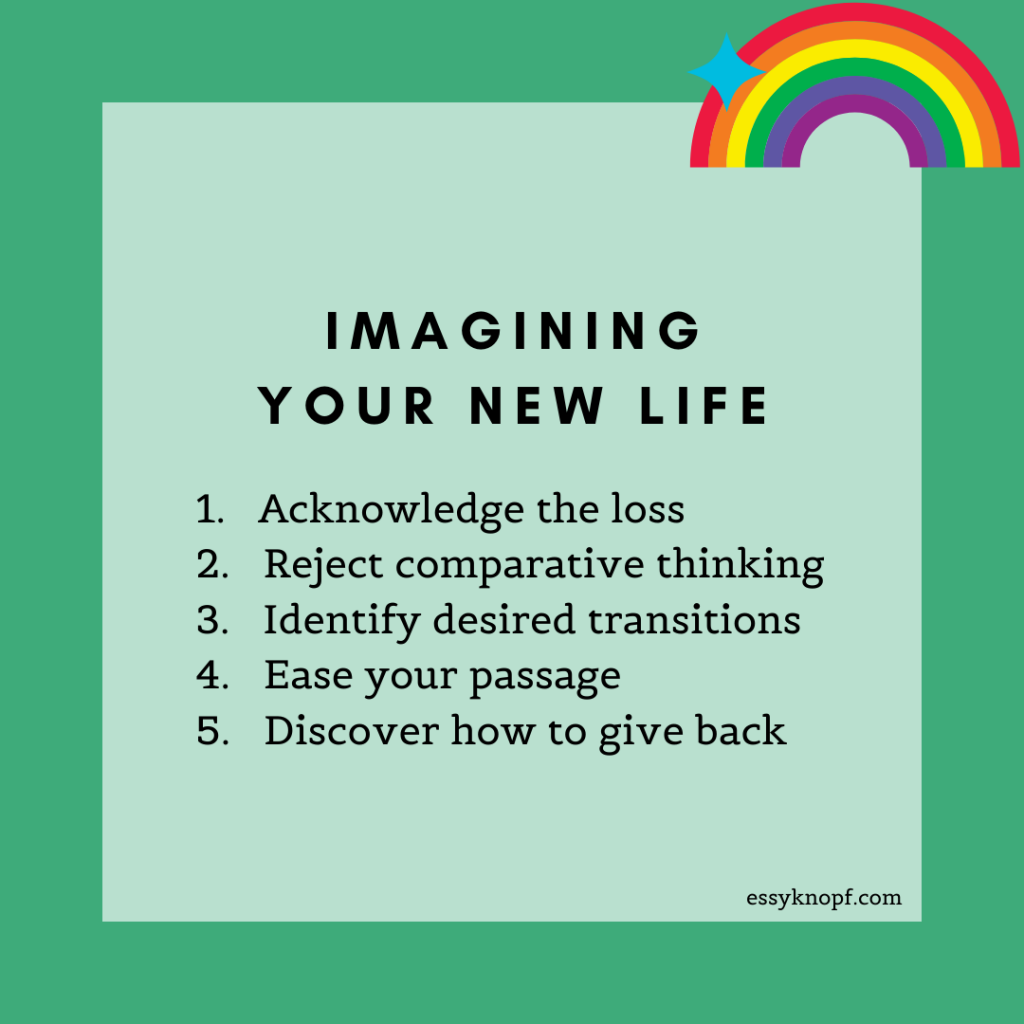
Resist comparative thinking

Comparative thinking is especially destructive where it comes to gay men. It does not acknowledge the fact that straight people have thousands of years of social tradition working in their favor. The modern gay community, on the other hand, is without precedent.

Worse still, in the spiritual teachings handed down to us, homosexual people are typically cast as undesirables living in the margins. There is little to no guidance offered to gay men committed to living an authentic, value-led existence.

Comparative thinking also fails to account for heterosexual privilege. Straight people by virtue of their sexuality don’t experience the specific kind of trauma, marginalization, and disadvantage we do. 

And let’s not forget the fact that many gay men in the West could not, at least until relatively recently, get married. No surprise then that we should struggle to achieve these life goals at a speed comparable to that of heterosexual men.

The journey faced by all gay men

Still, as we grow older, missing familiar life milestones along the way, some of us may find ourselves asking: “So that’s it?” 

We may flee our shame, grief, and dread, into the wilderness of material and sensual distraction.

For some gay men, however, these feelings are an opportunity to address the desires we once held for ourselves and begin the process of rewriting them.

In facing our supposed failings, we find we have no choice but to remove the yoke of social expectation. Those of us who make the journey through this valley of symbolic death will face the assailing winds of pain and doubt. 

But if we push on, we will most certainly emerge anointed with a newfound sense of personhood. For it is in the struggle that we learn to articulate our personal definition of a “life well-lived”. 

This journey does not simply involve grieving the things that could have or “should have” been: the children to whom we might have left our legacy, the symbolic safety that a life partner or a home offers. It also involves grieving the life that simply “is”.

For a long time, I pretended I was fine, that growing up as a gay man with a disability, suffering exclusion, bullying, the slow implosion of my family and the figurative loss of my parents had not affected me.

Attempting to escape the resulting depression and anxiety, I connected my sense of worthiness to striving and constant forward action. By setting milestones of my own making when those prescribed to me were no longer possible, I found purpose through achievement. 

But to value one’s self conditionally is to live conditionally. And living conditionally is a life defined by fear, not fulfillment. 

According to The Velvet Rage author Alan Downs, fleeing from pain into grandiosity is an almost universal behavior among gay men. Entering my 30s proved the tipping point in this regard. It was also an invitation to change. 

Entering the ‘neutral zone’

What I lamented when I turned 30 was the fact I had not fulfilled socially prescribed rites of passage. 

Rites of passage help mark the onset of new stages of life or social roles. Dutch anthropologist Arnold van Gennep defines each rite as having three stages:

  • Separation of the individual/group from the larger collective.
  • Transition from the old ways of existence to the new.
  • Incorporation of the individual/group back into the collective.

Gennep noted that during the transition phase, those making the journey will find themselves caught in a neutral zone, where they would remain until the change has been internalized. 

Transitions author William Bridge argues that completion of the middle step means letting go of “something that you have believed or assumed, some way you’ve always been or seen yourself, some outlook on the world or attitude toward others”. 

This requires passage through five states:

  • Disengagement from “the old cue system that served to reinforce our roles and to pattern our behavior”
  • Dismantling of old habits and behaviors
  • Disidentification from old ways of being
  • Disenchantment: realizing you do indeed want to change
  • Disorientation: enduring the confusion and emptiness that follows your choice to let go

According to Bridge, a successful passage is thus marked by a willingness to let go, to experience the resulting crisis, and to embrace self-examination. 

essy knopf gay men heteronormative life goals

Seeking alone time

The middle step for me involved disengaging from systems that perpetuated my sense of having failed. Specifically, I applied “voluntary simplicity” to my social media usage, reducing and sometimes cutting it off altogether. 

Why? You may have heard of the phrase conspicuous consumption: the purchase of luxury goods as a display of economic power. Social media I believe facilitates what I’ll call “conspicuous identification”: promoting images of an ideal self in a bid to capture social capital.

By disabling my Facebook feed with a browser plugin and deleting social media apps from my phone, I dismantled my habit of mindless scrolling, putting an end to what David Brooks calls the “hypercompetitive struggle for attention, for victories in the currency of ‘likes’”. 

No longer did I need to compare myself to others, to analyze where I had supposedly fallen short.

By negotiating with my employer to switch from full-time to part-time work, I was able to disidentify from the rat race and my sense of self as an achievement.

In cocooning myself in therapy and self-help books, I gained better insight into the disenchantment I was feeling. I formed a daily meditation practice to help find meaning in the midst of my disorientation, placing me on the path of self-realization.

While dwelling in the neutral zone, I cultivated self-compassion and started deliberately setting aside time for things as simple as relaxing. I suddenly found I had the time and energy to work my way through aspirational to-do lists, lists that I long since consigned to the dust heap. 

This allowed me to embrace those beliefs that were of most value to me while discarding those that had only kept me shackled to unhappiness.

Coming of age as gay men

Coming of age for many gay men means learning to surrender the baubles of distraction and to grieve old hopes. 

In learning to let go of what we may have long clung to, we escape an existence governed by impossible dichotomies like success/failure, worthy/unworthy, good/bad, and come into an inheritance of vast inner wealth. 

Without the struggle, there are no spoils. So it was, that in finally confronting the source of my inner torment, I understood that while my life had not “gone to plan”, my experiences had endowed me with compassion and empathy.

This realization inspired a career change, a shift towards a life of service, and the decision to launch this blog

Psychoanalyst Erik Erikson argues that from our 20s onwards, we are caught between two opposing forces: intimacy and isolation. Once we have established a firm sense of identity and a desire to share our lives with others, a choice that may not come until our 40s, the struggle after this period becomes one between stagnation and generativity. 

If we choose generativity, we achieve new levels of creativity and productivity in the service of others. We discover a life path oriented toward prosocial behavior and altruism. 

It is only now, years after crossing the gulf of what I then saw as a major crisis, that I recognize the true value of the life I now live. And all things considered, I’m doing pretty darn well. 

For those of you committed to making this transition, as countless others have done before you, I offer this assurance: you’ll probably think so too. 

Takeaways

  • Recognize how you might experience disengagement, dismantling, disidentification, disenchantment and disorientation during this transition.
  • Find wholesome ways of easing your passage through the neutral zone.
  • Imagine what generativity might look like for you.

Five reasons gay men should consider doing therapy

Essy Knopf gay men therapy
Reading time: 9 minutes

It’s not uncommon to meet fellow gay men suffering from anxiety and depression. It’s also not unusual that they are either unaware, in denial, or unwilling to recognize these challenges, or to take the steps necessary to address them.

Some years ago, I had a falling out with my flatmates. At the time I was directing a major shoot at film school and was under immense pressure. Amid my mad scramble to find a new apartment, I decided to meet Samson*, a gay man in his 20s who worked as an IT consultant. 

Having exchanged niceties, Samson quickly got down to brass tacks, advising me he wanted a flatmate willing to hang tea towels and stack dishwashers in a specific fashion.

As someone known for my somewhat OCD tendencies – I for example never allowed people to sit on my bed while wearing their “outside clothes” – I could to some degree relate. 

But Samson seemed to take things one step further. A health fanatic devoted to all-natural products, he told me I wouldn’t be allowed to clean with bleach, on the account he might be exposed to its fumes.

Despite my reservations, I took the room. But from that first meeting onward, the stipulations piled up. One minute I was using too much fridge space, the next I was filling the kettle with “excess” water and wasting energy.

Samson even took to switching off the oven when he believed I was using it too long.

While he managed to bend some of his rules for me, I couldn’t shake the feeling that my presence in Samson’s home was not welcome. I could tell that while he wanted to save on rent, but also wanted to live alone. 

Worse still, whenever we happened to cross paths, Samson would complain. First, it was about his cutthroat colleagues at work. A week later it was the ex who seemed incapable of empathy, and the friends who failed to understand Samson’s very specific health choices. 

Samson told me he was against eating hydrogenated oils, on account of them being carcinogenic. For him, discovering that a meal contained even a trace of such was enough to ruin an entire night out.

Listening to Samson, I felt torn. Some of his complaints were understandable, and yet I knew I was being used as a sounding board for his discontent.

I tried to bring empathy and some perspective to the issues Samson raised, and yet nothing I said or did made any difference. Samson was trapped in a cycle of negative thinking, focused only on assigning blame to others.

So long as he continued to see the apparent failures of others as a reflection of their respect for him – and by implication Samson’s worth as a person – this would likely continue.

Samson’s paradigm was clearly at fault here, but I became convinced that it was serving double duty as a smokescreen for Samson’s inability to manage his own distress. 

By pretending it was not there, he would never have to confront it. Yet this unwillingness to accept and recognize his covert depression was precisely what was keeping him stuck. Rather than practicing introspection, Samson searched for scapegoats. 

Once or twice I broached the subject of seeing a therapist. Each time, Samson produced a readymade excuse.

The few therapists Samson had approached would not take his health insurance. The nature of Samson’s job meant he was often on the road with short notice, making it difficult for him to plan therapy sessions in advance.

Then there was the question of trust: Samson didn’t want to open up to just anyone

These were legitimate friction points, ones faced by many gay men looking to undertake therapy. But they were also excuses. As per the old maxim, if you really want to do something, you’ll find a way.

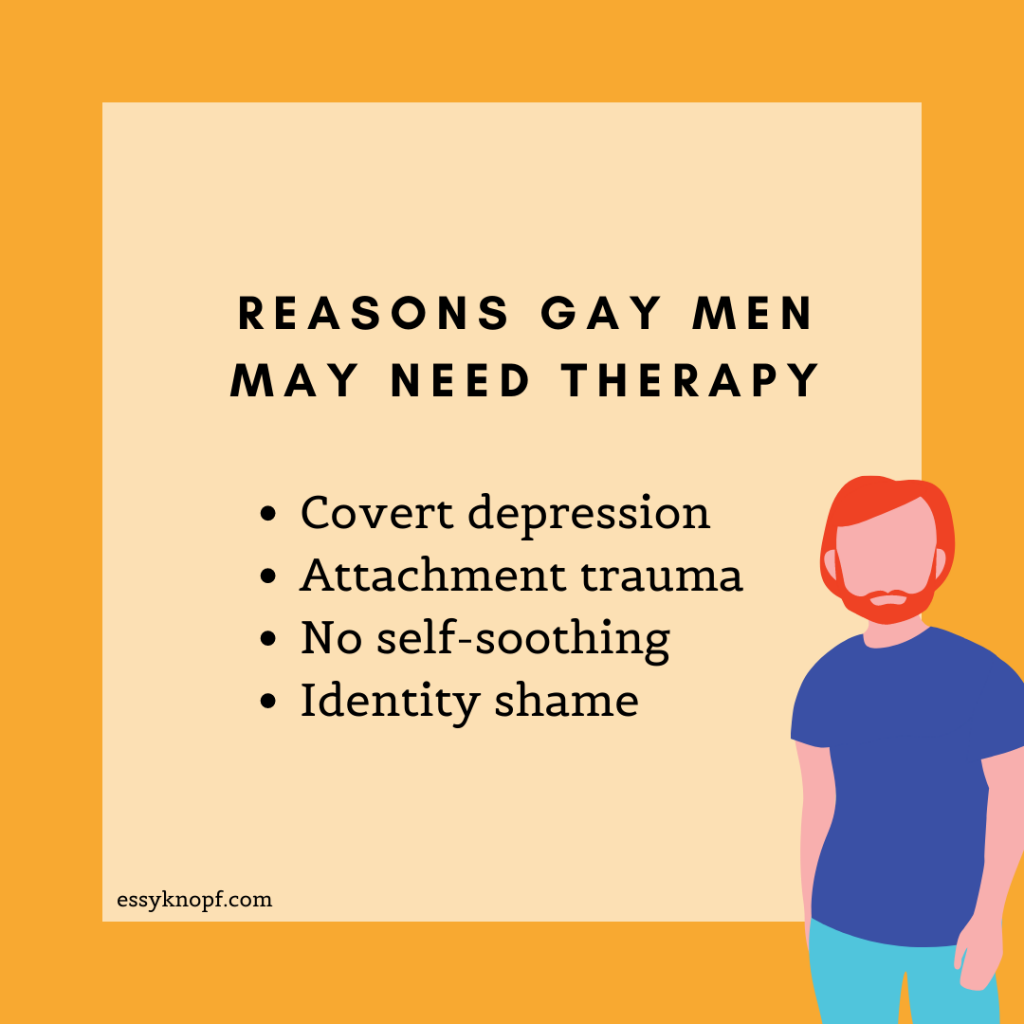
1. Gay men often suffer from depression

An inability or unwillingness to acknowledge one’s own mental health struggles is usually a product of self-denial; of alienation from one’s own authentic feelings.

Like a majority of men, we as gay men often suffer interpersonal prejudice and discrimination over our identities. These minority stresses can leave us stricken with shame while placing us at greater risk of depression, anxiety, and suicide.

That risk is exacerbated by the fact that males are socially programmed to go at it alone. Masculinity is popularly coded as being self-reliant, an idea more widely echoed in our culture’s embrace of rugged individualism, i.e. the “I don’t need help from anyone” mentality (see my earlier article on embracing your authentic gay identity).

Gay men tend to be more emotionally expressive than their straight counterparts. Gender-atypical tendencies like this often lead to us being singled out and persecuted. Any wonder then we should be especially challenged when it comes to asking for help.

But forcing ourselves to repress our emotions and to cut ourselves off from the help of others leaves us prone to covert depression. This depression is often the reason many of us should seek help…and yet it can also serve as a major source of resistance.

Depression sufferers know all too well how we can become trapped in the stasis field of negative thoughts and “automatic”, self-perpetuating cognitive distortions.

In his book Feeling Good, David D. Burns notes that these distortions lead in turn to procrastination and “do-nothingism”. That is, we found ourselves restrained by the very same inertia we are seeking to escape. 

Thus the depressive, lacking the motivation to change, surrenders to the comforting familiarity of their unhappiness.

Another reason it is difficult to take action is that covert depression operates as a kind of background presence that evades easy detection, or may be put down to just a passing “mood”.

Similarly, anxiety – depression’s fraternal sibling – may also be dismissed as an inevitable feature of modern life. It may even be regarded as a helpful crutch that gives the sufferer a motivational edge; a willingness to go the extra mile that is recognized and rewarded by employers.

2. We may have attachment difficulties

Caregivers play a crucial role not just in early development but our future wellbeing. They comfort us during times of distress, fostering a sense of security through healthy attachment. That attachment serves as a template for future relationships, shaping whether we are able to form close bonds with others. 

Attachment also provides children with an internal working model of self-worth. It defines whether we see the world as a safe or nurturing place, or one full of pain, uncertainty, and anguish. It provides the primary reference point for our lived experience

Ruptured attachment is the result of either active trauma, which typically involves a boundary violation such as physical or sexual abuse, or passive trauma, which involves some form of physical or emotional lack, such as neglect. Ruptured attachment can occur at any point during childhood or teenagehood.

Gay men experience both active and passive trauma when a parent rejects, neglects or attacks them over their sexuality, an experience which is all too common.

During early attachment, trauma is preverbal, making our suffering literally beyond words. As such, it can be difficult to “re-cognize” the experience and come to grips with its effect on us as adults.

Without the help of a trained practitioner, we will continue to live unknowingly in the shadow of our trauma, afflicted with mental health conditions like depression.

3. We may be unable to self-soothe

Ruptured attachment results in an inability to self-soothe. When our caregivers fail to properly “attune” to us and provide the correct behavioral modeling, we fail to develop this vital skill. 

Self-soothing means being able to realize we are hurting, to give ourselves the comfort we need, and to seek it from others when we can’t

Without self-soothing, we may find ourselves prone to “fight, flight, or freeze” in times of stress. 

That is, we engage in one of three coping strategies: coming out guns blazing, running from danger, or shutting down. We don’t seek the support we so desperately need, leaving us beholden to depression and anxiety.

In an attempt to pacify our troubled minds and hearts, we may turn to the Band-Aid fixes of grandiosity or process addictions.

4. Gay men are debilitated by shame

For gay men, depression is often compounded by longstanding shame. The distinction between guilt and shame, as pointed out by Brené Brown, is that guilt involves believing “I did something bad”, while shame involves assigning a permanent negative quality to yourself, like “I am bad”.

We come by shame firstly through socialization. Society teaches us our sexuality is abnormal, perverse, and even morally wrong. When this view is adopted by our caregivers, it may not necessarily lead to outright rejection, but rather words or deeds that are invalidating.

Invalidations, no matter how small they may seem, can inflict profound psychic wounds, Alice Miller says. If the only people in the world duty-bound to love you unconditionally mock or belittle you because of your sexuality, you may come to believe you are inherently unlovable.

The child with a devastating belief in his own unworthiness is likely to carry it into adulthood. If left unaddressed, this belief can leave us relationally impaired, resulting in an insecure attachment style.

Attached authors Amir Levine and Rachel Heller estimate about half of the adult population suffer from insecure attachment styles. In the case of gay men, this figure may arguably be even higher.

essy knopf gay men therapy

How a therapist can help gay men

Therapy is one way we can identify the impact ruptured attachment or invalidation has had upon us. It offers avenues for reconnecting with aspects of ourselves we may have become alienated from as a result of parental and social rejection and invalidation. 

And it is through this connection that we develop self-awareness, what Daniel Goleman calls “emotional intelligence”, and thus the ability to self-soothe.

A relationship with a therapist ideally is reparative. They model the unconditional acceptance of an ideal caregiver, creating an accepting space in which clients can vent to thoughts and feelings they have been forced to repress, often as a matter of survival. 

A good therapist uses compassion and insight to help their patients reintegrate alienated parts of the self. Through their guidance, gay men can come to terms with the loss and anguish they have suffered.

Therapy requires that we go to places we have been avoiding. After a lifetime spent mastering the art of emotional concealment, gay men undergoing therapy are asked to forgo their craft and expose their wounds and weak spots.

Embracing vulnerability in this fashion allows us to ultimately regain our long-lost ability to be emotionally authentic.

As Buddhist Pema Chödrön points out:

Without realizing it we continually shield ourselves from this pain because it scares us. We put up protective walls made of opinions, prejudices, and strategies, barriers that are built on a deep fear of being hurt… Finding the courage to go to the places that scare us cannot happen without compassionate inquiry into the workings of ego… Either we question our beliefs – or we don’t. Either we accept our fixed versions of reality – or we begin to challenge them. 

Choosing a therapist

Making the decision to undergo therapy sometimes feels like half the struggle. Then you have to deal with the deadly triad: money, scheduling, and what Samson called trust, but which I like to think of as compatibility

You can’t put a price on your mental wellbeing, so don’t let the cost alone thwart your efforts. If you don’t have a mental health care-inclusive health care plan, consider finding a therapist who offers sliding scale fees. If you need to take time out during working hours, negotiate with your manager or HR department.

When choosing a therapist, we all need assurance that we are in safe hands. We are, after all, seeking the unconditional acceptance we were once denied. Our chosen confidant, therefore, needs to show they will honor this responsibility. 

Bessel van der Kolk suggests three criteria by which you can gauge this: comfort, curiosity, and collaboration. To that list, I would also add proactivity and accountability:

  • Comfort: Do you feel comfortable and safe in the presence of this therapist? Do they seem comfortable with you? In the words of van der Kolk: “Someone who is stern, judgmental, agitated, or harsh is likely to leave you feeling scared, abandoned, and humiliated, and that won’t help you resolve your traumatic stress”.
  • Curiosity: Does the therapist seem interested in you as a person? Or do they see you as just another patient to be handed a rote list of advice and instructions? Do they actually listen to you? Are they comfortable sitting with your distress? Or do they immediately leap into diagnosis and prescription?
  • Collaboration: Is the therapist demonstrating a genuine desire to work with you, to explore your issues in-depth and to formulate a treatment plan?
  • Proactivity: Some therapists tend to take a nondirective role. As a result, you may feel you have to overcompensate. Sessions may become endless talk marathons, broken only by you prompting your therapist for participation. There is great value in a sympathetic ear, and venting is definitely part of the process. But given for example depression’s tendency to keep us trapped in automatic thoughts, we are never going to make the necessary shifts in our thinking without the help of someone willing to interrupt, redirect and even challenge, where necessary.
  • Accountability: Does your therapist honor their appointments with you? Do they cancel or reschedule on short notice? A therapist who is unpredictable or inconsistent can’t provide you with the security and caregiver-like “containment” you need. This also works in reverse. Do they help keep you accountable? Set tasks and homework? Without proper follow through on your behalf, your recovery may be hindered.

Remember: you are not locked into any therapist relationship. Treat the first session and those that follow like you would a date. You may be seeking immediate relief, but your objective should be to assess compatibility. 

In the end, there is no use building a relationship with someone who isn’t capable of giving you the support you need. Be willing to shop around until you find the right fit. And if it isn’t working, be prepared to move on. 

As with any endeavor, you will face setbacks. Sometimes these setbacks may simply come down to lack of motivation. If this is the case, break the task of finding a therapist into baby steps and try to complete one step a day.

The act of unlearning maladaptive behaviors and patterns can take months, if not years. Your recovery ultimately comes down to your being patient with the journey, flexible in your approach, and perhaps most importantly, remaining committed to your wellbeing.

Creating a new self unburdened by the injustices of your past first requires that you choose to break with the old.

“When I let go of what I am,” says Chinese philosopher Laozi, “I become what I might be”.

For advice on finding a therapist, check out this handy post by the American Psychological Association.

Takeaways

  • Acknowledge you may have depression.
  • Consider how your attachment history and feelings of shame might be playing a role.
  • Fight motivational inertia! Take it one baby step at a time.
  • Stay committed. You're in this for the long haul.

* Names and identifying details have been changed to protect the privacy of all individuals discussed in this article.

Confessions of a Control Freak – Part 1: An Obsessive Compulsion

Reading time: 8 minutes

Cocktail: The Joykiller.
Description: The perfect cocktail for the aspiring wet blanket.
Ingredients: Four ounces of perfectionism, a dollop of workaholism, a splash of stubbornness. Method: Mix, shake well, strain into a glass of rigid thinking. Serve with a twist of stinginess.

Confessions of a Control Freak is a memoir blog series exploring the impact of Obsessive Compulsive Personality Disorder, its origins, and the rocky path to recovery. Names and identifying details have been changed to protect the privacy of all featured individuals. Subscribe to receive all future posts. More about OCPD here.


I

Exploring India for most people may sound like a great way to spend a vacation, but for someone with undiagnosed Obsessive Compulsive Personality Disorder (OCPD), it was an unmitigated disaster.

Days before my trip, I completed a web series and the first draft of an alternate history fantasy novel—one of several creative projects on a never-ending, self-perpetuating carousel of work.

Having accrued more than a month’s worth of leave, I decided that the best way to spend my time “off”, naturally, would be to start yet another project. 

Essy Knopf Confessions of a Control Freak
Me, outside Dehli’s historic Parliament House.

No, I was not going to be going on an adventure and collecting photos for a post-trip slideshow with family and friends.

Instead, I was going to conduct research for a novel—a sequel to another book I technically hadn’t even finished yet. Talk about getting ahead of myself!

I booked a ten-day guided tour around the arid northern Indian state of Rajasthan, once a patchwork of princely states under the British Raj. 

This I figured was the very least amount of time I would need to document every inch of my surroundings. I couldn’t afford to miss a single thing.

Printing a copy of my novel draft, I packed my camera and boarded my flight. First stop: Mumbai, where I spent a few days visiting a friend, before striking out on my own to New Delhi.

The next ten days passed in a frantic blur. When I wasn’t snapping photos at some site of historical significance, I was ensconced in my hotel room bed, eating from room service trays as I scrawled notes on my already-dog-eared manuscript.

Room service would knock and I would bark a reply. My sheets and towels didn’t need changing, thank you very much. I could manage just fine with the ones I had.

If I had hoped to soak up the ambiance of my surroundings, I found myself too preoccupied to do even that. 

Instead, I found myself staring down, first in confusion, then horror at the metal nozzle projecting on from the toilet seat, not quite ready for the culture shock presaged by a bidet.

When I was outdoors, I distracted myself with a packed schedule. This meant that I was, more or less, constantly moving at a sprint, checking off sightseeing to-do lists in advance of my departure for Rajasthan. 

Relaxing, I told myself, would be a waste of my hard-earned leave time, and a plane ticket to boot. Ever the master of delaying gratification, I told myself I could take a proper vacation later, some other time, but only after I had truly earned it.

Essy Knopf Confessions of a Control Freak
The Amber Fort in Jaipur.

II

This unwillingness to relax took its toll, however, and by the time the touring car finally arrived to whisk me away to Rajasthan, I was practically manic. 

I may have already conducted a ton of research, and yet I still hadn’t completed the second draft of my novel. 

Then there was the irksome fact I’d had to sacrifice a crucial train trip to several UNESCO World Heritage sites due to last-minute itinerary changes.

Having planned my visit with the goal of literally seeing everything possible, the completionist in me ached with the idea that I might miss a single thing. 

And given my life was already bursting with other commitments, I couldn’t reasonably expect I’d be making a return trip anytime soon. 

For the remainder of the ride to Rajasthan, I sat in the back of the car, earphones in, head bowed, reviewing page after page of my manuscript. 

If I’d hoped to take satisfaction in my progress so far, I instead found the novel to be sorely wanting. The dialogue was clumsy, and the characterizations paper-thin.

Desert vistas crawled past my car window, and crumbling stonework ruins whizzed by, but I didn’t see them. 

Essy Knopf Confessions of a Control Freak
Not considering myself to be a “true” tourist, I was opposed to the camel and elephant rides that came as part of my tour package and reluctantly agreed to take them.

My driver slowed the car, pointing out to me grazing antelope. I looked up only long enough to feign wonderment, before resuming striking out text and scribbling corrections.

At the end of each day, I would lock myself in my hotel room and refuse to come out. There was still too much work to be done.

When people dragged their chairs in the restaurant one floor above, generating what sounded like thunder in my room directly below, I complained about the noise to the hotel receptionist. 

Didn’t these people realize I was engaged in serious work, churning the next cross-genre literary masterpiece?

How lucky they must be, these carefree vacationers. They didn’t carry with them multiple internal timepieces that were forever ticking over. They didn’t have to fear ceaseless deadlines.

When one hostel I was staying in notified me that hot water was only available one hour of the day, I barked at the receptionist.

Didn’t he understand I ran on my own schedule? That I had places to be and things to do?

Essy Knopf Confessions of a Control Freak
Walking among the tide pools in Mumbai.

III

My anger was proportional only to my dissatisfaction with myself. Forever hovering over me was the dreaded realization that there would need to be many more rewrites before my novel would be fit to show to the world.

And even then, when I finally did, time and distance would reveal to me a dozen blindspots that had gone unseen and undermined all my carefully planned and meticulously researched story sequences.

This was a position I had more or less already arrived at the minute I’d wrapped work on the first draft. 

If there wasn’t a problem, I would be sure to find one. My reasoning? It was better to preempt criticism and get the jump on disappointment than suffer a sucker punch from a stranger.

With each leg of the journey, my tour driver grew increasingly agitated, hunching over the wheel like someone with chronic road rage, intent on mowing down whoever might cross his path.

He stopped offering me free bottles of water and stopped calling my name. I was no longer “Mr. Ehsan”, but someone to be addressed strictly out of necessity—and only then in a clipped voice.

Essy Knopf Confessions of a Control Freak
Colorful saris in Jodhpur.

When, finally, I asked him what the matter was, he revealed he had been expecting to receive a daily tip from me. 

In the years of chaperoning foreign vacationers during the height of the tourist season, my driver had apparently never met someone who clung as stingily to my purse strings as I had.

In my defense, however, I had already paid a princely sum to the tour company. 

And then there was the fact that in my home country—Australia—we simply didn’t tip. Never mind my driver was expecting only a nominal amount. Not tipping him was, I told myself, a matter of principle.

Besides, I’d practically spent all the money I had getting here. And let’s remember, this wasn’t a true vacation, but a research trip

I wasn’t some privileged Westerner with deep pockets, but a reluctant martyr for my own ambitions.

This approach did not go down very well with one of my tour guides. When I failed to tip him at the end of our two-hour-long walk, he stood over me, glowering. I pretended not to notice. 

As far as I was concerned, he was the one who had breached social norms by expecting payment on top of the fee he’d already received from our tour company.

Essy Knopf Confessions of a Control Freak
Inside the Red Fort in Delhi.

IV

The rest of the trip slipped by like an afternoon dream: majestic hill forts of gold sandstone, soaring pink city walls, a shimmering sprawl of blue buildings at the edge of the Thar desert.

Towards the end, I climbed a hill to a viewpoint frequented by tourists. Local kids had gathered to fly kites or beg politely for pencils.

One of them was singing, accompanied by a wizened man on the harmonium. 

As I watched the sun dip toward the horizon, I was struck by the realization that for all the beauty that surrounded me, I was not moved. I felt in some ways cut off, my feelings trapped behind a rigid, impenetrable shell. 

Since my late teens, all I’d was a steely determination to survive in the face of whatever hardships might be thrown in my path.

The skies turned from gold to amber to umber. The young singer crooned a final, wistful tune. A crack appear in the shell, and suddenly I was crying.

I felt like a jack-o-lantern that had its insides scraped out. Empty, and exhausted.

Then came the profound sense of loneliness—a stalwart companion from earlier days.

Essy Knopf Confessions of a Control Freak
A stranger flying a kite on a hill overlooking Jaisalmer.

Rigidity as a survival mechanism

This same loneliness I credited for launching my never-ending crusade of workaholic perfectionism. 

Since my late teen years, I felt perpetually harried by a need to be productive. I’d create lists of things I wanted to achieve and, one by one, ticked them off with machine-like efficiency.

My default was “bustling”. When I wasn’t running to catch buses or bolting from commitment to commitment, I was writing a new story, shooting a new film, and undertaking a new degree.

My home was not a sanctuary—it was a workplace. I spent most of my time in front of my computer, taking the occasional break to tidy, clean, cook, and work out. When I wasn’t running on a physical treadmill, I was always running on a figurative one.

Nothing I did was ever good enough; I could always do better. Everything was a problem to be fixed. There was forever room for improvement. 

This philosophy extended to not just my life, but that of others as well. If all you have is a hammer, everything looks like a nail, and I hammered away to the detriment of my relationships.

In my mind, this behavior had the perfect rationale. I was someone with big dreams, the job I was doing wasn’t my true passion, and I lacked any sense of financial security. 

The only way I was going to rise above these obstacles was by applying myself. 

These standards I had set for myself, however exacting they might seem to others, were in my estimation fair.

If I could learn to follow them with religious zeal—so why couldn’t they? 

As righteous as I felt on this path, what I failed to acknowledge was that this work I endlessly generated for myself was really just a kind of coping mechanism. 

For too long, I had been troubled by the sense that something fundamental was wrong in the world; something that threatened my sense of wholeness, worthiness, and safety. 

But so long as I stayed in the saddle of workaholism, I could avert the many impending crises I imagined loomed large over my life.

Grandiosity, or Obsessive Compulsive Personality Disorder?

My behavior, I would later learn, had all the hallmarks of Obsessive-Compulsive Personality Disorder (OCPD).

OCPD, according to the DSM-5, involves a more “a pervasive pattern of preoccupation with orderliness, perfectionism, and mental and interpersonal control, at the expense of flexibility, openness, and efficiency”.

Key traits of OCPD include:

  • Preoccupation with details, rules, lists, order, organization, or schedules
  • Perfectionism that interferes with task completion
  • Excessive devotion to work and productivity
  • Being overly conscientious, scrupulous, and inflexible about matters of morality, ethics, or values
  • Being unable to discard worn-out or worthless objects without sentimental value
  • Reluctance to delegate tasks or to work with others unless they follow your precise way of doing things
  • A miserly spending style
  • Rigidity and stubbornness

A distinction should be made here between OCPD and the better-known Obsessive-Compulsive Disorder

People with OCD experience uncontrollable, persistent thoughts (obsessions) and behaviors (compulsions), which they often have some degree of insight about. 

People with OCPD on the other hand cling to their way of doing things and seem comfortable with their self-imposed systems of rules, believing nothing is inherently wrong with their style of thinking. 

A positive diagnosis

My trip to India represented a crisis point in my life. The rigid habits, rules, and structure by which I’d lived my life had been challenged, and the control I was forever grasping was slipping from my grasp.

When presented with demands to change, rather than making the necessary concessions, I dug in. Unstoppable force, meet immovable object.

The misunderstanding and misery that had resulted could, in hindsight, have easily been averted. 

I could, for example, have surrendered my constant need for productivity and been more mentally present, and actually enjoyed this once-in-a-lifetime experience.

I could have also smoothed ruffled feathers by tipping my driver and guides, rather than stingily withholding.

It would take some yearsand many more immovable objectshowever, before I would achieve true insight into my behavior. 

And even then, surrendering my self-appointed moral high ground would prove no easy task.


Confessions of a Control Freak continues with Part 2: “An excess of perfection”.

Confessions of a Control Freak – Part 2: An Excess of Perfection

Essy Knopf Confessions of a Control Freak
Reading time: 9 minutes

Confessions of a Control Freak is a memoir blog series exploring the impact of Obsessive Compulsive Personality Disorder, its origins, and the rocky path to recovery. Names and identifying details have been changed to protect the privacy of all featured individuals. Subscribe to receive all future posts. More about OCPD here.


I

“Police car!” I murmured.

At the far end of the alley, a police van had crawled into view. No sooner was it glimpsed, however, did the vehicle reverse back the way it had come.

My filming companion Nia looked up from the camera viewfinder.

“I can’t see anyone?” she said. “I think we’re good.”

At that very instant, we were standing a few feet from the McDonald’s parking lot, recording a scene for one of my college film assignments. 

Essy Knopf confessions of a Control Freak
A still from our rather daring shoot.

By scene, I am referring to a few shaky shots of me approaching the storefront, toy handgun in hand.

It was meant to be a cinematic allusion to a shooting that had occurred in the 80s. Minus, of course, the shooting part.

Nia and I had spent the past 15 minutes filming me doing multiple takes of me walking up an alley in a hoodie and taking a few bold strides across the lot.

After each take, we’d return to the alley to review the footage, whereupon I would identify some fault. Either I was walking too fast, the shot was too shaky, or the framing was somehow off.

I’d asked Nia if she didn’t mind “getting one more in the can”. A freshman keen for more filming experience, she’d obliged.

Soon, what had started as a quick-and-dirty exercise had ballooned out to become my own private Ben Hur.

“I’m pretty sure I just saw a paddy wagon,” I said, after a moment.

“Well, they’re gone now,” Nia said, raising the camera for another take.

“OK,” I said warily, “but this is the last take.” 

Certainly, this wasn’t the first time today I’d said it, but this time I meant it.

I was part way across the McDonald’s parking lot when I heard a shout.

“Drop the weapon!”

Officers burst from cover, surrounding me like in some scene from a cop show, guns pointed in readiness to shoot.

Instinct took over and I squatted, placing the toy gun on the ground.

“On your knees,” one of the officers shouted. “Hands behind your head.”

Next thing I was being cuffed and forced onto my face. Somewhere nearby I heard Nia’s voice. 

“We’re making a student film,” she cried, playing the part. “The gun isn’t real! The gun isn’t real!”

“Shut up!” someone barked. My pockets were searched and a barrage of questions followed.

Essy Knopf Confessions of a Control Freak
Me in one of many roles I would play over the years.

Did I have anything on me I shouldn’t have? Did I not realize that from a distance my gun had looked real? That I had been this close to being shot?

“Not that I’m aware”, “apparently not”, “it never entered my mind”, went my responses.

Little did the officer questioning me know that a few hours prior, I had considered painting over the toy gun’s fluorescent orange tip “for the sake of realism”, only to change my mind at the last minute.

This reflexive decision may have been what ultimately saved my life.

I tried, lamely, to explain myself, while the officer chastised me for my recklessness. It was revealed that just before Nia and I had shown up, a McDonald’s patron had called the police to report her child missing.

This patron had been sitting in her four-wheel drive, parked in the McDonald’s lot when I’d rolled up, toy gun in hand. Our eyes had even met on the first take.

By the second take, however, the woman had vanished. It was only now I realized that she in her panic had somehow connected her child’s disappearance with my appearance and called the cops on me.


II

I was 19. Just a kid, really. And I was about to be arrested and charged. My fledgling film career—if that was what you wanted to call it—was, as of that moment, over.

But after a few minutes, the police officers realized the extent of my naivety, and Nia and I were let go with only a warning.

We drifted back to the college campus, shell-shocked, trying to process what had just happened.

I eventually made my way home, vowing to never do something so stupid again. A few hours after my brush with death, I worked up the will to look through the footage on my desktop.

The resulting footage proved rather dramatic. Applying a black-and-white filter conveyed a certain impression of documentary realism. Our little gambit, it seemed, had paid off. 

But there was one problem. We had plenty of takes of me approaching the McDonalds, but none of me firing the gun. We hadn’t, in short, got the money shot…pun not intended. 

And given the gun was barely visible in my low-res MiniDV footage, how would viewers ever realize what I was trying to depict?

Essy Knopf Confessions of a Control Freak
The “money shot”.

The solution was obvious, if unpalatable, but I summoned my courage all the same. I was a serious filmmaker, and no serious filmmaker should be stopped by some fear of being arrested. Or say, killed.

Having honored my resolution not to take my life into my own hands again for a total of three hours, I collected my filming kit and went out to the front lawn of my apartment complex. 

Mounting the camera on a tripod, I pointed it towards the sky. Then, checking that the coast was clear, I hit record, extended the toy gun into view, and proceeded to hammer the trigger.

I played back the shot on the camera’s built-in LCD. The result was gloriously realistic, the toy pistol’s slider flicking backward with each pull of the trigger.

Tucking the toy gun out of view, I packed up my gear and returned indoors to begin work editing my masterpiece.


III

A few days later, the assignment was complete. It wasn’t due for a few more weeks yet however, which left me with time—time should be spent sharpening the filmmaking saw.

When the due date rolled around, I had not one but three films to submit from. I showed my classmates what I had accomplished and their only response was to stare. 

What person in their right mind would do a school assignment three times?

But this was, I told myself, what was required if I wanted to become a capital P Professional.

So I continued to film, adding new techniques bit by bit to my repertoire. Spooling through the raw footage, I would marvel at what I’d accomplished.

But I also wavered between a celebration of my artistic ability and insecurity.

Essy Knopf confessions of a Control Freak
More often than not, I was the (grudging) star of my own show.

Would my stilted acting pass for naturalistic? Would viewers appreciate that my choice to weave the camera around subjects was inspired by the rich tradition of cinéma vérité?

What I ultimately ended up with would be either worthy homages to my favorite films or confused pastiches: a little bit of everyday Italian neorealism here, a little bit of classic horror tension-building there.

As my skills improved, the bar rose. Determined to rise with it, I agonized over the little details: the choice of camera angle, the position of a prop, the lilt of an actress’s voice.

My growing competency meant that while my classmates were mastering basic editing in iMovie, I was trying to recreate Apple’s classic “silhouetted dancer” ad. 

My strategy was something that may best be described as…unique. 

One attempt at creating a chroma key effect involved assembling a green screen on my tiny balcony (because it offered the best lighting). 

Recording myself singing the backing track required that I crouch beneath a tented mattress (because it dampened reverb). 

Essy Knopf Confessions of a Control Freak
This still was a part of a swooping camera rise, complete with racked focus, over some composite images. It took days to perfect.

Then, finally, performing the actual dancing required I shimmy and pirouette in my underwear for all my neighbors to see (because wearing clothes interfered with pulling a key).

As time went by, my experiments grew bolder. I taught myself how to operate a soundboard and assemble a 5.1 surround soundtrack, tasks which involved spending days locked in the sound-dampened gloom of a mixing studio.

I taught myself to composite live footage with special effects, creating complex tracking shots across Photoshopped fantasy landscapes.

The plastic shell of my Macbook laptop was literally going to pieces, and yet still I would sit patiently as it rendered its shot, sometimes for hours, sometimes days, leaving the entry-level computer basically inoperable.

For a final project, I directed a short film set in both modern and 1980s East Germany (despite being in Sydney, Australia), with dialogue written exclusively in German (which I didn’t speak fluently), using native Germans (who weren’t actors).

The only limits, I told myself, would be those set by my own imagination.

Essy Knopf confessions of a Control Freak
There was no length I wouldn’t go to for my craft.

IV

These various projects were so time-consuming that I was barely able to hold down a job.

On one hand, I was content to live on the smell of an oily rag, but on the other, the absence of funds meant I had to serve multiple roles on any given project: storyboarder, scriptwriter, sound recordist, mixer, composer, producer, director, and editor.

And when there were no actors, I would hit “record’ and insert myself in front of the camera instead.

I cast myself in a variety of roles: cosmic fetus, creepy Hollywood executive, political terrorist, medieval village boy, zombie, time traveler, and barbarian warrior. Limits of my imagination, indeed.

When one role called for me to shave my head and don a monk’s habit, I didn’t hesitate. I was a card-carrying anything-for-art-ist.

As for having no funds or actors, there were always friends I could beg to shoot, star, or be interviewed. 

None of them proved immune to my approach, which could perhaps be best described as “exacting”. 

I’d dominate group meetings, interrogate doubters and argue detractors into silence. If someone gave me an inch, I’d take 10 miles. 

Essy Knopf confessions of a Control Freak
One of my less elaborate special effects composite shots, complete with grade, smoke effect, and screen shake.

Some may have dared crack a whip or brandish a chair against this onslaught, but fewer still would be able to back me in a corner. 

During a shoot, I’d niggle and micromanage. Inevitably I would learn that my volunteer crew members either weren’t up to snuff or didn’t share my level of dedication, I’d shoulder them aside and take the camera or boom.

When an actor didn’t hit their mark, I’d overcorrect with detailed instructions. A dozen takes were, as a general rule, mandatory. 

My “leadership”—and to call it that would be generous—was met with hostile silence and exchanged looks.

“Can you believe this guy?” my collaborators seemed to be saying to one another.

I was unrelenting; exhaustive in my film-from-every-angle approach and exhausting with my endless stream of instructions. 

There was one person, Nia—poor, indefatigable Nia—however, who weathered it all, always with a bounce in her step and nary a broadside. 

From her very first on-camera debut as a victim of spousal abuse, Nia carried herself with total aplomb.

Essy Knopf confessions of a Control Freak
When confronted with a vacant role, what did I do? I shaved my head and pulled on a monk’s habit.

When asked if she would be willing to smear her face with fake blood, she didn’t so much as blink and even offered to do it herself.

When handed a frying pan and instructed to wail on a phonebook in lieu of her onscreen abuser, Nia summoned rage with the ease of a seasoned pro.

When her role called for an emotional breakdown, Nia melted into hysterics so electrifying I almost didn’t dare to yell “cut”. And all of this on the first take. 

After the incident outside McDonald’s, I wouldn’t have blamed Nia if she’d decided to back out of future projects. 

Yet time and time again, Nia would turn up, eager to do anything that was asked of her.


V

There were many things Nia was prepared to tolerate in the name of my cinematic vision, but hectoring was not one of them.

Some months later, Nia turned up on a set we were both volunteering on, waving a script I had sent her several days late.

Fearing that her little flourishes might somehow signal to the crew we were amateurs, I asked if she wouldn’t mind putting it away.

“Stop bossing me around,” Nia snapped and walked away. 

This show of defiance was not only out of character—it was also just plain confusing. Couldn’t Nia see I was trying to save her—and by extension, me?

Despite our little row, Nia agreed to feature in another film of mine. She was to star as a wood nymph: a malevolent, shape-shifting seductress.

Not only did Nia agree to brave the cold, sludge-filled waters of a public lake—she also did it topless

While Nia was her usual no-questions-asked self, I sensed for the first time some reluctance. This proved our last collaboration together, and we soon fell out of touch. 

Then, some years later, by pure accident, I happened to spot her crossing the campus. 

Essy Knopf confessions of a Control Freak

“Hey, Nia!” I called. Nia turned and saw me.

“Oh, hi Essy,” she said, without so much as breaking her stride.

“How have you been?” I asked, catching up to her.

“Sorry, can’t talk—late for class!” Nia explained and left me in the dust.

This was, I understood, a dismissal…and possibly a deserved one at that.

The loss of my chief collaborator proved a blow to my filmmaking ambitions. It also left my conscience burdened more than ever by the realization that maybe—just maybe—it was my obsessiveness and not others’ lack of staying power that was driving them away.

My drive to reach some always-out-of-reach destination had meant not only that I had failed to truly make the journey, but that I also made it hospitable for my travel companions.

If people like Nia had been the cement foundations of my aspirations, I was like the workman with the earmuffs and jackhammer.

The problem wasn’t so much that I was a workaholic as that I—barring all obstacles save complete physical incapacitation—refused to settle for anything less than absolute perfection. And absolute perfection, for anybody, is a pretty tall order. 

Essy Knopf confessions of a Control Freak
When I couldn’t get access to a location for filming, I green-screened my way into a photo instead.

I convinced myself all the same that it was one I absolutely had to meet. That road to success was not paved by half-measures, after all.

But very quickly the pursuit of perfection would bleed into other aspects of my life, sometimes quite literally. I brushed my gums so hard that they bled, then eventually started to recede. 

While trying to meet one of my many perpetual deadlines, I sat at my desk, absently cramming the contents of a salad bowl into my mouth.

Thinking I was biting into a piece of capsicum, I chomped down on the tine of a metal fork instead. 

Later that week, while surveying my normally perfect pearly whites in the mirror, I saw that the bottom part of one front tooth had broken off. 

Most people I expect chip their teeth through genuine misadventure: a drunken faceplant or a brawl. 

But not me. I had managed such a feat with nothing less dramatic than an eating implement. 

This was, I realized, a case in point. My perfectionism and untiring ambition meant I was also forcing outcomes and rushing processes. Processes as basic as eating.

My little accident not only landed me in a dentist’s chair with a hefty bill—it also led me to a troubling realization. 

Sooner or later, there would be another accident just like this. And the results, potentially, could prove far, far worse.


Confessions of a Control Freak continues with Part 3: “A rebel yell”.