

Healing rejection sensitivity as a neurodivergent


How much of your personality is shaped by the fear that people will leave?
Not because you’re rude. Not because you don’t care about others. But because deep down, a part of you suspects that if people really saw you—your intensity, your honesty, your deep emotional currents, your very neurodivergence—they’d quickly slip away.
You’ve likely learned to scan every social interaction for danger signs. You second-guess that message you sent. You keep the group chat light, even when you’re going through something hard. You’re funny, but not too weird. Kind, but not too needy. Thoughtful, but never demanding.
You might say things like, “Sorry, I’m rambling,” when you were just excited. Or, “I totally understand if you’re busy,” even when you’re aching for a reply. You keep your joy small. Your opinions mild. Your needs…minimal.
All to avoid the moment when someone might think: “Ugh. Too much.”
This is what rejection sensitivity can look like in daily life. Sometimes, it’s subtle: a quiet shrinking of the self, over and over again, in service of conditional acceptance.
What Rejection Sensitivity Really Is
Rejection sensitivity isn’t just “taking things too personally.” It’s not about being dramatic, oversensitive, or emotionally immature, though you’ve probably been told some version of that before.
It’s a deeply embodied response. A nervous system reaction, not just a mental one. And it’s often born from years, sometimes decades, of subtle (and not-so-subtle) social injuries.
If you’re ADHD, you might know this experience as rejection sensitive dysphoria (RSD), a term used to describe the intense emotional pain that even perceived rejection can bring.
RSD isn’t in the DSM, but it’s widely recognized in ADHD spaces because it’s so incredibly common. If you’re autistic, you might not have a neat label for it. But you know what it feels like.
It’s the sudden drop in your stomach when a message is left on “read.” The hours you spend replaying a conversation, wondering if you said something wrong. The crushing shame after someone sighs or makes a face, even if they weren’t reacting to you. The total shutdown after a tiny social misstep.
Rejection sensitivity means your nervous system treats social disconnection like a threat. It is often a response to teasing, exclusion, and misunderstandings that were never cleared up. The way your intensity got misread as aggression, your honesty mistaken for rudeness, your silence taken as disinterest.
You may have learned early on: If I show up fully, I will be rejected.
And so, your brain started working overtime to protect you. Not from lions or fires, but from the pain of being misunderstood. Misjudged. Left.
That protection became hypervigilance: constantly scanning for eyerolls, clipped tones, silences that might mean you’re no longer welcome. You may not even realize you’re doing it, until your chest tightens, your thoughts race, your face burns with shame.
This is rejection sensitivity. People might say it’s “just in your head,” but truth be told, it’s also in your body.
You’re Not Broken. You’re Trying to Survive
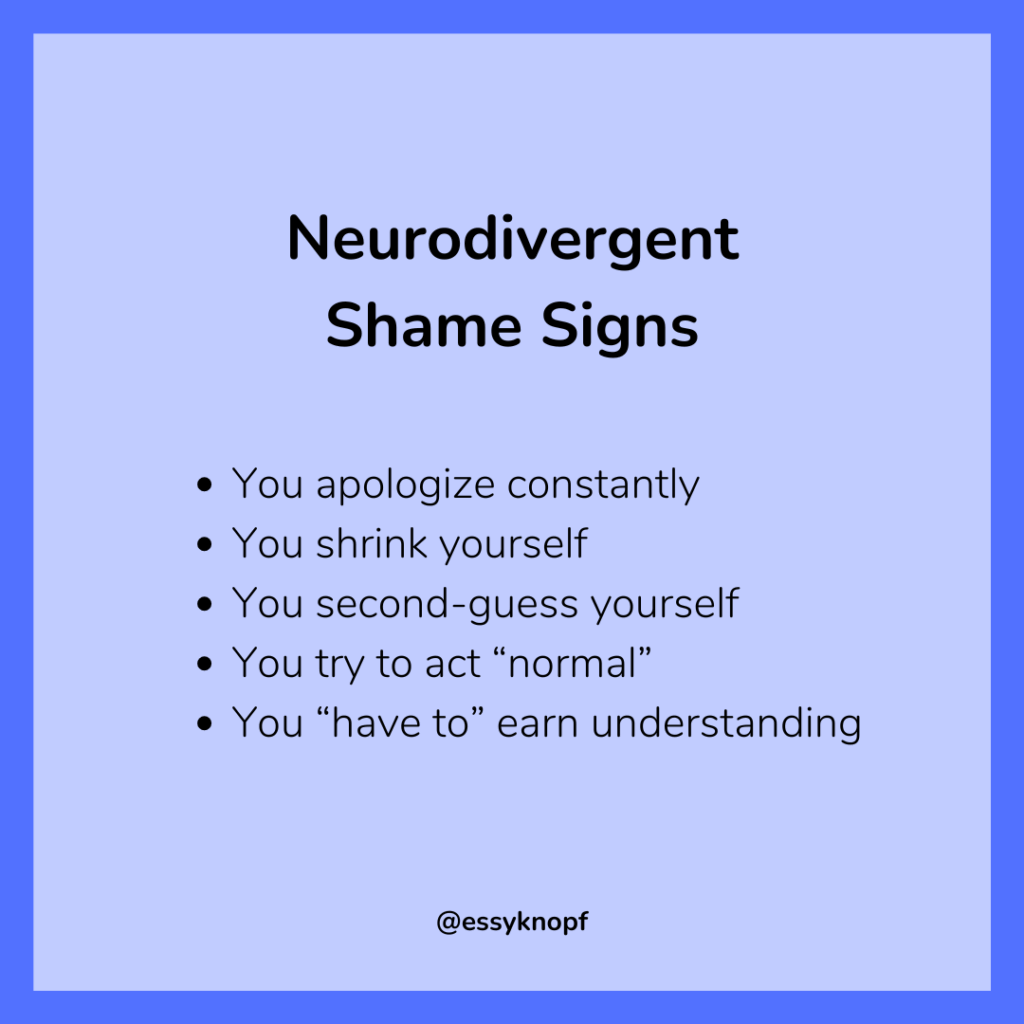
What you’re experiencing—this fear, this overthinking, this sense that you’re always on the verge of getting it wrong—leads you to protect yourself in the only ways you know how: by shrinking, by guessing, by performing.
As a result, you try so hard to stay connected in a world that made you feel like connection was something you had to earn.
Rejection sensitivity is not a character flaw. It’s what happens when your core need for belonging has been repeatedly met with confusion, punishment, or silence.
You’ve likely spent years decoding social cues like a second language. Years trying to translate your tone, your timing, your truth into something palatable. And maybe you got really good at it. But over time, it taught you that the real you might not be lovable. So you tucked that self away.
But the more you contort yourself to avoid rejection, the more you begin to internalize it.
You over-apologize when you’ve done nothing wrong. You downplay your feelings to keep others comfortable.
You talk yourself out of expressing needs before you even try. You tiptoe through conversations, scanning for signs that someone’s pulling away.
And when something does go wrong—when someone’s distant, or doesn’t respond, or seems annoyed—it confirms what you feared all along: “See? I knew I was too much.”
So you withdraw. Or shut down. Or ghost them before they ghost you.
But here’s what often gets missed: these may seem like “bad habits” or “immature reactions,” but they’re actually protective strategies. And they’ve probably helped you survive some really hard things.
So no. You’re not broken. You’re someone who’s been trying, so hard, for so long, to feel safe in a world that didn’t make space for you.
How Healing Begins
If rejection sensitivity is just your nervous system trying to protect you, then healing can’t come from self-criticism.
It doesn’t come either from forcing yourself to “toughen up” or grow a thicker skin. It doesn’t come from trying harder to be “easygoing.” And it definitely doesn’t come from pretending not to care.
You’ve already tried all that. And it left you exhausted, disconnected, and quietly grieving the parts of yourself you buried.
Healing starts in a different place: safety. Not the safety of never being rejected again, but the kind where you can stay connected to yourself, even when fear flares.
Because rejection sensitivity lives in the body, the work is often slow, steady, and rooted in practice.
Here are a few ways to begin:
1. Name the Pattern Without Shame
The next time your thoughts start spiraling, replaying a conversation, reading into a text, preparing an apology just in case, pause.
Put a gentle hand over your heart or your chest and say to yourself: “This is rejection sensitivity. I’m not in danger. I’m just triggered.”
You don’t have to fully believe it. But say it anyway.
Naming what’s happening brings awareness. And awareness brings space. And space is what helps you step out of the loop, instead of getting swept up in it.
2. Regulate Before You Ruminate
When your nervous system is in fight-or-flight, no amount of reasoning will work. Logic can’t get through the alarm bells.
So before you try to “think it through,” start with your body. For example:
- Try holding something warm.
- Try lengthening your exhales.
- Try putting gentle pressure on your chest, or lying under a weighted blanket.
- Try stimming, moving in a way that feels soothing, like rocking or tapping.
These actions speak directly to your nervous system, telling it: You’re safe. You’re okay. You can settle now.
And once your body feels calmer, your mind becomes clearer, and your inner critic a little quieter.
3. Build Relationships That Can Hold the Real You
You need spaces where you don’t have to filter yourself, shrink yourself, or mask just to stay welcome. For example:
- That might be one trusted friend.
- A neurodivergent peer group.
- A therapist who gets it.
- A space where your intensity is understood.
Start small. You don’t have to bare your soul. Let someone see a little more of you, the parts you usually hide. And when they stay? Let your nervous system breathe that in.
Because over time, repeated moments of safety become new wiring. They become evidence: Maybe I can be real… and still be loved.
4. Validate the Original Wound
So many of us want to move forward without looking back. But rejection sensitivity often has roots in earlier pain: younger versions of you who were left out, shamed, or misunderstood.
You don’t need to relive those moments. But you do need to acknowledge them.
Try saying: “Of course I fear rejection. I was rejected.” “Of course this hurts. It’s hurt for a long time.” “I’m not exaggerating. I’m remembering.”
You don’t heal shame by denying it. You heal it by bringing compassion to the parts of you that were never offered any.
Healing is slow. Nonlinear. Sometimes frustrating. But every time you pause instead of spiral… Every time you stay present with the discomfort… Every time you let yourself be seen, even when you’re scared…
You are creating a new possibility: I don’t have to disappear to stay safe. I can stay, as me.
Final Thoughts
If no one ever told you this before, let me say it now, clearly and without condition: you are someone whose nervous system has been shaped by real experiences, and whose longing for connection has never been the problem.
Rejection sensitivity is not a sign that you’re flawed. It’s a sign that you care. Deeply. It’s a sign that you’ve been hurt, and still show up anyway. It’s a sign that you crave authenticity, even in a world that hasn’t always welcomed it.
And that sensitivity is not something to fix or erase. It’s the doorway to your empathy, your truth-telling, your passion, your presence.
The parts of you that feel too intense… too tender… too honest? Those are the parts that make you who you are.
Belonging shouldn’t depend on perfect timing, flawless communication, or unshakable emotional regulation. It shouldn’t require that you always be agreeable, quiet, or easy.
Real belonging shouldn’t involve auditioning for acceptance, but arriving exactly as you are.
It’s built on mutuality. On people who see you, and stay. And yes, those people exist.
People who won’t flinch when your voice wavers with feeling. Who won’t pull away when you ask for clarity. Who see your honesty as a gift, not a threat. Who welcome your intensity not despite it, but because it’s real.
But here’s the twist: before you can truly receive that kind of acceptance from others, you may need to offer a little more of it to yourself.
To say: “Even when I’m scared, I still deserve love.” “Even when I’m triggered, I am still worthy.” “Even when I get it wrong, I still belong.”
Because you do.
How has rejection sensitivity shown up in your relationships? How have you learned to navigate it, or are you just starting to?
Essy Knopf is a therapist who likes to explore what it means to be neurodivergent and queer. Subscribe to get all new posts sent directly to your inbox.