How compliance culture silences neurodivergent voices

Essy Knopf compliance culture
Reading time: 4 minutes

Have you ever noticed how quickly people shift when you stop playing by the rules?

Not legal rules, but the subtle, invisible ones. The ones that tell you how to sit, speak, smile, react. The ones that reward you for blending in and quietly penalize you for standing out.

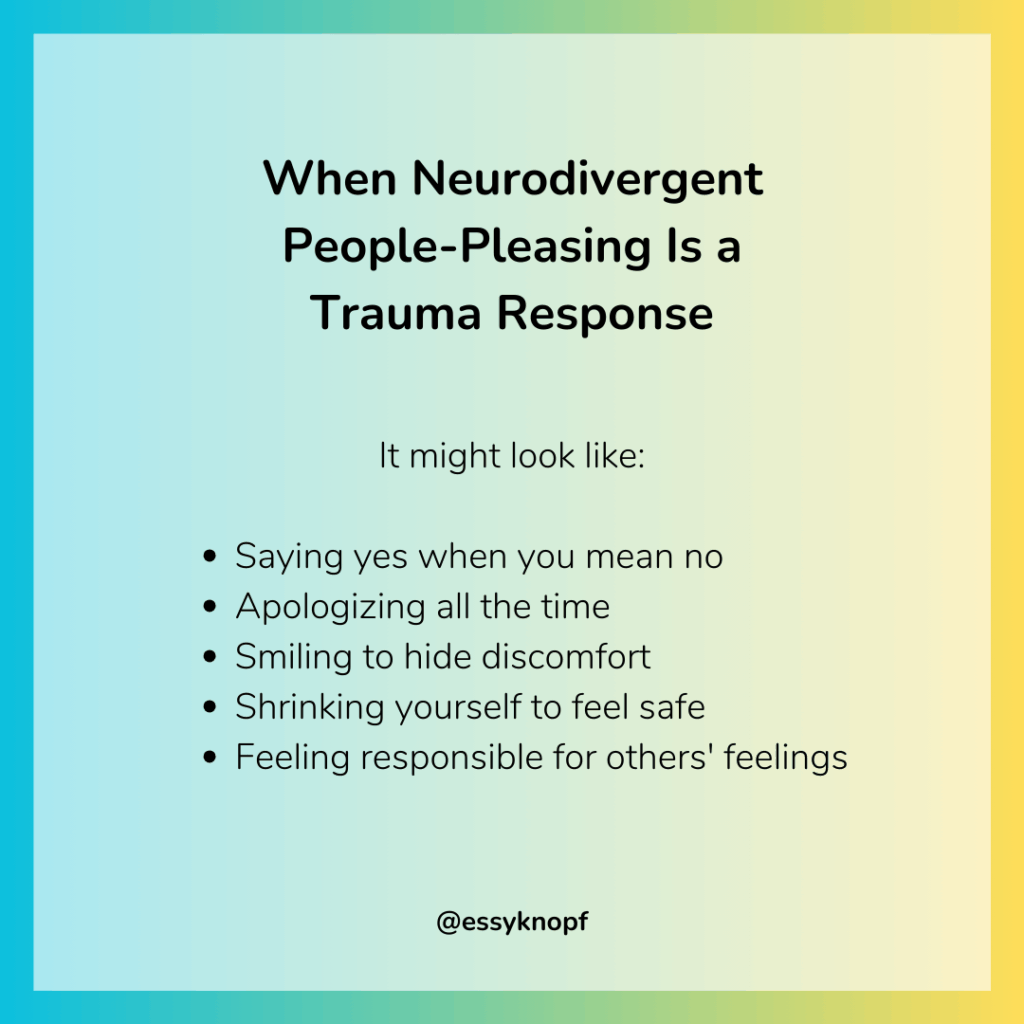
You say what you mean, and someone winces. You stim or flinch, and someone stares. You don’t match the mood or tone, and suddenly, you’re “off.”

This shift isn’t in your head. It’s a product of compliance culture—a web of social expectations designed to keep everyone in line. For neurodivergent people, that line is especially narrow. And stepping outside it, even for a second, can cost you.

What Compliance Culture Really Looks Like

Compliance culture is more than just rules about behavior. It’s an entire atmosphere; a quiet, persistent demand to be easy. Easy to understand. Easy to manage. Easy to forget.

It shows up when a teacher calls you “disruptive” for asking too many questions. When your manager raises an eyebrow because you skipped the team lunch to recover from a loud meeting.

When friends joke that you’re “a bit much” after you share something that genuinely excites you.

Over time, these signals accumulate into something heavy and hard to name.

That weight is compliance culture exerting pressure on your identity.

How Neurodivergent People Respond to Compliance Culture

Autistics and ADHDers often exist in contrast to what’s expected. We move, think, and respond in ways that don’t always fit neatly into the social flow. And for that, we’re often asked to do something subtle but insidious: self-edit.

Edit your pace of speaking. Edit your irregular gait. Edit your emotions so they don’t take up too much room.

You’re told—explicitly or not—that your presence is only welcome if it’s polished, predictable, and pleasant. Not intense. Not inconsistent. Not real.

And when you can’t meet those expectations, the consequences are often the withdrawal of warmth, of patience, of connection.

The Trouble With “Spiky” Abilities

Many neurodivergent people have what’s known as a spiky profile. Our abilities aren’t flat or predictable. They spike in some areas—deep knowledge, creative insight, emotional depth—and dip in others, like short-term memory, sensory processing, or small talk.

This mismatch confuses people. You might explain a complex system effortlessly, then forget to return a text. You might be calm in a crisis but unravel when the lights are too bright or the music’s too loud.

Compliance culture doesn’t allow for this kind of unevenness. It prefers consistency over complexity. When we can’t maintain a steady, expected performance, we’re met with frustration, not curiosity.

Instead of, “What do you need?” We hear, “Why can’t you just…?”

Burnout Disguised as Functioning

Masking—shaping yourself to appear more “acceptable”—is often rewarded. People praise you for being so “high functioning,” for how “well you manage.” But they don’t see the energy it takes.

They don’t see the days where basic tasks feel like running uphill through an active mudslide. They don’t see the sensory overload, or the panic when a routine is thrown off or your brain short-circuits from too much noise.

They only see the moment you stop coping, and then they act surprised. As if the warning signs weren’t visible all along. As if you suddenly became someone else.

That’s the trap of compliance culture: perform until you break, and then be blamed for breaking.

Compliance Culture Is Systemic

This pressure doesn’t exist in a vacuum. It’s embedded into institutions.

In school, it’s the child who finishes worksheets quietly who gets labeled “gifted,” even if they’re quietly falling apart inside.

At work, it’s the employee who doesn’t ask for accommodations who gets seen as a “team player.”

In healthcare, it’s the patient who doesn’t push back who gets called “compliant”, a term that says so much about who the system is designed to serve.

This happens because neurotypicals get to determine which behaviors are seen as “normal,” and which are flagged as disruptions. That’s structural ableism.

What Gets Lost When We Comply

Every time you contort yourself to meet an unspoken expectation as a neurodivergent, something gets chipped away.

That impulse you stifle. That laugh you mute. That question you don’t ask. It adds up.

And over time, it becomes harder to tell the difference between who you are and who you’ve had to become just to be allowed in the room.

That’s what makes compliance culture so dangerous.

Essy Knopf compliance culture

Pushing Back: What Resistance Can Look Like

Undoing the impact of compliance culture doesn’t mean becoming reckless or confrontational. It means practicing something quieter, but far more radical: honesty.

It might look like letting yourself stim in public without apology. Turning off your camera on Zoom when your sensory load is too high. Correcting someone when they misinterpret your silence as disinterest. Saying “I need a minute” instead of pretending you’re okay.

It’s about reclaiming your right to show up as yourself, and not the polished version others find more comfortable.

And yes, that might make some people uncomfortable. But discomfort isn’t danger. Discomfort is how people grow.

Final Thoughts

Compliance culture tells us that our differences are obstacles to connection. That to be accepted, we must be less us. But what if that’s a lie?

What if our difference isn’t the problem, but the key?

If you’ve ever felt like your existence depended on being manageable, I want you to know this: you don’t have to perform your way into belonging. You deserve to take up space as you are.

Not because you’ve masked well enough. Not because you’ve earned it through labor. But because you’re human, and that should be enough.

What’s one expectation you’ve stopped following in order to honor your neurodivergent self?

5 common autistic/ADHD survival strategies—and what to do instead

Essy Knopf neurodivergent thriving
Reading time: 4 minutes

Picture this: you’re in a meeting. You’ve been masking for hours. Someone cuts you off mid-sentence, and suddenly you freeze. Your thoughts spiral. Your chest tightens. You say nothing for the rest of the day.

If you’re autistic or ADHD, this might not be unusual.

You may have been told you’re “too sensitive” or “not resilient enough.” But what if those responses weren’t signs of weakness…. just survival strategies? And what if, instead of trying to “fix” yourself, you learned to support the version of you who had to develop them?

Let’s explore five survival strategies that helped many neurodivergents (NDs) get through an ableist world, and five empowering, neurodivergent thriving strategies to replace them.

Survival Strategy 1: Depressive Withdrawal

When the world feels punishing, pulling away can seem like the safest option. You stop sharing. You shut down emotionally. You tell yourself, “I’m the problem.”

Maybe your ideas were dismissed growing up. Maybe every time you showed emotion, someone told you to “get over it.” Over time, retreating felt like protection.

But this withdrawal—while once necessary—can isolate you. You become a ghost in your own life, locked in a cycle of silence and self-blame.

đź’ˇ Neurodivergent Thriving Strategy: Get Curious

Instead of collapsing inward, gently investigate. What emotion came up? What belief got triggered?

Try using the “DISCOVER” journaling tool:

  1. D – Detail the event (just the facts).
  2. I – Investigate the past. Has this happened before?
  3. S – Specify the shame script. (“I must be boring.”)
  4. C – Clarify where it started. (Negative feedback from teachers, parents, etc.)
  5. O – Observe your response. (Did you freeze, leave early, mask?)
  6. V – Verify shared responsibility. (It’s not all on you.)
  7. E – Evaluate your coping strategy.
  8. R – Reflect like a friend. What would you say to someone else in your shoes?

This self-inquiry is one of the most powerful neurodivergent thriving strategies. It builds awareness, not shame.

Survival Strategy 2: Denial, Rumination & Retaliation

Someone gives you feedback. You immediately feel cornered. Maybe you get defensive. Maybe you shut down, but the whole conversation loops in your head for days. You imagine comebacks. You analyze every word.

If you have been punished in the past for showing up as your authentic neurodivergent self, even mild criticism can feel threatening. Retaliation or obsessive rumination protects your sense of self.

But this strategy is heavy. It keeps you stuck in high-alert mode, replaying pain instead of resolving it.

đź’ˇ Neurodivergent Thriving Strategy: Ground Yourself

Use grounding techniques to return to the present. One neurodivergent thriving strategy here is the “5-4-3-2-1” method:

  1. 5 things you see
  2. 4 things you can touch
  3. 3 things you hear
  4. 2 things you can smell
  5. 1 thing you can taste

Pair this with deep breathing (inhale 4, hold 4, exhale 6). Let yourself land in your body. When your nervous system feels safe, you can process experiences without spiraling.

Survival Strategy 3: Fantasy & Hyper-Fixation

Reality gets overwhelming, so you disappear—into your favorite show, a special interest, or an imagined world where you have full control.

Fantasy offers an escape from overstimulation and emotional exhaustion. Hyper-fixations bring joy—but they can also become cocoons that disconnect us from real needs and relationships.

đź’ˇ Neurodivergent Thriving Strategy: Share the Fire

Your passion is a gift. With the “SPARK” method, you can channel it into connection:

  1. S – Select a passion (insects, video games, poetry).
  2. P – Pursue community (Reddit, Discord, fan spaces).
  3. A – Articulate your story. Why does this interest matter to you?
  4. R – Reflect on how it feels to share.
  5. K – Keep the flame alive. Your joy deserves to be seen.

Of all the neurodivergent thriving strategies, this one is about reclaiming belonging. You don’t have to hide what lights you up.

Essy Knopf neurodivergent thriving

Survival Strategy 4: Making Restitution

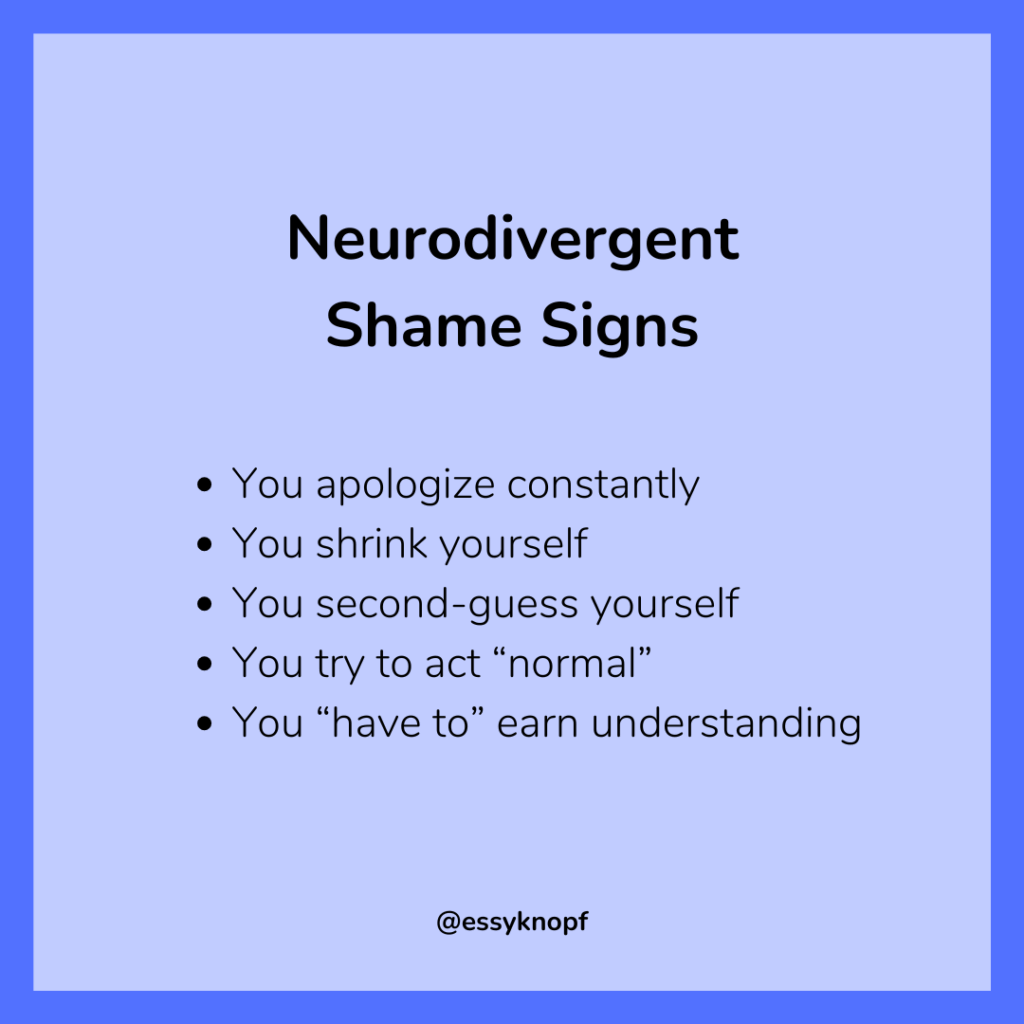
You over-apologize. You explain yourself 10 times. You feel like you always have to “make up for” being too much, or not enough.

This often stems from internalized ableism. You were taught that your way of being was wrong. So you hustle for worthiness by fixing, pleasing, over-functioning. But you’re not defective. You don’t need to earn acceptance.

đź’ˇ Neurodivergent Thriving Strategy: Speak Your Truth

Try using the “DEAR MAN” technique to ask for what you need:

  • D – Describe the situation clearly.
  • E – Express your feelings without blame.
  • A – Assert your need.
  • R – Reinforce how it will help.
  • M – Mindfully stay on point.
  • A – Appear confident.
  • N – Negotiate, if needed.

Example: “I get overwhelmed after family gatherings. I’d love a short quiet break before we jump into games. It helps me stay present and connected.”

This is one of the most liberating neurodivergent thriving strategies, because it rewrites the belief that your needs are a burden.

Survival Strategy 5: Masking, Camouflaging & Compensation

You smile when you’re uncomfortable. You mimic “normal” behavior. You hide your sensory needs, your stims, your real self, as you don’t feel safe to be fully seen.

Many autistics and ADHDers mask just to survive. But long-term masking erodes your sense of identity and leads to exhaustion and burnout.

đź’ˇ Neurodivergent Thriving Strategy: Modulate

Modulating is about adjusting for context while staying authentic. Use the “TWEAK” method:

  • T Take stock: What’s your default communication style?
  • W – Weed out one element to shift.
  • E – Execute the tweak in a low-stakes setting.
  • A – Assess how it felt. Did it help or hinder?
  • K – Keep refining. Build a “social toolbox.”

Modulation is a sustainable neurodivergent thriving strategy that offers flexibility without self-erasure.

Final Thoughts

Every one of these survival strategies was born from wisdom. From your body trying to protect you. From your brain navigating a world that wasn’t designed with you in mind. But surviving is not the same as thriving.

You don’t have to perform anymore. You don’t have to over-function, retreat, or hide. You are allowed to take up space, ask for what you need, and build a life that actually supports your neurotype.

So take a breath. Choose one small shift. And remember, thriving isn’t about becoming someone else. It’s about finally becoming yourself.

What survival strategies have you recognized in yourself? And which neurodivergent thriving strategies are you beginning to explore?

Why gatekeeping makes autism and ADHD diagnosis harder—and more harmful

Essy Knopf neurodivergence diagnosis gatekeeping
Reading time: 3 minutes

Have you ever felt like your life might finally make sense, if only someone would really listen?

Maybe you’ve spent years navigating anxiety, executive dysfunction, or sensory overwhelm, only to be told: “That’s just stress.” “You’re too articulate.” “You’re doing fine.” “That’s not what autism or ADHD looks like.”

It’s invalidating. It’s disorienting. And, unfortunately, neurodivergence diagnosis gatekeeping is more common than it should be.

Diagnosis Isn’t Just a Process—It’s a Privilege

Let’s be real: getting a formal autism or ADHD diagnosis as an adult? It’s often inaccessible, unaffordable, and emotionally exhausting.

Here’s a hypothetical examples.  After waiting 18 months to see a specialist, Maya, a 32-year-old nonbinary artist, was dismissed within 20 minutes because she “maintained eye contact” and held down a job. Never mind her lifelong struggles with shutdowns, masking, executive dysfunction, and sensory distress. She left the appointment feeling more confused—and more invisible—than ever.

If you don’t fit the narrow mold clinicians are taught—based on white, cis male children who are hyperactive or overtly socially “awkward”—you may be misdiagnosed or brushed off entirely. Especially if you’re a woman, trans, nonbinary, or a person of color.

The result? A system that gatekeeps care and invalidates experience—one that tells neurodivergents (NDs), “You’re not enough like them to count.”

Neurodivergence diagnosis gatekeeping not only delays support—it also chips away at trust in providers, and in ourselves.

The Cost of Being Undiagnosed

Before many even reach the point of seeking a diagnosis, they’ve often already paid a heavy emotional toll.

You might have grown up hearing that you were lazy, disorganized, too sensitive, too intense—or just “too much.” You may have spent your life trying to be “better,” without realizing that your struggles were linked to undiagnosed autism or ADHD.

Maybe you’ve over-apologized in every conversation, fearing you’ve said the “wrong thing.” Maybe you’ve masked every instinct to stim, fidget, or interrupt, just to “pass.” Or maybe you shut down emotionally after another failed attempt at socializing left you burnt out.

This is internalized ableism. It happens when our unmet needs are pathologized, and we start believing the problem lies with us—not with a world that wasn’t built for our brains.

Clinicians frequently miss neurodivergence because they diagnose only what they expect to see: anxiety, depression, trauma, maybe even borderline personality disorder. This is called diagnostic overshadowing, and it disproportionately affects people outside the “default” mold—especially those with intersectional identities.

So when people finally do seek answers, gatekeepers often tell them some version of: “This isn’t real.” “You’re overreacting.” “Try harder.”

The Power—and Controversy—of Online Self-Discovery

So where do people turn when the formal systems fail them?

More and more, it’s online spaces—where NDs are sharing their lived experiences with raw honesty and nuance. Social media, blogs, and forums have become places of recognition, healing, and validation.

Online, one person might realize their lifelong “clumsiness” was motor skills difference related to autism. Another might discover that their chronic procrastination and overwhelm weren’t moral failings—they were ADHD-related executive dysfunction.

Community validation can be life-changing. Many describe the moment they first encountered ND  voices and thought, “Wait. That’s me.” It was the first time their story had ever made sense.

Critics of self-diagnosis argue it’s reckless or misinformed. But most people who self-identify do so carefully—after years of struggling without answers, devouring research, and often feeling gaslit by medical professionals.

Self-diagnosis, in this context, isn’t attention-seeking. It’s a form of survival. It’s what happens when neurodivergence diagnosis gatekeeping makes formal recognition unattainable.

Essy Knopf neurodivergence diagnosis gatekeeping

What If We Let Neurodivergent People Define Themselves?

Here’s a radical thought: What if we trusted people to know themselves?

Gatekeeping assumes there’s one “real” way to be autistic or ADHD. But neurodivergence doesn’t look one way. It can be masked. It can be internalized. It can show up in emotional meltdowns or in frozen shutdowns, in hyperfixation or burnout.

What if the focus shifted from proving you’re “disabled enough” to simply being understood?

We don’t need fewer people claiming their neurodivergence—we need systems that meet people where they’re at. That means:

  • Training clinicians in diverse neurodivergent presentations
  • Reducing wait times and cost barriers
  • Listening to lived experiences as valid data
  • Creating neuroaffirming, not pathologizing, care models

The current system doesn’t just gatekeep diagnoses. It gatekeeps recognition, healing, adaptation, and transformation.

Final Thoughts

If you’ve ever wondered whether you might be autistic or ADHD, but were met with doubt or dismissal—know this: your experiences are valid, and you deserve support.

Gatekeeping helps no one. But sharing our stories? That changes everything.

Have you experienced gatekeeping around autism or ADHD diagnosis? What helped you move forward—or what support do you still need?

Neurodivergent unmasking explained: How to reclaim your authentic self

Essy Knopf neurodivergent unmasking
Reading time: 3 minutes

Have you ever come home from a day of socializing or work and felt like you’ve run a marathon, but can’t point to a single thing you did that would explain the exhaustion? That’s the invisible toll of neurodivergent unmasking.

For many of us—autistics, ADHDers, or both—the effort to “pass” in neurotypical (NT) spaces is constant, and it’s often a question of survival.

We adjust facial expressions, suppress our stims, rehearse small talk, and hold back our true thoughts. And we do it all hoping to be accepted, or at least not rejected.

What Exactly Is Neurodivergent Masking?

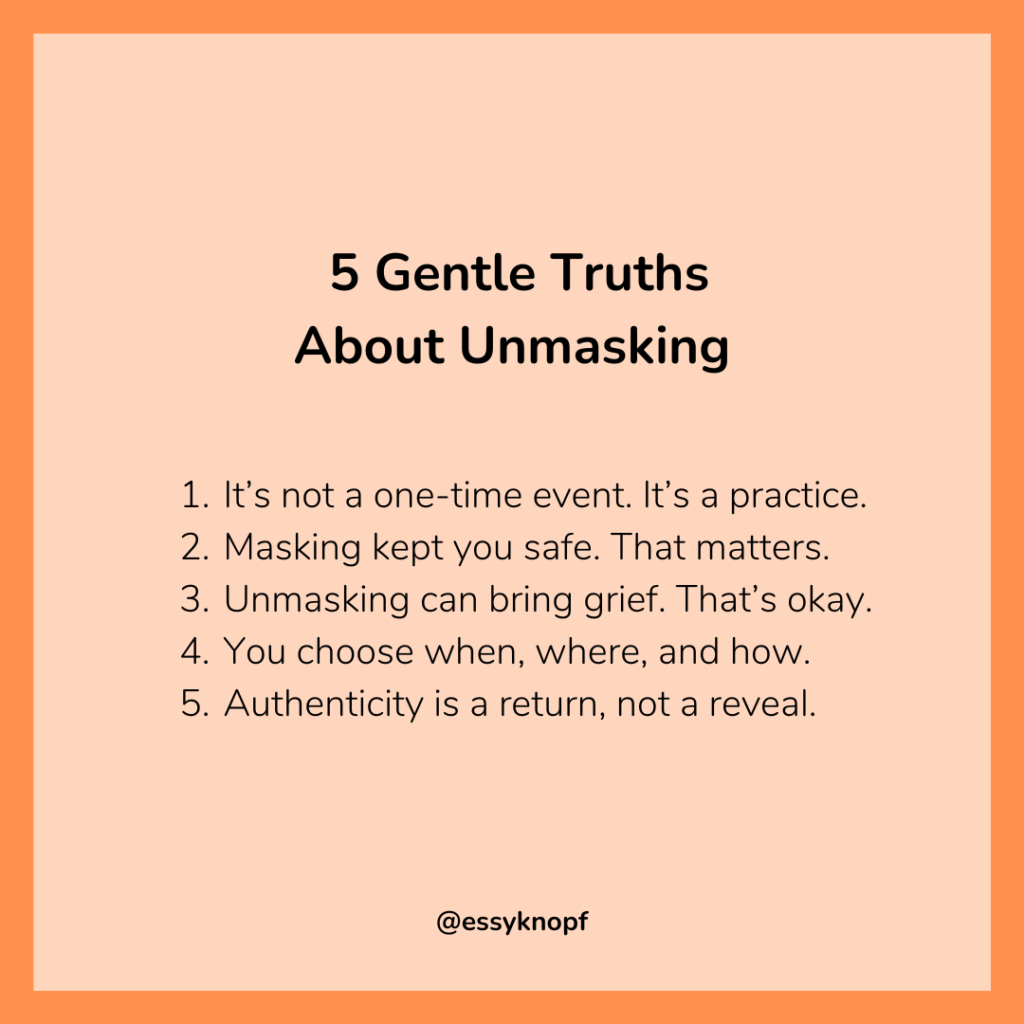
Neurodivergent unmasking refers to the process of consciously peeling back those layers of performance we’ve worn to fit in. Before we get to that point, most of us have spent years perfecting a system of:

  • Masking: Actively hiding traits that might be seen as “weird” or “too much”, like avoiding eye contact, or suppressing repetitive movements.
  • Camouflaging: Adopting NT social behaviors to blend in, like fake laughing, mirroring body language, or scripting conversations.
  • Compensating: Creating workarounds for challenges, like using apps to manage focus or memorizing emotional cues to avoid social missteps.

Often, we don’t even realize we’re doing it. These strategies become second nature because we’ve been taught—directly or indirectly—that our natural way of being is “wrong.” Neurodivergent unmasking begins when we start to notice this pattern and wonder what life might feel like if we didn’t have to filter ourselves so constantly.

The Emotional Cost of Constant Performance

Most of us began masking in childhood. It is because we wanted to deceive others, but because we quickly learned that showing our true selves often led to confusion, ridicule, or rejection.

Over time, this disconnect between how we act and how we feel inside can create deep internal conflict. We may ask ourselves: “Do they like me, or just the version of me I’ve carefully curated?” “Am I succeeding because I’m skilled, or because I’ve gotten good at pretending?”

That’s where imposter syndrome sneaks in. Even when we’re praised, it can feel like the validation isn’t truly ours, because it was earned by the masked version of us, not the real one. Neurodivergent unmasking is about bridging that gap between performance and authenticity.

The Inner Critic: Masking’s Shadow Side

When masking becomes a lifestyle, it often feeds a harsh inner critic. This voice carries all the messaging we’ve internalized: “Tone it down.” “You’re too sensitive.” “Act normal.”

It tells us that being our full selves is risky. That we must shrink or reshape who we are to gain approval. But here’s the thing: no matter how much we adjust, that inner critic is never satisfied. It keeps moving the goalposts.

The journey of neurodivergent unmasking often involves confronting this critic, recognizing that its demands are rooted in ableism, not truth. And then slowly, deliberately, choosing to show up anyway.

Why Neurodivergent Masking Is So Exhausting

Masking is both emotionally draining and physically taxing. Each moment of self-monitoring consumes energy. We analyze how we’re coming across, anticipate reactions, and course-correct in real-time. It’s like running dozens of mental tabs at once.

By the end of the day, many of us are completely depleted. This constant drain is known as “ego depletion”: mental fatigue caused by sustained self-control. No wonder we often collapse into silence, isolation, or shutdown once we’re alone.

Neurodivergent unmasking allows us to start reclaiming that energy for ourselves.

Essy Knopf neurodivergent unmasking

So How Do We Start Unmasking?

Neurodivergent unmasking doesn’t mean being vulnerable everywhere, with everyone, all at once. It means being strategically authentic; choosing the people, spaces, and moments where you can safely let your guard down.

Start small:

  • Allow yourself to stim in front of people you trust.
  • Let your infodumping shine when your passion is welcomed.
  • Practice saying things like, “I do things differently, and that’s okay.”
  • Ask for accommodations. Like breaks, dimmer lighting, or quiet space.

Let go of the pressure to be palatable. You’re not “too much”. You’ve just been trying to exist in spaces that asked you to be less.

Rewrite the Narrative

We’ve been told we need to mask to succeed. But what if that’s a lie?

What if your unique brain, your intense passions, your honesty, and your deep empathy are actually your superpowers?

Neurodivergent unmasking is about rewriting the story. It’s about naming your strengths, honoring your needs, and making space for joy and connection on your own terms.

Think about the moments when you were fully yourself, and someone responded with warmth, not rejection. The times when your authenticity led to connection, creativity, or relief. Let those moments be your anchor.

Final Thoughts

Masking might have helped you survive. But you deserve to live.

Neurodivergent unmasking is a process, not a destination. It takes practice, safety, and support. But every time you show up as your real self, even just a little, you’re reclaiming your identity. You’re rewriting the rules.

Have you begun your own unmasking journey? What helped you feel safe enough to be more yourself, and what challenges are you still facing?

The cost of conformity: What my sci-fi novel reveals about neurodivergent masking

Essy Knopf neurodivergent masking
Reading time: 3 minutes

What if survival meant becoming someone else—every thought filtered, every gesture rehearsed, every word chosen to match what others expect of you?

That’s the world Shayan lives in. He’s the protagonist of Nepo, my new YA sci-fi novel. But for many of us—especially those of us who are autistic or ADHD—it’s not fiction. It’s our lived experience.

Nepo is the book I needed as a teen. It’s also the book I needed as an undiagnosed neurodivergent (ND) adult—someone trying desperately to understand why the world felt like it wasn’t made for me.

The Mask We Wear to Survive

Like many NDs, I learned early that being “different” meant being misunderstood. I walked funny. I spoke differently. I was obsessed with bugs, then words, then fiction. Social cues felt like an invisible game with constantly changing rules—and I was always one move behind.

I learned to mask. Masking meant smiling when I was in sensory overload. It meant pretending not to care when I was excluded. It meant hiding the parts of me that didn’t “fit.”

So when I sat down to write Nepo, I wasn’t just creating a sci-fi story—I was creating a mirror. One where a character like Shayan, forced to perform for his survival, could give voice to something deeply personal: the unbearable weight of never being allowed to just be.

From Hollywood Glamor to Dystopian Control

I spent seven years in Los Angeles, working in film and media. I saw the curated personas, the constant pressure to stay “on brand.” Celebrities weren’t just people—they were products.

That’s what inspired Nepo‘s world. Shayan isn’t just any clone—he’s bred to replicate a long-dead Hollywood icon. His every move is scripted. One misstep, and he’s discarded.

Fame in Nepo is a cage. And for NDs, the pressure to perform—to meet neurotypical (NT) standards—is often a cage, too. One lined not with gold, but with shame, anxiety, and burnout.

A Future That Feels Familiar: Enter Neuropunk

I call Nepo “neuropunk.” It’s a subgenre I’m helping shape—one that centers ND experiences in speculative fiction. Think cyberpunk, but instead of focusing on tech, neuropunk focuses on how ND minds resist systems built to control or erase them.

In Nepo, society is split between the privileged “enclavers” and the oppressed “endis”—a mostly neurodivergent underclass whose labor sustains the city but whose identities are erased.

It’s dystopian, yes. But let’s be honest—it’s not far from reality.

Shayan’s Realization: The Egg Cracks

Shayan doesn’t know he’s “endi.” He just knows he feels…wrong. Like something doesn’t add up. That feeling of disconnection? Of not knowing why you’re always the odd one out? That’s familiar to many ND readers.

Eventually, Shayan discovers the truth—he’s not broken. He’s just different. ND.

It’s the “egg crack” moment. The moment so many of us experience when we finally get the language to describe our brain. When the mask starts to slip and we realize—maybe we never needed it in the first place.

That realization is liberating. But it’s also complicated. Because unmasking doesn’t erase years of shame. It doesn’t instantly rebuild your identity. And it doesn’t stop the world from demanding conformity.

Masking Hurts—But So Does Being Real

One of the questions Nepo asks is: What happens when the mask becomes who you are?

That’s what makes masking so insidious. Over time, it erodes our self-concept. We lose track of where the performance ends and where we begin. We internalize the idea that our real selves are unacceptable. That survival means self-erasure.

I’ve seen this pain in my clients. I’ve lived it myself.

And I wanted Nepo to hold space for that grief. To say: You’re not alone. You’re not broken. You’re reacting to a world that hasn’t made space for you.

Storytelling as Resistance

Speculative fiction gives us the distance we need to tell the truth.

Nepo isn’t just about one clone’s rebellion. It’s about systemic oppression, identity, and the radical act of self-acceptance. It’s about choosing authenticity in a world that punishes it.

And at the heart of the story is a plea: Let us be real. Let us be whole. Let us be seen.

Representation That Goes Beyond Stereotypes

I didn’t see myself in books growing up. Autistic characters, if they existed, were usually emotionless geniuses or comic relief. Rarely were they nuanced, messy, real.

I wrote Nepo for the readers like me. For the weird kids. The hyper-focused teens. The stimmers. The ones who got in trouble for being “too much.” The ones who’ve spent years trying to figure out why they feel alien on their own planet.

Shayan isn’t a trope. He’s a full person—conflicted, hopeful, and worthy of belonging. Because all of us are.

A Free Gift (And a Small Request)

If this story resonates with you, I’m offering Nepo as a free digital download for a limited time. All I ask is that you leave a review—let me know what spoke to you, what challenged you, what stayed with you.

I wrote Nepo because I believe stories can heal. And I hope it helps you feel just a little more seen, understood, and unmasked.

Have you ever felt like your life was a performance? Have you had your own “egg crack” moment?

Neurodivergents mask to survive systemic ableism—but at what cost?

systemic ableism autism masking Essy Knopf
Reading time: 6 minutes

Autistic/ADHD individuals learn early on that if they want to survive in a society shaped by systemic ableism, they have to mask their true selves.

But over time, masking damages our self-worth. And it may fuel internalized ableism. So why then do we persist in doing it?

While accommodations are sometimes made for people with disabilities/who are neurodivergent (ND), they are by far the exception to the rule.

In the case of autism and ADHD, accommodations can be even less likely, due to what clinicians call “disguised presentation”. That is, neurodivergence isn’t always that obvious, in some cases because the autistic/ADHDer is working very hard to keep their struggles hidden.

Neurotypicals (NTs) as a result may expect NDs to meet the same standards as people just like them, setting the bar for acceptance impossibly high.

When NTs expect ND folk to think and behave as they do, the moment the ND individual drops their mask—for example, by being overly direct or failing to read social cues—the NT will attribute that lapse to another cause, such as them being “selfish” or “rude”.

They may even respond by criticizing, judging, punishing, and excluding the ND.

Systemic ableism & microaggressions

The issue here is not merely that NTs are intolerant of neurodiversity and the differences it presents. It’s that NTs, in general, operate from baseline expectations that are ableist.

Most are oblivious to the extent to which this ableism informs their thinking, resulting in microaggressions: the “commonplace daily verbal, behavioral or environmental slights, whether intentional or unintentional, that communicate hostile, derogatory, or negative attitudes toward stigmatized or culturally marginalized groups” (see Microaggressions in Everyday Life).

Microaggressions can happen even within the families of ND folk. For instance, I remember my own parents calling me “antisocial” for my tendency to choose the company of books and computers over that of other human beings.

They also play out at school, with kids slapping all kinds of hurtful labels upon their ND peers.

I recall even teachers telling me that I lacked “common sense”, and that my handwriting was “poor” and “sloppy”. Turns out, all of these traits were part and parcel of my being ND. 

But even having a diagnosis doesn’t necessarily guarantee understanding and compassion. 

Shortly after I was told I was autistic, I had a friend suddenly touch me from behind. When I reacted with shock and explained my reasons, this friend responded by cussing out my “Asperger syndrome”. (Note: This was my diagnosis at the time. It is now considered to be an outdated term and no longer exists in the Diagnostic and Statistical Manual of Mental Disorders).

Rather than apologizing for having startled me, this friend did what so many NTs did and called out my autism as being the problem.

Miscommunications & Theory of Mind

These misunderstandings are compounded by issues related to a skill called “Theory of Mind”.

Theory of Mind (ToM) has been defined as: “the ability to recognize and understand thoughts, beliefs, desires and intentions of other people in order to make sense of their behaviour and predict what they are going to do next”.

Researchers have claimed many ND folks have impaired ToM. What I’ve noticed however is that our unusual thinking style and behavior can also general a kind of temporary ToM impairment among NTs. 

That is, NTs tend to ascribe NT motives to everyone, but doing this to ND folk can lead to confusion and misunderstanding. Turns on, there’s a name for this: the double empathy problem.

To give an example: when I got into trouble as a child, I would usually be upfront about the truth, believing that my confession would be taken at face value. 

But protesting my innocence or admitting to my naivety would rarely win me favors. In one case, an adult suggested I was “stupid” for expecting them to believe my story. 

What happened here was that this individual couldn’t fathom my intentions, and thus concluded my being honest had to be an act of deception.

Another example of this misattribution occurred during a visit to my parents. My mother told me she was going to fetch a can of tomatoes to make pasta sauce. With her fingers, she indicated that the can would be about the size of a bucket.

Knowing my mother had a tendency to bulk-buy, I assumed she indeed meant the can would be the size she suggested. Because of my impaired ToM, I interpreted her gesture literally. 

When I expressed my confusion over why she wanted to use such a big can, it didn’t occur to my parents that I was genuinely confused. Instead, they accused me of being a smart aleck.

We mask because authenticity is risky

As I’ve mentioned, this tendency of NTs to not adjust expectations when dealing with an ND individual can sometimes be the result of the disguised presentation.

Specifically, when NDs present themselves as NT. In some cases, this camouflaging is deliberate, with the ND trying to mask their struggles for fear of being judged, attacked, or marginalized.

Like NTs, autistics want above all to be accepted for their authentic selves. But when ND authenticity collides with ableist expectations, as in the situations I’ve described, disaster can result.

Due to the double empathy problem, it can be hard to understand NTs and anticipate how they might react to our actions. So we become master imitators and concealers. 

We mask, knowing that by hiding our neurodiversity, we are shielding ourselves against a perplexing and often hostile world.

Sometimes these compensations can be positive and adaptive, such as wearing headphones whenever out in public to compensate for sound sensitivities.

Other times, they are maladaptive. For example: avoiding talking about one’s interests, for fear of misreading social cues and rambling on.

But masking is self-defeating

NDs will often tell themselves that they need to change in order to fit NT expectations. But this really is an expression of internalized ableism.

Furthermore, ignoring your needs and hiding your differences as an ND is almost always self-defeating. 

Years ago I had a friend who would invite me to the movies. Personally, I find sitting in a movie theater to be sensory torture, with people constantly rustling bags and crunching on popcorn.

Rather than explaining this to my friend, I went along with her invitations, usually at great discomfort to myself.

Feeling shame over my sensory problems, I refused to tell her about the issue. Eventually, I started making excuses for not being able to join my friend, who came to believe I was intentionally avoiding her.

Difficulties with executive function are common among ND folk. Personally, in the past, as a result of my ADHD, I have struggled with self-organizing, managing my time, and staying on track.

One time, a manager unloaded on me over this, accusing me of being self-absorbed and irresponsible.

Rather than reacting defensively, I admitted my mistakes and asked this manager how I could improve certain executive function skills. She replied by telling me that my request was “beyond the scope of her role”.

It was one thing to turn professional feedback into a personal attack, but to then deny me support was quite another.

This is, unfortunately, a common experience for NDs. Often we’re told that we have done wrong, without being told how to course correct.

Systemic ableism creates internalized ableism

Until I was diagnosed as autistic and ADHD, I didn’t have a framework by which to explain or defend my difference. Having long been challenged and attacked over my ND traits, defenses have usually felt necessary.

Of course, even without having fully understood the whys and hows of my challenges, I could have still spoken up and tried to negotiate accommodations.

What stopped me, however, was the belief that I was somehow choosing to be difficult. Having internalized ableism, I had come to feel inferior and ashamed of my differences. 

My self-esteem consequently became conditional upon the approval of others. This led to me adopting a workaholic lifestyle in a bid to prove my worth to myself, and to others.

Personal boundaries blurred, to the point that I feared I was always somehow responsible when something went wrong.

Such was my shame that even after my diagnosis, I shied from the company of other NDs.

I convinced myself that the people who frequented autism and ADHD support groups weren’t like me, that I was somehow more “high functioning”—a term I’ve since realized is ableist.

What I feared—but dared not acknowledge—was that to be in their company might make me “one of them”. 

Ableism creates so much stigma around disability/neurodivergence, that despite everything I knew, I still believed my autism and ADHD to be a kind of flaw or personal shortcoming.

Wrap up

Systemic ableism oppresses NDs by demanding we abandon our identities and silence our needs.

We can start countering it by leaning into authenticity, the practice Brené Brown defines as “letting go of who we think we’re supposed to be and embracing who we are”.

One immediate way we can embrace our authentic ND selves is by seeking out fellow NDs around whom masking isn’t necessary.

The ND community exists to normalize individual experiences and to combat the stigma that can make being disabled/neurodivergent such an isolating experience.

ND readers, how does ableism show up in your life? Do you recognize any of the forms of internalized ableism I’ve described here? Drop a comment below.

Why childhood autism and ADHD often go overlooked

childhood autism Essy Knopf
Reading time: 5 minutes

Childhood autism and ADHD aren’t always obvious…except perhaps for the neurodivergent (ND) child themselves, who comes to the realization early on that they’re different.

It usually begins with other kids calling out our behaviors, telling us that we’re weird, or implying we’re inferior.

People clearly found me strange, but in my view, I was just unique and misunderstood. These two words perfectly summarized what it was like being an undiagnosed autistic and ADHDer in an ableist world.

They also describe why I often felt driven to mask my ND traits, and perhaps why many of them went overlooked.

But suppose I hadn’t masked. Suppose I made no attempt to conceal my supposed weirdness. Would I have received a diagnosis and received the necessary support sooner than I actually did?

Possibly—but possibly not. The lack of general awareness and education about autism and ADHD meant my traits would have continued to have been misattributed to my personality or (apparent lack of) intelligence.

This also comes down to the fact that autism and ADHD manifest quite differently for each individual. It thus requires a discerning eye to identify its presence.

Here’s how autism and ADHD showed up in my childhood.

Stimming: a common sign of childhood autism and ADHD

For years after receiving my autism (and later ADHD) diagnosis, I convinced myself that I had never stimmed. It was only upon hearing the accounts of other autistic people that in fact I did.

When I was living in the tropics, my favorite thing to do on a hot day was to chew on ice. Sure, it was refreshing, but the crunchiness of it was also deeply satisfying.

Another thing I loved to do was to play with chewing gum. Countless hours were spent blowing bubbles or pulling long strings of the stuff out of my mouth.

During long car rides, I would beatbox—it was a practice I never seemed to grow tired of. 

When I was 12, I also went through a period of sucking obsessively on a certain toy. (By “toy”, I’m referring here to a balloon stuffed with flour, with a pair of googly eyes and a cap of yarn hair.)

It was a kind of sensory ball, and it lasted all of a few weeks before suddenly exploding and spraying flour all over me. Imagine having to explain this development to my parents!

Another big stimming activity for me was delivering a series of DoggoLingo-style monologues to animals, such as the family dog, in a made-up accent.

For days, weeks, months, and even years afterward, I’ve felt the urge to recite DoggoLingo phrases of affection to myself, at random, for no clear reason, over and over again.

This behavior I previously thought was echolalia, though I’ve since learned the correct term for this is palilalia: the delayed repetition of words or phrases. 

childhood autism Essy Knopf
As a child, I was fanatical about animals.

Obsessive interests

My childhood autism/ADHD was perhaps most evident in my obsession with insects and spiders. Collecting factoids about each species proved a source of great delight. 

In my teen years, my area of interest shifted to fiction writing. The fantasy worlds I created provided an escape from my confusing and often overwhelming reality. 

Where previously I collected bug-related factoids, I started collecting new words, memorizing them straight out of the thesaurus.

There was a certain pleasure to be found in this mastery of meaning. To me, acquiring words represented the acquisition of some kind of secret, important knowledge.

Many of these words had a delicious quality to them. Consider for instance “lignite”. No idea what it means, but pronouncing it aloud just feels satisfying.

More than a decade later, riffling through a box of keepsakes, I would find ratty little lists of words I’d picked out from books, preserved since my teenagehood.

If you asked me to explain why I was keeping them, I’d be at a loss for…well, words. Even now, the very idea of throwing them away evokes pain.

The obsessive collecting didn’t stop there. At one point I received a pocket organizer with a digital address book, which I felt compelled to fill with phone numbers.

Despite the unusualness of my request, many of the people I asked at school obliged me by providing their own. I even worked up enough courage to ask my math teacher—of all people—for her details.

Suffice it to say, my teacher was not all too impressed, and I became the laughingstock of the class.

Social, environmental, and animal rights activism

An interest in environmental and social causes was one trait that’s typical of childhood autism.

I remember being age six and penning a handwritten letter to the Australian prime minister asking him to increase foreign aid to famine-stricken Sudan.

In fifth grade, I used my valuable show-and-tell time to lecture my peers about Captain Planet and climate change. While almost everyone rolled their eyes at me, I of course now have the satisfaction of knowing I was right all along!

My interest in animals also led to me adopting vegetarianism, a phase that lasted all of one year….before my mother tricked me into believing there was no meat in lunch meat.

childhood autism Essy Knopf
Taken during one of my childhood bug-catching expeditions. There was always a part of me that felt deeply embarrassed about my passion and suspected that others were laughing at me behind my back.

Fixing things and the problem-solving mindset

When any of my toys broke or stopped working, I worked obsessively to try and fix them.

The most memorable example of this was a special doll that could pee when “fed” milk. At some point, the doll stopped peeing. Concluding that there must be some kind of internal blockage, my six-year-old self decided to clear this blockage using a reed.

Granted, this was not exactly ideal behavior for a would-be future parent, and yet this ability to hyper-fixate—a quality that appears in both ADHDers and autistics—would later prove quite advantageous, especially when it came to problem-solving.

The same probably couldn’t have been said of my tendency to always try and set things right. In second grade, my homeroom teacher one day warned my peers that someone had been stealing food and money from backpacks.

Our school didn’t have lockers. Students instead had to leave their backpacks on racks. Given most of my peers were leaving their bags unzipped, the temptation to would-be thieves naturally was great,  

I thought long and hard about what I could do to fix this problem, then spent the following lunch break methodically zipping up every bag I could get my hands on.

I was a self-appointed Good Samaritan, but that wasn’t how two of my classmates saw it. They reported my apparently suspect behavior to the teacher, bringing a sudden end to my brief career as a school crimefighter.

Sensory sensitivities

As a child, I was accused of being a “picky eater”. What the adults around me didn’t understand was that I found certain foods extremely repulsive, usually because of their appearance, texture, taste, or a combination of all three.

One of these foods was yogurt. Another was a traditional Iranian stew my mother would make which contained red kidney beans and lamb shoulder called ghormeh sabzi.

Ghormeh sabzi was one of the few foods I devotedly ate, due to the delicious umami flavors, and yet I was extremely averse to doing so until the beans and lamb had first been removed.

Certain sensations could also make me very uncomfortable. Feeling my toenails against the surface of a pilling bedsheet was one of them. To avoid the possibility of contact, I became a stomach sleeper.

As for sleep, that was an activity that felt next to impossible unless I was under a sheet or blanket. Another requisite was that I needed to have a fan blowing on me—no matter the temperature.

Tags inside my clothes bugged me, and sometimes even my own underwear felt too tight.

One time, a teacher caught me trying to adjust my briefs through my pants and assumed I was having some kind of bladder problem. 

childhood autism Essy Knopf
Without a diagnosis, my autistic traits were often misattributed to other causes.

Wrap up

As perfectly natural as these preferences and behaviors felt to me, the downside was often obvious and immediate: alienation.

In the eyes of my parents, peers, and teachers, I was either too finicky, too stubborn, too sensitive, too clueless, or too weird. And without a diagnosis, what cause did I have to disbelieve them? 

But to view our authentic ND selves in such a light can leave a legacy of shame. 

It’s only now, years later, that I realize the problem was less my difference than the ableist system that defined that difference as a problem.

So to all my fellow autistics and ADHDers experiencing self-doubt: don’t shy from authenticity. Embrace it as your fundamental right.

What were your ND traits as a child, and how did others react to them? Let me know in the comments.

Is there a place for the graysexual identity within the LGBTQ+ community?

Gray-a demisexual graysexual asexual Essy Knopf
Reading time: 4 minutes

Apparently being LGBTQ+ also means being hypersexual. At least, that’s what many of us have been led to believe.

But human sexuality expresses itself very differently from person to person.

Today, I want to talk about two forms of this—gray asexuality/graysexuality and demisexuality—and the struggle many of us experience fitting in.

LGBTQ+ hypersexuality

At 18, when I was just starting to explore my LGBTQ+ identity, I found myself drawn to nightclubs. This seemed like the best venue in which to meet other gay men and hopefully make friends. 

Each club usually had a cover charge, but as a poor student, I often found myself balking. One time a bouncer laughed at my reaction.

“Don’t worry,” he said. “You’ll get laid.”

I remember feeling absolutely mortified. How could he have so mistaken my intentions?
Yet it was, as it turned out, a fairly normal assumption to make.

Inside these clubs, I frequently saw people sizing each other up across the dancefloor.

And when I tried to make small talk with strangers, I’d catch them looking over my shoulder at the latest person to walk through the door. Many people I met appeared to be solely looking for casual sex. 

Frankly, I was so bored by this idea, that I’d often end up sitting in a corner and browsing the free LGBTQ+ publications. 

The articles and advertisements I saw within seemed, again, to speak to this hypersexual facet of the LGBTQ+ identity—a facet that is often quite narrow in its definitions.

Being a graysexual in the LGBTQ+ ‘monoculture’

The LGBTQ+ community is, at least in theory, an inclusive one. In practice, however, it can lean towards being a monoculture.

The term “monoculture” refers to cultivating one kind of crop at a time. This is compared to polyculture, where one cultivates multiple crops at the same time.

The LGBTQ+ monoculture promotes the idea that all gay men should be hypersexual and openly discuss their sexual preferences with one another.

Sexuality for me on the other hand has always been personal and private. I’ve rarely felt any need to disclose my preferences with anyone, friends included, nor to actively pursue sex.

When I met other gay men online or in person, I’d explain that I wanted to be their friend and get to know them. For me, the familiarity and safety provided by a friendship were necessary before progressing the relationship.

Intellectual connection and interpersonal compatibility were also important, and I couldn’t be sure of either on short acquaintance.

But many people received my request to get to know them as a rejection. I was, in their view, friend-zoning them.

It seemed I had failed to grasp a common but unspoken belief: that when two gay men come into contact, sex must result.

What are graysexuality and demisexuality?

Given casual sex in the LGBTQ+ world is often treated as a kind of handshake, this expectation makes sense.

This is not to say that LGBTQ+ culture is monolithic. It arose after all as a response to the constraints of heterosexuality.

But this tendency to lean towards a single expression of sexuality can be marginalizing and oppressive to those who don’t and can’t follow it.

It’s only in the past few years, after coming to identify with the gray asexual and demisexual labels, that I’ve understood why hypersexuality never sat right with me.

What does it mean to be gray asexual, also known as graysexual, gray-a, and gray-ace? 

Graysexuals according to the Demisexual Resource Center

  • feel sexual attraction infrequently, of low intensity, to few people, or in specific circumstances
  • feel sexual attraction, but have no desire to act on it; have confusing or ambiguous feelings of sexual attraction
  • feel that sexual attraction is not a meaningful concept to them personally

Graysexuality clearly has many possible definitions and is experienced differently by each individual.

Demisexuality on the other hand involves “feeling sexual attraction only after forming an emotional bond”. Some consider demisexuality to be a subset of gray asexual.

In my case, I relate to both labels. I experience sexual attraction, but in limited circumstances, and at a low intensity.

These feelings are often ambiguous, aren’t that important to me, and I usually have little desire to act on them.

And if I do, full enjoyment is rarely possible unless I have first formed an emotional bond.

Quite a lot of fine print. And not exactly something one drops in a casual conversation.

When being graysexual conflicts with allosexuality

Allosexuality—that is, feeling sexual attraction—is often treated as the norm, so graysexuals and demisexuals like myself may thus find themselves pushed into the margins.

For example, we may often feel like our lack of sexual interest and/or drive is a problem and that something is wrong with us.

If we don’t indulge in hypersexuality, we may feel like we’re somehow failing the LGBTQ+ acid test.

Another fact to consider is that in LGBTQ+ culture, being sexually desirable is, unfortunately, often tied to self-worth. Having a lack of sexual interest in others may thus be interpreted as rejection.

Not wanting to engage in sexual activities may be perfectly comfortable for you. But failing to meet allosexuals’ expectations can create discomfort, if not frustration, for some.

Many a time, I’ve found myself in situations where another person clearly wanted a sexual outcome. When that outcome didn’t happen, some individuals would only pressure me further.

Sometimes I froze, and sometimes I gave in. When I did manage to find my voice and refuse, hurt and anger could result. 

Wrap up

It’s hard not to feel somehow wrong or at fault in these situations. You get to thinking that maybe it’s on you to be more upfront about your preferences.

But even when we are upfront, there’s always the possibility it might be explained away.

I’ve had more than a few people tell me that I “just hadn’t had the right sexual experience or partner” yet. Ironic, given that’s an argument that’s been used against LGBTQ+ people for having an interest in members of the same sex!

It isn’t fair that allosexuality is treated as a default and alternate sexual expressions as abnormal. We gray-aces and demisexuals feel blamed or shamed for failing to meet some kind of sexual mandate.

This is, after all, a fundamental part of who we are. And our diverse identities are just one variation of many that exist within the LGBTQ+ community

So enough about me, I want to know: do you identify as graysexual or demisexual? 

If so, what’s it been like for you? Let me know in the comments.