If you’re autistic or ADHD (or both), chances are you’ve spent much of your life feeling like an outsider in a world built for someone else. Maybe people called you weird. Maybe they punished your honesty or your quirks. Maybe they never even saw you for who you really were.
And maybe, like so many neurodivergents (NDs), you internalized all of it. Believing the problem was you.
The truth? It wasn’t.
Loneliness Is an Expression of Trauma, Not a Character Flaw
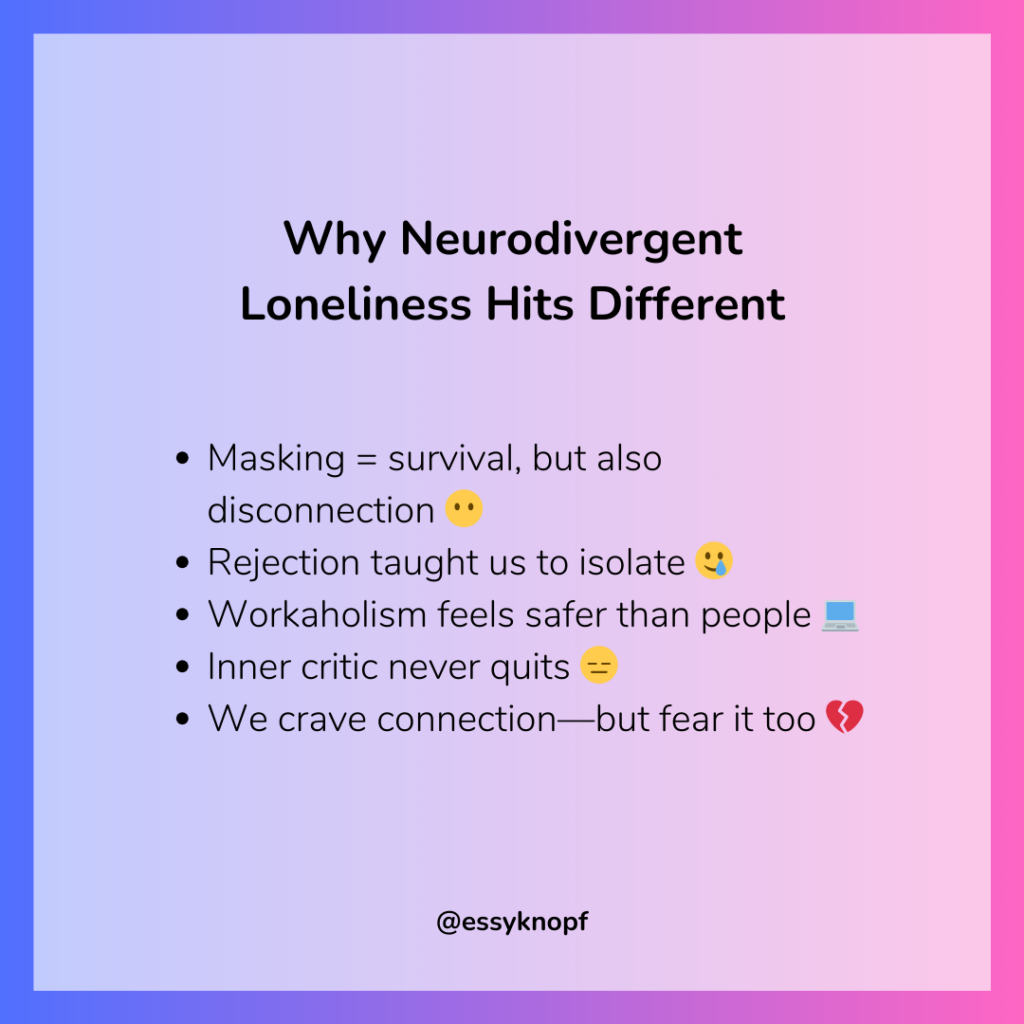
When you’re constantly told—directly or subtly—that you’re too much, too sensitive, too intense, too disinterested, or not enough of something else…you learn to hide. You might become hyper-independent, or retreat into perfectionism and workaholism to avoid the sting of rejection.
But loneliness isn’t just about being alone. It’s about being unseen. It’s about the longing for genuine connection and the fear that it may never come.
And that’s a trauma. Often a complex trauma, built over years of missed attunement from caregivers, bullying from peers, and chronic misattunement from society.
The Tyrannical Inner Critic
To survive, many of us develop an inner voice that warns us against risk. That tells us to stay silent. That mocks us when we try to be ourselves.
This voice—this tyrannical inner critic—may have once served to keep us safe. But now? It keeps us small. It keeps us alone.
And the worst part? It’s so familiar, we often believe it’s the truth.
When Work Becomes a Distraction from Pain
Many NDs (especially ADHDers) become hyper-productive. We chase dopamine through achievements, projects, passions. We tell ourselves: If I just succeed enough, maybe I’ll finally be worthy.
But that treadmill never ends. And when we step off it—even for a moment—we’re met with an overwhelming sense of emptiness. A question that cuts deep: If I’m not achieving…who even am I?
Finding Your Way Back
Healing from this kind of isolation doesn’t happen overnight. But it does happen.
It begins with understanding. With naming your neurodivergence. With reframing your past not as a failure, but as a survival story.
It continues with boundaries, assertiveness, and a slowly rebuilding sense of self-worth—one rooted not in how well you fit into a neurotypical mold, but in the intrinsic value of who you are.
And it blossoms in connection. Not with just anyone, but with people who see you, who get it, who don’t require you to shrink in order to be loved.
You’re Not Alone in Feeling Alone
You may feel like connection is out of reach. Like you’ve tried, and failed, too many times. But know this: You’re not broken. You’re not unlovable. And you’re not alone.
Many of us are walking this same road—quietly, invisibly. But we’re out here. And we’re looking for each other.
So keep reaching out. Keep showing up. And above all, be kind to the parts of you that learned to hide. They were only trying to keep you safe.
Have you struggled with loneliness or felt like you had to work extra hard just to feel “enough”? What helped you begin to reconnect—with yourself or with others?
Essy Knopf is a therapist who likes to explore what it means to be neurodivergent and queer. Subscribe to get all new posts sent directly to your inbox.
Friends and the media had told me to expect the worst – sprawling supermarket queues, panic buying, fights over toilet paper – but upon my return to Los Angeles, I found calm and order.
Lockdown had brought a range of unexpected benefits, the reduced traffic being one of them. There were the smog-free skies also, and the appearance of new public works projects.
But after a few days of self-imposed quarantine, my initially positive attitude began to fade.
I normally work from home and tend to mix up my daily routine with a range of physical and social activities. Twice a week I’ll go for a run down at the local park, explore a new hiking trail, or catch up with a friend.
Social distancing however now made these impractical, if not impossible.
As my motivation ebbed, I began sleeping in and stopped exercising. And gradually my mood took a turn for the worse.
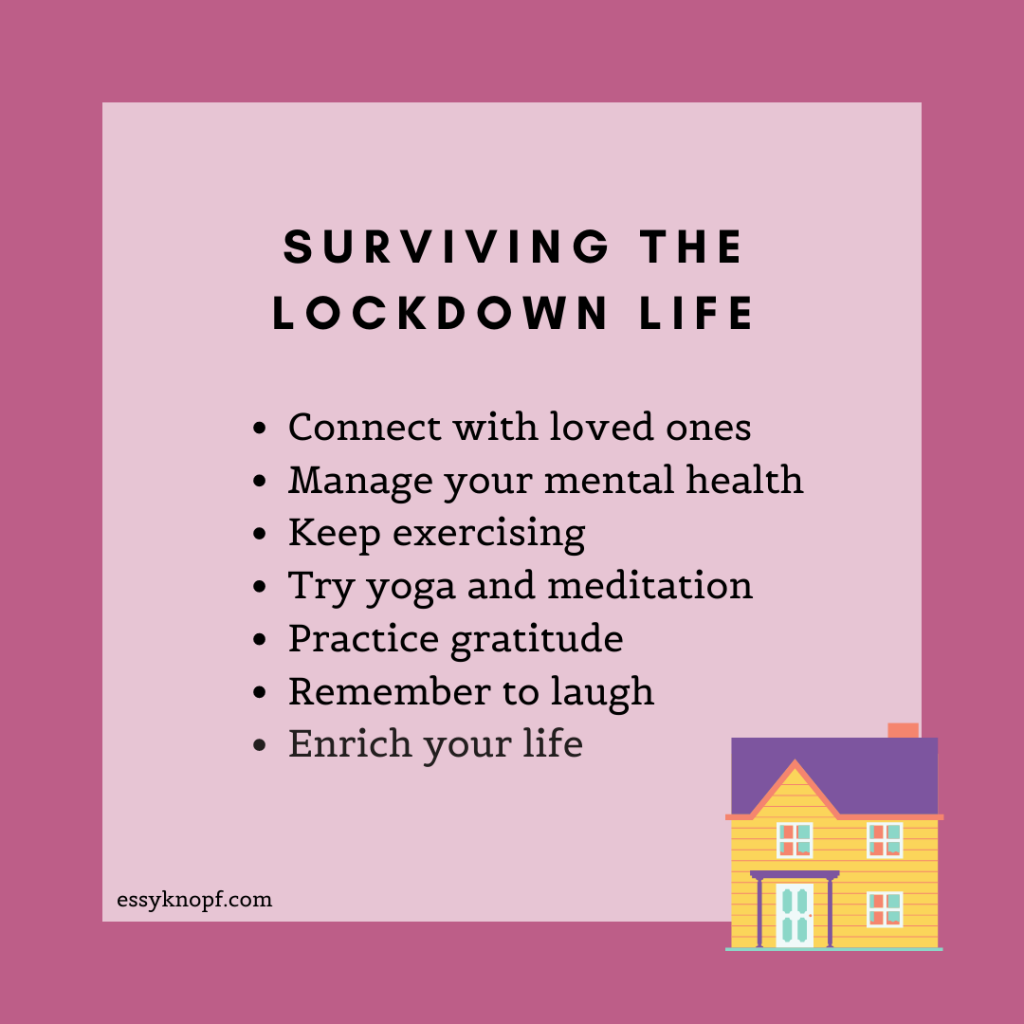
Connect with loved ones
With many public areas now closed and regions under coronavirus pandemic lockdown, a collective retreat indoors has resulted in social isolation seemingly overnight.
But the coronavirus crisis is not one that must be endured in solitude. For this reason, we should reach out to family members and friends. Chances are they’ll be equally grateful for our conversation and company.
If texting, calling, instant messaging, social media, or online multiplayer gaming aren’t doing it for you, consider throwing a virtual party over Zoom or Google Chat.
Modern hyperconnectivity right now cuts both ways. It means we can communicate with a tap of the thumb, but it also means we are bombarded around the clock with the latest coronavirus-related development.
Left to ruminate on these extraordinary circumstances, our minds will naturally tend towards anxious and depressive thinking.
“What if I catch coronavirus?” we wonder. “What do I do if shortages continue?” “Am I going to lose my job?” “Will things ever go back to being normal?”
The coronavirus pandemic, however, is an unprecedented development for which no individual can possibly be fully prepared.
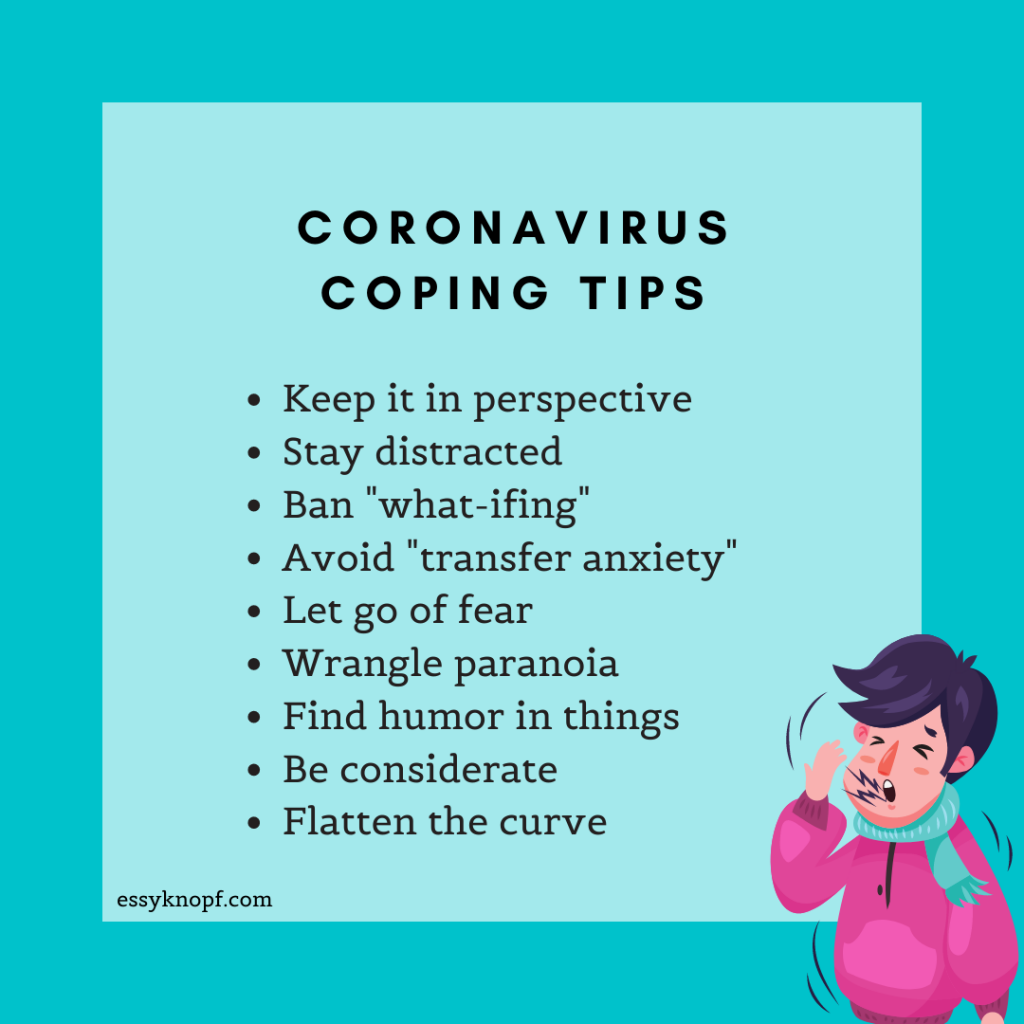
A more proactive approach involves striving to be aware of, and responsible for, our own mental wellbeing. We can do this by taking the following steps.
If you don’t have a treadmill, exercise bike, or weights bench at home, don’t despair. The sun may be setting on TV aerobics, but intrepid YouTubers have already stepped in to fill the workout void.
If high-energy aerobics or low-intensity Pilates isn’t your thing, you can always take a brisk walk, jog or run around the neighborhood.
Sunlight is a primary source of Vitamin D and getting your daily dose will help guard against depression.
Whatever you choose, set a schedule and stick to it. With most of us now homebound, establishing an exercise habit is more crucial to our well-being than ever.
Try yoga and meditation
Yoga and meditation are the kinds of practices most of us find ourselves putting off indefinitely.
“Not today,” we say. “Tomorrow.” But when tomorrow rolls around, we become caught up again in the other distractions of daily life and continue to postpone indefinitely.
With productivity in Western society often treated as the only measure of success, slowing down – especially for the grandiose among us – is often equated to personal failure.
The coronavirus pandemic has placed a moratorium upon many activities, suspending out memberships with the cult of busy.
Having more time than ever on our hands, combined with the stressors of a global pandemic, can result in a perfect storm for catastrophizing.
A daily gratitude practice may involve something as simple as writing down five things that you’re grateful for, or free-flow writing for a period of time or specific length (e.g. five minutes or three pages).
A phone call with a friend, a nice cup of coffee, enjoying perfect health – anything and everything goes.
Practicing gratitude may feel difficult or “fake” at first, but remember you are learning to use a mental muscle. And like all muscles, gratitude atrophies from disuse, so maintaining the habit is crucial.
You can’t always find something to be grateful for, but just because you can’t find it doesn’t mean it’s useless to look. It’s not finding gratitude that matters most; it’s remembering to look in the first place… With gratitude, it is often the searching, the looking, the fishing for gratitude that activates the circuitry. You can’t control what you see, but you can control what you’re looking for.
Remember to laugh
If there is an antidote to the pervasive atmosphere of grim paranoia the coronavirus pandemic has brought, it’s humor.
All the more reason to indulge in a golden oldie sitcom, browse YouTube’s many funny vid compilations, sample top joke tweets, catch up on a comedic podcast, or dust off a copy of your favorite comedian’s memoir.
A coronavirus lockdown is as much an opportunity to safeguard your wellbeing as it is a chance to enrich yourself.
That self-help book you were always planning to get to? Now’s the time. The environmental documentary your friend recommended? Well, what are you waiting for?
The new career path you wanted to explore? You’ve got no excuse now.
Time to get cracking.
Takeaways
The coronavirus pandemic has changed the pace of daily living – embrace it.
Treat this as a chance to bond with those not-so-near but still dear.
Maintain mental health with exercise, yoga, meditation, gratitude, and laughter.
Now is the time to pursue the interests and activities you’ve been putting off.
Essy Knopf is a therapist who likes to explore what it means to be neurodivergent and queer. Subscribe to get all new posts sent directly to your inbox.