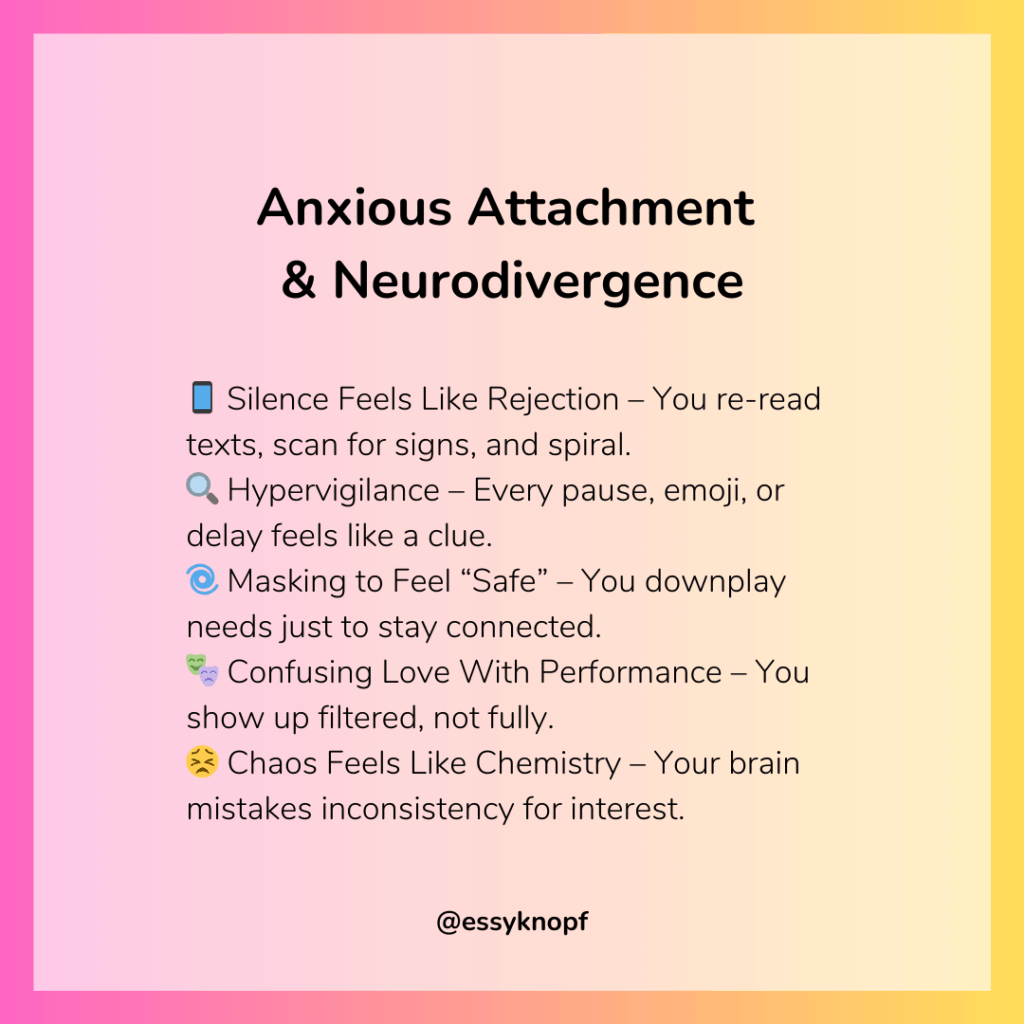
There’s something gutting about seeing friends gather without you, even when you know you would’ve struggled to be there.
Maybe you were already drained. Maybe the setting would’ve been too loud, too bright, too unpredictable. Maybe you knew it would take days to recover. And still, when no one asks if you want to come, it stings.
That sting isn’t about the party itself. It’s about not being seen. Not being remembered.
Sometimes, when an invitation does arrive, a different kind of discomfort shows up. You feel dread creeping in. You start bargaining with yourself: could you go for just an hour? Could you make it work somehow?
The guilt of wanting to decline battles the fear of missing out. You want to be part of things. You want to say yes. But you also know what it’s going to cost.
This kind of tension wears you down. Invitations start to feel more like pressure than possibility. You wonder if saying no too often means people will eventually stop asking.
And when they do, you tell yourself you saw it coming. But it still hurts.
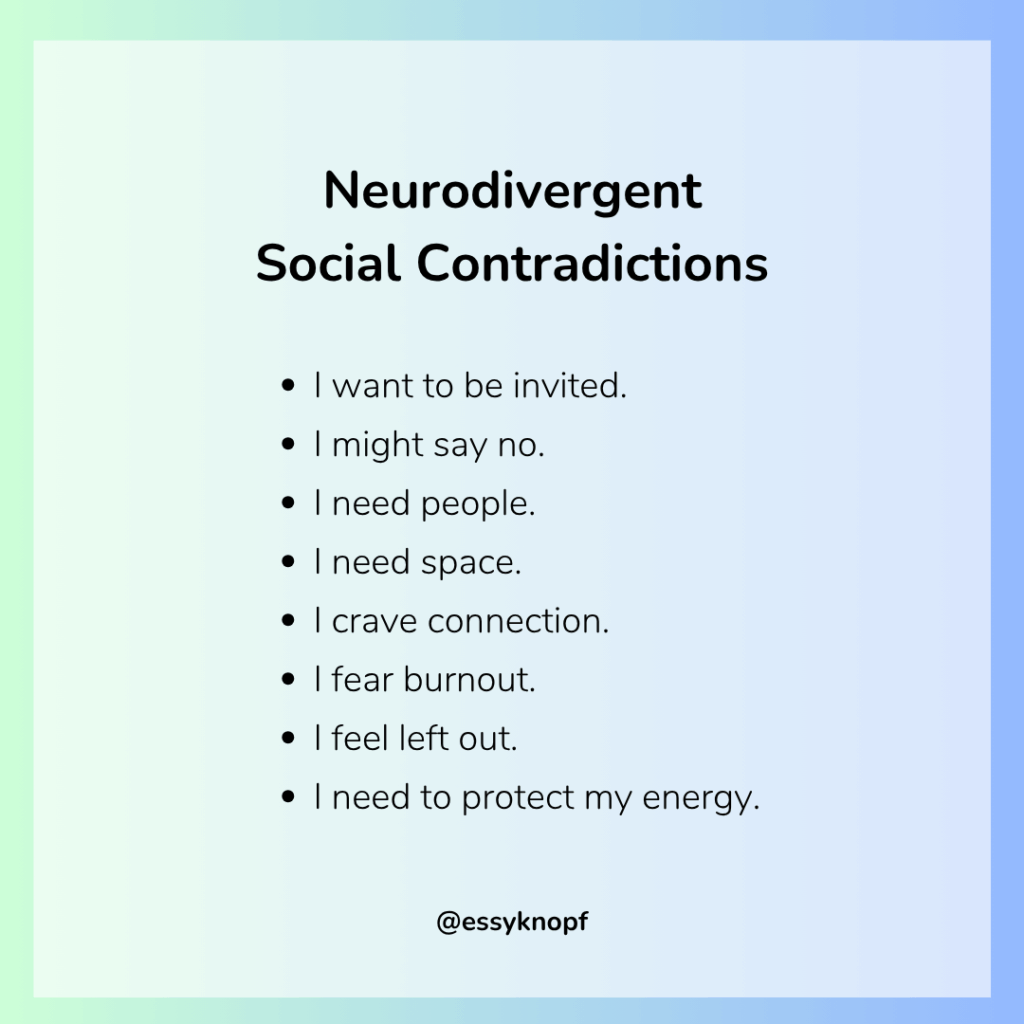
This is a core feature of neurodivergent social fatigue: the emotional conflict between desire for connection and the protective pull of solitude.
When Socializing Costs More Than It Gives
For many autistic and ADHD folks, socializing isn’t just showing up and having fun. It’s navigating complex terrain: planning, scripting, adjusting, and recovering. It’s effortful. Sometimes deeply draining.
Days in advance, the mental logistics begin. What’s the lighting like? Who’ll be there? What will I say? Will I have to explain why I’m not eating what everyone else is?
Once you arrive, sensory input starts to pile up. Bright lights, background chatter, music layered over conversation. You feel your nervous system go into high alert.
You smile. You laugh. You nod at the right moments. But internally, you’re juggling a dozen tasks at once. This is the side of neurodivergent social fatigue that others often don’t see.
And then comes the crash. The mask comes off. You lie still. You cancel plans. You fall into a loop of analyzing every word you said.
This is the hidden cost of connection. One that builds over time. And one that leaves you feeling like the “you” people see isn’t the whole you at all.
Feeling Left Out of Things We Didn’t Want to Attend
You see the photos: dinners, parties, spontaneous hangouts. Everyone smiling, shoulder to shoulder. And it hits—hard. This is what makes social comparison so dangerous.
You likely wouldn’t have gone. But no one asked. And that absence feels loud.
You try to reason with yourself. You remember all the events you turned down. All the times you needed space more than company. And yet, your heart still aches with loneliness.
That ache is familiar to anyone who’s lived with neurodivergent social fatigue. The pain that you weren’t thought of. That you don’t belong in the same way others do.
The Middle Place of Half-Belonging
There’s a quiet, hard-to-name place where many autistic and ADHD people live; a space between isolation and inclusion. You’re not totally alone. But you’re not fully held, either.
You have friends. You care about people. Some care deeply about you. But you still feel slightly out of orbit, like you’re never quite central in anyone’s world.
You’re rarely the first person someone calls. You don’t get added to the spontaneous group chat. If you don’t initiate, things often just… don’t happen.
So you become the one who plans. Who checks in. Who coordinates based on your bandwidth. It gives you a measure of control, and also reminds you of how little comes your way unless you ask.
When you stop reaching out, the quiet that follows feels unmistakable.
That quiet feeds into the sense that your social needs are inconvenient. That your boundaries are too high-maintenance. That others are happy to include you, but only if it’s easy.
This is a subtle, but deeply felt part of neurodivergent social fatigue: the slow accumulation of near-invisible reminders that your presence is optional. That people enjoy you, but don’t depend on you. That you’re liked, but not always remembered.
And somehow, almost-belonging can feel more painful than being entirely on your own.
Making Peace with the Contradiction
Some days, connection feels worth chasing. Other days, the idea of texting back or being “on” for anyone feels impossible.
Your needs shift. Your energy changes. And your ability to tolerate discomfort doesn’t always line up with your desire for closeness.
There’s nothing wrong with you for needing space. There’s nothing wrong with you for wanting closeness, either. These aren’t failures. They’re just your reality.
For those living with neurodivergent social fatigue, one of the most healing practices can be this: letting both truths exist. “I’m sad I wasn’t there.” And also, “I needed to stay home.” Both are real. Both matter.
Sometimes peace comes through small, manageable bridges: quiet hangouts with one trusted person, short calls with a friend who doesn’t need small talk, messages exchanged at your own pace.
You begin to build a rhythm that honors your nervous system, without giving up on connection entirely.
And slowly, maybe, you stop chasing the idea of a perfectly fitting social life. You start noticing what feels good, even if it doesn’t look like everyone else’s version of “normal.”
Final Thoughts
Living with neurodivergent social fatigue means constantly balancing between craving connection and preserving your energy. That’s a heavy emotional lift—especially when the world moves faster, louder, and more casually than you do.
If you’ve felt like you’re always the one adapting, adjusting, bracing, you’re not alone.
You’re doing the best you can to meet your needs while still showing up. That deserves recognition. That deserves care.
Imagine how much gentler life would feel if people understood this. If “no” didn’t mean goodbye. If solitude wasn’t taken personally. If invitations came with room for nuance.
We’re not fully there yet, but by talking about this contradiction, by honoring our limits and longings side by side, we inch closer to the world we need.
So if you’re navigating neurodivergent social fatigue—if you’re walking that thin line between connection and protection—I see you. And your way of being in the world makes complete sense.
Have you wrestled with the challenge of neurodivergent social fatigue in your own life?
Essy Knopf is a therapist who likes to explore what it means to be neurodivergent and queer. Subscribe to get all new posts sent directly to your inbox.
If you’ve ever felt like you had to be flawless just to be okay—like one slip-up might unravel your relationships, reputation, or even your sense of self—you’re not imagining things. For many neurodivergent folks, perfection is a question of safety.
This pressure to be “good” or “right” all the time is a trauma response; one that often stems from being judged, corrected, or punished for simply being different. This is the root of what we call moral perfectionism.
And here’s the thing: it makes sense. If your lived experience has taught you that being misunderstood can lead to shame, rejection, or even danger, of course you’ll try to control the narrative.
How Moral Perfectionism Develops
For many autistics and ADHDers, moral perfectionism is a slow build, shaped by years of subtle and not-so-subtle messages that being ourselves isn’t acceptable.
Think back to childhood. Maybe you were the kid who blurted out answers, who asked too many questions, who got fixated on fairness or honesty. And maybe the response from adults and peers wasn’t understanding, but annoyance, discipline, or dismissal.
Even when we weren’t explicitly punished, we were often corrected in ways that left deep impressions. A teacher might’ve snapped at you for interrupting when your ADHD brain just moved faster than the class. A friend might’ve gone quiet after you said something blunt, and no one ever explained why it upset them. These moments send a message: You’re not doing this right. Be careful. Don’t stand out.
So we start building rules in our heads. If I just follow this invisible script—if I’m polite, agreeable, emotionally controlled—maybe I won’t get hurt again. This is our attempt to construct a fragile kind of social safety net where the cost of error feels unbearably high.
That’s moral perfectionism: the desperate attempt to avoid harm by being unassailably “good.” It’s armor. But armor is heavy. And over time, it starts to suffocate the very person it was meant to protect.
The All-or-Nothing Trap
One of the most exhausting parts of moral perfectionism is the mental rigidity it breeds—what therapists often call black-and-white thinking or all-or-nothing thinking. It’s the belief that things are either right or wrong, safe or unsafe, good or bad, with no in-between.
This kind of thinking happens because ambiguity feels threatening. If you’ve spent your life trying to dodge social landmines, trying to avoid being shamed for things you didn’t even realize were “wrong,” then certainty becomes a lifeline. It’s easier to think in absolutes when the grey areas have historically been where you got hurt.
So we simplify. We tell ourselves: “If I get this right, I’m safe. If I mess up, I’m in danger.” But here’s the catch: the world is grey. Social rules are inconsistent. What’s “okay” in one group might be “rude” in another. And when we use rigid rules to try and manage a fluid world, we’re left feeling anxious, confused, and often ashamed.
The deeper problem is that this kind of black-and-white thinking affects how we see ourselves. A single mistake becomes a moral failure. A disagreement becomes a personal rejection. Suddenly, we’re not just someone who made an error—we’re a bad person.
Moral perfectionism tells us that being anything less than perfect is unacceptable. But living in that mental space is exhausting. And it slowly strips us of the ability to tolerate being human, with all the messiness and imperfection that entails.
The Inner Critic and External Judgment
If you live with moral perfectionism, you probably know the voice I’m about to describe. The one that says, “You should have known better.” “Why did you say that?” “They’re definitely upset with you.” It’s the voice that replays every interaction on a loop, picking apart your words, your tone, your timing.
This voice is relentless, and it doesn’t care about your intentions. To it, being perfect is the bare minimum. And that inner critic? It was built from all those years of being misunderstood, corrected, or excluded for being different.
For autistics and ADHDers, that critic often takes root early, constantly screaming warnings: Don’t mess up again. Don’t draw attention to yourself. Don’t let them see who you really are. Over time, we start to believe it. We mistake it for truth.
And here’s the twist: the longer we live under the tyranny of this critic, the more likely we are to project its judgments onto others. The same rigidity we apply to ourselves—expecting flawlessness, moral clarity, unshakeable rightness—can begin to show up in how we view the world. We might struggle to forgive others’ mistakes, or feel unsafe around those who act with ambiguity or imperfection.
But again, this isn’t because we’re cruel or hyperjudgmental. It’s because we’re wounded. We’ve survived by holding ourselves to impossible standards, and it feels terrifying to lower those standards—for ourselves or anyone else.
That’s the double bind of moral perfectionism: the critic inside keeps us small, and the judgment outside keeps us isolated. Breaking that cycle begins with recognizing the critic for what it is: a scared part of you trying to protect your heart. But it’s doing so with the wrong tools.
How to Start Unlearning Moral Perfectionism
If you’ve started to recognize moral perfectionism in your life, take a breath. This realization can feel heavy, but it’s also a powerful first step. Recognize that you’ve been responding exactly as anyone might when they’ve had to navigate years of judgment, rejection, and fear.
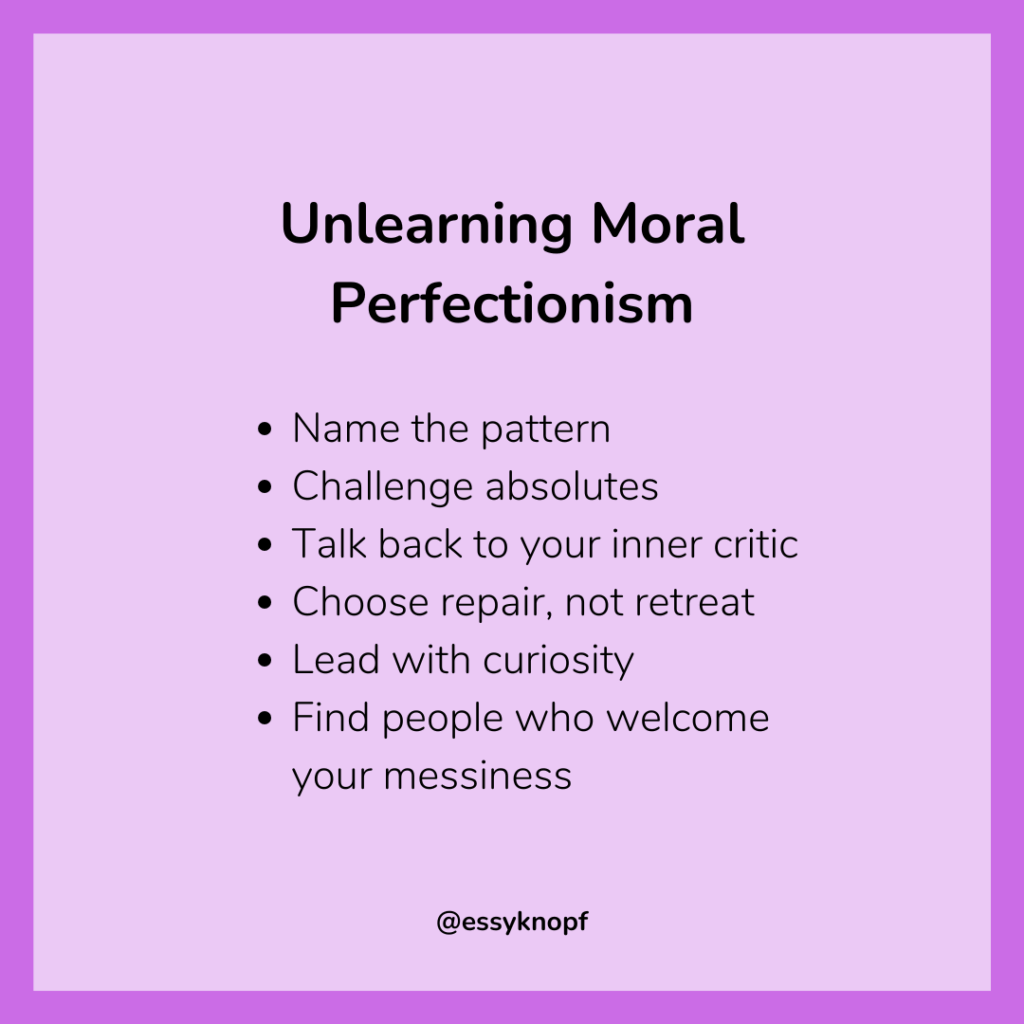
Unlearning moral perfectionism is about finding safety without needing to be flawless. Here’s how that journey can begin:
1. Name It When It’s Happening
The next time you catch yourself spiraling after a small mistake, pause. Say to yourself, “This feels like moral perfectionism.” That simple act of naming gives you space and turns a reaction into a moment of awareness. And that’s where change begins.
2. Ask: “What Else Might Be True?”
When your brain jumps to catastrophic conclusions—“They must hate me,” “I’m awful,” “This is ruined”—ask yourself: is there another way to see this? Maybe someone’s just distracted. Maybe they misunderstood. Maybe you’re tired. Not every misstep is a moral failure.
3. Recognize the Inner Critic—and Respond Kindly
When that inner voice starts up, acknowledge it: “I hear you. I know you’re trying to keep me safe.” Then add: “But I don’t need punishment. I need compassion.” Picture how you’d respond to a friend in the same situation and try offering that same grace to yourself.
4. Choose Repair Over Rejection
Mistakes happen. Ruptures are part of every relationship, whether personal or professional. When they do, practice staying. You don’t have to vanish in shame or lash out defensively. Apologize if needed, ask for clarification if you’re hurt, and keep showing up.
5. Lean Into Curiosity
Moral perfectionism thrives on certainty. But growth lives in curiosity. Ask yourself: what don’t I know here? What if there’s more to the story? Curiosity softens judgment. It opens space for connection, nuance, and learning.
6. Find People Who Welcome Your Imperfections
You deserve to be in spaces where you don’t have to earn love or acceptance with perfection. Look for people who can sit with complexity, give gentle feedback, and still choose you, especially when you’re messy or confused or unsure.
Final Thoughts
Moral perfectionism is often mistaken for high standards or personal integrity. But underneath, it’s usually something more tender; more painful. It’s the mark of someone who’s been hurt by judgment, by shame, by the endless need to explain themselves in a world that just didn’t get it.
If this post has made you think, “Oh… this is me,” know this: you are not alone. You didn’t choose to live with moral perfectionism, but you can choose to start unlearning it. It takes time and a ton of self-compassion.
You don’t have to be perfect to be good. You don’t have to be morally unimpeachable to deserve love, connection, or support. In fact, it’s in our mistakes, in our honest repair, and in our shared messiness that we often find the truest forms of human connection.
So let this be your reminder: you’re allowed to be complex. To change your mind. To speak imperfectly. You’re allowed to take up space as you are, and not as the flawless version of yourself your trauma once told you you had to be.
Have you noticed moral perfectionism showing up in your own life?
Essy Knopf is a therapist who likes to explore what it means to be neurodivergent and queer. Subscribe to get all new posts sent directly to your inbox.
Have you ever found yourself feeling like two different people in the same day: hyper-focused and inspired one minute, frozen and unable to function the next? Maybe you can deep-dive into a topic with laser focus for hours, but forget basic things like eating, replying to a text, or what day it is.
If that resonates, there’s a good chance you’re living with what psychologists call a “spiky neurocognitive profile”, a term that might sound clinical, but describes a very real and human experience for many autistics and ADHDers.
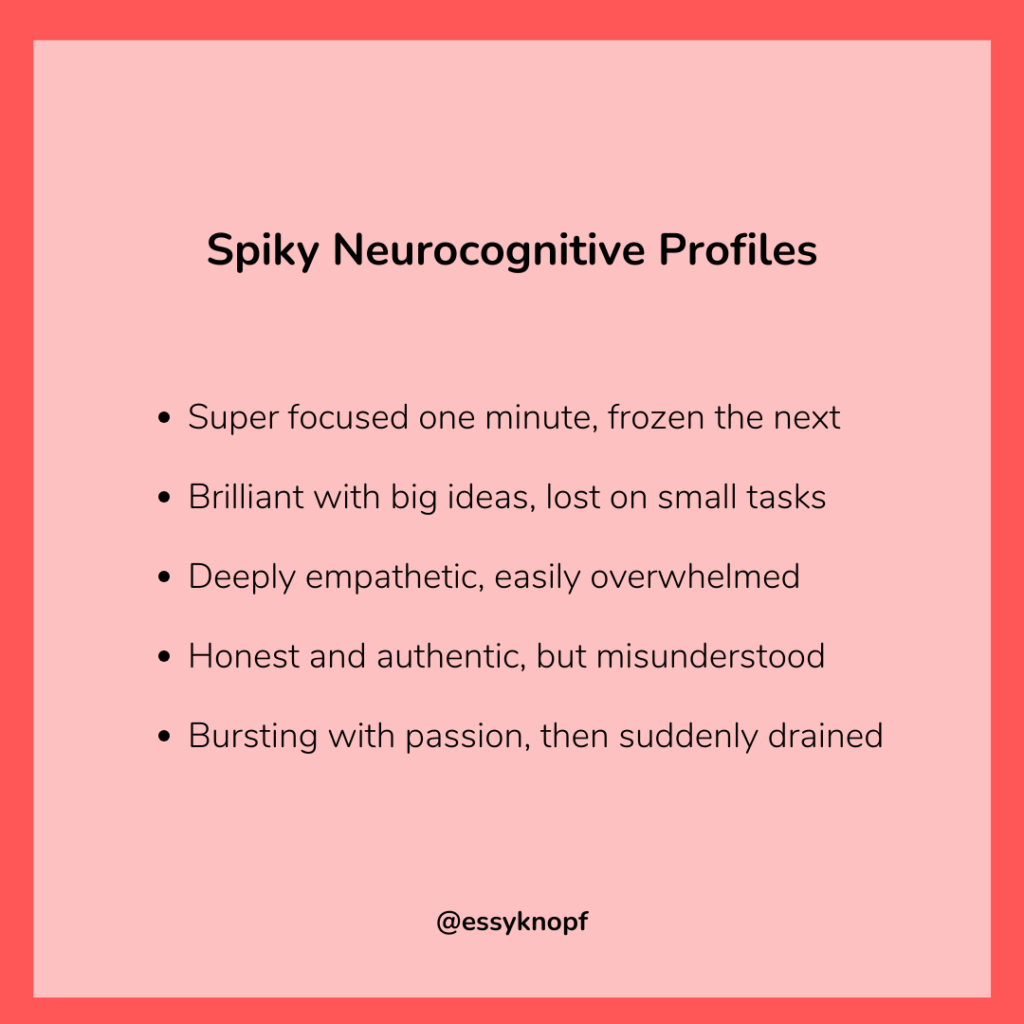
Rather than having “evenly distributed” cognitive abilities across all areas, people with spiky profiles experience dramatic highs and lows. Think of it like a jagged mountain range: towering peaks of strength alongside valleys of challenge. These are indicators of a brain that processes the world in its own vivid, nonlinear, and deeply personal way.
This post is about naming that reality. Not to fix it. Not to flatten it. But to understand and embrace it with strategy, compassion, and pride.
Why “Spiky” Isn’t a Flaw
In a society that prizes “well-roundedness” and consistency, living with a spiky neurocognitive profile can feel like a constant mismatch. You might be told you’re “too sensitive,” “too intense,” or “not living up to your potential.” But the real issue is that the world wasn’t built for your kind of brilliance.
These profiles mean you can excel in certain areas. Perhaps you write with startling clarity, have a photographic memory, or intuitively understand systems and emotions. But you may also struggle intensely with executive function, sensory input, or navigating unspoken social rules.
This variability can be frustrating, especially when others only see your peaks and assume the valleys are laziness or lack of effort. But spiky neurocognitive profiles are less a design flaw than a different design altogether.
In fact, they reflect how many neurodivergent brains are wired to function. The peaks often show us where our values, interests, and deepest motivations lie. The valleys often point to where we need support, accommodations, or healing from environments that misunderstood us.
So instead of asking, “Why am I like this?” maybe we can start asking, “What is this trying to show me?”
The Gifts in the Peaks
For those of us with spiky neurocognitive profiles, the peaks are often areas where our brains light up, our confidence kicks in, and our sense of flow comes alive.
Autistics, for example, are often hyper-systematizers: deeply attuned to structure and patterns across a wide range of domains. This might show up in how we organize physical spaces, decode emotional dynamics, or pick up on language cues that others miss.
This connects with another peak: deliberative thinking. Many autistics process slowly and thoroughly. We don’t rush to conclusions; we sit with complexity, ask hard questions, and make decisions rooted in depth, not impulse.
Then there’s hyper-empathy, an often-overlooked peak in both ADHDers and autistics. You might feel someone’s sadness before they say a word. You might weep at commercials or carry the emotional residue of a friend’s pain long after the conversation ends.
And let’s not forget authenticity. Many of us—especially those who’ve stopped masking or never learned to—communicate with refreshing honesty. We tell it like it is because we value truth.
When nurtured, these gifts transform relationships, workplaces, and communities. But to fully harness them, we have to stop apologizing for them. We have to name them for what they are: gifts, not glitches.
The Weight of the Valleys
For every dazzling peak in a spiky neurocognitive profile, there’s often a corresponding valley; a space where things just feel stuck, heavy, or impossible.
Imagine trying to start a simple task—like sending an email or getting out of bed—but feeling like your body and brain are locked in place. You want to do the thing. You know it’s important. But the initiation switch just won’t flip. That’s executive dysfunction.
For ADHDers, this might look like chronic procrastination, time blindness, or bouncing between tasks without completing any of them. For autistics, it might show up as inertia; feeling trapped in a routine or frozen when a plan changes unexpectedly. Both profiles can lead to intense emotional fallout, especially when tasks pile up and shame kicks in.
And speaking of shame, valleys are often made heavier not by the experience itself, but by the story we tell about it. “I should be able to do this.” “Everyone else can.” “What’s wrong with me?” These thoughts are the voice of internalized ableism, echoing years of societal messaging that says productivity equals worth.
In environments that don’t understand spiky neurocognitive profiles, our valleys get misread—labeled as defiance, disorganization, irresponsibility. And when we’re told those labels often enough, we start to believe them ourselves.
We end up in a vicious cycle: hit a valley → blame ourselves → push harder → burn out → repeat.
Breaking this cycle starts with understanding: your valleys are not moral failings. They are invitations. Signals. Areas where your brain is asking for scaffolding, not shame.
And when those valleys are supported with compassion—internally and externally—they inform you. They help you understand how your brilliant, complex, nonlinear brain truly works.
The Role of Context
If you take nothing else from this post, let it be this: spiky neurocognitive profiles exist in context.
Imagine trying to thrive as a visual thinker in a noisy, chaotic office with constant interruptions. Or navigating a rigid school system as a multi-passionate ADHDer who learns best through movement and exploration. Now imagine being told your struggles in those environments are a personal failing. Sound familiar?
When your peaks are unsupported and your valleys are misunderstood, life starts to feel like one long uphill battle. But it’s not your brain that’s the problem—it’s the fit.
This is where the social model of disability comes in. It tells us that people are disabled by environments that fail to accommodate their brains and bodies. And that changes everything.
Because instead of asking, “Why can’t I function like everyone else?” we start to ask, “What would help me function like myself?”
For a sensory-sensitive autistic in a loud workspace, accommodations like noise-canceling headphones, soft lighting, or a private office can make the difference between survival and thriving.
For an ADHDer student, allowing assignments to be submitted in creative formats—or offering flexible deadlines—can unlock passion and performance that rigid systems suppress.
These are acts of equity that level the playing field so our actual abilities can shine.
But when accommodations are denied—or when we internalize the belief that we shouldn’t need them—we start contorting ourselves to fit the system. We mask. We overperform. We burn out. And the longer we do it, the more it chips away at our self-worth.
This is why understanding the role of context is so crucial. It lets us shift from blaming ourselves to advocating for ourselves.
So the next time you find yourself stuck in a valley or struggling in a space that doesn’t make sense, ask: Is it me? Or is it the room I’m being asked to perform in?
Often, the answer will be loud and clear: it’s the room.
Reclaiming Your Profile with Compassion
Once you begin to recognize that your brain is not broken—but different—the path forward changes. You stop trying to “fix” your spiky neurocognitive profile, and start learning how to live with it. That’s what reclaiming looks like.
It begins with reframing. Instead of seeing yourself as inconsistent, start seeing yourself as specialized. You have a brain that excels in specific domains and struggles in others, not unlike an elite athlete who dominates their sport but needs a coach, nutritionist, and physical therapist to function at their best.
Your needs aren’t extra. They’re real. And they deserve to be met.
Start asking yourself gentler, more curious questions:
Instead of “Why can’t I do this simple thing?”, try “What’s getting in the way for my brain right now?”
Instead of “I should be able to focus!”, ask “What does my focus need in this moment—novelty, structure, or rest?”
Instead of “I’m just not good at adulting,” try “What tools could help this part of adulting work better for me?”
Once you reframe, you can strategize with supportive scaffolding that honors your profile.
If you hyper-focus, build in guardrails like timers, hydration reminders, visual breaks. If you’re multi-passionate, give yourself permission to move through seasons. You don’t have to pick one forever thing. You just have to pick the next right thing.
If executive dysfunction trips you up daily, start externalizing your memory: sticky notes, visual checklists, recurring alarms, “launch pads” by the front door. Ask for body-doubling or gentle accountability.
And if you’re feeling the burn of internalized ableism—the voice that whispers, You’re just making excuses. You should be able to do more—pause. Breathe. Then say back: “I deserve to feel safe, even when I’m struggling.”
That’s how we begin to reclaim the narrative. We name the reality of our spiky profiles without shame. We meet our needs without apology.
Final Thoughts
Living with a spiky neurocognitive profile means carrying contrasts within you: being both wildly capable and deeply overwhelmed, often in the same day. It’s confusing, exhausting, and yes, sometimes painful.
The fact the world wasn’t designed for spiky brains means the systems around you need to grow. And as you start to understand your profile—where the peaks are sharpest, where the valleys dip lowest—you build a kind of inner map. A guide for thriving on your own terms.
Gradually, you can learn to honor the truth of how you function, how you flourish, and what you need to feel whole.
So if you take anything from this post, let it be this: your profile is a way of being that deserves care, not correction.
Do you recognize parts of yourself in this post? Do you experience the peaks and valleys of a spiky neurocognitive profile?
Essy Knopf is a therapist who likes to explore what it means to be neurodivergent and queer. Subscribe to get all new posts sent directly to your inbox.
You make it through the week: meetings, deadlines, errands, everything on your list. You tell yourself, “Just get to Saturday.” And then, it arrives. No alarms. No emails. No obligations. A full day to yourself. Freedom.
But instead of relief, you feel an invisible weight pressing on your chest. You wander the house without purpose. You open your phone and scroll without focus. You think, This should feel good. Why doesn’t it?
A subtle dread creeps in. You start to feel unmoored, like you’ve slipped out of sync with the world. There’s nothing anchoring you, and instead of feeling free, you feel lost. Tired, even though you slept. Sad, even though nothing’s wrong. Irritable, but without a clear trigger.
This strange shift can feel so personal, like a flaw in your character. But for many neurodivergents, especially ADHDers and autistics, what you’re experiencing isn’t laziness or emotional instability, but rather a dopamine crash: a neurological dip that often follows periods of high stimulation or intense focus.
And when it hits, it sets the stage for something even more destabilizing: The Inventory.
The Inventory: When the Brain Turns Inward (and on You)
The Inventory doesn’t ask for permission. It doesn’t arrive with warning signs or knock gently on the door. It just appears, and suddenly, your brain is running an audit of your entire existence.
You’re lying in bed, or sitting on the couch, maybe halfway through a cup of tea. Then it begins: Am I doing enough with my life? Am I falling behind? Why don’t I feel closer to my friends? When was the last time I felt truly happy?
This is The Inventory. And it rarely pulls punches. It sifts through your relationships, your career, your body, your dreams… everything you’ve ever wanted or failed at. It’s as if your mind is trying to organize emotional clutter with the efficiency of a tax auditor on a deadline.
And sometimes, it hits on truths. Maybe you do want deeper friendships. Maybe your job is unfulfilling. These aren’t imaginary complaints. But what makes The Inventory so overwhelming is when it shows up.
You weren’t feeling this way yesterday. In fact, you might have been laughing, feeling connected, energized, even hopeful. What changed? The stimulation stopped. The dopamine dropped.
And that’s the crucial clue: The Inventory doesn’t start because your life fell apart. It starts because your brain, suddenly low on dopamine, is trying to explain the internal discomfort. It misreads chemistry as crisis. It turns a biological dip into an existential one.
When you understand this, it doesn’t erase the discomfort, but it can disrupt the spiral. Because The Inventory is often a sign that your nervous system is dysregulated and looking for meaning in the silence.
The Real Culprit: Dopamine Dysregulation
To understand what’s happening during these emotional plunges, we need to talk about dopamine. Dopamine is a neurotransmitter that helps us feel motivated, curious, and emotionally alive. It’s the chemical behind the little spark we feel when we start a project, connect with someone, or even just finish a to-do list.
For neurotypicals, dopamine flows relatively consistently. For many neurodivergent folks, especially autistics and ADHDers, dopamine is… spikier. It’s less like a gentle stream and more like a faucet someone keeps forgetting to turn on.
That means we might feel flat or irritable in the absence of stimulation, and euphoric, engaged, or even hyper-functional when we’re riding a dopamine high. And when that high ends—whether it’s after a project, a social event, or just the daily busyness of life—we crash.
You might feel heavy-limbed, foggy, or like you’re moving through molasses. Your interest in things you normally love evaporates. Your tolerance for noise, mess, or interruption drops to zero.
Because from the outside, nothing’s wrong. No crisis. No tragedy. And yet your body and brain are reacting like you’re in distress.
That’s the nature of dopamine dysregulation. Your brain has the chemicals it needs to feel balanced. And when it doesn’t? It tries to make sense of the imbalance. That’s where The Inventory comes in. It offers explanations—harsh ones—for what is, at its core, a neurological shift.
Recognizing this doesn’t make the crash go away. But it can give it shape. And with shape, you can begin to respond with understanding instead of self-judgment.
Dopamine Farming: How We Cope Without Knowing
When our brains are running low on dopamine, they don’t just sit back and suffer. They hustle. They scavenge. They adapt. This survival mode often leads us to something I call dopamine farming: the unconscious practice of seeking out tiny, fast hits of stimulation to offset the internal crash.
You’ve probably done it without even realizing. Maybe you open five tabs at once, scroll three different apps in rotation, snack even when you’re not hungry, or dive into an hours-long TikTok rabbit hole. This is your attempt to self-regulate.
Some of this is benign. Some of it is even creative, like switching between hobbies, dancing in the kitchen, or watching three episodes of your comfort show in a row. These can be gentle ways of topping up a depleted brain.
But not all dopamine farming is sustainable. For many neurodivergents, especially those with ADHD, the farming can become compulsive. What starts as a coping mechanism can spiral into overstimulation or burnout. You keep clicking, watching, doing, hoping to find the thing that gives you that little “zing.” And when nothing works? The crash hits harder.
The real catch is this: dopamine farming builds tolerance. That new app that gave you joy last week? It’s boring now. That hobby you used to love? You can’t get into it. You need more, faster, louder. And eventually, there’s nothing left to mine.
This is a strategy your brain has developed to stay afloat in a neurotypical world that rarely offers the kind of stimulation and structure you actually need.
And like all survival strategies, it works… until it doesn’t. Recognizing your farming patterns can help you shift from unconscious reaction to intentional support. You don’t need to give up dopamine farming altogether. You just need to diversify your crops.
Mountains and Irons: The Dopamine Management Strategies
If dopamine farming is the day-to-day survival method, then chasing mountains and juggling irons is the long game.
Many neurodivergent folks don’t just manage their dopamine dips with short-term fixes. We build systems around stimulation. Enter the “Many Mountains” and “Many Irons” strategies.
“Many Mountains” is about always having a summit in sight. Finish one big project? Immediately start planning the next. Hit a milestone? Start scouting for another goal to climb toward. There’s a thrill in the chase: the novelty, urgency, sense of progress. Each peak gives us a fresh burst of dopamine.
But it’s not really about reaching the top. It’s about the movement. Because stillness, for many of us, feels like sinking.
“Many Irons,” on the other hand, looks like having ten tasks in progress at any given time. You bounce between projects, rarely finishing one before another lights up your brain. Each switch keeps your mental energy flowing just enough to avoid the dreaded crash.
For a while, these strategies work. They make us productive, engaged, even creatively prolific. We might even feel proud of our momentum. But they’re also exhausting.
Climbing endless mountains can leave you burnt out before you realize it. Juggling too many irons can lead to overwhelm, paralysis, or deep emotional fatigue. Yet, when we stop, we’re faced with that old dread: the crash, the emptiness, the Inventory. So we keep moving.
There’s no shame in using these strategies. They’re ingenious, in their own way. But they’re not sustainable alone. The trick is to notice when the drive to do becomes a desperate attempt to avoid feeling. That’s when it might be time to shift from chasing peaks to cultivating balance.
When Work Becomes the Only Dopamine Source
Let’s talk about one of the most socially sanctioned—and most invisible—forms of dopamine farming: workaholism.
For many neurodivergent people, work can become our identity. It’s the one place where structure, praise, urgency, and clear goals collide to create a steady dopamine drip. And in a world where rest feels threatening and downtime feels dangerous, work becomes a lifeline.
But it’s a lifeline that’s wrapped in chains.
You start checking emails in bed. Skipping meals to finish “just one more thing.” You tell yourself you’ll rest after this project, and then immediately start the next one. You say yes to every opportunity, not because you want to, but because you’re afraid of what will surface in the silence if you say no.
And the world around you rewards it. Promotions, praise, validation—they reinforce the cycle. People call you driven, disciplined, passionate. But underneath the accolades, you’re running scared.
For many of us, workaholism isn’t ambition. It’s protection. From stillness. From shame. From the Inventory. From the crash.
It’s even trickier when you’ve tied your self-worth to what you produce. If you’ve spent a lifetime being praised for performance rather than presence, it can feel like your only value is in your output. So the idea of stopping—even for a day—feels like risking your entire identity.
But you are not your productivity. You are not only as good as your last deliverable.
Managing this behavior doesn’t always necessitate quitting your job or abandoning your passions. Sometimes, it’s about diversifying your dopamine sources.
The Crash: Not a Mood, a Pattern
The crash involves a full-body, full-brain shutdown that can leave you feeling hollow, heavy, or like someone pulled the plug on your internal power source.
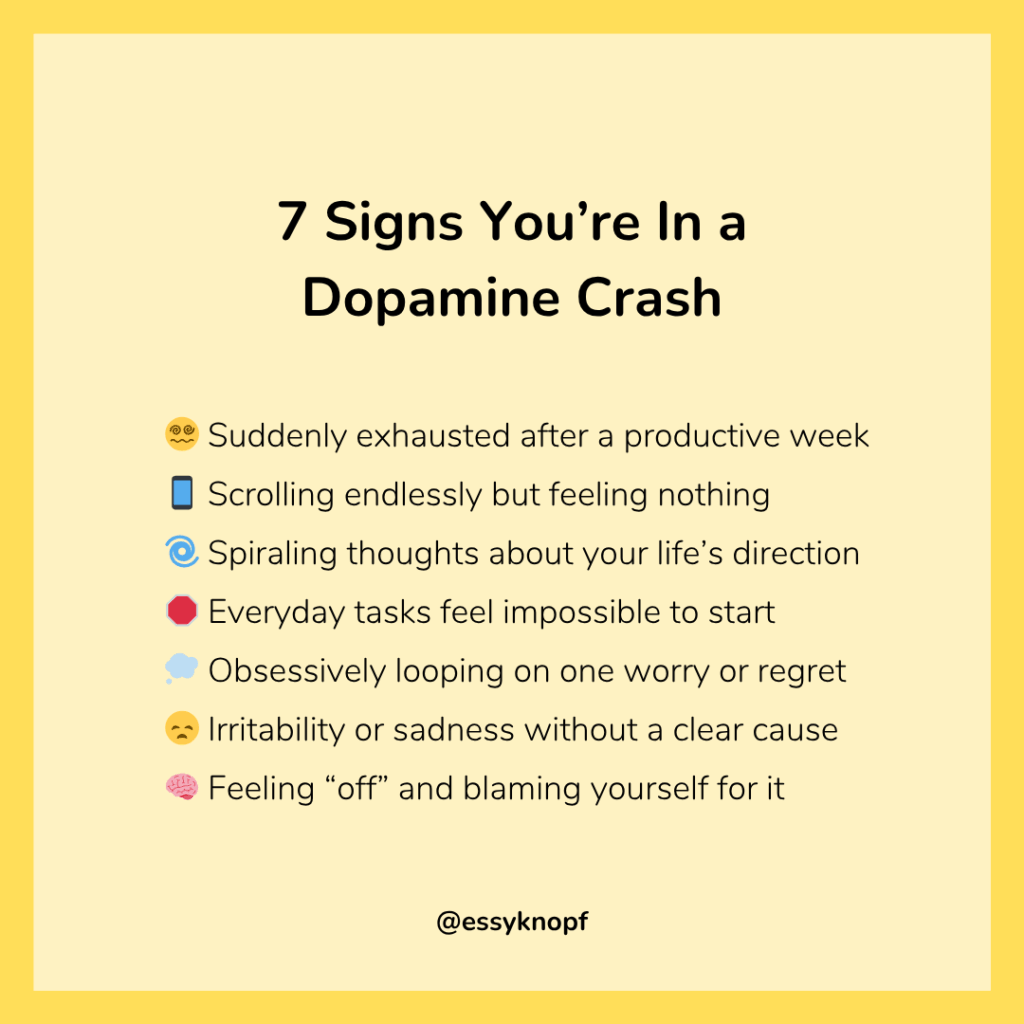
You might suddenly find everyday tasks insurmountable. Dishes, emails, even getting dressed can feel like climbing a mountain in fog. Your energy disappears without warning. Things you usually enjoy feel distant, lifeless. You might lie in bed for hours, not sleeping, just stuck. Maybe you scroll endlessly or start a show, only to abandon it minutes later. Nothing satisfies.
And then, as if on cue, the self-criticism kicks in: You’re lazy. You’re failing. You’re wasting your life. You start to panic.
This is the dopamine crash. I have described it as a neurological rubber band effect: your brain, after being stretched to its limit with constant stimulation, snapping back into depletion.
For many, this happens on weekends. You’ve over-functioned all week, masking distress, pushing through executive dysfunction, sprinting on fumes. And when the structure disappears? So does your ability to function.
I call it the “post-work plunge.” You spend the week sprinting through treacle, doing everything you can to keep up. Then Saturday hits… and you drop. You hit a wall. The quiet becomes a void, and the void becomes unbearable.
In response, you might instinctively self-medicate with dopamine sources, like junk food, social media, and retail therapy. But instead of feeling better, you often feel worse. Because what your brain needs is recovery, and not more stimulation.
And yet, the worst part might not be the crash itself, but what you tell yourself about the crash. That it means something’s wrong with you. That you’re broken. That everyone else is managing life better.
But this is a pattern—a neurological, predictable pattern. And if you can name it, you can start to break the shame that feeds it.
Perseveration: When the Brain Won’t Let Go
If dopamine crashes set the stage for emotional spirals, perseveration is what keeps you stuck in the loop.
Perseveration is that sticky, relentless mental looping where your brain grabs onto a thought and won’t let go. Like chewing on the same worry again and again, even when you know it’s hurting you. Even when you desperately want to stop.
Maybe it’s a fear: What if I never get my life together? Maybe it’s a regret: I shouldn’t have said that. I ruined everything. Maybe it’s a judgment: I’m a failure.
You might know rationally that it’s just a thought. But in that moment, it feels like truth. It feels urgent. Like your brain is trying to solve something, except it’s a puzzle with no solution. Just an infinite loop.
Perseveration is especially brutal during a crash, because your cognitive defenses are already down. Your dopamine is depleted, your executive function is compromised, and your emotional regulation is offline. So when your brain reaches for something to make sense of the discomfort, it often grabs the worst possible narrative, and hits replay.
It’s also deeply physical. Your stomach might tighten. Your chest may ache. Your thoughts blur into background static, except for that one thought, sharp and loud and impossible to shake.
Trying to fight it often makes it worse. Trying to logic your way out? Exhausting.
Perseveration is a symptom of neurodivergence, and often of a nervous system in distress. Of a brain trying to regulate without the chemicals it needs.
So What Helps?
If you’ve seen yourself in these patterns—dopamine crashes, endless inventories, work spirals, perseveration—I want you to know this: you’re navigating a complex, beautiful, and often misunderstood brain in a world that rarely supports how it functions.
This isn’t about trying harder. It’s about trying differently. Supporting your nervous system instead of shaming it. Creating structures that prevent the crash, or soften the fall.
Here are some strategies that can help:
1. Recognize the Pattern
Begin by noticing when the crash tends to hit. Is it after a long week? After finishing a big project? On slow Sunday mornings? Write it down. Track it. See if you can spot the rhythm. This awareness doesn’t stop the crash—but it gives you a foothold in it. It reminds you: This is a cycle. It’s not permanent.
2. Reframe the Narrative
When the Inventory starts, try to pause. Remind yourself: These thoughts might be a chemical response, not an existential crisis. You’re not forbidden from having needs or growth edges. But maybe this isn’t the best moment to decide your life needs a total overhaul. Let your brain recover before trying to interpret what it’s telling you.
3. Schedule Balanced Downtime
Free time doesn’t have to mean empty time. Try building a soft structure into your rest: a planned phone call, a favorite café, a slow walk with music. Include some low-key novelty. I like to mix things, such as video games for engagement, and a casual hangout for connection. It’s like scaffolding for your nervous system.
4. Set Limits on Work
Especially if work is your main dopamine source, boundaries are essential. Start small: no work emails after 7 PM. No “just checking” something on weekends. This boundary will feel uncomfortable at first. You’ll feel the pull to check, to do, to prove. But over time, your system will learn: I can rest and still be okay.
5. Use the “Many Mountains / Many Irons” Strategically
Not all multi-tasking is bad. Not all ambition is avoidance. The key is intention. Ask yourself: Which mountains energize me? Which irons actually nourish me? Are you building something meaningful, or just trying to outrun the crash?
6. Consider Medical Support
For some people, stimulant medication (under medical supervision) can significantly reduce the intensity of dopamine crashes. If this resonates, speak with a neurodivergent-aware psychiatrist. The goal isn’t to “fix” you. It’s to support your brain in functioning with more ease.
7. Mindfulness & Self-Compassion
Practices like journaling, movement, or breathwork can help you stay present and interrupt loops. But more than anything: be kind to yourself. When you crash, don’t ask, What’s wrong with me? Try asking, What does my nervous system need right now?
Sometimes the answer is stimulation. Sometimes it’s stillness. Sometimes, it’s just softness.
Final Thoughts: There’s a Name for This
If you’ve ever found yourself spiraling the moment life slows down—if rest feels more like a breakdown than a break—you’re not imagining it. You’re likely experiencing the very real, very misunderstood phenomenon of dopamine dysregulation.
This isn’t a personal failing. It’s not a sign that you’re too sensitive, too dramatic, or too lazy. It’s a reflection of how your brain is wired, and how hard it’s working to keep you upright in a world that doesn’t always meet your needs.
When we understand this, something powerful happens: we stop blaming ourselves. We start noticing patterns. And from there, we can create rhythms that honor our neurotype, where stimulation doesn’t have to lead to burnout, and rest doesn’t have to lead to collapse.
This is the work of self-understanding. Not pushing through, but tuning in. Building a life where you don’t need to chase productivity to feel okay. Where rest is allowed. Where balance is possible, even if it looks different for you than it does for others.
You don’t have to live at the mercy of the crash. You can learn to soften it. To ride it out. To meet it with compassion, instead of panic.
What does your crash look like? How do you notice it starting—and what helps you navigate it?
Essy Knopf is a therapist who likes to explore what it means to be neurodivergent and queer. Subscribe to get all new posts sent directly to your inbox.
Ever been called a “professional victim” for asking for basic dignity? Accused of having a “victim mentality” just because you pointed out how hard it is to function in a world that wasn’t built for your brain?
As a therapist who’s both autistic and ADHD. I talk about structural ableism a lot. Because I see it every day: in my clients, in my own history, in the systems we’re all trying to survive inside. I talk about burnout, masking, trauma, and the emotional toll of being misunderstood not because I want pity, but because naming the truth matters.
And yet, every time I name that truth, I get all kinds of backlash from online commenters.
Why Naming Needs Is Seen As Threatening
When you advocate for accommodations as a neurodivergents, you’re not asking for “extra.” You’re asking for the baseline things neurotypicals often take for granted: clear communication, environments that don’t trigger sensory overload, time to recover from burnout, compassion for executive dysfunction.
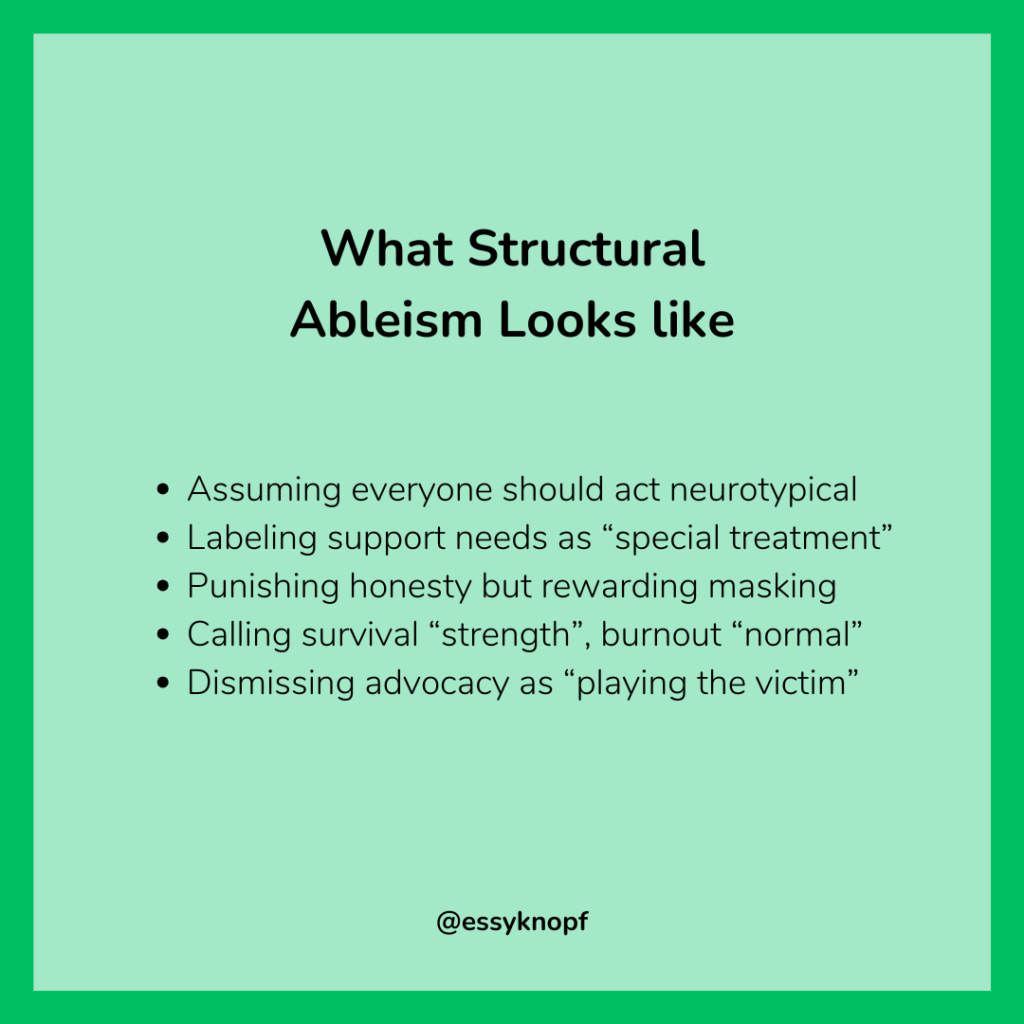
But we live in a culture steeped in structural ableism. It teaches everyone that asking for help is failure. That needing support means you’re not trying hard enough. That suffering is noble, and ease is indulgent.
So when you show up and say, “I need something different,” people think: “You think you deserve special treatment?” Because your truth forces them to confront their own stories, stories built around the myth that resilience means silence.
The Myth of the Self-Sufficient Human
Let’s get real: the idea that strength = independence is a fantasy. It’s a fantasy baked into capitalism, toxic individualism, and neuronormativity. This belief system is a cornerstone of structural ableism, which defines “normal” around neurotypical standards, and then punishes anyone who can’t meet them.
If you’ve ever been told, “Just try harder,” or “We all struggle,” or “Stop making excuses,” you’ve experienced this firsthand. These are cultural scripts meant to shut down dissent. They reinforce the idea that struggle is personal failure, not a signal that the system itself is broken.
But the truth is, many of us are already trying harder. We’re masking, people-pleasing, forcing ourselves through burnout and panic attacks and executive dysfunction just to meet the bare minimum. And we’re still being told we’re not doing enough.
That’s not a motivation problem. That’s structural ableism at work.
Survival Isn’t Strength. It’s What We Were Forced Into.
I moved out at 17. I worked, studied, moved countries, burned out again and again—and I never asked for help. Not because I didn’t need it, but because I believed needing help made me weak.
That belief didn’t come from nowhere. It came from being socialized in a world that shames neurodivergent needs. From hearing, “You’re too sensitive,” or “You think the rules don’t apply to you,” or “That’s just life.”
I internalized all of it.
But here’s the truth: survival isn’t a virtue. It’s a trauma response. Real strength is knowing you have needs and choosing to honor them anyway. It’s saying: “I refuse to perform a false version of ‘okay’ just so others won’t feel uncomfortable.”
Why They Call Us “Victims”
The label “professional victim” doesn’t come from critical thinking, but fear. From people who were never allowed to have needs, and so resent those who name theirs out loud.
Structural ableism teaches all of us to disconnect from our needs. To normalize pain. To see vulnerability as weakness. So when someone dares to speak up and say, “This isn’t working for me,” the world panics.
They mock. They gaslight. They blame. Because it’s easier to believe someone else is exaggerating than to admit that you, too, might be hurting…and that you deserved better, and didn’t get it.
This is why so many people lash out when we advocate for change. They see support as favoritism. They confuse advocacy with accusation. They call us “entitled” when all we’re doing is asking for parity.
Structural Ableism Is Real—And It’s Everywhere
Structural ableism isn’t just interpersonal ignorance. It’s built into institutions: schools that reward compliance over curiosity, workplaces that confuse burnout with dedication, healthcare systems that treat ADHD and autism as personal problems rather than systemic failures to accommodate.
It shows up when people can’t get diagnosed because they’ve masked too well. When they’re denied medication because their symptoms don’t match a textbook. When they’re mocked or excluded for being “weird” instead of recognized as navigating a hostile environment.
It also shows up as microaggressions, like being told you’re “overreacting” to sensory overwhelm, or having your direct communication style interpreted as rudeness.
Naming these realities isn’t playing the victim. It’s truth-telling.
Compassion Isn’t Coddling
When I say we need accommodations, I’m not asking the world to bend over backward. I’m asking it to stop breaking us. I’m asking for a culture that values sustainability over stoicism. That replaces “push through” with “pause and listen.”
I’m not lowering the bar. I’m redefining success.
Because if success requires burnout, masking, or erasing who we are to survive, we don’t want it. We deserve something better.
Final Thoughts
If you’ve ever been made to feel like your needs are “too much”, please hear this: your needs are human. And honoring them is not weakness. It’s wisdom.
We are not professional victims. We are people who are tired of being invisible. People with vision. People with fire in our bellies and hope in our hearts that this world can change. And that we can help change it.
Have you ever been shamed for advocating for your needs? Told you were too sensitive, dramatic, or weak? I’d love to hear how you responded—and what kept you going.
Essy Knopf is a therapist who likes to explore what it means to be neurodivergent and queer. Subscribe to get all new posts sent directly to your inbox.
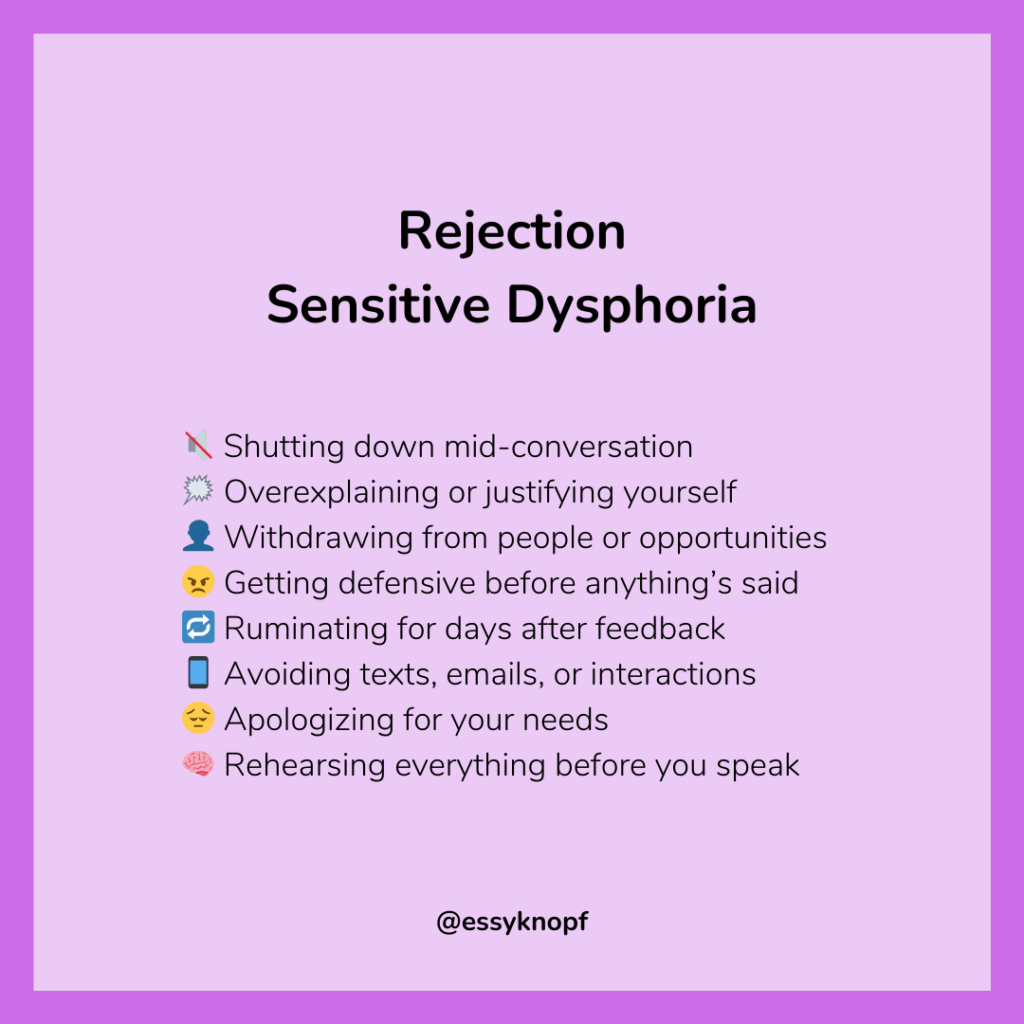
Rejection sensitive dysphoria (RSD) is an experience many autistic and ADHD people know intimately, even if they’ve never had the words to describe it.
It’s that gut punch feeling when someone says, “Hey, can we talk later?” It’s the mental spiral that kicks off before you even open a message, your brain filling in the blanks with the worst-case scenario.
It’s the shame that rushes in after you interrupt someone, stumble on your words, or send a message and don’t get a reply right away.
These are patterned, practiced, and deeply wired emotional responses.
Rejection sensitive dysphoria anticipates rejection. It crouches in the background of your mind, scanning for any hint that you might be in trouble: socially, emotionally, relationally.
It exists, I believe, because your nervous system has learned through experience that even small cues can lead to big pain. So now it prepares in advance. It braces. It overcorrects. It shuts down or explodes, trying to manage the threat before it fully lands.
And that “threat” can be as subtle as a short reply, a change in someone’s tone, a pause that feels just a little too long. The result? Your whole system goes on red alert.
You might freeze and go silent. You might start apologizing for things you haven’t even done. You might talk too fast, over-explain, or withdraw completely.
Some people get angry, preemptively defending themselves before they’ve even been accused of anything.
But all of it—the shutdowns, the spirals, the overreactions—is your nervous system doing what it’s been trained to do: survive social danger.
Why Does Rejection Sensitive Dysphoria Happen?
Rejection sensitive dysphoria doesn’t come out of nowhere.
You don’t just wake up one day suddenly afraid of being misunderstood, criticized, or “too much.” That sensitivity? That bracing-for-impact feeling? It’s learned. Layered. Shaped by dozens—maybe hundreds—of moments over time.
Especially for neurodivergent folks, that learning usually starts early. As children, many of us were asked, “Why are you like this?”
We were told to stop crying, stop talking, stop asking so many questions. We were called dramatic, sensitive, weird, difficult. Sometimes the words were harsh. Other times, it was just the tone. The sigh. The side-eye. The silence.
Those little moments of disconnection, especially when they came from people we relied on, added up.
When your nervous system doesn’t feel safe being fully seen, it learns to adapt. You start scanning for signs of disappointment before they’re even spoken. You rehearse what you’re going to say before saying it. You shrink in response to disapproval. You learn to apologize before you even know what you’re apologizing for.
You learn that visibility comes with risk, and that being misunderstood might cost you connection, belonging, or emotional safety.
This is especially true for autistic and ADHD individuals who grew up in environments that expected compliance, not curiosity. Who were taught to self-correct rather than be understood.
So your body begins to prepare. It sharpens its focus. It tightens your muscles. It quickens your heart. It tells you: “Watch out. Don’t mess up. Don’t be too much. Again.”
And that’s what rejection sensitive dysphoria really is: not a flaw in your character. Not an overreaction. But a nervous system that has internalized the expectation of being hurt, and is trying to get ahead of it.
The Impact of Structural Ableism
It’s important to stress that rejection sensitive dysphoria is not just about one hard conversation or one misunderstood comment, but about repeated exposure to a world that isn’t designed for your way of thinking, feeling, or communicating.
For neurodivergent people, structural ableism is the air we breathe. It’s everywhere, and often invisible to those who don’t experience it.
It shows up in classrooms that punish daydreaming instead of recognizing divergent attention. In workplaces that value speed over depth.
In social norms that expect eye contact, perfect timing, and just the right amount of emotional expression: not too much, not too little.
Even when we do our best to “pass,” we’re still often told we’re doing it wrong.
We’re called unprofessional for needing more processing time. Rude for being direct. Lazy for struggling with executive function. Too intense for showing passion. Too sensitive for naming how something hurt.
Over time, these microinjuries compound.
When you’re consistently met with misinterpretation or dismissal, you stop asking why the system is built this way. You start assuming you are the problem.
That’s how internalized ableism begins. You start to believe the judgment you’ve received. And eventually, you preempt it, rejecting yourself before anyone else has a chance to.
This is what makes rejection sensitive dysphoria so deeply painful: it often leaves us fighting the rejection after it’s taken root inside you.
It’s also why “just get over it” or “don’t take it so personally” is such an unhelpful response.
When the world has consistently told you your reactions are wrong—your way of being is wrong—it’s not just hard to bounce back. It feels dangerous to be fully yourself.
And so, many neurodivergent people begin to mask. Not because we’re trying to deceive others. But because we’re trying to survive inside systems that punish authenticity.
What Rejection Sensitive Dysphoria Can Look Like
Rejection sensitive dysphoria isn’t always obvious from the outside. It doesn’t have a single “look.” But on the inside, it’s almost always intense.
For some people, it hits like a shutdown. You’re mid-conversation, and suddenly you’re quiet. Frozen. Your brain starts looping through every word you just said, trying to spot what might’ve gone wrong. Your body is there, but your mind has exited the room.
Others go into overdrive. You feel cornered, even if no one has accused you of anything. You start overexplaining, trying to clarify every detail before you’re misunderstood.
You might get defensive, even panicky. You might interrupt, trying to fix something before you even know what it is.
And then there’s the spiral. You smile through it, nod politely, keep it together.
But later? You unravel. You reread a message twenty times, searching for proof that someone’s mad at you. You draft a reply, delete it, rewrite it. Maybe you don’t send it at all, and then obsess over your silence.
You ask yourself, Did I say the wrong thingDid I misread the tone?Are they annoyed with me?Was I too much?
And it doesn’t stop there.
You replay the whole interaction on loop, sometimes for hours. Sometimes for days.
This is what rejection sensitive dysphoria does to your nervous system. It hijacks it. It treats every unclear interaction like a pending disaster.
And the thing is, your brain can’t tell the difference between emotional pain and physical danger. So it launches a full fight/flight/freeze/fawn response over… an emoji. A pause. A neutral tone of voice.
This happens because you’ve been trained—often through real experience—to expect harm in moments like these.
And to protect yourself, you do what anyone would do: you avoid situations that might trigger more of it.
So you stop initiating conversations. You leave messages unanswered. You ghost creative projects, back out of job applications, cancel plans.
Or, you build elaborate mental systems to “prepare” for every outcome: scripting, rehearsing, people-pleasing, apologizing preemptively.
To an outside observer, it might look like you’re overreacting. But what’s actually happening is this: Your system is responding to a lifetime of pattern recognition. It’s saying, “This might not be safe. Let’s not get hurt again.”
When Others Misunderstand What’s Really Going On
One of the most painful parts of living with rejection sensitive dysphoria is this: most people don’t see it for what it is. They see the reaction, not the reason behind it.
You say, “That felt hard for me,” and they respond, “You’re being dramatic.” You express anxiety, and they tell you, “You’re making something out of nothing.” You ask for clarification, and they accuse you of overthinking, or worse: being manipulative.
When your emotions are constantly dismissed or minimized, the message becomes clear: your way of feeling is unacceptable. Your needs are inconvenient. Your pain makes other people uncomfortable.
And if you grew up neurodivergent in an ableist world, you probably learned that message early.
We’re told that other people can handle feedback “just fine.” That we’re too sensitive. That we need thicker skin. That our feelings are the problem.
But rejection sensitive dysphoria isn’t a personal failing. It’s not immaturity, or narcissism, or attention-seeking. It’s not “making it about you.”
Again, it’s a nervous system trying to survive social injury in a world that hands out those injuries far too often to neurodivergent people.
In a culture that prizes stoicism, emotional control, and “toughness,” there’s very little room for complex emotions, especially when they come from those of us who don’t perform them in “acceptable” ways.
Which is why we start filtering. We tone ourselves down. We start asking permission to have the feelings we’re already having.
The Shame Spiral and the Voice That Isn’t Yours
When rejection sensitive dysphoria takes root, it starts to reshape how you respond to yourself.
You begin to question your own emotions. To second-guess every reaction. You wonder: Am I being too sensitive? Did I make that up?Was I the problem all along?
You start replaying conversations, dissecting yourself and your ever move. What did I do wrong? Why am I like this? Why can’t I just let things go?
This is the beginning of the shame spiral. And once it starts, it’s hard to stop.
You come to see a moment of discomfort, an unsuccessful exchange, a misstep, as a moral indictment. A character flaw.
And when that shame becomes chronic, we adapt in the only ways we know how. We shrink our personalities. We avoid authenticity. We apologize for having feelings. We mask.
And here’s the cruel twist: even when others aren’t judging us, that internal voice still is. We start policing ourselves on behalf of the people who hurt us.
We hear their echoes: “You’re overreacting.” “People won’t want to deal with this side of you.” “You’re exhausting.” “You always take things the wrong way.”
Even when someone gives you kind feedback, you still panic. Even when someone reassures you, you still spiral. Even when no one is mad… your body prepares for fallout. Because you’re still fighting rejection from within.
Softening the Spiral: Internal Strategies for Rejection Sensitivity
There’s no five-step hack to make rejection sensitive dysphoria disappear. And honestly, most of us don’t need fixing. We need understanding.
That begins with the most powerful internal shift:
Naming what’s happening.
Just being able to say, “This feels like rejection, and my body is on high alert,” is often enough to break the shame-spiral, even just a little.
You’re not imagining things. You’re not being weak. You’re having a patterned nervous system response, and it makes sense.
That awareness creates space. And in that space, you can ask yourself gentler questions: What am I afraid this moment says about me? What part of me is trying to protect me right now? What would I offer a friend feeling what I’m feeling? Can I allow the feeling without letting it take over the story?
We often think we need to analyze our way out of spirals. But the truth is, many of us need to feel safe enough first in our bodies.
That’s where regulation comes in.
For some, that means movement: walking, stretching, shaking out tension. For others, it’s breathwork, music, or soothing sensory input.
Other examples include using weighted blankets, compression gear, nature sounds, stimming in peace, and rocking, humming, holding a fidget.
Sometimes, it’s saying your thoughts out loud to someone who won’t try to fix them, just witness them.
The more you practice noticing your nervous system’s cues before the spiral goes too deep, the more capacity you create to stay grounded when those rejection alarms go off.
And that? That’s real resilience.
Creating Safety in Connection: Interpersonal Support for RSD
Rejection sensitive dysphoria can be isolating.
Many of us have learned to brace for other people’s reactions. To anticipate invalidation. To expect criticism. And sometimes… we stop sharing altogether.
But the truth is, support can help. When someone meets our vulnerability with care instead of confusion, it changes everything.
So what does that look like?
If you care about someone who lives with RSD:
Don’t tiptoe, but do be clear and kind.
Vague statements like, “We need to talk,” “This isn’t working,” or “I have some feedback…” can send a rejection-sensitive nervous system into full-blown panic before the conversation even starts.
Try leading with reassurance and clarity: “Hey, I want to talk through something, but I want you to know upfront that I care about this relationship, and I’m not upset.” “There’s something I’d like to work on together. I want you to feel safe having the conversation.”
This isn’t coddling. It’s co-regulation. It helps the other person stay present enough to actually hear you.
And if someone does react strongly—by spiraling, shutting down, over-explaining, or seeming defensive—don’t assume they’re trying to manipulate the moment.
One of the most healing things you can do is affirm their experience without needing to debate it: “That makes sense, knowing what you’ve been through.” “You don’t need to justify your reaction to me.” “We’re okay—I’m not going anywhere.”
That kind of grounding helps us come back into connection.
And if you’re the one with rejection sensitivity?
You might find it hard to ask for this kind of support. Maybe you’ve been dismissed in the past. Maybe you’re afraid of seeming needy.
But you’re allowed to say: “Hey, I’m someone who’s sensitive to tone and ambiguity. When something’s up, it really helps if you can be direct but gentle.”
Or: “If we’re going to talk through something difficult, could you let me know upfront that you’re not angry? That helps my brain stay regulated.”
Or even: “I might get quiet or overexplain if I feel unsafe. I’m not trying to be difficult. It’s just how my nervous system protects me.”
You don’t have to apologize for needing clarity. You don’t have to feel ashamed for asking for reassurance. You don’t have to earn kindness.
Support works best when it’s mutual. We learn to regulate and self-advocate, while others learn to communicate with more care.
It’s Not Just You—It’s the System, Too
Rejection sensitive dysphoria is often treated like a personal flaw. Something to manage, fix, or hide. An emotional quirk that makes you hard to be around.
But let’s be clear: we don’t develop these responses in isolation. We learn them inside systems that reward emotional flatness, punish intensity, and treat neurodivergent expressions as problems to be solved.
And when you’re constantly navigating environments that see your sensitivity as weakness, your boundaries as overreactions, your requests as demands, it’s no wonder your nervous system stays on high alert.
So yes, there is personal work to do: learning regulation. Practicing self-trust. Untangling internalized shame. Reclaiming your emotional needs.
But that work doesn’t happen in a vacuum.
If the world around you keeps reactivating your pain… If institutions, families, workplaces, and even friends continue to interpret your sensitivity as dysfunction… It won’t matter how many coping strategies you master.
Because no amount of breathwork can override the harm of being repeatedly misunderstood. This is why healing from rejection sensitive dysphoria has to be a shared commitment.
We, as neurodivergent people, are already doing the labor: reflecting, adjusting, regulating, advocating. We need the people around us to meet us halfway.
We need systems that stop framing our pain as personality flaws. We need conversations that don’t weaponize feedback. We need emotional ramps the same way we build physical ones: simple, thoughtful, accessible.
This isn’t about walking on eggshells. It’s about treating emotional difference the way we treat any other form of human variation: with care, not control.
So if you live with rejection sensitivity, know this. Your reactions make sense. Your pain is valid. Your intensity is not a character defect. And your healing doesn’t have to be a solo journey.
Final Thoughts
If you experience rejection sensitive dysphoria, chances are you’ve just spent a long time adapting to an unsafe emotional world.
You deserve relationships that can hold your truth without making you feel broken for it.
Have you found ways to explain your sensitivity to others? What helps you feel safe during emotionally charged moments?
Has RSD shaped the way you connect, speak up, or show up?
Essy Knopf is a therapist who likes to explore what it means to be neurodivergent and queer. Subscribe to get all new posts sent directly to your inbox.
If you’re neurodivergent, chances are you’ve been judged simply for being yourself.
Maybe someone told you outright that you were rude. Or lazy. Or too sensitive. Or maybe no one said anything at all, but you felt the shift in energy after you forgot something, interrupted, or reacted “too much.”
And instead of someone asking what was going on for you, they decided what kind of person you were. Careless. Selfish. Dramatic. Disrespectful.
If you’re autistic or ADHD (or both), you’ve probably experienced this more times than you can count. And each time, a quiet, painful message was reinforced: you’re not just different. Rather, your character is defective.
When Behavior Gets Moralized
Most people don’t see the overwhelmed nervous system behind the meltdown. The literal thinking behind the confusion. The executive dysfunction behind the missed deadline. The emotional intensity behind the “overreaction.”
Instead, they make snap judgments. “He’s being difficult.” “She’s overreacting.” “They’re just making excuses.”
This is where neurodivergent shame begins: when other people interpret neurological differences as moral failures, and we begin to believe them.
Instead of seeing autism and ADHD as neurotypes, people treat them like personality defects. And slowly, quietly, that misunderstanding sinks in. Not just into how others treat us, but into how we treat ourselves.
We start to wonder, “Am I just inherently bad at life?”
The Weight We Learn to Carry
The shame we carry as neurodivergents doesn’t usually come from one single moment. It’s cumulative. It builds up over years of being misunderstood and misjudged.
It shows up in subtle ways:
Apologizing constantly, even when you haven’t done anything wrong
Shrinking your presence in a room
Second-guessing your tone, your word choice, your entire personality
Telling yourself to “just be normal” when your needs feel inconvenient
This is neurodivergent shame, and it runs deep. It’s the voice that says, “You’re too much. You’re hard to love. You’re broken.”
And it often starts in childhood. When we’re corrected, criticized, or excluded for things we didn’t even know were “wrong.” Over time, the message sticks: you can only be accepted if you hide who you are.
So we mask. We perform. We silence ourselves. And even though we might get by, we don’t feel whole.
The Double Empathy Problem (And Why We Get Blamed)
Damian Milton coined the term “double empathy problem” to describe the mutual misunderstanding between neurotypical and neurodivergent people. But let’s be real: only one group usually gets blamed.
Neurotypicals are seen as the “default”, so when communication breaks down, the assumption is that we failed.
They didn’t misunderstand us—we were just “rude.” They didn’t miss our distress—we were “overly emotional.” They didn’t notice our effort—we were “not trying hard enough.”
This dynamic deepens neurodivergent shame, especially because many of us do care deeply about how we impact others. We want to connect. We want to get it right. But we’re stuck navigating unspoken rules we weren’t taught, in a language we weren’t handed.
So we spend our lives trying to decode everyone else, while being misread in return.
When We Start to Believe the Worst About Ourselves
The most heartbreaking part? After enough of these misinterpretations, we stop advocating. We stop explaining. We stop trusting that we deserve to be understood.
We internalize the idea that we’re not just misunderstood, but defective. We tell ourselves: “I should’ve known better.” “Why am I like this?” “I’m probably just making excuses.” “Everyone else seems to manage. What’s wrong with me?”
It leads us to over-mask, over-apologize, and overextend. And worst of all, it makes us feel like we have to earn our humanity.
Neurodivergent shame doesn’t come from nowhere. It’s a product of a culture that glorifies conformity, punishes difference, and upholds neurotypical ways of being as morally superior.
We’re taught to see deviations from the norm not just as quirks, but as threats.
Think about how society labels behavior. Quiet? You’re standoffish. Blunt? You’re rude. Overwhelmed? You’re unstable. Inattentive? You’re lazy.
When you live in an ableist world where your very way of existing is constantly scrutinized, it’s not surprising that shame takes root.
Reclaiming the Narrative
Here’s the truth: you are not bad because your nervous system responds differently. You are not unworthy because you missed a cue, cried too loudly, forgot the thing, or said the quiet part out loud.
What you’ve experienced is less personal failure than it is systemic misunderstanding. And the shame you carry? It’s not yours to begin with. It’s inherited, conditioned, and imposed.
Healing from neurodivergent shame isn’t about becoming someone else. It’s about reconnecting with the parts of you that never needed to be hidden in the first place.
So What Can We Do About It?
🌱 Start with compassion—for yourself. You were never meant to thrive in a world that didn’t accommodate you. Every so-called “mistake” you made was likely a survival response.
🧠 Learn about your neurotype. The more you understand your brain, the easier it becomes to see your past through a lens of empathy instead of judgment.
💬 Find your people. Community matters. Being in spaces where your traits are normalized (or even celebrated) is an antidote to shame.
🛑 Set boundaries—with others and yourself. That includes saying no to over-apologizing, overworking, and self-silencing.
🎯 Shift the story. When that inner critic starts up, ask: “Is this shame speaking, or is this me?” If it’s shame, it doesn’t get to lead.
Final Thoughts
If this resonated, you’re not alone. Neurodivergent shame is something so many of us carry. Not because there’s something wrong with us, but because we were taught to believe there was.
You deserve spaces where you don’t have to justify your needs. You deserve relationships where you don’t have to perform. You deserve a life where your brain isn’t a burden.
Have you experienced neurodivergent shame? How have you started to unlearn it—or how do you want to?
Essy Knopf is a therapist who likes to explore what it means to be neurodivergent and queer. Subscribe to get all new posts sent directly to your inbox.
Have you ever wished for a tool that just gets your brain?
For autistics and ADHDers, AI is quickly becoming that tool; a supportive presence that helps manage chaos, navigate shutdowns, and rewrite that awkward email you’ve drafted five times in your head.
But like any tool, it’s not perfect. So let’s unpack the real ways AI is helping neurodivergent people, why it’s more than just a tech trend, and what ethical concerns we can’t ignore.
AI and Neurodivergence: Accessibility That Actually Works
Let’s talk about accessibility, not in the vague, corporate-policy sense, but in the “I can finally send that email I’ve been avoiding for three weeks” kind of way.
If you’re neurodivergent, you already know that accessibility isn’t about fancy features or abstract inclusion statements. It’s about reducing friction: the invisible kind that creeps into daily tasks and quietly derails everything. And one of the biggest sources of that friction? Executive dysfunction.
This isn’t occasional forgetfulness or “procrastination.” Executive dysfunction can feel like your brain has been hijacked. It’s the paralysis before starting, the mental fog halfway through, and the complete blank-out when you try to pick a task back up. It’s knowing what you should do and still not being able to do it, then feeling the crushing guilt afterward.
This is where the connection between AI and neurodivergence becomes deeply personal, and incredibly powerful.
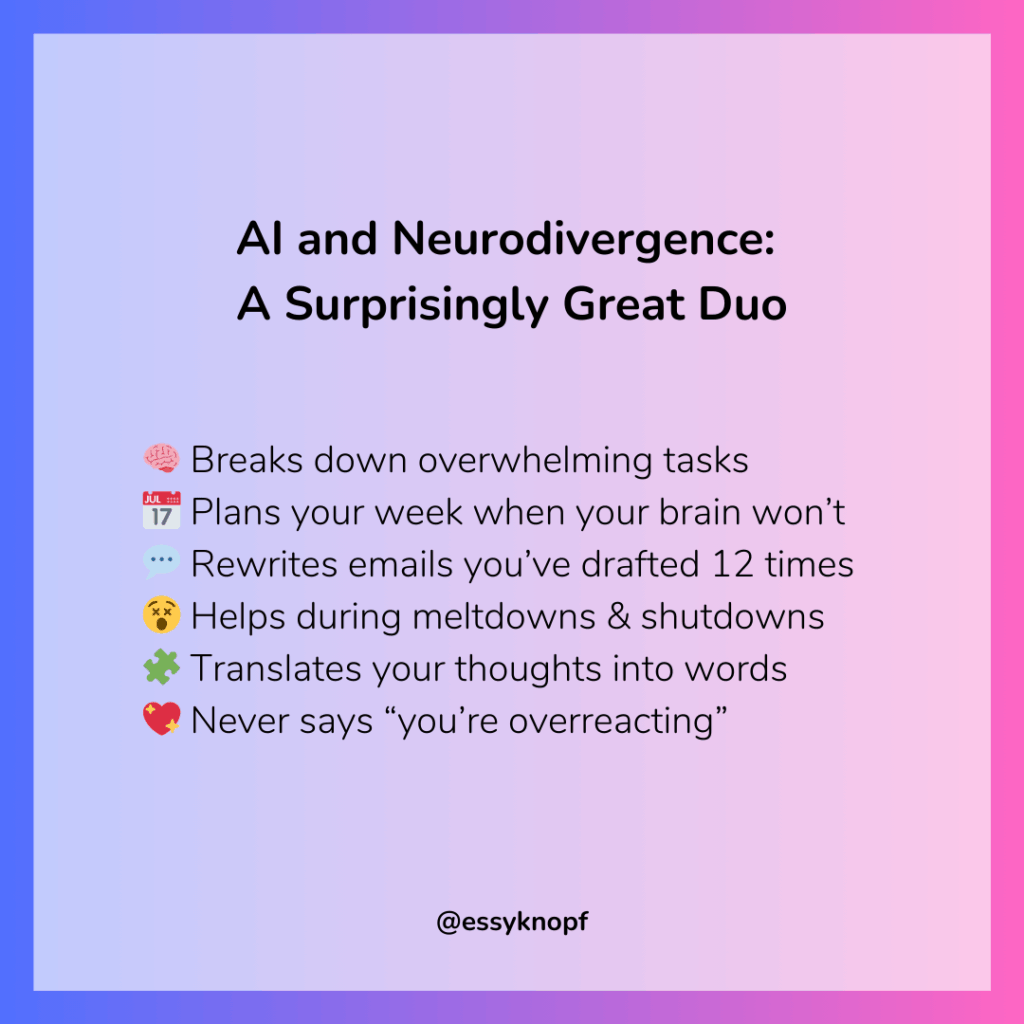
AI offers something we don’t get nearly enough: real-time, nonjudgmental support. You can say, “Help me break this task down,” and it does. You can say, “Can you reframe this in ADHD-friendly language?” and it will. Want a checklist? A visual breakdown? A five-minute version of a fifty-minute task? Done.
There’s no exasperation. No “You should know this already.” No watching the clock while you try to find the words. Just scaffolding: customizable, calm, and always available.
For many neurodivergents, that kind of support is revolutionary.
Because in a world that constantly punishes you for struggling with “simple” things, being able to complete a task on your terms, with dignity and without shame, is nothing short of life-changing.
That’s what accessibility should be. And that’s what the relationship between AI and neurodivergence is finally making possible.
Emotional Regulation and Shutdowns
When you’re on the brink of a shutdown, caught in the looping spiral of rejection sensitivity, or feeling the slow creep of a meltdown, what you often need most is someone to just be there. Someone steady. Nonjudgmental. Safe.
But mental health crises rarely wait for appointments. Support systems aren’t always awake at 2 a.m. And not everyone has access to consistent, affirming care. That’s where AI becomes an unlikely but deeply impactful lifeline.
No, it’s not a therapist. But it doesn’t dismiss your pain. It won’t invalidate you. It won’t say, “You’re overreacting.” Instead, it says, “Tell me what’s going on.” And for many neurodivergents—especially those who’ve been gaslit, shamed, or misunderstood—those words land like oxygen.
The relationship between AI and neurodivergence is evolving into a surprising form of emotional scaffolding. Some use AI to talk through meltdowns in real time. Others use it to co-regulate, naming sensations, exploring grounding techniques, or reflecting their feelings back to them with curiosity rather than critique.
In moments of distress, AI offers structure when everything feels formless. Clarity when thoughts are tangled. Gentle neutrality when the world feels hostile.
It’s not a replacement for human care. But it is an anchor, especially when your nervous system is overwhelmed and your brain is stuck in survival mode.
And sometimes, a calm, consistent presence—even one made of code—is exactly what brings you back to center.
Communication That Honors Authenticity
For many autistics and ADHDers, communication can be exhausting. Social scripts don’t always come naturally. Language gets tangled. Your message is clear in your head, but somehow becomes a minefield of second-guessing when you try to speak or write it aloud.
Drafting the “right” email, expressing a boundary, preparing for a job interview—these aren’t small tasks. They can become full-on emotional marathons. And the risk of being misunderstood? It’s not hypothetical. It’s something we carry in our bodies.
This is where AI and neurodivergence intersect in a beautifully empowering way. AI can help shape your words without erasing your voice. You can say, “Here’s what I want to say. Can you help me make it clearer?” or “Can you reword this to sound confident but kind?” And it will. No eye rolls. No shame.
For those navigating rejection sensitivity, slow processing, or social trauma, this kind of assistance can be game-changing. It’s not about sounding like someone else. It’s about expressing yourself in a way that’s true to your values, but easier for others to receive.
Think of AI not as a filter, but as a translator: someone who helps your internal clarity reach the outside world intact. That’s not just practical. It’s healing.
More Than a Convenience: It’s Access
It’s easy for some to look at AI tools and say, “That’s just a shortcut.” But for neurodivergents, AI and neurodivergence together offer something much deeper than convenience. They offer access.
Access to follow-through when executive dysfunction steals your momentum. Access to emotional regulation when your nervous system is in overdrive. Access to self-expression when words are hard to find.
And perhaps most importantly, access to dignity.
Because when you’re undiagnosed, under-resourced, or deep in burnout, life often becomes a series of impossible choices. Do I cook or answer emails? Shower or return that phone call? Do I try to explain my needs one more time, or just mask until I collapse?
AI doesn’t solve these problems, but it can soften them. It can help you plan your week in 10-minute hyperfocus bursts. It can simplify that overwhelming medical form. It can draft a therapy prep note so you don’t walk into your session blank and dissociated.
This is the heart of the conversation around AI and neurodivergence. Some people imply it’s not about cutting corners, when it’s really about building bridges to functioning, to autonomy, to being seen.
In a world where support is often conditional, AI offers something powerful: help without having to prove you need it.
Creativity, Therapy, and the Unexpected Ways We Thrive
AI can improve functioning, yes, but it also holds the potential to help neurodivergents thrive.
This goes beyond task lists or to-do reminders. For many autistics and ADHDers, creativity and self-expression are deeply meaningful, but often blocked by executive dysfunction, overwhelm, or even fear of judgment. That’s where the relationship between AI and neurodivergence becomes radical.
Writers use AI to co-brainstorm when the blank page feels like a brick wall. It can offer prompts, structure ideas, or gently reshape scattered thoughts into something usable, without robbing the work of its authenticity.
Artists use it to storyboard, plan exhibitions, or even generate reference images when their internal visual library feels too burnt out to draw from.
Neurodivergent entrepreneurs have started using AI to map out business pitches or create website content when the pressure to “sound professional” otherwise triggers anxiety or rejection sensitivity.
And in therapeutic spaces, some use AI to explore their emotions in private, especially those who struggle with alexithymia or verbal processing. It can help identify emotional patterns, track energy fluctuations, or even simulate reflective questions that they can later bring into sessions with a human therapist.
The beauty of AI and neurodivergence working together is not in outsourcing ability, but in reducing friction. It offers a gentle nudge where inertia might otherwise take over. It creates forward motion when internal chaos makes stillness feel impossible.
Let’s Talk Ethics (Without the Shame)
Now, let’s be clear: this isn’t a love letter to AI. It’s not perfect. It’s not magic. And it’s definitely not without serious ethical concerns. Any responsible conversation about the role of AI and neurodivergence needs to include the other side of the equation:
Environmental impact. The energy consumption behind training and running large AI models is enormous. We can’t ignore that these tools rely on vast computing resources, often powered by fossil fuels, and contribute to global sustainability issues.
Creator consent. Many AI systems are trained on content scraped from the internet, writing, art, music, often without the creators’ knowledge or permission. This raises critical questions about ownership, compensation, and exploitation.
Misinformation risks. AI doesn’t always get things right. In fact, it can confidently generate responses that are inaccurate, biased, or even harmful, especially dangerous when it comes to medical, legal, or crisis-related topics.
Overuse as avoidance. For some, AI can become a crutch, used to sidestep discomfort or delay important growth. That might look like never practicing difficult conversations or outsourcing every decision out of fear of “getting it wrong.”
These are real, valid concerns. And they deserve thoughtful, ongoing discussion, especially as AI continues to evolve faster than the regulations around it.
But here’s what’s not ethical: shaming marginalized people for using tools that finally meet their needs.
For many neurodivergents, AI isn’t replacing support. It’s providing it in a world that often doesn’t. It’s stepping in when therapy is inaccessible, when burnout makes functioning feel impossible, when rejection sensitivity makes even a simple email feel like a mountain.
The value of AI and neurodivergence isn’t that AI is flawless. It’s that it’s there. When waitlists are months long. When friends don’t understand. When you’ve run out of executive function but still have life to live.
Critiquing AI is necessary. Holding tech companies accountable? Vital. But when that critique gets directed at neurodivergents, already navigating systemic ableism, isolation, and exhaustion, it stops being about ethics and starts becoming moral gatekeeping.
We don’t need perfection. We need compassion. And we need tools that help us survive without requiring us to explain, again and again, why we need help in the first place.
Final Thoughts
AI isn’t a magic wand, but for autistics and ADHDers, it can be a transformative.
In a society that constantly tells us to mask, hustle, and self-regulate without help, AI offers something radical: support that adapts to neurodivergent needs. And for many of us, that’s the first time we’ve truly felt accommodated.
Have you used AI to support your executive function, manage emotions, or navigate communication challenges? What’s helped, or what hasn’t?
Essy Knopf is a therapist who likes to explore what it means to be neurodivergent and queer. Subscribe to get all new posts sent directly to your inbox.
Have you ever been told you’re not trying hard enough, even when you’re giving it everything you’ve got?
If you’re neurodivergent, that might sound all too familiar. You show up. You push through. But somehow, it still feels like you’re falling short.
But the truth is, it’s not you. It’s the environment. And distributive justice is the lens that helps us see that clearly.
So, What Is Distributive Justice?
Distributive justice is about redefining fairness. Not as “treating everyone the same,” but as “meeting people where they are.”
It’s a concept rooted in disability justice, and it completely flips the script on what most people think fairness looks like.
Giving everyone the same thing might seem equal, but it’s not always equitable. If you hand out identical bikes to a 6-foot-tall adult, a child, and someone who uses a wheelchair, you’re technically being equal, but not remotely fair.
Distributive justice says: let’s stop pretending that sameness equals justice. Let’s actually give people what they need.
For Neurodivergents, Fairness Looks Different
Fairness isn’t one-size-fits-all. For those of us who are autistic or ADHD, it might look like:
Pacing your work without a ticking clock
Access to low-stimulation zones when the world gets too loud
Options to communicate without picking up the phone (hello, email and text!)
Deadlines that flex with your energy, not just the calendar
Freedom to move, fidget, or stim without side-eyes or shame
They’re the basic things that help us function as neurodivergents. Distributive justice frames these supports as essential, not as favors, not as exceptions, and definitely not as burdens.
Because expecting everyone to thrive in a system designed for one type of brain isn’t fair. It’s exclusion dressed up as neutrality.
What Happens When Support Isn’t Built In?
When we don’t get the support we need, we start to believe we’re the problem. That inner voice gets louder: “Why can’t you keep up?” “Why are you like this?” “Everyone else is managing, so why can’t you?”
That voice is internalized ableism, and it grows in environments where distributive justice is missing.
But when our needs are recognized and honored, that voice quiets down. We begin to replace self-blame with self-trust.
Neurodivergent Needs Aren’t Static, and Our Support Shouldn’t Be Either
Here’s something most systems don’t account for: neurodivergence isn’t always consistent.
Some days, we’re on top of everything. Other days, replying to one email feels like climbing Everest.
Distributive justice acknowledges this fluctuation. It calls for support that adapts, because the alternative is forcing people to constantly prove their struggles just to receive basic accommodations.
This kind of flexibility is the heart of equitable access.
If You Have to Mask, It’s Not Real Inclusion
Masking refers to all the ways we learn to hide or shrink ourselves to “fit in.”
We suppress stims, avoid saying what we really mean, force eye contact, and memorize social scripts. Just to seem “normal.” Just to be accepted.
But any space that demands you abandon your authenticity isn’t inclusive. It’s conditional.
Distributive justice asks a better question: not “how can you fit in?” but “how can this space meet you halfway?”
This Is Bigger Than Just Accommodations
Distributive justice goes beyond support, touching on everything from policy to representation.
Who designs the systems? Who decides what help looks like? Who gets a voice in shaping solutions?
Too often, it’s not neurodivergents. And that needs to change.
Real justice means redistributing power, not just resources. It means recognizing the emotional labor we already carry—educating others, self-advocating, masking—and shifting some of that burden off our shoulders.
Final Thoughts
Thriving shouldn’t be something we have to earn by pushing ourselves to burnout.
Distributive justice is about building environments that adapt to our needs, instead of demanding we mold ourselves to theirs. It’s about designing systems where neurodivergent people don’t have to fight for the basics.
Because when the world stops asking us to prove we’re worthy of support—and simply offers it—we stop surviving and start thriving.
What would distributive justice look like in your life?
Essy Knopf is a therapist who likes to explore what it means to be neurodivergent and queer. Subscribe to get all new posts sent directly to your inbox.
Have you ever sent a text that felt raw and real, only to get silence in return?
Have you re-read the thread a dozen times, wondering if you said something wrong, came on too strong, or imagined the whole connection?
If you’re autistic, ADHD, or both, what might seem like “overthinking” is often your nervous system in high alert, scanning for danger. People might say you’re being “too sensitive,” but the reality is your brain has learned that connection can be unpredictable, and sometimes, unsafe.
This is anxious attachment, and for neurodivergent people, it hits differently.
What Is Anxious Attachment, Really?
Anxious attachment isn’t about being “clingy” or “too much.” It’s a pattern shaped by inconsistency.
When love, attention, or validation were given and then taken away—or delivered conditionally—you learned to brace for loss.
As a child, maybe your emotions were met with confusion, withdrawal, or punishment.
As an adult, you might now find yourself hyperaware of tone, pauses, and the space between replies. Every interaction becomes a high-stakes event.
For neurodivergent folks, this experience is even more complex. The world has often misread our intentions, dismissed our needs, and told us our perceptions are flawed. So we over-explain. We shape-shift. We chase emotional breadcrumbs. And we call it love.
How Autism and ADHD Fuel the Pattern
Autistics are often deeply sensitive to changes in emotional rhythm, even if we struggle with interpreting subtext.
ADHDers might hyperfocus on relationships, craving clarity and intensity, only to become dysregulated by mixed signals.
When someone pulls away or grows vague, your entire body reacts. It feels sudden, even if the signs were subtle.
That’s because your nervous system is storing a history of unpredictability and treating this moment like a threat.
This often is more than anxious attachment. It may even be complex PTSD. And this response is your body is trying to keep you safe.
Internalized Ableism and Emotional Gaslighting
If you’re neurodivergent, you’ve likely heard messages like: “You’re overreacting.” “You’re reading too much into it.” “You’re just being dramatic.”
Over time, this teaches us not to trust ourselves. So when we feel anxious attachment coming online, we question it.
We minimize our needs. We apologize for existing. We believe the problem must be us.
But often, what looks like anxiety is just your nervous system asking, “Am I safe to be real here?”
The Anxious-Avoidant Loop (and Why It’s So Familiar)
Many neurodivergent people fall into a particular pattern: you meet someone who seems into you.
They’re present. Responsive. Curious. Your brain lights up. You think, “Finally, someone who sees me.”
And then… they pull away. Suddenly, they’re vague. They stop texting. Their energy drops off.
You panic. You double-text. You check your tone. You wonder if you misread everything. They respond less. You try harder. They drift further.
This is the anxious-avoidant loop: you pursue, they withdraw.
The more anxious you feel, the more you reach out. The more you reach, the more they pull away. It becomes a cycle that feels impossible to stop, and devastating to stay in.
But here’s the truth: it’s often not even about them. It’s your body trying to resolve the old ache of being emotionally dropped. Trying to turn a confusing connection into a safe one.
And that loop? It’s toxic. It keeps you chasing closure from people who can’t—or won’t—offer it. It drains your self-worth, until love starts to feel like proving you’re not too much to stay.
ADHD, Dopamine, and the Lure of Mixed Signals
If you’re ADHD, this dynamic can feel especially addictive.
The inconsistency? It mimics a reward cycle. The uncertainty keeps the dopamine flowing. Every small validation—a heart emoji, a delayed “hey”—feels massive.
But you’re not actually hooked on the person. You’re hooked on the relief. On the sense that maybe this time, someone will stay.
This isn’t romantic. It’s rejection sensitive dysphoria, attachment wounding, and a dopamine-seeking brain stuck in a loop of “almost.”
And some people don’t disappear completely. They linger—liking your stories, sending a flirty meme, acting familiar but never consistent.
This is breadcrumbing. And if you have anxious attachment, it can feel like hope.
But here’s the hard truth: if you’re always decoding their behavior, that is the answer. Real connection doesn’t require detective work.
Masking to Avoid Rejection
Many neurodivergent folks are skilled at masking, suppressing our true selves to fit in.
In relationships, masking can look like:
Pretending you’re okay with emotional vagueness
Downplaying your need for reassurance
Avoiding hard conversations so you won’t seem “too much”
But masking doesn’t create intimacy. It creates performance. And performances are lonely.
When someone only connects with your filtered self, you stay hidden, even when you’re in love.
Why Security Might Feel Boring at First
Here’s something surprising: when someone is clear, consistent, and kind… it might not feel romantic right away.
You might even feel bored. That’s not because you are. It’s because your nervous system is calibrated to chaos.
Anxious attachment makes peace feel suspicious. But the more you experience grounded connection, the more your body will learn: this is what safe feels like.
Healing Is Slow—And That’s Okay
Recovering from anxious attachment isn’t a glow-up moment. It’s not a final breakthrough.
It’s learning to pause when your stomach drops. It’s asking, “Do I want this person, or just the feeling of safety?” It’s letting yourself grieve what never felt secure.
It’s unlearning the belief that love has to be earned through silence, softness, and shrinking. And slowly, it’s letting your real self take up space.
Final Thoughts
If anxious attachment feels like your reality, you’re not alone. You might feel defective, but you are responding to a world that often failed to meet you with the clarity, safety, and care you needed.
Your need for directness is valid. Your sensitivity is not a flaw. Your longing for steady connection is human.
You don’t have to twist yourself to be loved.
Have you experienced anxious attachment in your relationships? What helped you recognize it—or start shifting the pattern?
Essy Knopf is a therapist who likes to explore what it means to be neurodivergent and queer. Subscribe to get all new posts sent directly to your inbox.